

Serum Dipeptidyl Peptidase-4 Activity in Insulin Resistant Patients with Non-Alcoholic Fatty Liver Disease: A Novel Liver Disease Biomarker
Open accessThe DOI matches its Crossref record; 24 of the 25 references it cites were found in a registry or an index.
Abstract
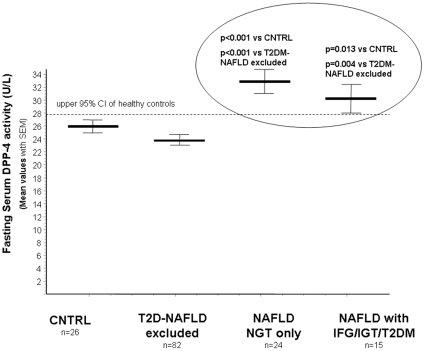
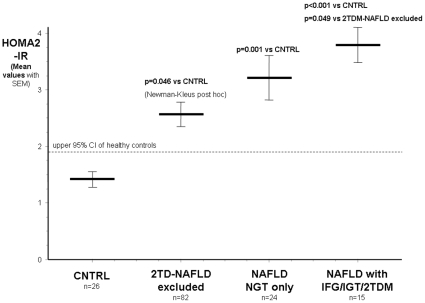
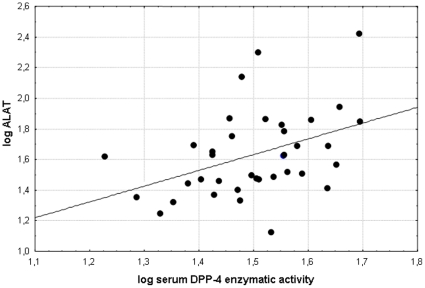
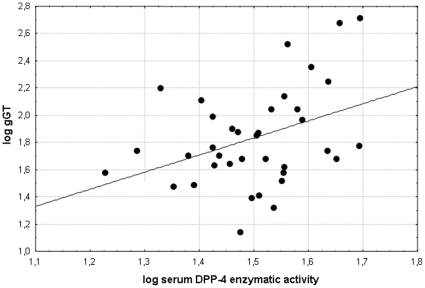
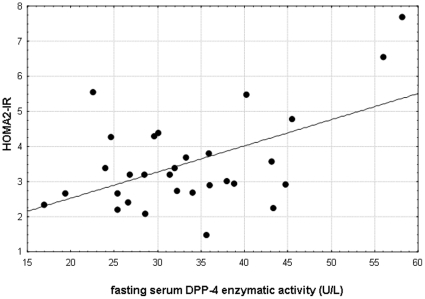
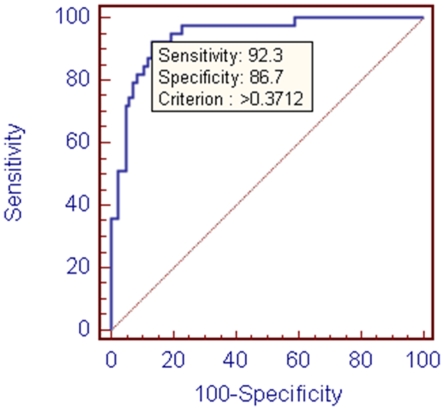
BACKGROUND: In a cross-sectional study we studied the fasting serum DPP-4 enzymatic activity (sDPP-4) and the insulin resistance index (HOMA2-IR) in gliptin naïve patients with type 2 diabetes and in non-alcoholic fatty liver disease (NAFLD) and in healthy controls (CNTRL). METHODS AND FINDINGS: sDPP-4 was measured by kinetic assay in 39 NAFLD (F/M:19/20, mean age: 47.42 yrs) and 82 type 2 diabetes (F/M:48/34, 62.8 yrs) patients and 26 (F/M:14/12, 35.3 yrs) controls. Definition of T2D group as patients with type 2 diabetes but without clinically obvious liver disease created non-overlapping study groups. Diagnosis of NAFLD was based on ultrasonography and the exclusion of other etiololgy. Patients in T2D and NAFLD groups were similarly obese. 75 g CH OGTT in 39 NAFLD patients: 24-NGT, 4-IGT or IFG ("prediabetes"), 11-type 2 diabetes. HOMA2-IR: CNTRL: 1.44; T2D-group: 2.62 (p = 0.046 vs CNTRL, parametric tests); NAFLD(NGTonly): 3.23 (p = 0.0013 vs CNTRL); NAFLD(IFG/IGT/type 2 diabetes): 3.82 (p<0.001 vs CNTRL, p = 0.049 vs 2TD group). sDPP-4 activity was higher in NAFLD both with NGT (mean:33.08U/L) and abnormal glucose metabolism (30.38U/L) than in CNTRL (25.89U/L, p<0.001 and p = 0.013) or in T2D groups (23.97U/L, p<0.001 and p = 0.004). Correlations in NAFLD among sDPP-4 and ALT: r = 0.4637,p = 0.0038 and gammaGT: r = 0.4991,p = 0.0017 and HOMA2-IR: r = 0.5295,p = 0.0026 and among HOMA2-IR and ALT: r = 0.4340,p = 0.0147 and gammaGT: r = 0.4128,p = 0.0210. CONCLUSIONS: The fasting serum DPP-4 activity was not increased in T2D provided that patients with liver disease were intentionally excluded. The high serum DPP-4 activities in NAFLD were correlated with liver tests but not with the fasting plasma glucose or HbA1C supporting that the excess is of hepatic origin and it might contribute to the speedup of metabolic deterioration. The correlation among gammaGT, ALT and serum DPP-4 activity and also between serum DPP-4 activity and HOMA2-IR in NAFLD strongly suggests that serum DPP-4 activity should be considered as a novel liver disease biomarker.
Overview
The claims and statistics of this paper haven’t been checked yet.
Free: it reads the open-access text and checks the first 5 claims that cite a source we can check. Create a free account to check every claim.
Integrity signals
Registry
Cites
Statistics
Figures
Verification
Claims the paper makes
The claims and statistics of this paper haven’t been checked yet.
Free: it reads the open-access text and checks the first 5 claims that cite a source we can check. Create a free account to check every claim.
Claims other papers make about this one
Each is checked against this paper’s own text: does it say what the citing paper says it does?
In the citing paper
“Moreover, serum DPP-4 activity and hepatic staining of DPP-4 are correlated with NASH grade but do not correlate with the fasting blood glucose concentration or glycosylated hemoglobin (HbA1c) [189,190].”
From Gut-pancreas-liver Axis as a target for treatment of NAFLD/NASH (2020) · cites this paper as [189]
Self-check
Percentages, sums and reported differences re-computed from the paper’s own numbers.
The self-check needs the paper’s full text.
Citations
Cites
Grundy, S. M., Bilheimer, D. W., Chait, A., Clark, L. T., Denke, M. A., Havel, R. J., Hazzard, W. R., Hulley, S. B., Hunninghake, D. B., Kreisberg, R. A., et al. (1993) · JAMA · doi:10.1001/jama.269.23.3015 · Cited by 27,947
Expert Panel on Detection, E. (2001) · JAMA: The Journal of the American Medical Association · doi:10.1001/jama.285.19.2486 · Cited by 26,011
Alberti, K. G. M. M., Eckel, R. H., Grundy, S. M., Zimmet, P. Z., Cleeman, J. I., Donato, K. A., Fruchart, J.-C., James, W. P. T., Loria, C. M., & Smith, S. C. (2009) · Circulation · doi:10.1161/circulationaha.109.192644 · Cited by 14,860
Use and Abuse of HOMA Modeling
Wallace, T. M., Levy, J. C., & Matthews, D. R. (2004) · Diabetes Care · doi:10.2337/diacare.27.6.1487 · Cited by 5,114 · cited 1×
“uk) due to the higher accuracy compared to the HOMA1 method.[13] Metabolic syndrome was both defined as proposed by the NCEP in ATPIII and as recently suggested by the AHA and IDF.”
MethodPrevalence of Hepatic Steatosis in An Urban Population in the United States: Impact of Ethnicity
Browning, J. D., Szczepaniak, L. S., Dobbins, R., Nuremberg, P., Horton, J. D., Cohen, J. C., Grundy, S. M., & Hobbs, H. H. (2004) · Hepatology · doi:10.1002/hep.20466 · Cited by 3,664 · cited 1×
“[5] The prevalence of fatty liver disease in a population based study was 34% over 90% of which was due to non-alcoholic causes (NAFLD) that is generally asymptomatic, frequently associated with obesity, type 2 diabetes and metabolic syndrome.[6,7]”
BackgroundAngulo, P., Hui, J. M., Marchesini, G., Bugianesi, E., George, J., Farrell, G. C., Enders, F., Saksena, S., Burt, A. D., Bida, J. P., et al. (2007) · Hepatology · doi:10.1002/hep.21496 · Cited by 3,203 · cited 1×
“Although only two out of 39 pts underwent liver biopsy that confirmed the clinical diagnosis and showed macrovesicular steatosis, we applied a non-invasive scoring system to evaluate fibrosis [12] and OGTT (75 gCH) to assess carbohydrate metabolism (except 9 patients with previously known diabetes) in NAFLD.”
MethodBedogni, G., Miglioli, L., Masutti, F., Tiribelli, C., Marchesini, G., & Bellentani, S. (2005) · Hepatology · doi:10.1002/hep.20734 · Cited by 1,263
Kieffer, T. J., McIntosh, C. H., & Pederson, R. A. (1995) · Endocrinology · doi:10.1210/endo.136.8.7628397 · Cited by 1,124
Tabák, A. G., Jokela, M., Akbaraly, T. N., Brunner, E. J., Kivimäki, M., & Witte, D. R. (2009) · The Lancet · doi:10.1016/s0140-6736(09)60619-x · Cited by 898 · cited 2×
“(Figure 5) As published recently by Tabak et al [20] using HOMA method the insulin sensitivity starts to decline earlier (based on his figuresapproximately 4 years before the diabetes onset) throughout the course in the development of type2 diabetes mellitus than the definitive impairment of the glucose tolerance.”
MethodCause-specific mortality in type 2 diabetes. The Verona Diabetes Study.
de Marco, R., Locatelli, F., Zoppini, G., Verlato, G., Bonora, E., & Muggeo, M. (1999) · Diabetes Care · doi:10.2337/diacare.22.5.756 · Cited by 405
Cited by
Items 101–121 of 121
Rumney, R. M. H., & Górecki, D. C. (2026) · International Journal of Molecular Sciences · doi:10.3390/ijms27062731 · Cited by 3
“…0.940 ng/mL and 1.212 ng/mL [13]; 20 U/mL DPP4 (ab79138, AbCam, Cambridge, UK) corresponding to previous reports of 20 to 25 U/mL in human serum [38,39]; 1 ng/mL linagliptin (provided by Boehringer Ingelheim) corresponding to the recommended IC 50 for the inhibition of DPP-4 activity [40], 5.9…”
InfluentialDiagnosis and Management of Horses with Equine Metabolic Syndrome (EMS)
Chameroy, K. A. (2010) · Cited by 6
Kato, K., Jojima, T., Tanuma, D., Suda, K., Sakurai, S., Iijima, T., Tomaru, T., Usui, I., & Aso, Y. (2025) · Clinics · doi:10.1016/j.clinsp.2025.100839 · Cited by 3
“17 Recently, athe present study and several others reported an elevated level of serum sDPP-4/CD26 in patients with type 2 diabetes and MASLD or MASH, , 18 – 20 suggesting that serum sDPP-4/CD26 may be considered a new biomarker for liver fibrosis and progressive MASH, especially cirrhosis.”
Koh, G. (2018) · Journal of Obesity & Metabolic Syndrome · doi:10.7570/jomes.2018.27.1.71 · Cited by 2
Dawood, A. A., Elghobashy, Y., & Elgamal, A. (2018) · The Egyptian Journal of Internal Medicine · doi:10.4103/ejim.ejim_34_17 · Cited by 2
Alves, E. S., Furioso, A. C. T., Alves, V. P., Moraes, C. F., Pérez, D. I. V., Bastos, I. M. D., CORDOVA, C. O., & Nóbrega, O. D. T. (2022) · Brazilian Journal of Medical and Biological Research · doi:10.1590/1414-431x2022e12148 · Cited by 2
“Also, markers of liver function were not evaluated, since liver diseases have already been associated with altered DPP4 levels and activity (13).”
BackgroundResultSitagliptin in Patients with Non-Alcoholic Steatohepatitis: A Randomized, Placebo-Controlled Trial
Beaton, M. D., JOY, T. R., Tirona, R. G., Summers, K. L., Malhotra, N., & Chakrabarti, S. (2017) · Gastroenterology · doi:10.1016/s0016-5085(17)34002-7 · Cited by 2
Aso, Y. (2012) · Translational research · doi:10.1016/j.trsl.2012.01.017 · Cited by 2
Firneisz, G., & Zóka, A. (2016) · Diabetes Research and Clinical Practice · doi:10.1016/j.diabres.2016.08.005 · Cited by 2
Self-citationAre GLP-1 Analogues a New Solution for the Treatment of NAFLD?
Sudoł, M., Dąbek, K., Ochwat, M., Piekarska, M., Skowronek, A., Kajtel, A., Mierzwa, G., & Sudoł, Z. (2024) · Quality in Sport · doi:10.12775/qs.2024.35.56304 · Cited by 1
Mochizuki, K., Fuchigami, A., Hirose, T., & Uchino, H. (2025) · Diabetes Obesity and Metabolism · doi:10.1111/dom.16559 · Cited by 1
“31 Elevated DPP-4 activity may contribute to the development of type 2 diabetes and metabolic deterioration.”
The Wide and Complex Field of NAFLD Biomarker Research: Trends
Wichro, E., Macheiner, T., Schmid, J., Kavsek, B., & Sargsyan, K. (2014) · ISRN Hepatology · doi:10.1155/2014/846923 · Cited by 1
Dietrich, C. G. (2022) · Springer eBooks · doi:10.1007/978-3-662-62484-5_27 · Cited by 1
Dietrich, C. G., & Geier, A. (2024) · Expert Opinion on Drug Metabolism & Toxicology · doi:10.1080/17425255.2024.2324015 · Cited by 1
“Several years ago it has been shown that dipeptidyl peptidase-4 activity is increased in NAFLD patients but not in diabetic patients [21], indicating that metabolic changes in NAFLD/MASLD are not confined to classic metabolic pathways.”
BackgroundSell, H., Bl, M., Schlich, R., Willems, M., Ruppe, F., Knoefel, W. T., Dietrich, A., Fielding, B. A., Arner, P., Frayn, K. N., et al. (2013)
Extrapancreatic contribution to glucose regulation by dipeptidyl peptidase 4 inhibition
Omar, B. A., & Åhrén, B. (2016) · Cardiovascular Endocrinology · doi:10.1097/xce.0000000000000088
ALMAFAJTÁK MOLEKULÁRIS ELKÜLÖNÍTÉSE ÉS REZISZTENCIAGÉN ANALÓGOK AZONOSÍTÁSA
Egyetem, S. I., Iskola, N. D., & László, H. (2010)
The pathophysiology of gut–liver connection
Maroni, L., Fianchi, F., Miele, L., & Svegliati‐Baroni, G. (2021) · Elsevier eBooks · doi:10.1016/b978-0-12-821927-0.00002-4
AIE‐active Fluorescence Probes for Enzymes and Their Applications in Disease Theranostics
Wang, J., & Jiang, G. (2022) · Wiley eBooks · doi:10.1002/9781119643098.ch54
Serum dipeptidyl peptidase-4 in chronic liver disease patients with osteoporosis
Elmetwaly, N. F. M., Behairy, O. G. A., EL-Defrawy, M. S., Abdelmotaleb, D. S., & Battawy, E. K. A. E. (2026) · Egyptian Liver Journal · doi:10.1186/s43066-025-00487-z
“[16] found that serum DPP4 level correlated positively with the liver disease histopathological index in patients having Non-Alcoholic Fatty Liver Disease (NAFLD).”
Tidke, S., Shah, S., & Chaple, D. (2026) · Letters in Applied NanoBioScience · doi:10.33263/lianbs151.046
Metadata
- Authors
- Firneisz, G., Varga, T., Lengyel, G., Fehér, J., Ghyczy, D., Wichmann, B., Selmeci, L., Tulassay, Z., Rácz, K., & Somogyi, A.
- Affiliations
- Semmelweis University (HU)
- Corresponding author
- Firneisz, Gábor
- Venue
- PLoS ONE
- Publisher
- Public Library of Science (PLoS)
- Published
- 2010-08-18
- Volume
- 5
- Issue
- 8
- Pages
- e12226
- ISSN
- 1932-6203 (ISSN-L)
- PMC
- PMC2923594
- OpenAlex
- W2012528744
- Cited by
- 121
- References
- 25
- Citations by year
- 2026: 3 · 2025: 2 · 2024: 4 · 2023: 4 · 2022: 6 · 2021: 7 · 2020: 8 · 2019: 4 · 2018: 11 · 2017: 15 · 2016: 15 · 2015: 12 · 2014: 12 · 2013: 8 · 2012: 3
- FWCI
- 4.20
- Type
- journal article
- Language
- en
- Open access
- gold
- doi.org
- Locations
- PLoS ONE (publishedVersion, cc-by)
- PubMed Central (publishedVersion, cc-by)
- PubMed (publishedVersion)
- DOAJ (DOAJ: Directory of Open Access Journals) (submittedVersion, cc-by-sa)
- Semmelweis University Repository (Semmelweis University) (submittedVersion)
- Funders
- Magyar Diabetes Társaság
- Hungarian Scientific Research Fund
- Topics
- Health Sciences › Medicine › Hepatology › Liver Disease Diagnosis and Treatment
- Life Sciences › Biochemistry, Genetics and Molecular Biology › Biochemistry › Peptidase Inhibition and Analysis
- Health Sciences › Medicine › Endocrinology, Diabetes and Metabolism › Diabetes Treatment and Management
- Keywords
- dipeptidyl peptidase IV, non-alcoholic fatty liver disease, insulin resistance, type 2 diabetes, HOMA-IR, liver disease biomarkers, alanine aminotransferase, gamma-glutamyl transferase, prediabetes, insulin resistance index, hepatic steatosis, liver fibrosis
- MeSH terms
- Adult, Aged, Diabetes Mellitus, Type 2, Fasting, Fatty Liver, Female, Humans, Insulin Resistance, Liver, Male, Middle Aged, Obesity, Biomarkers, Logistic Models, Case-Control Studies, Dipeptidyl Peptidase 4
About these checks
Registry, retraction, Cites and statistics results are computed, not judged, with one exception: a printed reference that no index lists is read once by a model before it counts as a citation error. Claims are extracted by a model and kept only when their quote appears verbatim in the text; each cited source is then checked, with a model’s help, for whether it says what the claim relies on. Those verdicts can be wrong — read the claim’s quote and the cited source before relying on one.
Statistics and arithmetic are recomputed, not judged.
Confidence bands are shown only for fields calibrated on our annotated test set. None is calibrated yet, so no band is shown.
What counts as a claim ›How we measure confidence ›How we check this ›
Are you an author, or do you see a problem with this page? Request a review
Data sources
Bibliographic data: Semantic Scholar, OpenAlex, Crossref.
Contains information from the Semantic Scholar Academic Graph Datasets, made available under the ODC Attribution License (ODC-BY 1.0).
Semantic Scholar’s data is described in: Kinney, R., et al. (2023). The Semantic Scholar Open Data Platform. arXiv:2301.10140.
