

Promoting Functional Health in Midlife and Old Age: Long-Term Protective Effects of Control Beliefs, Social Support, and Physical Exercise
Open accessThe DOI matches its Crossref record; 91 of the 97 references it cites were found in a registry or an index.
Abstract
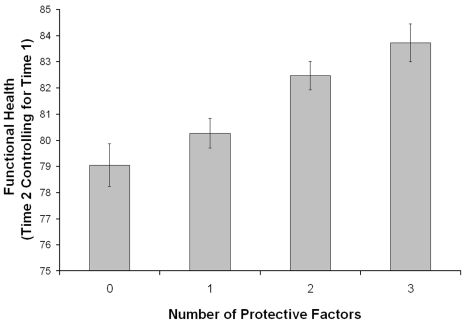
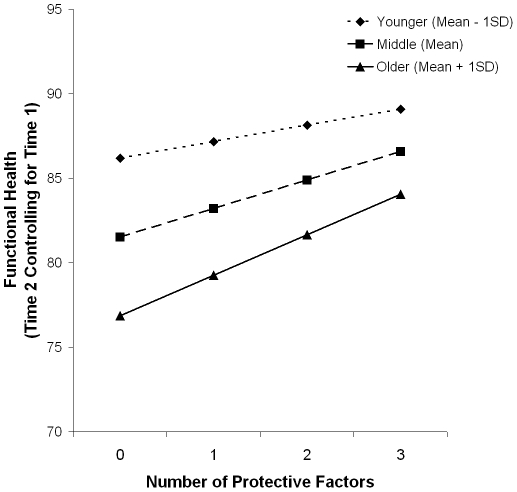
BACKGROUND: Previous studies have examined physical risk factors in relation to functional health, but less work has focused on the protective role of psychological and social factors. We examined the individual and joint protective contribution of control beliefs, social support and physical exercise to changes in functional health, beyond the influence of health status and physical risk factors in middle-aged and older adults. Given that functional health typically declines throughout adulthood, it is important to identify modifiable factors that can be implemented to maintain functioning, improve quality of life, and reduce disability. METHODOLOGY/PRINCIPAL FINDINGS: We conducted a national longitudinal study, Midlife in the United States (MIDUS), with assessments in 1995-1996 and 2004-2006, and 3,626 community-residing adults, aged 32 to 84, were included in the analyses. Functional health (Physical Functioning subscale of the SF-36) and protective factors were measured at both occasions. While controlling for socio-demographic, health status, and physical risk factors (large waist circumference, smoking, and alcohol or drug problems), a composite of the three protective variables (control beliefs, social support, and physical exercise) at Time 1 was significantly related to functional health change. The more of these factors at Time 1, the better the health maintenance over 10 years. Among middle-aged and older adults, declines in health were significantly reduced with an increased number of protective factors. CONCLUSION/SIGNIFICANCE: Age-related declines in health were reduced among those with more protective factors up to a decade earlier in life. Modifiable psychological, social, and physical protective factors, individually and in the aggregate, are associated with maintenance of functional health, beyond the damaging effects of physical risk factors. The results are encouraging for the prospect of developing interventions to promote functional health and for reducing public health expenditures for physical disability in later life.
Overview
The claims and statistics of this paper haven’t been checked yet.
Free: it reads the open-access text and checks the first 5 claims that cite a source we can check. Create a free account to check every claim.
Integrity signals
Registry
Cites
Statistics
Figures
Verification
Claims the paper makes
The claims and statistics of this paper haven’t been checked yet.
Free: it reads the open-access text and checks the first 5 claims that cite a source we can check. Create a free account to check every claim.
Claims other papers make about this one
Each is checked against this paper’s own text: does it say what the citing paper says it does?
In the citing paper
“Of course, factors associated with cognitive reserve such as education are also associated with engagement in health-promoting behaviors that may further protect the individual against both depression and cognitive decline128.”
From Psychobiological factors of resilience and depression in late life (2019) · cites this paper as [128]
Self-check
Percentages, sums and reported differences re-computed from the paper’s own numbers.
The self-check needs the paper’s full text.
Citations
Cites
(1992) · PubMed · Cited by 33,716
The MOS 36-ltem Short-Form Health Survey (SF-36): I. Conceptual Framework and Item Selection
Ware, J. E., & Sherbourne, C. D. (1992) · Medical Care · doi:10.1097/00005650-199206000-00002 · Cited by 30,033 · cited 1×
“This measure was based on seven items from the Physical Functioning subscale from the SF-36 Health Survey (α reliability = .90 at Time 1; α reliability = .92 at Time 2)”
MethodApplied Multiple Regression/Correlation Analysis for the Behavioral Sciences
Cohen, P., Cohen, P., West, S. G., & Aiken, L. S. (2014) · Psychology Press eBooks · doi:10.4324/9781410606266 · Cited by 20,737
Social Relationships and Health
House, J. S., Landis, K. R., & Umberson, D. (1988) · Science · doi:10.1126/science.3399889 · Cited by 7,073 · cited 2×
“Among these factors, control beliefs [28–31], social support [16,25,32,33,34,35,36,37] and physical exercise [12,38,39,40,41,42,43] are consistently identified as predictors of functional health.”
BackgroundFrom social integration to health: durkheim in the new millennium
Berkman, L. F., Glass, T., Brissette, I., & Seeman, T. E. (2000) · Social Science & Medicine · doi:10.1016/s0277-9536(00)00065-4 · Cited by 4,821 · cited 2×
“Among these factors, control beliefs [28–31], social support [16,25,32,33,34,35,36,37] and physical exercise [12,38,39,40,41,42,43] are consistently identified as predictors of functional health.”
BackgroundKahn, R. L. (1998) · Cited by 4,295
Handbook of the Psychology of Aging
(2016) · Elsevier eBooks · doi:10.1016/c2012-0-07221-3 · Cited by 3,394
Measuring Functioning and Well-Being: The Medical Outcomes Study Approach
Stewart, A., & Ware, J. (1992) · doi:10.7249/cb361 · Cited by 2,689
(2003) · JAMA · doi:10.1001/jama.289.23.3106 · Cited by 1,870 · cited 1×
“Moreover, a variety of studies have shown that control beliefs [44], social support [45,46] and physical exercise [47] are modifiable and thus can be subject to interventions to reduce disability and improve functional health.”
BackgroundMcEwen, B. S. (2008) · European Journal of Pharmacology · doi:10.1016/j.ejphar.2007.11.071 · Cited by 1,864 · cited 1×
“, stress hormones [82], inflammation [83], allostatic load [84]} that may be involved in linking the protective factors to health.”
Background
Research works printed but not linked: 1
- Antonucci TC Birditt KS Akiyama H 2009 Convoys of social relations: An interdisciplinary approach. Bengtson VL Silverstein M Putney NM Gans D The handbook of theories of aging. 2nd ed New York Springer Publishing Company 247 260
Cited by
Items 101–174 of 174
Remote workers’ life quality and stress during COVID-19: a systematic review
Carraro, E., Rapisarda, P., Maran, D. A., Filippetti, S., Palella, M., Pellegrino, E., Ferrante, M., Torre, G. L., & Fiore, M. (2025) · European Journal of Public Health · doi:10.1093/eurpub/ckae167 · Cited by 18
“Lachman and Agrigoroaei (2010) noted that age decreases perceived control and stress management, raising the risk of fatigue [22].”
Physical Activity and the Science of Successful Aging
Archer, E., Paluch, A. E., Shook, R. P., & Blair, S. N. (2013) · Kinesiology Review · doi:10.1123/krj.2.1.29 · Cited by 15
Health Behavior Profiles of Korean Baby Boomers
Kim, B., Kim, K., Burr, J. A., & Han, G.-H. (2019) · The International Journal of Aging and Human Development · doi:10.1177/0091415018811095 · Cited by 9
“Indeed, research shows that health behaviors in midlife are linked to the rate of physical decline and various health outcomes in later life, including longevity (Kim, 2011; Lachman & Agrigoroaei, 2010).”
BackgroundCognitive control beliefs and cognitive functioning in mid‐ to late‐life
Raldiris, T. L., Perez, E., Donovan, E. K., & Dzierzewski, J. M. (2020) · British Journal of Developmental Psychology · doi:10.1111/bjdp.12357 · Cited by 10
“Previous research on physical health in older adults does support that despite decreases in health over time, thosewithheightened general control beliefs had attenuated cognitive declines (Lachman & Agrigoroaei, 2010).”
Musich, S. A., Wang, S. S., Schaeffer, J. A., Kraemer, S., Wicker, E. R., & Yeh, C. S. (2022) · Geriatric Nursing · doi:10.1016/j.gerinurse.2022.08.011 · Cited by 13
Teas, E., Marceau, K., & Friedman, E. M. (2023) · Advances in Life Course Research · doi:10.1016/j.alcr.2023.100529 · Cited by 11
Shen, C., Lin, Y.-C., Lin, H., Chen, L., & Hsiao, F. (2023) · Aging Clinical and Experimental Research · doi:10.1007/s40520-023-02613-6 · Cited by 9
Matchar, D. B., Ansah, J. P., Koh, V., & Whitson, H. E. (2018) · System Dynamics Review · doi:10.1002/sdr.1611 · Cited by 9
“Recent work supports this view (Lachman and Agrigoroaei, 2010; Zeng and Shen, 2010; Manning et al., 2014).”
Young adult women’s meaning-making of living with type 1 diabetes: towards growth and optimism
Kruger, S., Deacon, E., van Rensburg, E., & Segal, D. G. (2021) · Psychology and Health · doi:10.1080/08870446.2021.1977303 · Cited by 15
“In line with this finding, research has linked a sense of competence to well-being (Lachman & Agrigoroaei, 2010).”
BackgroundResultHösch, H. S., Rupprecht, F. S., & Lang, F. R. (2023) · Journal of Adult Development · doi:10.1007/s10804-023-09441-y · Cited by 11
“Unrelated to successive generations, feelings of obsolescence can occur as a result of the increased loss of abilities that might come with old age (Lachman & Agrigoroaei, 2010).”
BackgroundWu, I., Hsiung, C. A., Chang, I., Wu, M., Chang, Y., & Hsu, C. (2014) · Geriatrics and gerontology international/Geriatrics & gerontology international · doi:10.1111/ggi.12334 · Cited by 10
The Psychological Mediators of Social Inequalities in Health: Self-efficacy in Europe and Russia
Русинова, Н. Л., & Сафронов, В. В. (2018) · Sociological Journal · doi:10.19181/socjour.2018.24.4.6096 · Cited by 10
Weinberg, D., Stevens, G. W. J. M., Peeters, M., Visser, K., Frankenhuis, W. E., & Finkenauer, C. (2023) · Development and Psychopathology · doi:10.1017/s0954579423000214 · Cited by 8
Positive Relationships Questionnaire (PRQ): A Pilot Study
Mitskidou, P., Mertika, A., Pezirkianidis, C., & Stalikas, A. (2021) · Psychology · doi:10.4236/psych.2021.127062 · Cited by 15
“In addition, positive relationships are positively associated with maintaining the physical health of the elderly (Lachman & Agrigoroaei, 2010).”
BackgroundHIV stigma and its metaphors: Photos, symbols, and solutions
Teti, M., Epping, S., Myroniuk, T. W., & Evans‐Agnew, R. A. (2021) · Journal of HIV/AIDS & Social Services · doi:10.1080/15381501.2021.1911903 · Cited by 7
“As a result, the way a person perceives their health and illness can influence their actual health (Lachman & Agrigoroaei, 2010; Park et al., 2008).”
BackgroundMiller, S. E., Hong, J. H., & Almeida, D. M. (2023) · Aging & Mental Health · doi:10.1080/13607863.2023.2165623 · Cited by 6
“Specifically, sense of con-trol is comprised of perceptions about one’s ability (i.e. mastery) and barriers (i.e. constraints) to achieving outcomes (Lachman & Agrigoroaei, 2010).”
BackgroundGe, W., Wang, H., Chen, J., Yang, X., & Wang, Y. (2024) · Current Psychology · doi:10.1007/s12144-024-06489-1 · Cited by 9
“Such correlations have been observed among children, adolescents and the elderly, with a stronger link in adolescents compared to children (Weisz et al., 2001; Kempen et al., 2005; Lachman & Agrigoroaei, 2010).”
Sharifian, N., & O’Brien, E. L. (2018) · Aging & Mental Health · doi:10.1080/13607863.2018.1437595 · Cited by 6
“Moreover, when they examined change over time in physical well-being, Lachman and Agrigoroaei (2010) found a cumulative effect of psychosocial resources.”
BackgroundPersonality and change in perceived control during the acute stage of the coronavirus pandemic
Sesker, A. A., Lee, J. H., Luchetti, M., Aschwanden, D., Stéphan, Y., Terracciano, A., & Sutin, A. R. (2022) · Personality and Individual Differences · doi:10.1016/j.paid.2022.111607 · Cited by 7
“Even during nonstressful times, higher PC is associated with better physical health and lower mortality (Lachman & Agrigoroaei, 2010; Turiano et al., 2014), perhaps due to healthier behavioral, motivational, and cognitive responses to stress (Skinner, 2016; Volk et al., 2021).”
Verdoodt, K., Batink, T., Simons, M., Janssens, M., Peeters, S., Lataster, J., Jacobs, N., & Reijnders, J. (2023) · Educational Gerontology · doi:10.1080/03601277.2022.2160571 · Cited by 5
“Perceived health and well-being in midlife often have a determining influence on the later years of life (Lachman et al., 2010; Sabia et al., 2012).”
BackgroundSmoking may compromise physical function long before it kills you
Glei, D. A., & Weinstein, M. (2023) · Frontiers in Public Health · doi:10.3389/fpubh.2023.1261102 · Cited by 5
Ulichney, V., Schmidt, H., & Helion, C. (2024) · Personality and Social Psychology Bulletin · doi:10.1177/01461672231224991 · Cited by 8
“…growth is facilitated by supportive relationships (Lee et al., 2018), and support and strain in relationships are associated with health outcomes including cardiovascular inflammation (Yang et al., 2014), functional health (Lachman & Agrigoroaei, 2010), and psychological health (Hung et al., 2019).”
Hagan, J. L., Sipe, M. H., Tyer‐Viola, L. A., Corless, I. B., Quinn, L., Hall, K., Carney, J. R., Griffith, C. A., & Banister, G. E. (2023) · Journal of Clinical Nursing · doi:10.1111/jocn.16868 · Cited by 6
Acceptance as a cognitive emotion regulation strategy across the lifespan
Wolfe, H. E., & Isaacowitz, D. M. (2022) · The Psychology of learning and motivation/The psychology of learning and motivation · doi:10.1016/bs.plm.2022.07.002 · Cited by 10
Al‐Hamad, A., Yasin, Y. M., Rahman, R., Hayrabedian, V., & Metersky, K. (2025) · Journal of Holistic Nursing · doi:10.1177/08980101251323012 · Cited by 7
“Access to preventive health-care and mental health services is also crucial for maintaining both physical and emotional well-being, enabling older migrants to lead independent, ful-fi lling lives (Georgeou et al., 2023; Lachman & Agrigoroaei, 2010).”
Ansah, J. P., Chia, A. W.-Y., Koh, V. J. W., Lai, W. X., Koh, J. S. B., Goh, K. S., Yeo, W., Howe, T. S., Seow, D. C. C., Mamun, K., et al. (2023) · Frontiers in Rehabilitation Sciences · doi:10.3389/fresc.2023.1184484 · Cited by 4
Stowell, E., Zhang, Y., Castaneda‐Sceppa, C., Lachman, M. E., & Parker, A. G. (2019) · arXiv (Cornell University) · doi:10.48550/arxiv.1908.09984 · Cited by 4
“Since intrinsic motivation, enjoyment, and social support are key factors for sustained healthy behavior [45, 89], exergaming may have the potential to decrease attrition and increase adherence to PA programs [75].”
BackgroundSelf-citationLee, S. E., & Neupert, S. D. (2024) · Mental Health Science · doi:10.1002/mhs2.56 · Cited by 3
Hayek, R., Saad, O., & Springer, S. (2023) · Healthcare · doi:10.3390/healthcare11071040 · Cited by 5
“Finally, the physical portion of the SF-36 includes a three-point Likert scale that is considered less accurate for assessing functional abilities, as it is argued that the minimum number of categories should be in the range of five to seven [29–31].”
MethodInfluentialSamat, N., Zambri, N. A., Chea, C. C., Halim, N. A., & Nadzri, N. R. M. (2024) · International Journal of Academic Research in Business and Social Sciences · doi:10.6007/ijarbss/v14-i7/21923 · Cited by 3
“Also, social relationships with family and acquaintances play a crucial role in reducing negative emotions and increasing self-confidence (Lachman & Agrigoroaei, 2010).”
BackgroundGolden years happiness: analyzing the nostalgic aspect of leisure
Önal, L., Bedir, F., Turan, M., Mavibaş, M., Savaş, B. Ç., & Yaşartürk, F. (2024) · Frontiers in Psychology · doi:10.3389/fpsyg.2024.1466626 · Cited by 3
“In a study conducted by Lachman and Agrigoroaei (2010), it was found that individuals who engage in leisure activities have higher happiness.”
BackgroundHaeger, M., Bock, O. L., & Zijlstra, W. (2020) · Zeitschrift für Gerontologie und Geriatrie · doi:10.1007/s00391-020-01700-x · Cited by 4
Русинова, Н. Л., & Исааковна, Б. С. (2019) · Telescope Journal of Sociological and Marketing Research · doi:10.33491/telescope2019.5-604 · Cited by 2
Development of the “Construction of aging strategies” questionnaire
Strizhitskaya, O. Y., & Petrash, M. D. (2024) · Vestnik of Saint Petersburg University Psychology · doi:10.21638/spbu16.2024.110 · Cited by 3
Dapari, R., Wahab, M. R. A., Zamzuri, M. ‘. I. A., Hassan, M. R., Dom, N. C., & Rahim, S. S. S. A. (2024) · BMC Public Health · doi:10.1186/s12889-024-19411-y · Cited by 3
“For instance, the healthy ageing agenda can be disseminated among the pre-retirement working population as previous evidence showed that workplace programmes that target the pre-retirement population can cast a positive impact on healthy ageing [6, 7].”
BackgroundGautam, N., Chowdhury, A., Rahman, M. M., & Khanam, R. (2025) · PLoS ONE · doi:10.1371/journal.pone.0321861 · Cited by 3
“A balanced lifestyle is an important predictor of health and well-being [37,38].”
Sonnier-Netto, M. E. (2018) · VTechWorks (Virginia Tech) · Cited by 2
Dudziak, M., Franssen, M., Vervliet, B., & Beckers, T. (2025) · Behaviour Research and Therapy · doi:10.1016/j.brat.2025.104842 · Cited by 2
Alastalo, H. (2013) · Helda - University of Helsinki Institutional Repository · Cited by 2
Soltanian, L., Aghababa, A., Nabilpour, M., & Alvar, Y. M. (2022) · Complementary Medicine Journal · doi:10.32598/cmja.11.4.1151.1 · Cited by 1
Vulnerabilidade física, social e programática de idosos: estudo descritivo
Barbosa, K. T. F., & Fernandes, M. D. G. M. (2015) · Online Brazilian Journal of Nursing · doi:10.17665/1676-4285.20155226 · Cited by 1
Thakur, M. B., & Joshi, N. (2016) · Indian Journal of Mental Health(IJMH) · doi:10.30877/ijmh.3.2.2016.167-173 · Cited by 1
Positive Psychiatry in Midlife
Tripathi, S., & Messias, E. (2020) · Springer eBooks · doi:10.1007/978-3-030-33264-8_5 · Cited by 1
THE EFFECTS OF THE MENSTRUATION PERIOD ON THE PERCEPTION OF AGING VIA IMITATION
Özsungur, F. (2020) · International Journal Of Eurasia Social Sciences · doi:10.35826/ijoess.2697 · Cited by 2
“Researches focus on the psychological, social, economic and physical effects of aging (Lachman & Agrigoroaei, 2010; Fiscella & Franks, 1997; McTeer & Curtis, 1990; Johnson et al., 2011).”
THE EFFECTS OF THE MENSTRUATION PERIOD ON THE PERCEPTION OF AGING VIA IMITATION OF MENOPAUSE
Özsungur, F. (2020) · International Journal Of Eurasia Social Sciences · Cited by 1
Memory of visual paired associates in healthy aging. A transcultural study
Álvarez González, M. Á., Brito-Cruz, T. D. J., Balmaseda Serrano, R. (., Gracia Morilla, C., García Morales, L., Fernández-Cahill, M., & Manzanero, A. L. (2021) · Revista Iberoamericana de Psicología y Salud · doi:10.23923/j.rips.2021.01.049 · Cited by 1
A Case Study of Older Adult Experiences with a Novel Community Paramedicine Program
Brydges, M. (2014) · MacSphere (McMaster University) · doi:10.71548/20953 · Cited by 2
Dorresteijn, T. A. C. (2016) · Research Publications (Maastricht University) · doi:10.26481/dis.20160512td · Cited by 21
Stahl, S. T. (2010) · The Research Repository @ WVU (West Virginia University) · doi:10.33915/etd.4660 · Cited by 1
Angus, C. L. (2012) · DalSpace (Dalhousie University)
Life course disadvantage and systemic inflammation : the role of psychosocial functioning
Elliot, A. J., & Douthit, K. Z. (2015) · UR Research (University of Rochester)
ANALISI PROTEOMICA DEL MUSCOLO CARDIACO DI RATTO IN CORSO D'INVECCHIAMENTO
Leone, R. (2014) · Archivio Istituzionale della Ricerca (Universita Degli Studi Di Milano) · doi:10.13130/leone-roberta_phd2014-02-04
The determinants of meaning of pain following an acute traumatic injury
Slomp, F., Mayan, M. J., Lasiuk, G. C., & Dick, B. D. (2017) · Scandinavian Journal of Caring Sciences · doi:10.1111/scs.12493 · Cited by 1
McSparron, J. I., & Iwashyna, T. J. (2020) · Elsevier eBooks · doi:10.1016/b978-0-323-64068-8.00013-4
Transforming Acute Pain Experience Into a Pain Score: The Challenges
Slomp, F. (2019) · ERA: Education and Research Archive (University of Alberta) · doi:10.7939/r3-pp1y-wp34
Young adult women's meaning making of living with Type 1 Diabetes
Kruger, S. (2020) · Boloka Institutional Repository (North-west University)
EXAMINING THE ASSOCIATION BETWEEN MUSCULAR FATIGUE INDEX AND PHYSICAL FUNCTION IN MIDDLE-AGED WOMEN
Finnegan, O. (2021) · Digital Commons - URI (University of Rhode Island) · doi:10.23860/thesis-finnegan-olivia-2021
The Social Gradient in Adolescent Mental Health: What, Why and for Whom
Weinberg, D. (2021) · Utrecht University Repository (Utrecht University) · doi:10.33540/736
Användbar IT: användarcentrerad IT-utveckling i den statliga sektorn
Gulliksen, J. (2010)
Pandya, S. P. (2022) · Journal of Disability & Religion · doi:10.1080/23312521.2022.2035884
“To calculate respondents’ overall sense of control, items in the personal mastery subscale are reverse scored so that higher scores mean more control, and then calculate the average of the two subscale scores (Lachman & Agrigoroaei, 2010).”
BackgroundMehta, P. S. (2018) · The Research Repository @ WVU (West Virginia University) · doi:10.33915/etd.6209
“They promote healthier behaviors, such as higher physical activity, they can reduce stress, and they even can help with recovery from physical issues such as functional limitations because of the security they provide (Mavandadi et al., 2007; Lachman & Agrigoroaei, 2010; Seeman et al., 1995).”
BackgroundNIGERIA JOURNAL OF HOME ECONOMICS (Nig-JHEC) Vol 8, No 3, March 2020
Nig., J. H. E. C. (2018) · Nigeria Journal of Home Economics · doi:10.61868/njhe.v8i3.1
Szűcs, D., & Mohácsi, B. (2023) · Magyar Gerontológia · doi:10.47225/mg/15/42/14319
Analysis of Self-Awareness Types in Middle-Aged Women
Choi, E., Han, J., & Yoo, S. (2025) · Journal of Social Science · doi:10.16881/jss.2025.01.36.1.97
Taylor, M. K., Schiloski, K. A., & Lachman, M. E. (2025) · Journal of Behavioral Medicine · doi:10.1007/s10865-025-00603-9
“However, few studies have considered such factors together to examine their additive or combined effects (see Lachman & Agrigoroaei, 2010; Agrigoroaei & Lachman, 2011).”
Self-citationPositive Psychiatry in Midlife
Tripathi, S., & Messias, E. (2025) · Springer eBooks · doi:10.1007/978-3-031-94645-5_5
Simons, M., Reijnders, J. S. A. M., Klippel, A., Völlink, T., & Jacobs, N. (2026) · Journal of Adult Development · doi:10.1007/s10804-026-09549-x
“Among the protective factors identified in research, social support (Kremen et al., 2012 ; Lachman & Agrigoroaei, 2010) and a sense of control (Harris et al., 2019; Hong et al., 2021; Nicolaisen et al., 2018) are particularly relevant during midlife and can be considered resources provided by an…”
Zaninotto, P., Knowles, B., Fledderjohann, J., Ashcroft, A., & Steptoe, A. (2026) · medRxiv · doi:10.64898/2026.02.27.26347198
“…limited by differences in measurement and study design, the present findings are in line with evidence suggesting that growth-oriented beliefs and behaviours tend to co-occur with more favourable cognitive, health, and social profiles in later life (Fabio et al., 2023; Lachman & Agrigoroaei, 2010).”
Zaninotto, P., Knowles, B., Fledderjohann, J., Ashcroft, A., & Steptoe, A. (2026) · The Journals of Gerontology Series B · doi:10.1093/geronb/gbag134
“Growth Mindset shares similarities with perceived control and self-efficacy, which have been associated with healthier aging, better cognitive functioning, and greater resilience in later life (Lachman & Agrigoroaei, 2010).”
InfluentialKnowledge–practice concordance and discrepancies in very old adults
Schönenberg, A., Ruttloff, J. M., Heimrich, K. G., & Prell, T. (2026) · Frontiers in Medicine · doi:10.3389/fmed.2026.1891660
Wang, H., Liu, J., & Ye, Z. (2026) · International Journal of Sport and Exercise Psychology · doi:10.1080/1612197x.2026.2730158
Gkintoni, E., Farmakopoulou, I., Theodoratou, M., & Panagioti, M. (2026) · Brain Sciences · doi:10.3390/brainsci16090993
Metadata
- Authors
- Lachman, M. E., & Agrigoroaei, S.
- Affiliations
- Brandeis University (US)
- Corresponding author
- Lachman, Margie E.
- Venue
- PLoS ONE
- Publisher
- Public Library of Science (PLoS)
- Published
- 2010-10-11
- Volume
- 5
- Issue
- 10
- Pages
- e13297
- ISSN
- 1932-6203 (ISSN-L)
- PMC
- PMC2952603
- OpenAlex
- W2048543091
- Cited by
- 173
- References
- 97
- Citations by year
- 2026: 6 · 2025: 7 · 2024: 10 · 2023: 16 · 2022: 11 · 2021: 9 · 2020: 13 · 2019: 13 · 2018: 17 · 2017: 8 · 2016: 17 · 2015: 6 · 2014: 16 · 2013: 8 · 2012: 9
- FWCI
- 7.63
- Type
- journal article
- Language
- en
- Open access
- gold
- doi.org
- Locations
- PLoS ONE (publishedVersion, cc-by)
- PubMed Central (publishedVersion, cc-by)
- PubMed (publishedVersion)
- RePEc: Research Papers in Economics (submittedVersion)
- Brandeis Institutional Repository (submittedVersion, cc-by)
- Digital Access to Libraries (submittedVersion, other-oa)
- DOAJ (DOAJ: Directory of Open Access Journals) (submittedVersion, cc-by-sa)
- Figshare (submittedVersion, cc-by)
- Funders
- U.S. Department of Veterans Affairs
- John D. and Catherine T. MacArthur Foundation
- Stanford Center on Longevity
- National Institutes of Health (5r01ag032271-02)
- Center for Advanced Study in the Behavioral Sciences, Stanford University
- National Institute on Aging (P01-AG 20166, R01 AG17920, R01AG017920, R01-AG-032271, PO1 AG20166, AG17920, AG 20166, P01AG020166)
- Center for Advanced Study, University of Illinois at Urbana-Champaign
- Topics
- Health Sciences › Medicine › Public Health, Environmental and Occupational Health › Aging, Health, and Disability
- Social Sciences › Health › Health disparities and outcomes
- Social Sciences › Psychology › Developmental and Educational Psychology › Aging and Gerontology Research
- Keywords
- functional health, physical function, control beliefs, social support, physical activity, protective factors, midlife, older adults, age-related health decline, physical risk factors, disability, quality of life, MIDUS
- MeSH terms
- Activities of Daily Living, Aged, Female, Health Status, Humans, Internal-External Control, Male, Middle Aged, Surveys and Questionnaires, Risk Factors, Social Support, Exercise
About these checks
Registry, retraction, Cites and statistics results are computed, not judged, with one exception: a printed reference that no index lists is read once by a model before it counts as a citation error. Claims are extracted by a model and kept only when their quote appears verbatim in the text; each cited source is then checked, with a model’s help, for whether it says what the claim relies on. Those verdicts can be wrong — read the claim’s quote and the cited source before relying on one.
Statistics and arithmetic are recomputed, not judged.
Confidence bands are shown only for fields calibrated on our annotated test set. None is calibrated yet, so no band is shown.
What counts as a claim ›How we measure confidence ›How we check this ›
Are you an author, or do you see a problem with this page? Request a review
Data sources
Bibliographic data: Semantic Scholar, OpenAlex, Crossref.
Contains information from the Semantic Scholar Academic Graph Datasets, made available under the ODC Attribution License (ODC-BY 1.0).
Semantic Scholar’s data is described in: Kinney, R., et al. (2023). The Semantic Scholar Open Data Platform. arXiv:2301.10140.
