

Analysing the large decline in coronary heart disease mortality in the Icelandic population aged 25–74 between the years 1981 and 2006
Open accessThe DOI matches its Crossref record; 34 of the 34 references it cites were found in a registry or an index.
Abstract
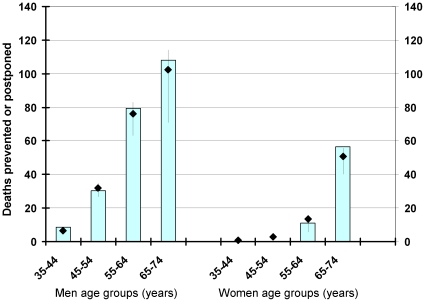
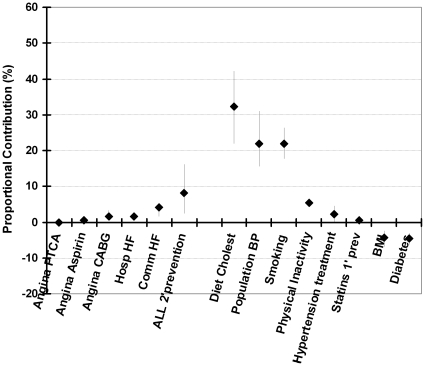
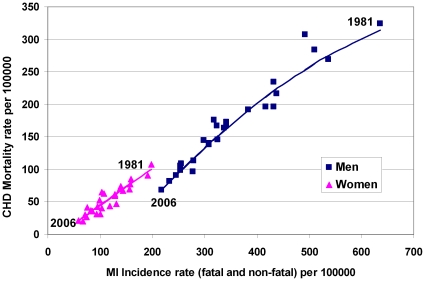
BACKGROUND: Coronary heart disease (CHD) mortality rates have been decreasing in Iceland since the 1980s. We examined how much of the decrease between 1981 and 2006 could be attributed to medical and surgical treatments and how much to changes in cardiovascular risk factors. METHODOLOGY: The previously validated IMPACT CHD mortality model was applied to the Icelandic population. The data sources were official statistics, national quality registers, published trials and meta-analyses, clinical audits and a series of national population surveys. PRINCIPAL FINDINGS: Between 1981 and 2006, CHD mortality rates in Iceland decreased by 80% in men and women aged 25 to 74 years, which resulted in 295 fewer deaths in 2006 than if the 1981 rates had persisted. Incidence of myocardial infarction (MI) decreased by 66% and resulted in some 500 fewer incident MI cases per year, which is a major determinant of possible deaths from MI. Based on the IMPACT model approximately 73% (lower and upper bound estimates: 54%-93%) of the mortality decrease was attributable to risk factor reductions: cholesterol 32%; smoking 22%; systolic blood pressure 22%, and physical inactivity 5% with adverse trends for diabetes (-5%), and obesity (-4%). Approximately 25% (lower and upper bound estimates: 8%-40%) of the mortality decrease was attributable to treatments in individuals: secondary prevention 8%; heart failure treatments 6%; acute coronary syndrome treatments 5%; revascularisation 3%; hypertension treatments 2%, and statins 0.5%. CONCLUSIONS: Almost three quarters of the large CHD mortality decrease in Iceland between 1981 and 2006 was attributable to reductions in major cardiovascular risk factors in the population. These findings emphasize the value of a comprehensive prevention strategy that promotes tobacco control and a healthier diet to reduce incidence of MI and highlights the potential importance of effective, evidence based medical treatments.
Overview
The claims and statistics of this paper haven’t been checked yet.
Free: it reads the open-access text and checks the first 5 claims that cite a source we can check. Create a free account to check every claim.
Integrity signals
Registry
Cites
Statistics
Figures
Verification
Claims the paper makes
The claims and statistics of this paper haven’t been checked yet.
Free: it reads the open-access text and checks the first 5 claims that cite a source we can check. Create a free account to check every claim.
Claims other papers make about this one
Each is checked against this paper’s own text: does it say what the citing paper says it does?
The source backs part of the claim, not all of it — or backs it for a different population, condition or comparison.
In the citing paper
“More than half of the reduction in CV mortality in the last three decades has been attributed to population-level changes in CV risk factors, primarily reductions in cholesterol and blood pressure levels and smoking. 13-16”
From 2016 ESC/EAS Guidelines for the Management of Dyslipidaemias (2016) · cites this paper as [14]
Experimental — accuracy not yet measuredThe source backs part of the claim, not all of it — or backs it for a different population, condition or comparison.
In the citing paper
“This favourable trend is partly offset by increases in other major risk factors, such as obesity and type 2 diabetes. 13-16”
From 2016 ESC/EAS Guidelines for the Management of Dyslipidaemias (2016) · cites this paper as [14]
Experimental — accuracy not yet measured
Self-check
Percentages, sums and reported differences re-computed from the paper’s own numbers.
The self-check needs the paper’s full text.
Citations
Cites
Optimal Medical Therapy with or without PCI for Stable Coronary Disease
Boden, W. E., O'Rourke, R. A., Teo, K. K., Hartigan, P. M., Maron, D. J., Kostuk, W. J., Knudtson, M., Dada, M., Casperson, P., Harris, C. L., et al. (2007) · New England Journal of Medicine · doi:10.1056/nejmoa070829 · Cited by 4,699 · cited 1×
“The contribution from revascularizations was modest, reflecting a relatively small number of eligible patients and limited mortality benefits in stable angina[25].”
BackgroundExplaining the decrease in U.S. deaths from coronary disease, 1980–2000
Ford, E. S., Ajani, U. A., Croft, J. B., Critchley, J. A., Labarthe, D. R., Kottke, T. E., Giles, W. H., & Capewell, S. (2007) · New England Journal of Medicine · doi:10.1056/nejmsa053935 · Cited by 2,757
Self-citationOptimal Diets for Prevention of Coronary Heart Disease
Hu, F. B. (2002) · JAMA · doi:10.1001/jama.288.20.2569 · Cited by 1,503 · cited 1×
“meat and dairy products) and (‘‘very bad’’) transfats from hydrogenated fatty acids concealed in junk food, processed food, cakes and cookies.[31]”
BackgroundCritchley, J. A., & Capewell, S. (2003) · JAMA · doi:10.1001/jama.290.1.86 · Cited by 1,089 · cited 1×
“[6,24,25] Sensitivity Analyses Because of the uncertainties surrounding many of the values, multi-way sensitivity analyses were performed using Brigg’s analysis of extremes method.”
MethodSelf-citationUnal, B., Critchley, J. A., & Capewell, S. (2004) · Circulation · doi:10.1161/01.cir.0000118498.35499.b2 · Cited by 739 · cited 5×
“[23] The number of deaths prevented or postponed as a result of the change observed in Iceland was then estimated as:[6] Number of deaths prevented = (12e x change) ) x expected deaths in 2006 = (12e (20.”
BackgroundMethodInfluentialSelf-citationEffect of PCI on Quality of Life in Patients with Stable Coronary Disease
Weintraub, W. S., Spertus, J. A., Kolm, P., Maron, D. J., Zhang, Z., Jurkovitz, C., Zhang, W., Hartigan, P. M., Lewis, C., Veledar, E., et al. (2008) · New England Journal of Medicine · doi:10.1056/nejmoa072771 · Cited by 727 · cited 1×
“However, the improvement in quality of life is important and well recognized [28].”
BackgroundRepresentation of the Elderly, Women, and Minorities in Heart Failure Clinical Trials
Heiat, A., Gross, C. P., & Krumholz, H. M. (2002) · Archives of Internal Medicine · doi:10.1001/archinte.162.15.1682 · Cited by 723 · cited 1×
“Elderly patients and women have been consistently underrepresented in a majority of clinical trials and surveys in cardiovascular disease[35].”
BackgroundHunink, M. G. M. (1997) · JAMA · doi:10.1001/jama.277.7.535 · Cited by 679
Research works printed but not linked: 1
- Capewell S Ford E Croft J Critchley J Greenlund K 2008 Cardiovascular Risk Factor Trends in the US Population and Options for Reducing Future Coronary Heart Disease Mortality. WHO Bulletin (in press)
Cited by
Items 101–119 of 119
Moylett, S. (2017) · Arrow@dit (Dublin Institute of Technology)
Sjálfbært mataræði til bjargar
Torfadottir, J. E., Torfadóttir, J. E., Aspelund, T., & Aspelund, T. (2019) · Læknablaðið · doi:10.17992/lbl.2019.06.234
Self-citationHow can the Nordic experience be used for nutrition in the future?
Publications, N. (2014) · doi:10.6027/na2014-921 · Cited by 1
Nutrition, ageing, and longevity
Cederholm, T., & Hellénius, M.-L. (2017) · Oxford University Press eBooks · doi:10.1093/med/9780198701590.003.0165
Keil, U. (2019) · Faculty Opinions – Post-Publication Peer Review of the Biomedical Literature · doi:10.3410/f.727224507.793557056
Management and revascularization of diabetics with coronary artery disease in Iceland
Kristjánsdóttir, M. K., Reynisdóttir, H. Ó., Mogensen, B., Andersen, K. K., Guðbjartsson, T., Sigurdsson, M. I., & Guðmundsdóttir, I. J. (2022) · Læknablaðið · doi:10.17992/lbl.2022.0708.699
Self-citationMahmoudi, S., Mohammadifard, N., Hassannejad, R., Nouri, F., Mansourian, M., & Sarrafzadegan, N. (2023) · PubMed Central · doi:10.48305/arya.2023.17203.2697
1990, S. Á. M. (2014) · Skemman
Áhrif mataræðis á þróun kransæðasjúkdóma : kerfisbundin heimildasamantekt
1975, E. M. E., 1967, G. H. G., & 1978, R. H. (2017) · Skemman
Hrafnsdóttir, Þ. (2020) · Skemman
1974, Á. B., 1974, D. H. G., 1969, H. A. G., & 1973, S. A. H. (2016) · Skemman
Sjálfsumönnun einstaklinga með kransæðasjúkdóm og hætta þeirra á að fá sykursýki af tegund 2
1967, K. G. S. (2019) · Skemman
Hreggviðsdóttir, S. (2018) · Skemman
Non-HDL kólesteról hefur meira forspárgildi fyrir kransæðasjúkdóm en LDL kólesteról
1996, H. V. (2018) · Skemman
Þekking kransæðasjúklinga á kransæðasjúkdómnum : kerfisbundin heimildasamantekt
1988, S. V. H. (2018) · Skemman
Þekking og fræðsluþarfir einstaklinga sem greinast með kransæðasjúkdóma
1978, J. Þ., & 1978, Á. L. I. (2012) · Skemman
Vegur til heilbrigðis : einstaklingsmiðuð íþróttakennsla í grunnskólum
Valgeirsdóttir, S. K. (2019) · Skemman
Tracheal mineralization : cellular and molecular mechanisms in mice
Tabcheh, L. (2014) · theses.fr (ABES) · doi:10.70675/6a754cc5z6c67z4c81z8986za1b47edc5e3f
Metadata
- Authors
- Aspelund, T., Gudnason, V., Magnusdottir, B. T., Andersen, K., Sigurdsson, G., Thorsson, B., Steingrimsdottir, L., Critchley, J., Bennett, K., O'Flaherty, M., & Capewell, S.
- Affiliations
- University of Iceland (IS)
- Newcastle University (GB)
- St. James's Hospital (IE)
- University of Liverpool (GB)
- Corresponding author
- Gudnason, Vilmundur
- ORCID
- Venue
- PLoS ONE
- Publisher
- Public Library of Science (PLoS)
- Published
- 2010-11-12
- Volume
- 5
- Issue
- 11
- Pages
- e13957
- ISSN
- 1932-6203 (ISSN-L)
- PMC
- PMC2980472
- OpenAlex
- W2163515455
- Cited by
- 106
- References
- 34
- Citations by year
- 2025: 2 · 2023: 3 · 2022: 9 · 2021: 4 · 2020: 1 · 2019: 12 · 2018: 8 · 2017: 8 · 2016: 12 · 2015: 8 · 2014: 7 · 2013: 10 · 2012: 17
- FWCI
- 7.47
- Type
- journal article
- Language
- en
- Open access
- gold
- doi.org
- Locations
- PLoS ONE (publishedVersion, cc-by)
- PubMed Central (publishedVersion, cc-by)
- PubMed (publishedVersion)
- St George's Online Research Archive (St George's University of London) (acceptedVersion)
- DOAJ (DOAJ: Directory of Open Access Journals) (submittedVersion, cc-by-sa)
- Hirsla (Landspítali University Hospital) (submittedVersion)
- Newcastle University ePrints (Newcastle Univesity)
- Funders
- Háskóli Íslands
- Hjartavernd
- Topics
- Health Sciences › Medicine › Epidemiology › Healthcare Systems and Public Health
- Health Sciences › Medicine › Cardiology and Cardiovascular Medicine › Cardiovascular Health and Risk Factors
- Health Sciences › Medicine › Public Health, Environmental and Occupational Health › Health Promotion and Cardiovascular Prevention
- Keywords
- coronary heart disease mortality, mortality decline, cardiovascular risk factors, myocardial infarction incidence, cholesterol, smoking, blood pressure, physical inactivity, diabetes mellitus, obesity, secondary prevention, statins, revascularization, acute coronary syndrome, heart failure treatment, tobacco control
- MeSH terms
- Adult, Aged, Coronary Disease, Female, Humans, Iceland, Male, Middle Aged, Mortality, Myocardial Infarction, Models, Statistical, Incidence
About these checks
Registry, retraction, Cites and statistics results are computed, not judged, with one exception: a printed reference that no index lists is read once by a model before it counts as a citation error. Claims are extracted by a model and kept only when their quote appears verbatim in the text; each cited source is then checked, with a model’s help, for whether it says what the claim relies on. Those verdicts can be wrong — read the claim’s quote and the cited source before relying on one.
Statistics and arithmetic are recomputed, not judged.
Confidence bands are shown only for fields calibrated on our annotated test set. None is calibrated yet, so no band is shown.
What counts as a claim ›How we measure confidence ›How we check this ›
Are you an author, or do you see a problem with this page? Request a review
Data sources
Bibliographic data: Semantic Scholar, OpenAlex, Crossref.
Contains information from the Semantic Scholar Academic Graph Datasets, made available under the ODC Attribution License (ODC-BY 1.0).
Semantic Scholar’s data is described in: Kinney, R., et al. (2023). The Semantic Scholar Open Data Platform. arXiv:2301.10140.
