Cited by 29

The DOI matches its Crossref record; 1 of the 1 references it cites were found in a registry or an index.

Functional Identification of Neuroprotective Molecules

Dai, Cheng, Liang, Dong, Li, Huiwu, Sasaki, Masayuki, Dawson, Ted M., Dawson, Valina L.·2010·PLoS ONE

Overview

The claims and statistics of this paper haven’t been checked yet.

Run the check — free, no account needed. It reads the open-access text and checks the sources it cites.

A few free checks a day · papers already verified open instantly · results are public

Integrity signals

Registry

Crossref · 10.1371/journal.pone.0015008

Cites

1 of 1 references verified0 citation errors · 0 not checkable

Statistics

Figures

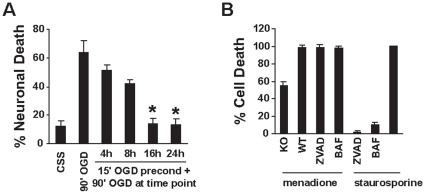
Figure 1 Preconditioning induces neuroprotection and menandione kills cells via Parthanatos. (A) 15 min of OGD preconditioning induces neuroprotection 16 h and 24 h later against 90 min of lethal OGD. Primary cortical cultures were exposed to 90 min lethal OGD without preconditioning (90′ OGD) and compared to cultures exposed to 15 min of OGD and rechallenged with 90 min OGD 4 h, 6 h, 16 h and 24 h after the 15 min of OGD preconditioning. Cell viability was determined 24 h after 90 min lethal OGD by Hoescht 33342 (1 µg/ml) and prodidium iodide (7 µM) staining and unbiased computer assisted cell counting [29]. (B). Menadione induces Parthanatos (PARP-1-dependent caspase-independent) fibroblast death. Menadione (175 µM, 10 min) kills almost all of the wild type fibroblasts (WT) but only 55% or PARP-1 knockout fibroblasts (KO). Menadione induced fibroblast death cannot be blocked by the caspase inhibitor, ZVAD (100 µM) or BAF (50 µM), which can blocks staurosporine (500 nM, 24 h) induced cell death. Experiments were performed four times. Data are the mean ± SEM. *p<0.01 (Student's t-test) comparing OGD (90 min) against OGD (15 min/90 min). An average number of 500,000 cells were counted.
Figure 1 Preconditioning induces neuroprotection and menandione kills cells via Parthanatos. (A) 15 min of OGD preconditioning induces neuroprotection 16 h and 24 h later against 90 min of lethal OGD. Primary cortical cultures were exposed to 90 min lethal OGD without preconditioning (90′ OGD) and compared to cultures exposed to 15 min of OGD and rechallenged with 90 min OGD 4 h, 6 h, 16 h and 24 h after the 15 min of OGD preconditioning. Cell viability was determined 24 h after 90 min lethal OGD by Hoescht 33342 (1 µg/ml) and prodidium iodide (7 µM) staining and unbiased computer assisted cell counting [29]. (B). Menadione induces Parthanatos (PARP-1-dependent caspase-independent) fibroblast death. Menadione (175 µM, 10 min) kills almost all of the wild type fibroblasts (WT) but only 55% or PARP-1 knockout fibroblasts (KO). Menadione induced fibroblast death cannot be blocked by the caspase inhibitor, ZVAD (100 µM) or BAF (50 µM), which can blocks staurosporine (500 nM, 24 h) induced cell death. Experiments were performed four times. Data are the mean ± SEM. *p<0.01 (Student's t-test) comparing OGD (90 min) against OGD (15 min/90 min). An average number of 500,000 cells were counted.CC BY · PubMed Central
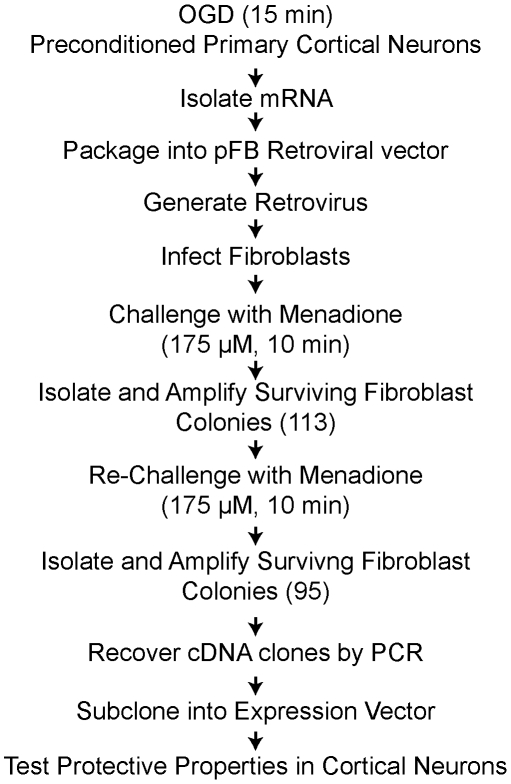
Figure 2 Functional cloning strategy. Diagram of the functional cloning strategy utilized to identify neuroprotective genes (see text for details).
Figure 2 Functional cloning strategy. Diagram of the functional cloning strategy utilized to identify neuroprotective genes (see text for details).CC BY · PubMed Central
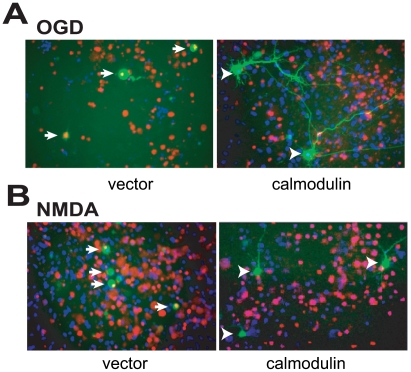
Figure 3 Calmodulin overexpression protects against OGD and NMDA Excitotoxicity. (A and B) Representative photomicrographs of cortical cultures transfected with empty vector or calmodulin and then exposed to (A) 90 min OGD or (B) 500 µM NMDA for 5 min. Cell death was assessed 24 h later. Arrows or arrowheads indicate dead or surviving transfected neurons, respectively.
Figure 3 Calmodulin overexpression protects against OGD and NMDA Excitotoxicity. (A and B) Representative photomicrographs of cortical cultures transfected with empty vector or calmodulin and then exposed to (A) 90 min OGD or (B) 500 µM NMDA for 5 min. Cell death was assessed 24 h later. Arrows or arrowheads indicate dead or surviving transfected neurons, respectively.CC BY · PubMed Central
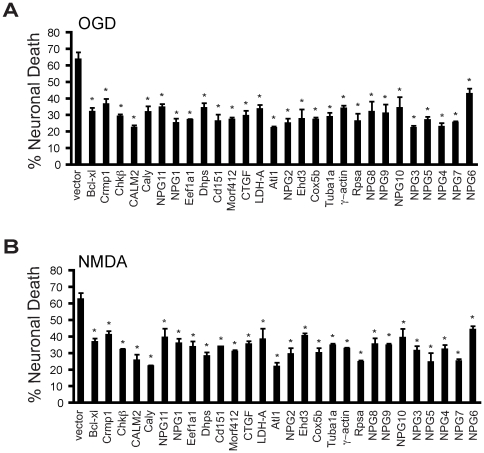
Figure 4 Functionally cloned genes are neuroprotective. (A and B). Primary cortical neurons were transfected with 28 of the identified genes or the empty pCI vector or the ADCGI vector. EGFP serves as the reporter for transfected cells. 48 h later, the neurons were treated with (A) OGD (90 min) or (B) NMDA (500 µM, 5 min). 24 h after treatment, neurons were stained with Hoechst 33342 and propidium iodide. Only EGFP positive cells were scored. Dead neurons were scored as those cells that were propidium iodide positive, with condensed, or fragmented nuclei. Experiments were performed at least three times. Data are the mean ± SEM. *p<0.01 (Student's t-test) comparing empty vector to each identified gene.
Figure 4 Functionally cloned genes are neuroprotective. (A and B). Primary cortical neurons were transfected with 28 of the identified genes or the empty pCI vector or the ADCGI vector. EGFP serves as the reporter for transfected cells. 48 h later, the neurons were treated with (A) OGD (90 min) or (B) NMDA (500 µM, 5 min). 24 h after treatment, neurons were stained with Hoechst 33342 and propidium iodide. Only EGFP positive cells were scored. Dead neurons were scored as those cells that were propidium iodide positive, with condensed, or fragmented nuclei. Experiments were performed at least three times. Data are the mean ± SEM. *p<0.01 (Student's t-test) comparing empty vector to each identified gene.CC BY · PubMed Central
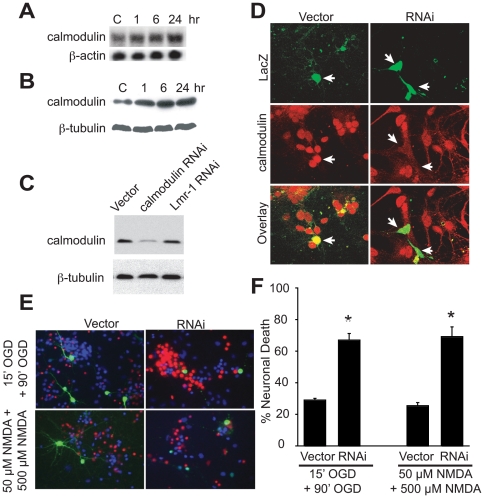
Figure 5 Calmodulin participates in preconditioning induced neuroprotection. Rat primary cortical neurons were treated with 15 min OGD and harvested at the indicated time points for (A) Northern blot or (B) immunoblot analysis. β-actin and β-tubulin are the loading control for Northern blot and immuonblot analysis, respectively. These experiments were conducted 3 times with similar results. (C) HEK 293 cells were transfected with calmodulin RNAi, unrelated RNAi (Lmr-1 RNAi) or empty vector. Two days later Western blot of whole-cell extracts shows reduction of calmodulin expression following calmodulin RNAi treatment but not Lmr-1 RNAi or empty vector. β–tubulin immunoreactivity was used as a loading control. (D) Primary cortical neurons were transfected for 48 h with a control vector or calmodulin RNAi along with CMV-β-Gal. Overlay of the anti-calmodulin and anti-β-Gal antibody staining. White arrows indicate transfected cells. (E and F) Primary cortical neurons were transfected with empty vector or calmodulin RNAi. EGFP serves as the reporter for transfected cells. 48 h later, the cells were preconditioned with OGD (15 min) or NMDA (50 µM, 5 min). 24 h after preconditioning, the cells were treated with OGD (90 min) or NMDA (500 µM, 5 min), respectively. 24 h after treatment, neurons were stained with Hoechst 33342 and propidium iodide. Only EGFP positive cells were scored. Dead neurons were scored as those cells that were propidium iodide positive, with condensed, or fragmented nuclei. (F) Quantification of cell viability. Experiments were performed for three times, and the data was presented as mean ± SEM. *p<0.001 (Student's t-test) when comparing RNAi to empty vector.
Figure 5 Calmodulin participates in preconditioning induced neuroprotection. Rat primary cortical neurons were treated with 15 min OGD and harvested at the indicated time points for (A) Northern blot or (B) immunoblot analysis. β-actin and β-tubulin are the loading control for Northern blot and immuonblot analysis, respectively. These experiments were conducted 3 times with similar results. (C) HEK 293 cells were transfected with calmodulin RNAi, unrelated RNAi (Lmr-1 RNAi) or empty vector. Two days later Western blot of whole-cell extracts shows reduction of calmodulin expression following calmodulin RNAi treatment but not Lmr-1 RNAi or empty vector. β–tubulin immunoreactivity was used as a loading control. (D) Primary cortical neurons were transfected for 48 h with a control vector or calmodulin RNAi along with CMV-β-Gal. Overlay of the anti-calmodulin and anti-β-Gal antibody staining. White arrows indicate transfected cells. (E and F) Primary cortical neurons were transfected with empty vector or calmodulin RNAi. EGFP serves as the reporter for transfected cells. 48 h later, the cells were preconditioned with OGD (15 min) or NMDA (50 µM, 5 min). 24 h after preconditioning, the cells were treated with OGD (90 min) or NMDA (500 µM, 5 min), respectively. 24 h after treatment, neurons were stained with Hoechst 33342 and propidium iodide. Only EGFP positive cells were scored. Dead neurons were scored as those cells that were propidium iodide positive, with condensed, or fragmented nuclei. (F) Quantification of cell viability. Experiments were performed for three times, and the data was presented as mean ± SEM. *p<0.001 (Student's t-test) when comparing RNAi to empty vector.CC BY · PubMed Central
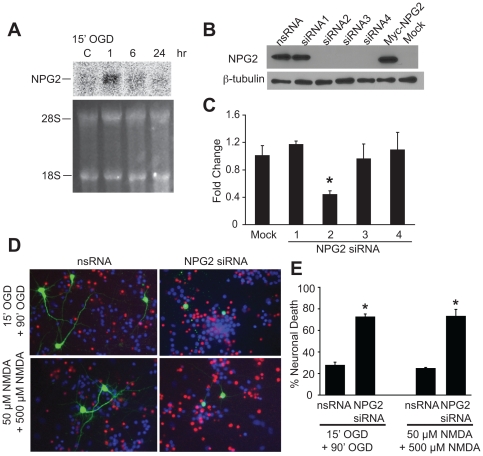
Figure 6 NPG2 participates in preconditioning induced neuroprotection. Primary cortical neurons were treated with 15 min OGD and harvested at the indicated time for (A) Northern blot analysis. Lower panel shows loading of RNA. These experiments were conducted three times with similar results. (B) HEK 293 cells were transfected with myc-tagged NPG2 and non-silencing control siRNA (nsRNA) or four different siRNA to NPG2 (siRNA1-4). Western blots for anti-myc show siRNA 2-4 effectively knock-down NPG2 expression. β–tubulin immunoreactivity was used as a loading control. (C) QT-PCR of Rat-2 cells transfected for 48 h with a control vector or siRNA to NPG2 shows that siRNA2 effectively knocks down endogenous NPG2 transcript. (D and E) Primary cortical neurons were transfected with an empty vector or NPG2 siRNA along with EGFP. 48 h later, the cells were preconditioned with OGD (15 min) or NMDA (50 µM, 5 min). 24 h after preconditioning, the cells were treated with OGD (90 min) or NMDA (500 µM, 5 min), respectively. 24 h later, the cells were stained with Hoescht 33342 and propidium iodide. Only EGFP positive neurons were scored. (D) Viable neurons were scored as those cells that displayed normal morphology. Dead neurons were scored as those cells that were propidium iodide positive, with condensed, or fragmented nuclei. (E) Quantification of cell viability. Experiments were performed three times, and the data was presented as mean ± SEM. *p<0.001 (Student's t test) when comparing siRNA to empty vector.
Figure 6 NPG2 participates in preconditioning induced neuroprotection. Primary cortical neurons were treated with 15 min OGD and harvested at the indicated time for (A) Northern blot analysis. Lower panel shows loading of RNA. These experiments were conducted three times with similar results. (B) HEK 293 cells were transfected with myc-tagged NPG2 and non-silencing control siRNA (nsRNA) or four different siRNA to NPG2 (siRNA1-4). Western blots for anti-myc show siRNA 2-4 effectively knock-down NPG2 expression. β–tubulin immunoreactivity was used as a loading control. (C) QT-PCR of Rat-2 cells transfected for 48 h with a control vector or siRNA to NPG2 shows that siRNA2 effectively knocks down endogenous NPG2 transcript. (D and E) Primary cortical neurons were transfected with an empty vector or NPG2 siRNA along with EGFP. 48 h later, the cells were preconditioned with OGD (15 min) or NMDA (50 µM, 5 min). 24 h after preconditioning, the cells were treated with OGD (90 min) or NMDA (500 µM, 5 min), respectively. 24 h later, the cells were stained with Hoescht 33342 and propidium iodide. Only EGFP positive neurons were scored. (D) Viable neurons were scored as those cells that displayed normal morphology. Dead neurons were scored as those cells that were propidium iodide positive, with condensed, or fragmented nuclei. (E) Quantification of cell viability. Experiments were performed three times, and the data was presented as mean ± SEM. *p<0.001 (Student's t test) when comparing siRNA to empty vector.CC BY · PubMed Central

Verification

Claims the paper makes

The claims and statistics of this paper haven’t been checked yet.

Run the check — free, no account needed. It reads the open-access text and checks the sources it cites.

A few free checks a day · papers already verified open instantly · results are public

Claims other papers make about this one

Each is checked against this paper’s own text: does it say what the citing paper says it does?

Self-check

Percentages, sums and reported differences re-computed from the paper’s own numbers.

The self-check needs the paper’s full text.

Citations

Cites

  • Parthanatos, a messenger of death

    David, K. K. (2009) · Frontiers in Bioscience · doi:10.2741/3297 · Cited by 450 · cited 1×

    “In the nervous system NMDA excitotoxicity is mediated largely by parthanatos, poly (ADP-ribose) polymerase 1 (PARP-1) dependent cell death [2,3].”
    Background

Show all 1 references

Research works printed but not linked: 31

  1. JM Gidday, 2006, Cerebral preconditioning and ischaemic tolerance., Nat Rev Neurosci, 7, 437, 10.1038/nrn1927 · DOI · Paper page
  2. Y Wang, 2009, Poly(ADP-ribose) signals to mitochondrial AIF: a key event in parthanatos., Exp Neurol, 218, 193, 10.1016/j.expneurol.2009.03.020 · DOI
  3. D Fambrough, 1999, Diverse signaling pathways activated by growth factor receptors induce broadly overlapping, rather than independent, sets of genes., Cell, 97, 727, 10.1016/S0092-8674(00)80785-0 · DOI
  4. VR Iyer, 1999, The transcriptional program in the response of human fibroblasts to serum., Science, 283, 83, 10.1126/science.283.5398.83 · DOI
  5. H Jiang, 2000, RaSH, a rapid subtraction hybridization approach for identifying and cloning differentially expressed genes., Proc Natl Acad Sci U S A, 97, 12684, 10.1073/pnas.220431297 · DOI
  6. P Liang, 1992, Differential display of eukaryotic messenger RNA by means of the polymerase chain reaction., Science, 257, 967, 10.1126/science.1354393 · DOI
  7. M Schena, 1995, Quantitative monitoring of gene expression patterns with a complementary DNA microarray., Science, 270, 467, 10.1126/science.270.5235.467 · DOI · Paper page
  8. VE Velculescu, 1995, Serial analysis of gene expression., Science, 270, 484, 10.1126/science.270.5235.484 · DOI
  9. AS Parsadanian, 1998, Bcl-xL is an antiapoptotic regulator for postnatal CNS neurons., J Neurosci, 18, 1009, 10.1523/JNEUROSCI.18-03-01009.1998 · DOI
  10. A Cheng, 2003, Calmodulin mediates brain-derived neurotrophic factor cell survival signaling upstream of Akt kinase in embryonic neocortical neurons., J Biol Chem, 278, 7591, 10.1074/jbc.M207232200 · DOI
  11. N Wahab, 2007, Connective tissue growth factor (CTGF) promotes activated mesangial cell survival via up-regulation of mitogen-activated protein kinase phosphatase-1 (MKP-1)., Biochem J, 406, 131, 10.1042/BJ20061817 · DOI
  12. S Talapatra, 2002, Elongation factor-1 alpha is a selective regulator of growth factor withdrawal and ER stress-induced apoptosis., Cell Death Differ, 9, 856, 10.1038/sj.cdd.4401078 · DOI
  13. CM Abbott, 2009, eEF1A2 and neuronal degeneration., Biochem Soc Trans, 37, 1293, 10.1042/BST0371293 · DOI
  14. Y Huang, 2007, Neuronal growth and survival mediated by eIF5A, a polyamine-modified translation initiation factor., Proc Natl Acad Sci U S A, 104, 4194, 10.1073/pnas.0611609104 · DOI
  15. MP Kurnellas, 2010, Reduced expression of plasma membrane calcium ATPase 2 and collapsin response mediator protein 1 promotes death of spinal cord neurons., Cell Death Differ
  16. J Liauw, 2008, Thrombospondins 1 and 2 are necessary for synaptic plasticity and functional recovery after stroke., J Cereb Blood Flow Metab, 28, 1722, 10.1038/jcbfm.2008.65 · DOI
  17. MT Lin, 2006, Mitochondrial dysfunction and oxidative stress in neurodegenerative diseases., Nature, 443, 787, 10.1038/nature05292 · DOI · Paper page
  18. WX Zong, 2006, Necrotic death as a cell fate., Genes Dev, 20, 1, 10.1101/gad.1376506 · DOI
  19. X Zhao, 2001, Mutations in a newly identified GTPase gene cause autosomal dominant hereditary spastic paraplegia., Nat Genet, 29, 326, 10.1038/ng758 · DOI · Paper page
  20. DA Keays, 2007, Mutations in alpha-tubulin cause abnormal neuronal migration in mice and lissencephaly in humans., Cell, 128, 45, 10.1016/j.cell.2006.12.017 · DOI
  21. R Zemni, 2000, A new gene involved in X-linked mental retardation identified by analysis of an X;2 balanced translocation., Nat Genet, 24, 167, 10.1038/72829 · DOI
  22. S Charrin, 2009, Lateral organization of membrane proteins: tetraspanins spin their web., Biochem J, 420, 133, 10.1042/BJ20082422 · DOI
  23. N Lezcano, 2000, Dual signaling regulated by calcyon, a D1 dopamine receptor interacting protein., Science, 287, 1660, 10.1126/science.287.5458.1660 · DOI
  24. N Naslavsky, 2009, EHD3 regulates early-endosome-to-Golgi transport and preserves Golgi morphology., J Cell Sci, 122, 389, 10.1242/jcs.037051 · DOI
  25. J Wang, 2009, The lysine demethylase LSD1 (KDM1) is required for maintenance of global DNA methylation., Nat Genet, 41, 125, 10.1038/ng.268 · DOI
  26. DM Ivey, 1993, Cloning and characterization of a putative Ca2+/H+ antiporter gene from Escherichia coli upon functional complementation of Na+/H+ antiporter-deficient strains by the overexpressed gene., J Biol Chem, 268, 11296, 10.1016/S0021-9258(18)82124-X · DOI
  27. YA Moon, 2003, Identification of two mammalian reductases involved in the two-carbon fatty acyl elongation cascade., J Biol Chem, 278, 7335, 10.1074/jbc.M211684200 · DOI
  28. M Gonzalez-Zulueta, 1998, Manganese superoxide dismutase protects nNOS neurons from NMDA and nitric oxide-mediated neurotoxicity., J Neurosci, 18, 2040, 10.1523/JNEUROSCI.18-06-02040.1998 · DOI
  29. M Gonzalez-Zulueta, 2000, Requirement for nitric oxide activation of p21(ras)/extracellular regulated kinase in neuronal ischemic preconditioning., Proc Natl Acad Sci U S A, 97, 436, 10.1073/pnas.97.1.436 · DOI
  30. F Michiels, 2000, Expression of Rho GTPases using retroviral vectors., Methods Enzymol, 325, 295, 10.1016/S0076-6879(00)25451-7 · DOI
  31. U Pohl, 2000, EHD2, EHD3, and EHD4 encode novel members of a highly conserved family of EH domain-containing proteins., Genomics, 63, 255, 10.1006/geno.1999.6087 · DOI

Cited by

Sorted by citations

Metadata

Authors
Dai, C., Liang, D., Li, H., Sasaki, M., Dawson, T. M., & Dawson, V. L.
Venue
PLoS ONE
Published
2010-11-24
Volume
5
Issue
11
Pages
e15008
ISSN
1932-6203
Cited by
29
References
1
Language
en

About these checks

Registry, retraction, Cites and statistics results are computed, not judged, with one exception: a printed reference that no index lists is read once by a model before it counts as a citation error. Claims are extracted by a model and kept only when their quote appears verbatim in the text; each cited source is then checked, with a model’s help, for whether it says what the claim relies on. Those verdicts can be wrong — read the claim’s quote and the cited source before relying on one.

Statistics and arithmetic are recomputed, not judged.

Confidence bands are shown only for fields calibrated on our annotated test set. None is calibrated yet, so no band is shown.

What counts as a claim ›How we measure confidence ›How we check this ›

Are you an author, or do you see a problem with this page? Request a review