

Natural Plant Sugar Sources of Anopheles Mosquitoes Strongly Impact Malaria Transmission Potential
Open accessThe DOI matches its Crossref record; 31 of the 33 references it cites were found in a registry or an index.
Abstract
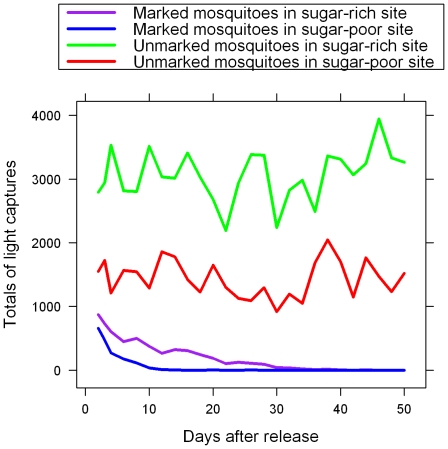
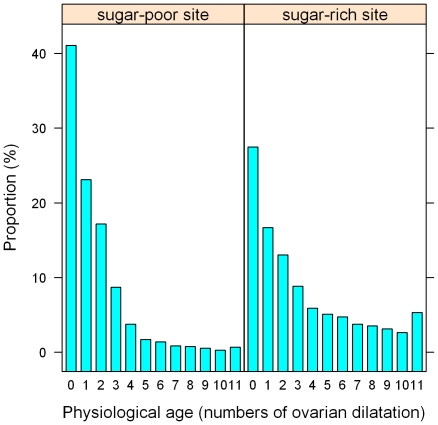
An improved knowledge of mosquito life history could strengthen malaria vector control efforts that primarily focus on killing mosquitoes indoors using insecticide treated nets and indoor residual spraying. Natural sugar sources, usually floral nectars of plants, are a primary energy resource for adult mosquitoes but their role in regulating the dynamics of mosquito populations is unclear. To determine how the sugar availability impacts Anopheles sergentii populations, mark-release-recapture studies were conducted in two oases in Israel with either absence or presence of the local primary sugar source, flowering Acacia raddiana trees. Compared with population estimates from the sugar-rich oasis, An. sergentii in the sugar-poor oasis showed smaller population size (37,494 vs. 85,595), lower survival rates (0.72 vs. 0.93), and prolonged gonotrophic cycles (3.33 vs. 2.36 days). The estimated number of females older than the extrinsic incubation period of malaria (10 days) in the sugar rich site was 4 times greater than in the sugar poor site. Sugar feeding detected in mosquito guts in the sugar-rich site was significantly higher (73%) than in the sugar-poor site (48%). In contrast, plant tissue feeding (poor quality sugar source) in the sugar-rich habitat was much less (0.3%) than in the sugar-poor site (30%). More important, the estimated vectorial capacity, a standard measure of malaria transmission potential, was more than 250-fold higher in the sugar-rich oasis than that in the sugar-poor site. Our results convincingly show that the availability of sugar sources in the local environment is a major determinant regulating the dynamics of mosquito populations and their vector potential, suggesting that control interventions targeting sugar-feeding mosquitoes pose a promising tactic for combating transmission of malaria parasites and other pathogens.
Overview
The claims and statistics of this paper haven’t been checked yet.
Free: it reads the open-access text and checks the first 5 claims that cite a source we can check. Create a free account to check every claim.
Integrity signals
Registry
Cites
Statistics
Figures
Verification
Claims the paper makes
The claims and statistics of this paper haven’t been checked yet.
Free: it reads the open-access text and checks the first 5 claims that cite a source we can check. Create a free account to check every claim.
Claims other papers make about this one
Each is checked against this paper’s own text: does it say what the citing paper says it does?
The cited source says what the claim attributes to it.
In the citing paper
“As recently described [23], the environments of the two oases are very similar except for the availability of sugar sources.”
The cited source says what the claim attributes to it.
In the citing paper
“As demonstrated in a recent comparative study of An. sergentii in sugar-rich and sugar-poor oases in Israel, the availability of natural plant sugar sources affects mosquito fitness, population dynamics, and malaria vector capacity [23].”
Self-check
Percentages, sums and reported differences re-computed from the paper’s own numbers.
The self-check needs the paper’s full text.
Citations
Cites
R: A Language and Environment for Statistical Computing
R Core Team (2025) · doi:10.32614/r.manuals · Cited by 352,181
Direct microdetermination of sucrose
van Handel, E. (1968) · Analytical Biochemistry · doi:10.1016/0003-2697(68)90317-5 · Cited by 729
Auclair, J. L. (1963) · Annual Review of Entomology · doi:10.1146/annurev.en.08.010163.002255 · Cited by 506 · cited 1×
“Sugar content in these alternative plant tissue sources is frugal, as compared to high concentrations (20– 60%) in nectar and honeydew [32,33,34].”
BackgroundStatics and dynamics of malaria infection in Anopheles mosquitoes.
(2004) · Malaria Journal · doi:10.1186/1475-2875-3-13 · Cited by 473 · cited 1×
“It is well documented that the effects of interventions on the mosquito survival rates are extremely important [30].”
BackgroundKilleen, G. F., Smith, T. A., Ferguson, H. M., Mshinda, H., Abdulla, S., Lengeler, C., & Kachur, S. P. (2007) · PLoS Medicine · doi:10.1371/journal.pmed.0040229 · Cited by 408 · cited 1×
“, bednets and source reduction of aquatic habitats, can significantly affect population dynamics and the vectorial capacity of pathogen transmitting mosquitoes [8,9,10].”
BackgroundEcology: A Prerequisite for Malaria Elimination and Eradication
Ferguson, H. M., Dornhaus, A., Beeche, A., Borgemeister, C., Gottlieb, M., Mulla, M. S., Gimnig, J. E., Fish, D., & Killeen, G. F. (2010) · PLoS Medicine · doi:10.1371/journal.pmed.1000303 · Cited by 374 · cited 3×
“Vector ecology has been reiterated as the key for the development of much-needed new approaches beyond LLINs and IRS for controlling malaria vector species and locally eliminating malaria parasite transmission [6].”
BackgroundInfluentialHow to make evolution-proof insecticides for malaria control
Read, A. F., Lynch, P. A., & Thomas, M. B. (2009) · PLoS Biology · doi:10.1371/journal.pbio.1000058 · Cited by 288 · cited 1×
“Nevertheless, scale-up applications of LLINs and IRS inevitably lead to development of insecticide resistance and do not suffice to sustain long-term control effects [3,4].”
BackgroundMüller, G. C., Beier, J. C., Traore, S. F., Toure, M. B., Traore, M. M., Bah, S., Doumbia, S., & Schlein, Y. (2010) · Malaria Journal · doi:10.1186/1475-2875-9-210 · Cited by 239
Self-citationKilleen, G. F., McKenzie, F. E., Foy, B. D., Schieffelin, C., Billingsley, P. F., & Beier, J. C. (2000) · The American journal of tropical medicine and hygiene · doi:10.4269/ajtmh.2000.62.535 · Cited by 220 · cited 2×
“2 - 4 days [23], our estimation was weighted average to take into account the variation of individual mosquitoes.”
BackgroundSelf-citationPost‐secretory determinants of sugar concentration in nectar
CORBET, S. A., WILLMER, P. G., BEAMENT, J. W. L., UNWIN, D. M., & PRŶS‐JONES, O. E. (1979) · Plant, Cell & Environment · doi:10.1111/j.1365-3040.1979.tb00084.x · Cited by 209 · cited 1×
“Sugar content in these alternative plant tissue sources is frugal, as compared to high concentrations (20– 60%) in nectar and honeydew [32,33,34].”
BackgroundEffects of salinity on biochemical components of the mangrove, Aegiceras corniculatum
Parida, A. K., Das, A. B., Sanada, Y., & Mohanty, P. (2004) · Aquatic Botany · doi:10.1016/j.aquabot.2004.07.005 · Cited by 199
Vectorial capacity: Must we measure all its components?
Dye, C. (1986) · Parasitology Today · doi:10.1016/0169-4758(86)90082-7 · Cited by 178 · cited 1×
“Following Dye [28], our focus was on comparison of estimated VC in the two sites rather than calculation of absolute values.”
BackgroundGU, W., & NOVAK, R. J. (2005) · The American Journal of Tropical Medicine and Hygiene · doi:10.4269/ajtmh.2005.73.546 · Cited by 135 · cited 1×
“Here, we adopted a value of 10 days [29] as a conservative estimate to compare the effect of sugar sources on VC because larger values of EIP would more drastically amplify the difference in VC between the two oases.”
MethodSelf-citationSugar questing mosquitoes in arid areas gather on scarce blossoms that can be used for control
Müller, G., & Schlein, Y. (2006) · International Journal for Parasitology · doi:10.1016/j.ijpara.2006.06.008 · Cited by 123 · cited 4×
“Our previous studies in Israel indicate that female mosquitoes frequently feed on preferred flowering plants, some up to 130 times more attractive than others [14,31].”
BackgroundSelf-citationMüller, G. C., Kravchenko, V. D., & Schlein, Y. (2008) · Journal of the American Mosquito Control Association · doi:10.2987/8756-971x(2008)24[147:doasaa]2.0.co;2 · Cited by 116 · cited 1×
“Other mosquito species included Aedes caspius and Culex pipiens occurring in small percentages[15].”
BackgroundSelf-citationKilleen, G. F., McKenzie, F. E., Foy, B. D., Bøgh, C., & Beier, J. C. (2001) · Transactions of the Royal Society of Tropical Medicine and Hygiene · doi:10.1016/s0035-9203(01)90005-7 · Cited by 115 · cited 1×
“, bednets and source reduction of aquatic habitats, can significantly affect population dynamics and the vectorial capacity of pathogen transmitting mosquitoes [8,9,10].”
BackgroundSelf-citationThe other habit: sugar feeding by mosquitoes
Yuval, B. (1992) · Bulletin of the Society of Vector Ecologists · Cited by 112
The importance of physiological ecology in conservation biology
Tracy, C. R., Nussear, K. E., Esque, T. C., Dean-Bradley, K., Tracy, C. R., DeFalco, L. A., Castle, K. T., Zimmerman, L. C., Espinoza, R. E., & Barber, A. M. (2006) · Integrative and Comparative Biology · doi:10.1093/icb/icl054 · Cited by 109 · cited 1×
“food shortage and habitat loss, are the center of concern in animal ecology and conservation biology[7].”
BackgroundGarrett-Jones, C., & Grab, B. (1964) · Europe PMC (PubMed Central) · Cited by 104
Source reduction of mosquito larval habitats has unexpected consequences on malaria transmission
Gu, W., Regens, J. L., Beier, J. C., & Novak, R. J. (2006) · Proceedings of the National Academy of Sciences · doi:10.1073/pnas.0608452103 · Cited by 100 · cited 2×
“, bednets and source reduction of aquatic habitats, can significantly affect population dynamics and the vectorial capacity of pathogen transmitting mosquitoes [8,9,10].”
BackgroundSelf-citationMortality of Leishmania major in Phlebotomus papatasi Caused by Plant Feeding of the Sand Flies
Schlein, Y., & Jacobson, R. L. (1994) · American Journal of Tropical Medicine and Hygiene · doi:10.4269/ajtmh.1994.50.1.tm0500010020 · Cited by 85 · cited 2×
“Random samples of marked and unmarked female mosquitoes were tested for sugar feeding using the cold anthrone test for fructose [17,18] as modified by Schlein & Jacobson [19].”
MethodSelf-citationSchlein, Y., & Müller, G. C. (2008) · Journal of Medical Entomology · doi:10.1603/0022-2585(2008)45[384:aatmcu]2.0.co;2 · Cited by 83 · cited 2×
“Our previous studies in Israel indicate that female mosquitoes frequently feed on preferred flowering plants, some up to 130 times more attractive than others [14,31].”
BackgroundSelf-citationWHO position statement on integrated vector management.
(2008) · PubMed · Cited by 83
Schlein, Y., & Müller, G. C. (1995) · Journal of Medical Entomology · doi:10.1093/jmedent/32.6.882 · Cited by 79 · cited 3×
“Citation: Gu W, Müller G, Schlein Y, Novak RJ, Beier JC (2011) Natural Plant Sugar Sources of Anopheles Mosquitoes Strongly Impact Malaria Transmission Potential.”
MethodSelf-citationAgent-based modelling of mosquito foraging behaviour for malaria control
Gu, W., & Novak, R. J. (2009) · Transactions of the Royal Society of Tropical Medicine and Hygiene · doi:10.1016/j.trstmh.2009.01.006 · Cited by 65 · cited 1×
“limited flight ability, short perceptual ranges, and small energetic budget [8,35].”
BackgroundSelf-citationPlant tissues: the frugal diet of mosquitoes in adverse conditions
Müller, G., & Schlein, Y. (2005) · Medical and Veterinary Entomology · doi:10.1111/j.1365-2915.2005.00590.x · Cited by 60 · cited 3×
“low levels of sugar obtained from plant tissue can produce positive anthrone tests[20].”
BackgroundSelf-citationEstimation and Comparison of Mosquito Survival Rates with Release-Recapture-Removal Data
Buonaccorsi, J. P., Harrington, L. C., & Edman, J. D. (2003) · Journal of Medical Entomology · doi:10.1603/0022-2585-40.1.6 · Cited by 56 · cited 2×
“To estimate the daily survival rates, we adopted a nonlinear model [25] based on recaptures of marked mosquitoes after a single cohort of release.”
MethodThe implications of Anopheles sergenti for malaria eradication programmes east of the Mediterranean.
FARID, M. A. (1956) · Europe PMC (PubMed Central) · Cited by 19
Laboratory rearing techniques and adult life table parameters for Anopheles sergentii from Egypt.
Beier, M. S., Beier, J. C., Merdan, A., Sawaf, B. M. E., & Kadder, M. A. (1987) · PubMed · Cited by 16
Self-citationResponding to the challenge to end malaria deaths in Africa
Chambers, R. G., Gupta, R., & Ghebreyesus, T. A. (2008) · The Lancet · doi:10.1016/s0140-6736(08)60609-1 · Cited by 10 · cited 1×
“Nevertheless, scale-up applications of LLINs and IRS inevitably lead to development of insecticide resistance and do not suffice to sustain long-term control effects [3,4].”
Background(1974) · Europe PMC (PubMed Central)
Research works printed but not linked: 3
- WHO 2004 Global strategic framework for integrated vector management. WHO/CDS/CPE/PVC/2004 10 1 12
- Zohary M Orshansky G 1949 Structure and ecology of the vegetation in the Dead Sea region of Palestine. Palest J Bot 4 177 206
- Van Handel E 1972 The detection of nectar in mosquitoes. Mosq News 32 458
Cited by
Characterizing, controlling and eliminating residual malaria transmission
Killeen, G. F. (2014) · Malaria Journal · doi:10.1186/1475-2875-13-330 · Cited by 506
Burkett-Cadena, N. D., & Vittor, A. Y. (2018) · Basic and Applied Ecology · doi:10.1016/j.baae.2017.09.012 · Cited by 201
Flies and Flowers III: Ecology of foraging and pollination
Inouye, D. W., Larson, B. M. H., Ssymank, A., & Kevan, P. G. (2015) · Journal of Pollination Ecology · doi:10.26786/1920-7603(2015)15 · Cited by 213
“It is important to understand the ecology of floral foraging by Diptera because their access to nutritional resources at flowers is so critical to their fitness (Magnarelli & Anderson 1977; Haslett 1989a; Gu et al. 2011;).”
BackgroundBeier, J. C., Müller, G. C., Gu, W., Arheart, K. L., & Schlein, Y. (2012) · Malaria Journal · doi:10.1186/1475-2875-11-31 · Cited by 199
“Both sites covered areas of about 5 ha, included small fresh-water springs surrounded by dense non-flowering vegetation which was largely grazed out by camels and donkeys with no visible plant sugar sources during the period of field experiments [23,24].”
BackgroundInfluentialSelf-citationNyasembe, V. O., Teal, P. E. A., Mukabana, W. R., Tumlinson, J. H., & Torto, B. (2012) · Parasites & Vectors · doi:10.1186/1756-3305-5-234 · Cited by 154
“As such, the availability of sugar sources in the local environment is a major determinant regulating survival, the dynamics of mosquito populations and their vector potential [15,16].”
Background
Metadata
- Authors
- Gu, W., Müller, G., Schlein, Y., Novak, R. J., & Beier, J. C.
- Affiliations
- University of Alabama (US)
- Hebrew University of Jerusalem (IL)
- University of Alabama at Birmingham (US)
- University of Miami (US)
- Corresponding author
- Gu, Weidong
- Venue
- PLoS ONE
- Publisher
- Public Library of Science (PLoS)
- Published
- 2011-01-20
- Volume
- 6
- Issue
- 1
- Pages
- e15996
- ISSN
- 1932-6203 (ISSN-L)
- PMC
- PMC3024498
- OpenAlex
- W1982736581
- Semantic Scholar
- 0e1cf6dc9c43781be5efa453540d3c4c8776d9b4
- Cited by
- 128
- References
- 33
- Citations by year
- 2026: 5 · 2025: 13 · 2024: 8 · 2023: 4 · 2022: 6 · 2021: 7 · 2020: 9 · 2019: 6 · 2018: 9 · 2017: 11 · 2016: 4 · 2015: 13 · 2014: 7 · 2013: 10 · 2012: 10
- FWCI
- 10.07
- Type
- journal article
- Language
- en
- Open access
- gold
- doi.org
- Locations
- PLoS ONE (publishedVersion, cc-by)
- PubMed Central (publishedVersion, cc-by)
- PubMed (publishedVersion)
- DOAJ (DOAJ: Directory of Open Access Journals) (submittedVersion, cc-by-sa)
- Funders
- Bill and Melinda Gates Foundation (47302)
- Topics
- Health Sciences › Medicine › Public Health, Environmental and Occupational Health › Malaria Research and Control
- Health Sciences › Medicine › Public Health, Environmental and Occupational Health › Mosquito-borne diseases and control
- Life Sciences › Agricultural and Biological Sciences › Insect Science › Insect behavior and control techniques
- Keywords
- Anopheles sergentii, malaria vectors, floral nectar, Acacia raddiana, mosquito population dynamics, vectorial capacity, gonotrophic cycle, mosquito survival
- MeSH terms
- Acacia, Animals, Anopheles, Feeding Behavior, Malaria, Mosquito Control, Plants, Population Dynamics, Carbohydrate Metabolism
About these checks
Registry, retraction, Cites and statistics results are computed, not judged, with one exception: a printed reference that no index lists is read once by a model before it counts as a citation error. Claims are extracted by a model and kept only when their quote appears verbatim in the text; each cited source is then checked, with a model’s help, for whether it says what the claim relies on. Those verdicts can be wrong — read the claim’s quote and the cited source before relying on one.
Statistics and arithmetic are recomputed, not judged.
Confidence bands are shown only for fields calibrated on our annotated test set. None is calibrated yet, so no band is shown.
What counts as a claim ›How we measure confidence ›How we check this ›
Are you an author, or do you see a problem with this page? Request a review
Data sources
Bibliographic data: Semantic Scholar, OpenAlex, Crossref.
Contains information from the Semantic Scholar Academic Graph Datasets, made available under the ODC Attribution License (ODC-BY 1.0).
Semantic Scholar’s data is described in: Kinney, R., et al. (2023). The Semantic Scholar Open Data Platform. arXiv:2301.10140.
