

The DOI matches its Crossref record; 64 of the 66 references it cites were found in a registry or an index.
Internet-Based Cognitive Behavior Therapy vs. Cognitive Behavioral Group Therapy for Social Anxiety Disorder: A Randomized Controlled Non-inferiority Trial
Open accessAbstract
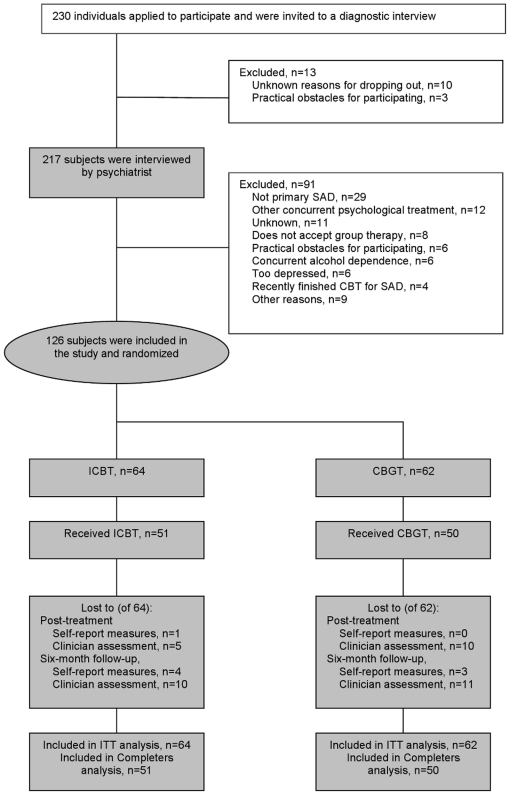
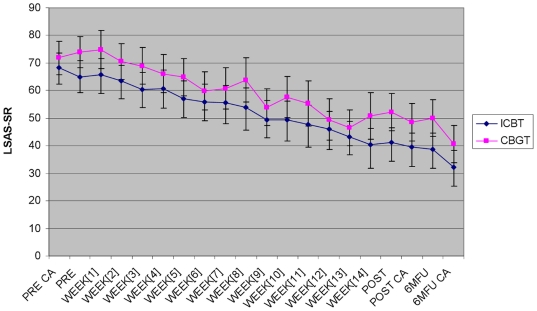
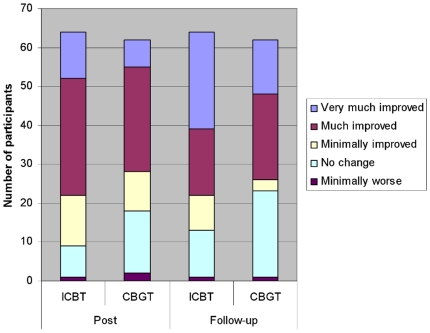
BACKGROUND AND AIMS: Cognitive behavioral group therapy (CBGT) is an effective, well-established, but not widely available treatment for social anxiety disorder (SAD). Internet-based cognitive behavior therapy (ICBT) has the potential to increase availability and facilitate dissemination of therapeutic services for SAD. However, ICBT for SAD has not been directly compared with in-person treatments such as CBGT and few studies investigating ICBT have been conducted in clinical settings. Our aim was to investigate if ICBT is at least as effective as CBGT for SAD when treatments are delivered in a psychiatric setting. METHODS: We conducted a randomized controlled non-inferiority trial with allocation to ICBT (n=64) or CBGT (n=62) with blinded assessment immediately following treatment and six months post-treatment. Participants were 126 individuals with SAD who received CBGT or ICBT for a duration of 15 weeks. The Liebowitz Social Anxiety Scale (LSAS) was the main outcome measure. The following non-inferiority margin was set: following treatment, the lower bound of the 95 % confidence interval (CI) of the mean difference between groups should be less than 10 LSAS-points. RESULTS: Both groups made large improvements. At follow-up, 41 (64%) participants in the ICBT group were classified as responders (95% CI, 52%-76%). In the CBGT group, 28 participants (45%) responded to the treatment (95% CI, 33%-58%). At post-treatment and follow-up respectively, the 95 % CI of the LSAS mean difference was 0.68-17.66 (Cohen's d between group=0.41) and -2.51-15.69 (Cohen's d between group=0.36) favoring ICBT, which was well within the non-inferiority margin. Mixed effects models analyses showed no significant interaction effect for LSAS, indicating similar improvement across treatments (F=1.58; df=2, 219; p=.21). CONCLUSIONS: ICBT delivered in a psychiatric setting can be as effective as CBGT in the treatment of SAD and could be used to increase availability to CBT. TRIAL REGISTRATION: ClinicalTrials.gov NCT00564967.
Overview
The claims and statistics of this paper haven’t been checked yet.
Run the check — free, no account needed. It reads the open-access text and checks the sources it cites.
Integrity signals
Registry
Cites
Statistics
Figures
Verification
Claims the paper makes
The claims and statistics of this paper haven’t been checked yet.
Run the check — free, no account needed. It reads the open-access text and checks the sources it cites.
Claims other papers make about this one
Each is checked against this paper’s own text: does it say what the citing paper says it does?
The cited source doesn’t support the claim as written.
In the citing paper
“In one of our more recent comparative trials on social anxiety disorder, we found that patients preferred internet treatment over group treatment [Hedman et al., 2011]”
From Internet-based treatments - Experiences from Sweden (2013) · cites this paper as Hedman et al., 2011
Checked by a reasoning model — may be wrong.
Experimental — accuracy not yet measuredThe source backs part of the claim, not all of it — or backs it for a different population, condition or comparison.
In the citing paper
“an increasing number of controlled studies indicate that for common psychiatric disorders ICBT is as effective as face-to-face delivered treatment [11-13]”
From Acceptability, effectiveness, and cost-effectiveness of internet-based exposure treatment for irritable bowel syndrome in a clinical sample: A randomized controlled trial (2011) · cites this paper as [13]
Experimental — accuracy not yet measuredThe cited source says what the claim attributes to it.
In the citing paper
“Both treatments are well documented [17, 24, 75] and have been implemented in scientific research before in treatment studies for GCBT (e.g. [76–79]) and individual and group ST (e.g. [19, 43, 80, 81]).”
Self-check
Percentages, sums and reported differences re-computed from the paper’s own numbers.
The self-check needs the paper’s full text.
Citations
Cites
Kessler, R. C., Berglund, P., Demler, O., Jin, R., Merikangas, K. R., & Walters, E. E. (2005) · Archives of General Psychiatry · doi:10.1001/archpsyc.62.6.593 · Cited by 20,391
(1998) · The Journal of Clinical Psychiatry · Cited by 19,139
An inventory for measuring clinical anxiety: Psychometric properties.
Beck, A. T., Epstein, N., Brown, G., & Steer, R. A. (1988) · Journal of Consulting and Clinical Psychology · doi:10.1037/0022-006x.56.6.893 · Cited by 14,407
SAUNDERS, J. B., AASLAND, O. G., BABOR, T. F., DE LA FUENTE, J. R., & GRANT, M. (1993) · Addiction · doi:10.1111/j.1360-0443.1993.tb02093.x · Cited by 13,597 · cited 1×
“, MADRS-S, the Alcohol Use Disorders Identification Test (AUDIT)”
(1998) · PubMed · Cited by 10,216
Jacobson, N. S., & Truax, P. (1991) · Journal of Consulting and Clinical Psychology · doi:10.1037/0022-006x.59.1.12 · Cited by 7,770
The mini international neuropsychiatric interview
Lecrubier, Y., Sheehan, D. V., Hergueta, T., & Weiller, E. (1998) · European Psychiatry · doi:10.1016/s0924-9338(99)80239-9 · Cited by 5,899
Diagnostic and Statistical Manual of Mental Disorders ( DSM ‐ IV ‐ TR )
Segal, D. L. (2010) · Wiley eBooks · doi:10.1002/9780470479216.corpsy0271 · Cited by 4,687
Mattick, R. P., & Clarke, J. C. (1998) · Behaviour Research and Therapy · doi:10.1016/s0005-7967(97)10031-6 · Cited by 3,367
Anxiety, sensitivity, anxiety frequency, and the prediction of fearfulness
Reiss, S., Peterson, R. A., Gursky, D. M., & McNally, R. J. (1986) · Behaviour Research and Therapy · doi:10.1016/0005-7967(86)90143-9 · Cited by 3,169
Research works printed but not linked: 1
- 2002, Structured clinical interview for DSM-IV-TR axis I Disorders, research version, patient edition.
Cited by
Sorted by citations
Persuasive System Design Does Matter: a Systematic Review of Adherence to Web-based Interventions
Kelders, S. M., Kok, R. N., Ossebaard, H. C., & Van Gemert-Pijnen, J. E. (2012) · Journal of Medical Internet Research · doi:10.2196/jmir.2104 · Cited by 1,308
Carlbring, P., Andersson, G., Cuijpers, P., Riper, H., & Hedman-Lagerlöf, E. (2018) · Cognitive Behaviour Therapy · doi:10.1080/16506073.2017.1401115 · Cited by 1,232
Self-citationAndersson, G., Cuijpers, P., Carlbring, P., Riper, H., & Hedman, E. (2014) · World Psychiatry · doi:10.1002/wps.20151 · Cited by 1,077
Self-citationKatzman, M. A., Bleau, P., Blier, P., Chokka, P., Kjernisted, K., Van Ameringen, M., & the Canadian Anxiety Guidelines Initiative Group on behalf of the Anxiety Disorders Association of Canada/Association Canadienne des troubles anxieux and McGill University (2014) · BMC Psychiatry · doi:10.1186/1471-244x-14-s1-s1 · Cited by 1,090
“CBT [414,415], while being more cost-effective [416].”
Hedman, E., Ljótsson, B., & Lindefors, N. (2012) · Expert Review of Pharmacoeconomics & Outcomes Research · doi:10.1586/erp.12.67 · Cited by 672
Self-citation
Metadata
- Authors
- Hedman, E., Andersson, G., Ljótsson, B., Andersson, E., Rück, C., Mörtberg, E., & Lindefors, N.
- Affiliations
- Linköping University (SE)
- Karolinska Institutet (SE)
- Stockholm University (SE)
- Venue
- PLoS ONE
- Publisher
- Public Library of Science (PLoS)
- Published
- 2011-03-25
- Volume
- 6
- Issue
- 3
- Pages
- e18001
- ISSN
- 1932-6203 (ISSN-L)
- PMC
- PMC3070741
- OpenAlex
- W1979037945
- Cited by
- 285
- References
- 66
- Citations by year
- 2026: 7 · 2025: 12 · 2024: 9 · 2023: 18 · 2022: 10 · 2021: 50 · 2020: 10 · 2019: 11 · 2018: 11 · 2017: 19 · 2016: 19 · 2015: 16 · 2014: 28 · 2013: 34 · 2012: 26
- FWCI
- 37.80
- Type
- journal article
- Language
- en
- Open access
- gold
- doi.org
- Licence
- cc-by
- Locations
- PLoS ONE (publishedVersion, cc-by)
- Europe PMC (PubMed Central) (publishedVersion, cc-by)
- PubMed Central (publishedVersion, cc-by)
- PubMed (publishedVersion)
- KTH Publication Database DiVA (KTH Royal Institute of Technology) (submittedVersion, other-oa)
- DOAJ (DOAJ: Directory of Open Access Journals) (submittedVersion, cc-by-sa)
- Figshare (submittedVersion, cc-by)
- Funders
- Stockholms Läns Landsting
- Topics
- Social Sciences › Psychology › Applied Psychology › Digital Mental Health Interventions
- Social Sciences › Psychology › Experimental and Cognitive Psychology › Anxiety, Depression, Psychometrics, Treatment, Cognitive Processes
- Social Sciences › Psychology › Clinical Psychology › Psychological Treatments and Assessments
- Keywords
- internet-based cognitive behavioral therapy, group cognitive behavioral therapy, social anxiety disorder, non-inferiority, psychiatric treatment, treatment availability, dissemination of psychotherapy, Liebowitz Social Anxiety Scale
- MeSH terms
- Adolescent, Adult, Female, Humans, Male, Middle Aged, Phobic Disorders, Psychotherapy, Group, Cognitive Behavioral Therapy, Treatment Outcome, Internet, Young Adult
About these checks
Registry, retraction, Cites and statistics results are computed, not judged, with one exception: a printed reference that no index lists is read once by a model before it counts as a citation error. Claims are extracted by a model and kept only when their quote appears verbatim in the text; each cited source is then checked, with a model’s help, for whether it says what the claim relies on. Those verdicts can be wrong — read the claim’s quote and the cited source before relying on one.
Statistics and arithmetic are recomputed, not judged.
Confidence bands are shown only for fields calibrated on our annotated test set. None is calibrated yet, so no band is shown.
What counts as a claim ›How we measure confidence ›How we check this ›
Are you an author, or do you see a problem with this page? Request a review
