

The DOI matches its Crossref record; 39 of the 39 references it cites were found in a registry or an index.
Biological Surface Coating and Molting Inhibition as Mechanisms of TiO2 Nanoparticle Toxicity in Daphnia magna
Open accessAbstract
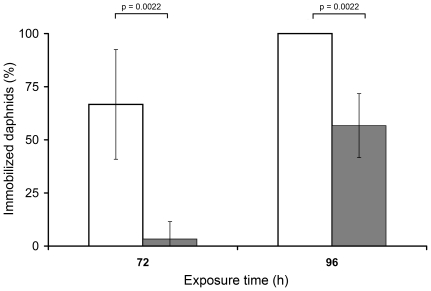
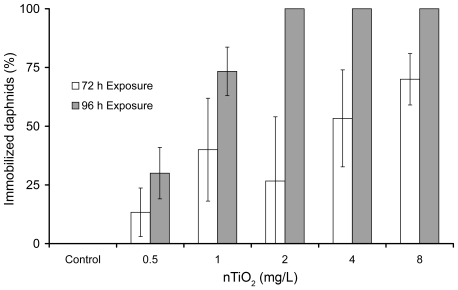
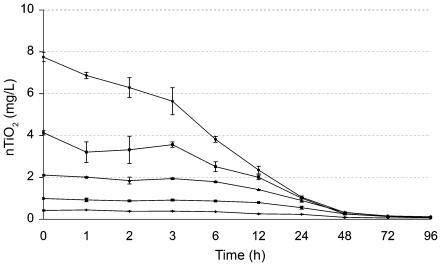
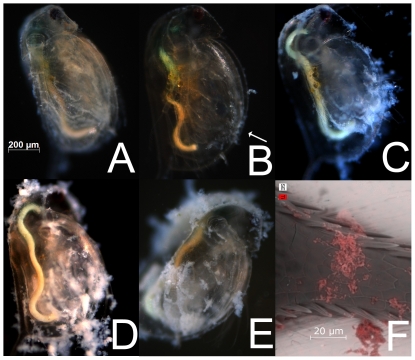
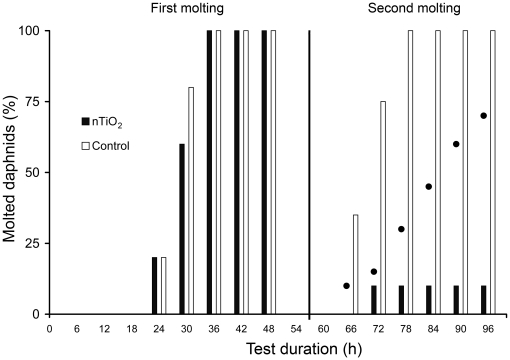
The production and use of nanoparticles (NP) has steadily increased within the last decade; however, knowledge about risks of NP to human health and ecosystems is still scarce. Common knowledge concerning NP effects on freshwater organisms is largely limited to standard short-term (≤48 h) toxicity tests, which lack both NP fate characterization and an understanding of the mechanisms underlying toxicity. Employing slightly longer exposure times (72 to 96 h), we found that suspensions of nanosized (∼100 nm initial mean diameter) titanium dioxide (nTiO(2)) led to toxicity in Daphnia magna at nominal concentrations of 3.8 (72-h EC(50)) and 0.73 mg/L (96-h EC(50)). However, nTiO(2) disappeared quickly from the ISO-medium water phase, resulting in toxicity levels as low as 0.24 mg/L (96-h EC(50)) based on measured concentrations. Moreover, we showed that nTiO(2) (∼100 nm) is significantly more toxic than non-nanosized TiO(2) (∼200 nm) prepared from the same stock suspension. Most importantly, we hypothesized a mechanistic chain of events for nTiO(2) toxicity in D. magna that involves the coating of the organism surface with nTiO(2) combined with a molting disruption. Neonate D. magna (≤6 h) exposed to 2 mg/L nTiO(2) exhibited a "biological surface coating" that disappeared within 36 h, during which the first molting was successfully managed by 100% of the exposed organisms. Continued exposure up to 96 h led to a renewed formation of the surface coating and significantly reduced the molting rate to 10%, resulting in 90% mortality. Because coating of aquatic organisms by manmade NP might be ubiquitous in nature, this form of physical NP toxicity might result in widespread negative impacts on environmental health.
Overview
The claims and statistics of this paper haven’t been checked yet.
Run the check — free, no account needed. It reads the open-access text and checks the sources it cites.
Integrity signals
Registry
Cites
Statistics
Figures
Verification
Claims the paper makes
The claims and statistics of this paper haven’t been checked yet.
Run the check — free, no account needed. It reads the open-access text and checks the sources it cites.
Claims other papers make about this one
Each is checked against this paper’s own text: does it say what the citing paper says it does?
In the citing paper
“MPs may also adhere directly to organisms (Dabrunz et al., 2011;Cole et al., 2013).”
From Studies of the Effects of Microplastics on Aquatic Organisms: What Do We Know and Where Should We Focus Our Efforts in the Future? (2018) · cites this paper as Dabrunz et al., 2011
Self-check
Percentages, sums and reported differences re-computed from the paper’s own numbers.
The self-check needs the paper’s full text.
Citations
Cites
Toxic potential of materials at the nanolevel
Nel, A., Xia, T., Mädler, L., & Li, N. (2006) · Science · doi:10.1126/science.1114397 · Cited by 9,324 · cited 3×
“Another possible reason for a higher toxicity of nano sized particles is the higher rate of formation of reactive oxygen species as a result of the higher reactivity [2].”
BackgroundGottschalk, F., Sonderer, T., Scholz, R. W., & Nowack, B. (2009) · Environmental Science & Technology · doi:10.1021/es9015553 · Cited by 2,388 · cited 1×
“085 mg/L nTiO2, which are well below those implicated in environmental risks [11].”
BackgroundSize‐Dependent Cytotoxicity of Gold Nanoparticles
Pan, Y., Neuß, S., Leifert, A., Fischler, M., Wen, F., Simon, U., Schmid, G., Brandau, W., & Jahnen‐Dechent, W. (2007) · Small · doi:10.1002/smll.200700378 · Cited by 1,881 · cited 1×
“[26] found that gold NP of around 1 nm caused a higher toxicity to human and mouse cell lines than gold particles about 15 fold larger and attributed these findings to different uptake kinetics.”
BackgroundHeinlaan, M., Ivask, A., Blinova, I., Dubourguier, H., & Kahru, A. (2008) · Chemosphere · doi:10.1016/j.chemosphere.2007.11.047 · Cited by 1,547
Ritz, C., & Streibig, J. C. (2005) · Journal of Statistical Software · doi:10.18637/jss.v012.i05 · Cited by 1,456 · cited 1×
“EC50 values were calculated using the drc package [21].”
MethodBrunner, T. J., Wick, P., Manser, P., Spohn, P., Grass, R. N., Limbach, L. K., Bruinink, A., & Stark, W. J. (2006) · Environmental Science & Technology · doi:10.1021/es052069i · Cited by 1,385 · cited 1×
“intrinsic toxic potential of titanium itself [34], it is likely that acute”
BackgroundStability and Aggregation of Metal Oxide Nanoparticles in Natural Aqueous Matrices
Keller, A. A., Wang, H., Zhou, D., Lenihan, H. S., Cherr, G. N., Cardinale, B. J., Miller, R. J., & Ji, Z. (2010) · Environmental Science & Technology · doi:10.1021/es902987d · Cited by 1,369
Toxicity of nanoparticles of CuO, ZnO and TiO2 to microalgae Pseudokirchneriella subcapitata
Aruoja, V., Dubourguier, H., Kasemets, K., & Kahru, A. (2008) · The Science of The Total Environment · doi:10.1016/j.scitotenv.2008.10.053 · Cited by 1,261
The ecotoxicology and chemistry of manufactured nanoparticles
Handy, R. D., von der Kammer, F., Lead, J. R., Hassellöv, M., Owen, R., & Crane, M. (2008) · Ecotoxicology · doi:10.1007/s10646-008-0199-8 · Cited by 915 · cited 2×
“However, for nanomaterials, particle size and particle surface characteristics appear to be at least as important as the available dose in driving the extent of potential toxic effects [14].”
BackgroundHandy, R. D., Owen, R., & Valsami‐Jones, E. (2008) · Ecotoxicology · doi:10.1007/s10646-008-0206-0 · Cited by 890
Research works printed but not linked: 1
- RD Handy, 2008, The ecotoxicology of nanoparticles and nanomaterials: current status, knowledge gaps, challenges, and future needs., Ecotoxicology, 17, 315, 10.1007/s10646-008-0206-0 · DOI
Cited by
Sorted by citations
de Sá, L. C., Oliveira, M., Ribeiro, F., Rocha, T. L., & Futter, M. N. (2018) · Science of The Total Environment · doi:10.1016/j.scitotenv.2018.07.207 · Cited by 1,316
Nanoparticles in the environment: where do we come from, where do we go to?
Bundschuh, M., Filser, J., Lüderwald, S., McKee, M. S., Metreveli, G., Schaumann, G. E., Schulz, R., & Wagner, S. (2018) · Environmental Sciences Europe · doi:10.1186/s12302-018-0132-6 · Cited by 913
“The acute toxicity of TiO2 NP and Fe3O4 NP in daphnids, for instance, was attributed to a physical inhibition of moulting, ultimately inducing death [155, 156].”
BackgroundUptake and effects of microplastic textile fibers on freshwater crustacean Daphnia magna
Jemec, A., Horvat, P., Kunej, U., Bele, M., & Kržan, A. (2016) · Environmental Pollution · doi:10.1016/j.envpol.2016.10.037 · Cited by 619
“magna revealed some new hazardous effects on daphnids that were not revealed in the 48 h exposure period (Dabrunz et al., 2011).”
BackgroundResultNano-plastics in the aquatic environment
Mattsson, K., Hansson, L., & Cedervall, T. (2015) · Environmental Science Processes & Impacts · doi:10.1039/c5em00227c · Cited by 621
Rehse, S., Kloas, W., & Zarfl, C. (2016) · Chemosphere · doi:10.1016/j.chemosphere.2016.02.133 · Cited by 508
Metadata
- Authors
- Dabrunz, A., Duester, L., Prasse, C., Seitz, F., Rosenfeldt, R., Schilde, C., Schaumann, G. E., & Schulz, R.
- Affiliations
- University of Koblenz and Landau (DE)
- Technische Universität Braunschweig (DE)
- Corresponding author
- Schulz, Ralf
- Venue
- PLoS ONE
- Publisher
- Public Library of Science (PLoS)
- Published
- 2011-05-27
- Volume
- 6
- Issue
- 5
- Pages
- e20112
- ISSN
- 1932-6203 (ISSN-L)
- PMC
- PMC3103543
- OpenAlex
- W1971246481
- Cited by
- 208
- References
- 38
- Citations by year
- 2026: 4 · 2025: 4 · 2024: 7 · 2023: 9 · 2022: 12 · 2021: 10 · 2020: 14 · 2019: 15 · 2018: 17 · 2017: 13 · 2016: 26 · 2015: 22 · 2014: 22 · 2013: 13 · 2012: 14
- FWCI
- 12.45
- Type
- journal article
- Language
- en
- Open access
- gold
- doi.org
- Locations
- PLoS ONE (publishedVersion, cc-by)
- PubMed Central (publishedVersion, cc-by)
- PubMed (publishedVersion)
- DOAJ (DOAJ: Directory of Open Access Journals) (submittedVersion, cc-by-sa)
- Topics
- Physical Sciences › Environmental Science › Health, Toxicology and Mutagenesis › Environmental Toxicology and Ecotoxicology
- Physical Sciences › Materials Science › Materials Chemistry › Nanoparticles: synthesis and applications
- Physical Sciences › Environmental Science › Pollution › Microplastics and Plastic Pollution
- Keywords
- titanium dioxide nanoparticles, nanoparticle toxicity, Daphnia magna, molting inhibition, particle size effects, freshwater zooplankton, ecotoxicology, long-term exposure
- MeSH terms
- Animals, Daphnia, Dose-Response Relationship, Drug, Particle Size, Suspensions, Time Factors, Titanium, Water, Molting, Nanoparticles
About these checks
Registry, retraction, Cites and statistics results are computed, not judged, with one exception: a printed reference that no index lists is read once by a model before it counts as a citation error. Claims are extracted by a model and kept only when their quote appears verbatim in the text; each cited source is then checked, with a model’s help, for whether it says what the claim relies on. Those verdicts can be wrong — read the claim’s quote and the cited source before relying on one.
Statistics and arithmetic are recomputed, not judged.
Confidence bands are shown only for fields calibrated on our annotated test set. None is calibrated yet, so no band is shown.
What counts as a claim ›How we measure confidence ›How we check this ›
Are you an author, or do you see a problem with this page? Request a review
