

The DOI matches its Crossref record; 42 of the 42 references it cites were found in a registry or an index.
Detection of Campylobacter concisus and Other Campylobacter Species in Colonic Biopsies from Adults with Ulcerative Colitis
Open accessAbstract
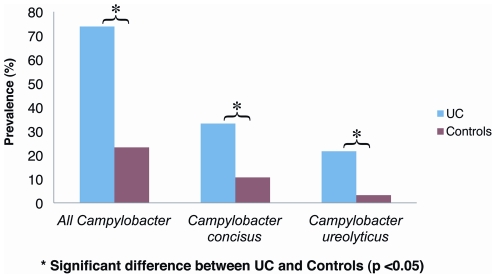
INTRODUCTION: The critical role of bacteria in the pathogenesis of ulcerative colitis (UC) is well recognized, but an individual causative microorganism has not been singled out so far. Campylobacter concisus and other non-jejuni species of Campylobacter have been implicated as putative aetiological agents in inflammatory bowel disease in children, but such studies have not been addressed in adults. This study investigated the prevalence of Campylobacter species in colonic biopsy samples from adults with UC and healthy controls. METHODS: Adult patients who were undergoing diagnostic colonoscopy were recruited for the study, which included 69 patients with histologically proven UC and 65 healthy controls. DNA was extracted from the biopsy samples and subjected to Campylobacter genus specific and Campylobacter concisus specific polymerase chain reaction and sequencing. RESULTS: Detection of all Campylobacter DNA utilising genus specific primers was significantly higher in cases of UC, with a prevalence of 73.9% (51/69) compared to 23.1% (15/65) in controls (p = 0.0001). Nested PCR for C. concisus DNA was positive in 33.3% (23/69) of biopsy samples from subjects with UC, which was significantly higher than the prevalence rate of 10.8% (7/65) from controls (p = 0.0019). Sequencing of the remaining Campylobacter positive samples revealed that Campylobacter ureolyticus was positive in 21.7% (15/69) of samples from UC subjects as opposed to 3.1% (2/65) in controls (p = 0.0013). Mixed Campylobacter species were more common in UC patients, 20.3% (14/69) as compared to controls 4.6% (3/65) (p = 0.0084). CONCLUSION: The higher prevalence of Campylobacter genus and more specifically C. concisus and C. ureolyticus in biopsy samples from adults with UC suggests these genera of bacteria may be involved in the chronic inflammation that is characteristically seen in UC. To the best of our knowledge this is the first report of this association of C. concisus and C. ureolyticus with UC in adults.
Overview
The claims and statistics of this paper haven’t been checked yet.
Run the check — free, no account needed. It reads the open-access text and checks the sources it cites.
Integrity signals
Registry
Cites
Statistics
Figures
Verification
Claims the paper makes
The claims and statistics of this paper haven’t been checked yet.
Run the check — free, no account needed. It reads the open-access text and checks the sources it cites.
Claims other papers make about this one
Each is checked against this paper’s own text: does it say what the citing paper says it does?
In the citing paper
“Changes in the two dominant phyla, Firmicutes and Bacteroidetes, are coupled with an increase in abundance of members of the Proteobacteria phylum, which have been increasingly found to have a key role in IBD.66”
From The gut microbiota and host health: a new clinical frontier (2016) · cites this paper as [66]
Self-check
Percentages, sums and reported differences re-computed from the paper’s own numbers.
The self-check needs the paper’s full text.
Citations
Cites
MEGA4: Molecular Evolutionary Genetics Analysis (MEGA) Software Version 4.0
Tamura, K., Dudley, J. T., Nei, M., & Kumar, S. (2007) · Molecular Biology and Evolution · doi:10.1093/molbev/msm092 · Cited by 28,734
Diversity of the Human Intestinal Microbial Flora
Eckburg, P. B., Bik, E. M., Bernstein, C. N., Purdom, E., Dethlefsen, L., Sargent, M., Gill, S. R., Nelson, K. E., & Relman, D. A. (2005) · Science · doi:10.1126/science.1110591 · Cited by 7,913
The environment and disease: association or causation?
Hill, A. B. (2015) · Journal of the Royal Society of Medicine · doi:10.1177/0141076814562718 · Cited by 7,804
The Environment and Disease: Association or Causation?
Hill, A. B. (1965) · Proceedings of the Royal Society of Medicine · doi:10.1177/003591576505800503 · Cited by 6,974
Silverberg, M. S., Satsangi, J., Ahmad, T., Arnott, I. D., Bernstein, C. N., Brant, S. R., Caprilli, R., Colombel, J., Gasché, C., Geboes, K., et al. (2005) · Canadian Journal of Gastroenterology · doi:10.1155/2005/269076 · Cited by 3,410
Loftus, E. V. (2004) · Gastroenterology · doi:10.1053/j.gastro.2004.01.063 · Cited by 3,106
Guidelines for the management of inflammatory bowel disease in adults
Carter, M. J., Lobo, A. J., & Travis, S. P. L. (2004) · Gut · doi:10.1136/gut.2004.043372 · Cited by 1,084
Epidemiology of pediatric inflammatory bowel disease: A systematic review of international trends
Benchimol, E. I., Fortinsky, K. J., Gozdyra, P., van den Heuvel, M., Limbergen, J. V., & Griffiths, A. M. (2010) · Inflammatory Bowel Diseases · doi:10.1002/ibd.21349 · Cited by 953
Gradel, K. O., Nielsen, H. L., Schønheyder, H. C., Ejlertsen, T., Kristensen, B., & Nielsen, H. (2009) · Gastroenterology · doi:10.1053/j.gastro.2009.04.001 · Cited by 424
Assessment of microbial diversity in human colonic samples by 16S rDNA sequence analysis
Hold, G. L., Pryde, S. E., Russell, V. J., Furrie, E., & Flint, H. J. (2002) · FEMS Microbiology Ecology · doi:10.1111/j.1574-6941.2002.tb00904.x · Cited by 406
Self-citationLinton, D., Owen, R. J., & Stanley, J. (1996) · Research in Microbiology · doi:10.1016/s0923-2508(97)85118-2 · Cited by 363
Engberg, J., On, S. L. W., Harrington, C. S., & Gerner‐Smidt, P. (2000) · Journal of Clinical Microbiology · doi:10.1128/jcm.38.1.286-291.2000 · Cited by 319
Picco, M. F. (2010) · Yearbook of Gastroenterology · doi:10.1016/s0739-5930(09)79399-7 · Cited by 314
Rising incidence of pediatric inflammatory bowel disease in Scotland*
Henderson, P., Hansen, R., Cameron, F., Gerasimidis, K., Rogers, P., Bisset, W. M., Reynish, E. L., Drummond, H. E., Anderson, N., Limbergen, J. V., et al. (2011) · Inflammatory Bowel Diseases · doi:10.1002/ibd.21797 · Cited by 241
Self-citationMan, S. M., Zhang, L., Day, A. S., Leach, S. T., Lemberg, D. A., & Mitchell, H. M. (2009) · Inflammatory Bowel Diseases · doi:10.1002/ibd.21157 · Cited by 183
Campylobacter Species in Health, Gingivitis, and Periodontitis
Macuch, P. J., & Tanner, A. C. R. (2000) · Journal of Dental Research · doi:10.1177/00220345000790021301 · Cited by 167
Increasing incidence of both juvenile-onset Crohn's disease and ulcerative colitis in Scotland
Armitage, E. L., Drummond, H. E., Wilson, D. C., & Ghosh, S. K. (2001) · European Journal of Gastroenterology & Hepatology · doi:10.1097/00042737-200112000-00007 · Cited by 159
Enteric Salmonella or Campylobacter infections and the risk of inflammatory bowel disease
Jess, T., Simonsen, J., Nielsen, N. M., Jørgensen, K. T., Bager, P., Ethelberg, S., & Frisch, M. (2010) · Gut · doi:10.1136/gut.2010.223396 · Cited by 154
Zhang, L., Man, S. M., Day, A. S., Leach, S. T., Lemberg, D. A., Dutt, S., Stormon, M., Otley, A. R., O'Loughlin, E. V., Magoffin, A., et al. (2008) · Journal of Clinical Microbiology · doi:10.1128/jcm.01949-08 · Cited by 145
Marshall, S. M., Melito, P. L., Woodward, D. L., Johnson, W. M., Rodgers, F. G., & Mulvey, M. R. (1999) · Journal of Clinical Microbiology · doi:10.1128/jcm.37.12.4158-4160.1999 · Cited by 137
Enterohepatic Helicobacter in Ulcerative Colitis: Potential Pathogenic Entities?
Thomson, J., Hansen, R., Berry, S. H., Hope, M. E., Murray, G. I., Mukhopadhya, I., McLean, M. H., Shen, Z., Fox, J. G., El-Omar, E. M., et al. (2011) · PLoS ONE · doi:10.1371/journal.pone.0017184 · Cited by 130
Self-citationThe role of infection in the aetiology of inflammatory bowel disease
Hansen, R., Thomson, J., El-Omar, E. M., & Hold, G. L. (2010) · Journal of Gastroenterology · doi:10.1007/s00535-009-0191-y · Cited by 127
Self-citationMomozawa, Y., Deffontaine, V., Louis, E. J., & Medrano, J. F. F. (2011) · PLoS ONE · doi:10.1371/journal.pone.0016952 · Cited by 127
Man, S. M., Kaakoush, N. O., Leach, S. T., Nahidi, L., Lu, H. K., Norman, J. M., Day, A. S., Zhang, L., & Mitchell, H. M. (2010) · The Journal of Infectious Diseases · doi:10.1086/657316 · Cited by 117
Saitoh, S. I., Noda, S., Aiba, Y., Takagi, A., Sakamoto, M., Benno, Y., & Koga, Y. (2002) · Clinical and Vaccine Immunology · doi:10.1128/cdli.9.1.54-59.2002 · Cited by 89
Vandamme, P. A. R., Debruyne, L., Brandt, E. D., & Falsen, E. (2009) · INTERNATIONAL JOURNAL OF SYSTEMATIC AND EVOLUTIONARY MICROBIOLOGY · doi:10.1099/ijs.0.017152-0 · Cited by 84
Bohr, U. R. M., Glasbrenner, B., Primus, A., Zagoura, A., Wex, T., & Malfertheiner, P. (2004) · Journal of Clinical Microbiology · doi:10.1128/jcm.42.6.2766-2768.2004 · Cited by 83
Zhang, L., Budiman, V., Day, A. S., Mitchell, H. M., Lemberg, D. A., Riordan, S. M., Grimm, M., Leach, S. T., & Ismail, Y. (2010) · Journal of Clinical Microbiology · doi:10.1128/jcm.02391-09 · Cited by 81
IBD Around the world: Comparing the epidemiology, diagnosis, and treatment
Baumgart, D. C., Bernstein, C. N., Abbas, Z., Colombel, J. F., Day, A. S., D’Haens, G., Dotan, I., Goh, K., Hibi∥, T., Kozarek, R. A., et al. (2010) · Inflammatory Bowel Diseases · doi:10.1002/ibd.21409 · Cited by 77
Kalischuk, L. D., & Inglis, G. D. (2011) · BMC Microbiology · doi:10.1186/1471-2180-11-53 · Cited by 68
Campylobacter concisus: an evaluation of certain phenotypic and genotypic characteristics
Engberg, J., Bang, D. D., Aabenhus, R. M., Aarestrup, F. M., Fussing, V., & Gerner‐Smidt, P. (2005) · Clinical Microbiology and Infection · doi:10.1111/j.1469-0691.2005.01111.x · Cited by 56
Aabenhus, R. M., On, S. L. W., Siemer, B. L., Permin, H., & Andersen, L. P. (2005) · Journal of Clinical Microbiology · doi:10.1128/jcm.43.10.5091-5096.2005 · Cited by 56
Prevalence of Campylobacter concisus in Diarrhoea of Immunocompromised Patients
Aabenhus, R. M., Permin, H., On, S. L. W., & Andersen, L. P. (2002) · Scandinavian Journal of Infectious Diseases · doi:10.1080/00365540110080566 · Cited by 55
齊藤, 真. (2002) · Medical Entomology and Zoology · Cited by 54
Campylobacter ureolyticus:an emerging gastrointestinal pathogen?
Bullman, S., Corcoran, G. D., O'Leary, J., Lucey, B., Byrne, D., & Sleator, R. D. (2010) · FEMS Immunology & Medical Microbiology · doi:10.1111/j.1574-695x.2010.00760.x · Cited by 49
The Bowel Microbiota and Inflammatory Bowel Diseases
Tannock, G. W. (2010) · International Journal of Inflammation · doi:10.4061/2010/954051 · Cited by 49
Clinical Relevance of Campylobacter concisus Isolated from Pediatric Patients
Lastovica, A. J. (2009) · Journal of Clinical Microbiology · doi:10.1128/jcm.00568-09 · Cited by 33
Characterization ofCampylobacter concisushemolysins
Istivan, T. S., Smith, S. C., Fry, B. N., & Coloe, P. J. (2008) · FEMS Immunology & Medical Microbiology · doi:10.1111/j.1574-695x.2008.00467.x · Cited by 27
A Comparison of Bacteroides ureolyticus isolates from different clinical sources
Duerden, B. I., Eley, A., Goodwin, L., Magee, J. T., Hindmarch, J. M., & Bennett, K. W. (1989) · Journal of Medical Microbiology · doi:10.1099/00222615-29-1-63 · Cited by 25
Changing Patterns of Human Campylobacteriosis, England and Wales, 1990–2007
Gillespie, I. A., O’Brien, S. J., & Bolton, F. J. (2009) · Emerging infectious diseases · doi:10.3201/eid1512.090280 · Cited by 21
Sonnenberg, A. (2009) · European Journal of Gastroenterology & Hepatology · doi:10.1097/meg.0b013e32832e9d54 · Cited by 8
Anaerobic bacteria and non-gonococcal urethritis
Woolley, P. D. (2000) · International Journal of STD & AIDS · doi:10.1258/0956462001915976 · Cited by 6
Cited by
Sorted by citations
The gut microbiota and host health: a new clinical frontier
Marchesi, J. R., Adams, D. H., Fava, F., Hermes, G. D. A., Hirschfield, G. M., Hold, G., Quraishi, M. N., Kinross, J., Smidt, H., Tuohy, K. M., et al. (2016) · Gut · doi:10.1136/gutjnl-2015-309990 · Cited by 2,302
“66 Studies have shown a shift towards an increase in species belonging to this phylum, suggesting an aggressor role in the initiation of chronic in fl ammation in patients with IBD.”
BackgroundSelf-citationTherapeutic Peptides: Current Applications and Future Directions
Wang, L., Wang, N., Zhang, W., Cheng, X., Yan, Z., Shao, G., Wang, X., Wang, R., & Fu, C. (2022) · Signal Transduction and Targeted Therapy · doi:10.1038/s41392-022-00904-4 · Cited by 2,131
Global Epidemiology of Campylobacter Infection
Kaakoush, N. O., Castaño‐Rodríguez, N., Mitchell, H. M., & Man, S. M. (2015) · Clinical Microbiology Reviews · doi:10.1128/cmr.00006-15 · Cited by 1,542
IBD—what role do Proteobacteria play?
Mukhopadhya, I., Hansen, R., El-Omar, E. M., & Hold, G. L. (2012) · Nature Reviews Gastroenterology & Hepatology · doi:10.1038/nrgastro.2012.14 · Cited by 810
Self-citationThe clinical importance of emerging Campylobacter species
Man, S. M. (2011) · Nature Reviews Gastroenterology & Hepatology · doi:10.1038/nrgastro.2011.191 · Cited by 502
Metadata
- Authors
- Mukhopadhya, I., Thomson, J. M., Hansen, R., Berry, S. H., El-Omar, E. M., & Hold, G. L.
- Affiliations
- University of Aberdeen (GB)
- Corresponding author
- Hold, Georgina L.
- Venue
- PLoS ONE
- Publisher
- Public Library of Science (PLoS)
- Published
- 2011-06-27
- Volume
- 6
- Issue
- 6
- Pages
- e21490
- ISSN
- 1932-6203 (ISSN-L)
- PMC
- PMC3124515
- OpenAlex
- W2100955999
- Cited by
- 145
- References
- 42
- Citations by year
- 2026: 1 · 2025: 7 · 2024: 8 · 2023: 4 · 2022: 11 · 2021: 9 · 2020: 8 · 2019: 8 · 2018: 12 · 2017: 7 · 2016: 13 · 2015: 14 · 2014: 15 · 2013: 12 · 2012: 12
- FWCI
- 8.58
- Type
- journal article
- Language
- en
- Open access
- gold
- doi.org
- Locations
- PLoS ONE (publishedVersion, cc-by)
- Europe PMC (PubMed Central) (publishedVersion, cc-by)
- PubMed Central (publishedVersion, cc-by)
- PubMed (publishedVersion)
- Discovery Research Portal (University of Dundee) (publishedVersion, other-oa)
- ENLIGHTEN (Jurnal Bimbingan dan Konseling Islam) (acceptedVersion)
- UNSWorks (University of New South Wales, Sydney, Australia) (submittedVersion, cc-by-nc-nd)
- UNSWorks (UNSW Sydney) (submittedVersion, cc-by-nc-nd)
- Aberdeen University Research Archive (Aberdeen University) (submittedVersion)
- DOAJ (DOAJ: Directory of Open Access Journals) (submittedVersion, cc-by-sa)
- Topics
- Health Sciences › Medicine › Gastroenterology › Inflammatory Bowel Disease
- Life Sciences › Agricultural and Biological Sciences › Food Science › Salmonella and Campylobacter epidemiology
- Life Sciences › Biochemistry, Genetics and Molecular Biology › Molecular Biology › Gut microbiota and health
- Keywords
- Campylobacter concisus, Campylobacter ureolyticus, ulcerative colitis, colonic biopsy, inflammatory bowel disease, bacterial etiology, adults, chronic inflammation, prevalence, nested PCR, DNA detection
- MeSH terms
- Adult, Campylobacter, Campylobacter Infections, Colitis, Ulcerative, Colon, Humans, Molecular Sequence Data, Polymerase Chain Reaction
About these checks
Registry, retraction, Cites and statistics results are computed, not judged, with one exception: a printed reference that no index lists is read once by a model before it counts as a citation error. Claims are extracted by a model and kept only when their quote appears verbatim in the text; each cited source is then checked, with a model’s help, for whether it says what the claim relies on. Those verdicts can be wrong — read the claim’s quote and the cited source before relying on one.
Statistics and arithmetic are recomputed, not judged.
Confidence bands are shown only for fields calibrated on our annotated test set. None is calibrated yet, so no band is shown.
What counts as a claim ›How we measure confidence ›How we check this ›
Are you an author, or do you see a problem with this page? Request a review
