

Srv Mediated Dispersal of Streptococcal Biofilms Through SpeB Is Observed in CovRS+ Strains
Open accessThe DOI matches its Crossref record; 56 of the 56 references it cites were found in a registry or an index.
Abstract
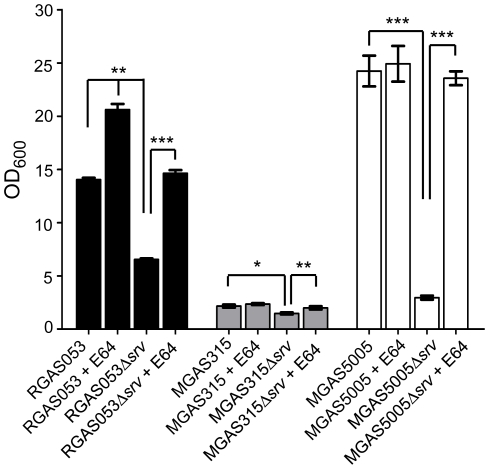
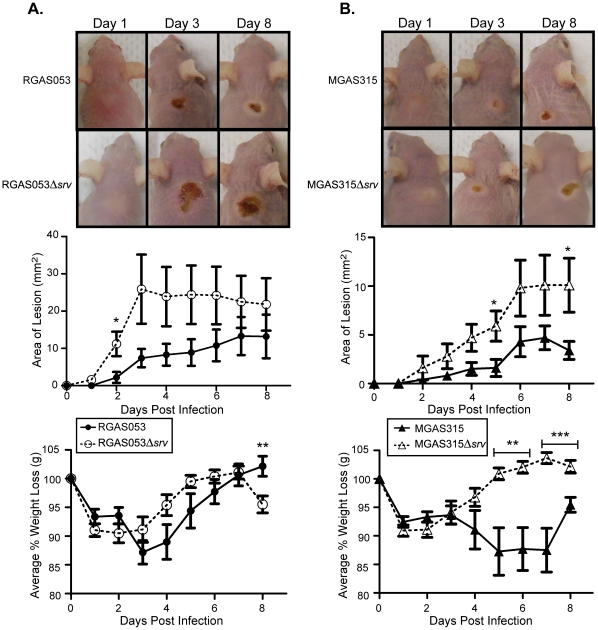
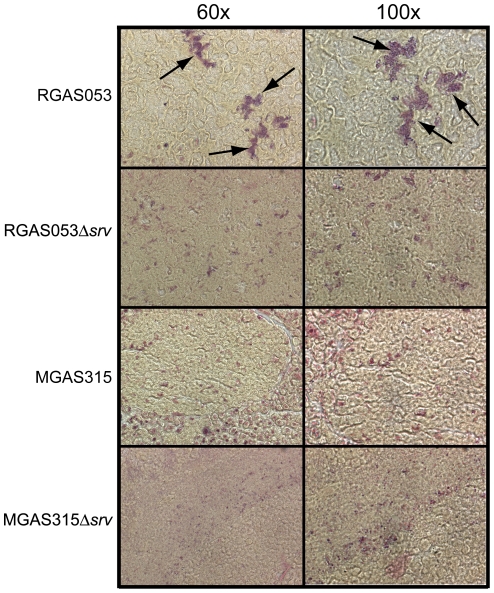
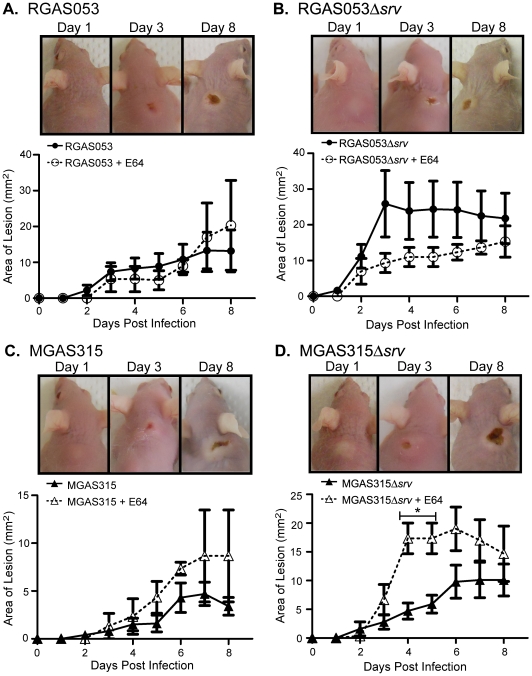
Group A Streptococcus (GAS) is a human specific pathogen capable of causing both mild infections and severe invasive disease. We and others have shown that GAS is able to form biofilms during infection. That is to say, they form a three-dimensional, surface attached structure consisting of bacteria and a multi-component extracellular matrix. The mechanisms involved in regulation and dispersal of these GAS structures are still unclear. Recently we have reported that in the absence of the transcriptional regulator Srv in the MGAS5005 background, the cysteine protease SpeB is constitutively produced, leading to increased tissue damage and decreased biofilm formation during a subcutaneous infection in a mouse model. This was interesting because MGAS5005 has a naturally occurring mutation that inactivates the sensor kinase domain of the two component regulatory system CovRS. Others have previously shown that strains lacking covS are associated with decreased SpeB production due to CovR repression of speB expression. Thus, our results suggest the inactivation of srv can bypass CovR repression and lead to constitutive SpeB production. We hypothesized that Srv control of SpeB production may be a mechanism to regulate biofilm dispersal and provide a mechanism by which mild infection can transition to severe disease through biofilm dispersal. The question remained however, is this mechanism conserved among GAS strains or restricted to the unique genetic makeup of MGAS5005. Here we show that Srv mediated control of SpeB and biofilm dispersal is conserved in the invasive clinical isolates RGAS053 (serotype M1) and MGAS315 (serotype M3), both of which have covS intact. This work provides additional evidence that Srv regulated control of SpeB may mediate biofilm formation and dispersal in diverse strain backgrounds.
Overview
The claims and statistics of this paper haven’t been checked yet.
Free: it reads the open-access text and checks the first 5 claims that cite a source we can check. Create a free account to check every claim.
Integrity signals
Registry
Cites
Statistics
Figures
Verification
Claims the paper makes
The claims and statistics of this paper haven’t been checked yet.
Free: it reads the open-access text and checks the first 5 claims that cite a source we can check. Create a free account to check every claim.
Self-check
Percentages, sums and reported differences re-computed from the paper’s own numbers.
The self-check needs the paper’s full text.
Citations
Cites
Biofilms: Survival Mechanisms of Clinically Relevant Microorganisms
Donlan, R. M., & Costerton, J. W. (2002) · Clinical Microbiology Reviews · doi:10.1128/cmr.15.2.167-193.2002 · Cited by 6,644 · cited 1×
“Generally, a bacterial biofilm has been defined as a bacterial sessile community encased in an extracellular matrix that is attached to a substratum or interface [39].”
BackgroundThe global burden of group A streptococcal diseases
Carapetis, J. R., Steer, A. C., Mulholland, E. K., & Weber, M. (2005) · The Lancet Infectious Diseases · doi:10.1016/s1473-3099(05)70267-x · Cited by 2,998 · cited 1×
“span a broad spectrum of clinical severity, from mild to severe [1].”
BackgroundQuantification of biofilm structures by the novel computer program comstat
Heydorn, A., Nielsen, A. T., Hentzer, M., Sternberg, C., Givskov, M., Ersbøll, B. K., & Molin, S. (2000) · Microbiology · doi:10.1099/00221287-146-10-2395 · Cited by 2,179
Wolfe, A. J. (2005) · Microbiology and Molecular Biology Reviews · doi:10.1128/mmbr.69.1.12-50.2005 · Cited by 1,233 · cited 13×
“GAS strains lacking covS, such as MGAS5005, continue to have speB repressed by CovR [19,28,29].”
BackgroundInfluentialDubnau, D., & Losick, R. (2006) · Molecular Microbiology · doi:10.1111/j.1365-2958.2006.05249.x · Cited by 726 · cited 13×
“GAS strains lacking covS, such as MGAS5005, continue to have speB repressed by CovR [19,28,29].”
BackgroundInfluentialBeres, S. B., Sylva, G. L., Barbian, K. D., Lei, B., Hoff, J. S., Mammarella, N. D., Liu, M.-Y., Smoot, J. C., Porcella, S. F., Parkins, L. D., et al. (2002) · Proceedings of the National Academy of Sciences · doi:10.1073/pnas.152298499 · Cited by 499 · cited 1×
“MGAS315 is a M3 serotype strain isolated from a case of GAS toxic shock syndrome in the late 1980’s and has been well characterized [4,44,45,46,47].”
BackgroundSumby, P., Whitney, A. R., Graviss, E. A., DeLeo, F. R., & Musser, J. M. (2006) · PLoS Pathogens · doi:10.1371/journal.ppat.0020005 · Cited by 459
DNase Sda1 provides selection pressure for a switch to invasive group A streptococcal infection
Walker, M. J., Hollands, A., Sanderson-Smith, M. L., Cole, J. N., Kirk, J. K., Henningham, A., McArthur, J. D., Dinkla, K., Aziz, R. K., Kansal, R. G., et al. (2007) · Nature Medicine · doi:10.1038/nm1612 · Cited by 426 · cited 4×
“prevents the degradation of the secreted virulence factors Sdn and Sla that are associated with the increased severity of invasive disease characteristic of this strain [13,52,53].”
BackgroundInfluentialMusser, J. M., Hauser, A. R., Kim, M. H., Schlievert, P. M., Nelson, K., & Selander, R. K. (1991) · Proceedings of the National Academy of Sciences · doi:10.1073/pnas.88.7.2668 · Cited by 421 · cited 4×
“MGAS315 is a M3 serotype strain isolated from a case of GAS toxic shock syndrome in the late 1980’s and has been well characterized [4,44,45,46,47].”
BackgroundInfluentialHoge, C. W. (1993) · JAMA · doi:10.1001/jama.269.3.384 · Cited by 406 · cited 1×
“15,000 cases of invasive GAS infections annually, including cases of necrotizing fasciitis and toxic shock syndrome, with a mortality rate of ,10% [2,3].”
Background
Cited by
Sulfur(VI) Fluoride Exchange (SuFEx)-Enabled High-Throughput Medicinal Chemistry
Kitamura, S., Zheng, Q., Woehl, J. L., Solania, A., Chen, E., Dillon, N., Hull, M. V., Kotaniguchi, M., Cappiello, J. R., Kitamura, S., et al. (2020) · Journal of the American Chemical Society · doi:10.1021/jacs.9b13652 · Cited by 209
Streptococcus pyogenes biofilms—formation, biology, and clinical relevance
Fiedler, T., Köller, T., & Kreikemeyer, B. (2015) · Frontiers in Cellular and Infection Microbiology · doi:10.3389/fcimb.2015.00015 · Cited by 107
“However, it has to be kept in mind that the data discussed here are all based on in vitro experiments that most likely only poorly resemble the in vivo situation.”
BackgroundInfluentialA Histone Deacetylase Complex Mediates Biofilm Dispersal and Drug Resistance in Candida albicans
Nobile, C. J., Fox, E. P., Hartooni, N., Mitchell, K. F., Hnisz, D., Andes, D. R., Kuchler, K., & Johnson, A. D. (2014) · mBio · doi:10.1128/mbio.01201-14 · Cited by 87
Deciphering Streptococcal Biofilms
Yadav, P., Verma, S., Bauer, R., Kumari, M., Dua, M., Johri, A. K., Yadav, V., & Spellerberg, B. (2020) · Microorganisms · doi:10.3390/microorganisms8111835 · Cited by 64
Global Analysis and Comparison of the Transcriptomes and Proteomes of Group A Streptococcus Biofilms
Freiberg, J. A., Breton, Y. S. L., Tran, B. Q., Scott, A. J., Harro, J. M., Ernst, R. K., Goo, Y. A., Mongodin, E. F., Goodlett, D. R., McIver, K. S., et al. (2016) · mSystems · doi:10.1128/msystems.00149-16 · Cited by 39
Metadata
- Authors
- Connolly, K. L., Braden, A. K., Holder, R. C., & Reid, S. D.
- Affiliations
- Wake Forest University Health Sciences (US)
- Corresponding author
- Reid, Sean D.
- Venue
- PLoS ONE
- Publisher
- Public Library of Science (PLoS)
- Published
- 2011-12-07
- Volume
- 6
- Issue
- 12
- Pages
- e28640
- ISSN
- 1932-6203 (ISSN-L)
- PMC
- PMC3233586
- OpenAlex
- W2021836633
- Cited by
- 20
- References
- 56
- Citations by year
- 2021: 1 · 2020: 4 · 2019: 1 · 2018: 1 · 2017: 1 · 2016: 5 · 2015: 4 · 2014: 3
- FWCI
- 0.94
- Type
- journal article
- Language
- en
- Open access
- gold
- doi.org
- Licence
- Locations
- PLoS ONE (publishedVersion, public-domain)
- Europe PMC (PubMed Central) (publishedVersion, public-domain)
- PubMed Central (publishedVersion, public-domain)
- PubMed (publishedVersion)
- DOAJ (DOAJ: Directory of Open Access Journals) (submittedVersion, cc-by-sa)
- Funders
- American Heart Association
- Carestream Health
- Wake Forest University
- National Institutes of Health
- National Institute of Allergy and Infectious Diseases (R01AI063453)
- Topics
- Health Sciences › Medicine › Infectious Diseases › Streptococcal Infections and Treatments
- Life Sciences › Biochemistry, Genetics and Molecular Biology › Molecular Biology › Bacterial biofilms and quorum sensing
- Life Sciences › Biochemistry, Genetics and Molecular Biology › Molecular Biology › Biochemical and Structural Characterization
- Keywords
- Streptococcus pyogenes, biofilm dispersal, biofilm formation, invasive streptococcal infection, M1 serotype, extracellular matrix
- MeSH terms
- Animals, Bacterial Proteins, Cell Adhesion, Exotoxins, Female, Gene Expression Regulation, Gentian Violet, Mice, Hairless, Mutation, Stem Cells, Streptococcal Infections, Streptococcus pyogenes, Time Factors, Transcription Factors, Virulence, Gene Expression Regulation, Bacterial, Protein Structure, Tertiary, Biofilms, Mice, Cysteine Proteases
About these checks
Registry, retraction, Cites and statistics results are computed, not judged, with one exception: a printed reference that no index lists is read once by a model before it counts as a citation error. Claims are extracted by a model and kept only when their quote appears verbatim in the text; each cited source is then checked, with a model’s help, for whether it says what the claim relies on. Those verdicts can be wrong — read the claim’s quote and the cited source before relying on one.
Statistics and arithmetic are recomputed, not judged.
Confidence bands are shown only for fields calibrated on our annotated test set. None is calibrated yet, so no band is shown.
What counts as a claim ›How we measure confidence ›How we check this ›
Are you an author, or do you see a problem with this page? Request a review
How to cite
Cite CoChat for the checks on this page, and the paper for its own findings.
- This page
- CoChat. (2026). Citation check: Srv Mediated Dispersal of Streptococcal Biofilms Through SpeB Is Observed in CovRS+ Strains. https://app.cochat.ai/papers/10.1371/journal.pone.0028640
- The paper
- Connolly, K. L., Braden, A. K., Holder, R. C., & Reid, S. D. (2011). Srv Mediated Dispersal of Streptococcal Biofilms Through SpeB Is Observed in CovRS+ Strains. PLoS ONE. https://doi.org/10.1371/journal.pone.0028640
Data sources
Bibliographic data: Semantic Scholar, OpenAlex, Crossref.
Contains information from the Semantic Scholar Academic Graph Datasets, made available under the ODC Attribution License (ODC-BY 1.0).
Semantic Scholar’s data is described in: Kinney, R., et al. (2023). The Semantic Scholar Open Data Platform. arXiv:2301.10140.
