

The DOI matches its Crossref record; 28 of the 28 references it cites were found in a registry or an index.
Conductive Polymer Combined Silk Fiber Bundle for Bioelectrical Signal Recording
Open accessAbstract
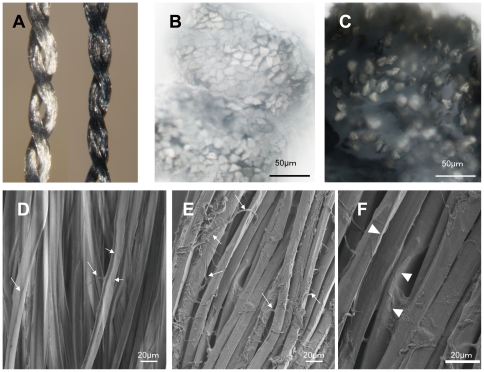
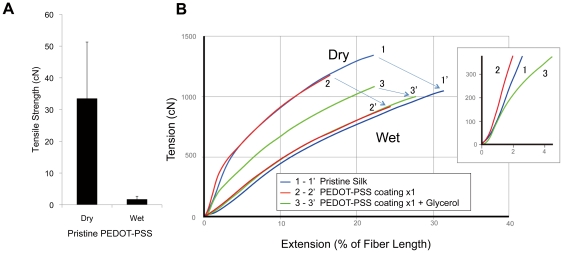
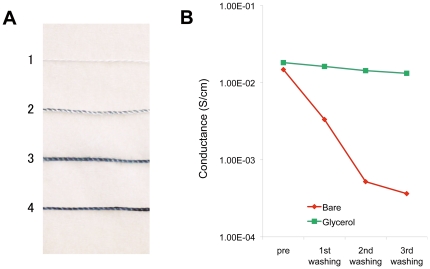
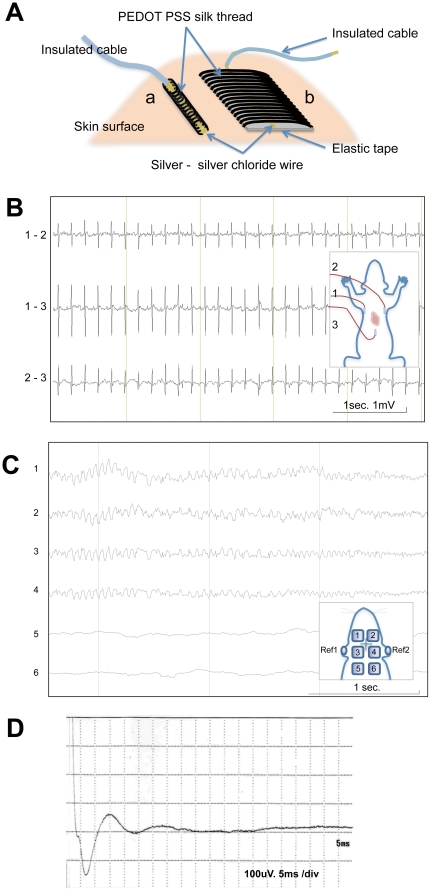
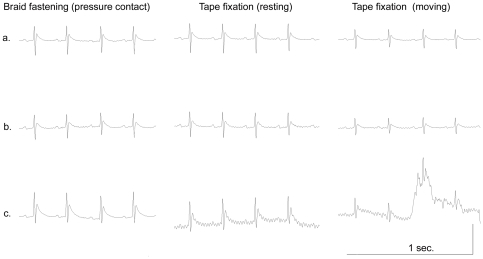
Electrode materials for recording biomedical signals, such as electrocardiography (ECG), electroencephalography (EEG) and evoked potentials data, are expected to be soft, hydrophilic and electroconductive to minimize the stress imposed on living tissue, especially during long-term monitoring. We have developed and characterized string-shaped electrodes made from conductive polymer with silk fiber bundles (thread), which offer a new biocompatible stress free interface with living tissue in both wet and dry conditions.An electroconductive polyelectrolyte, poly(3,4-ethylenedioxythiophene)-poly(styrenesulfonate) (PEDOT-PSS) was electrochemically combined with silk thread made from natural Bombyx mori. The polymer composite 280 µm thread exhibited a conductivity of 0.00117 S/cm (which corresponds to a DC resistance of 2.62 Mohm/cm). The addition of glycerol to the PEDOT-PSS silk thread improved the conductivity to 0.102 S/cm (20.6 kohm/cm). The wettability of PEDOT-PSS was controlled with glycerol, which improved its durability in water and washing cycles. The glycerol treated PEDOT-PSS silk thread showed a tensile strength of 1000 cN in both wet and dry states. Without using any electrolytes, pastes or solutions, the thread directly collects electrical signals from living tissue and transmits them through metal cables. ECG, EEG, and sensory evoked potential (SEP) signals were recorded from experimental animals by using this thread placed on the skin. PEDOT-PSS silk glycerol composite thread offers a new class of biocompatible electrodes in the field of biomedical and health promotion that does not induce stress in the subjects.
Overview
The claims and statistics of this paper haven’t been checked yet.
Run the check — free, no account needed. It reads the open-access text and checks the sources it cites.
Integrity signals
Registry
Cites
Statistics
Figures
Verification
Claims the paper makes
The claims and statistics of this paper haven’t been checked yet.
Run the check — free, no account needed. It reads the open-access text and checks the sources it cites.
Self-check
Percentages, sums and reported differences re-computed from the paper’s own numbers.
The self-check needs the paper’s full text.
Citations
Cites
Dissolvable films of silk fibroin for ultrathin conformal bio-integrated electronics
Kim, D.-H., Viventi, J., Amsden, J. J., Xiao, J., Vigeland, L., Kim, Y.-S., Blanco, J. A., Panilaitis, B., Frechette, E. S., Contreras, D., et al. (2010) · Nature Materials · doi:10.1038/nmat2745 · Cited by 1,721
Kim, Y. H., Sachse, C., Machala, M. L., May, C., Müller‐Meskamp, L., & Leo, K. (2011) · Advanced Functional Materials · doi:10.1002/adfm.201002290 · Cited by 1,498
Mechanism of silk processing in insects and spiders
Jin, H., & Kaplan, D. L. (2003) · Nature · doi:10.1038/nature01809 · Cited by 1,391
KIM, J. Y., Jung, J.-H., Lee, D. E., & Joo, J. S. (2002) · Synthetic Metals · doi:10.1016/s0379-6779(01)00576-8 · Cited by 1,101
Poly(alkylenedioxythiophene)s—new, very stable conducting polymers
Heywang, G., & Jonas, F. (1992) · Advanced Materials · doi:10.1002/adma.19920040213 · Cited by 1,054
Mechanical properties of brain tissue in tension
Miller, K., & Chinzei, K. (2002) · Journal of Biomechanics · doi:10.1016/s0021-9290(01)00234-2 · Cited by 636
Richardson-Burns, S. M., Hendricks, J. L., Foster, B., Povlich, L. K., Kim, D., & Martin, D. C. (2006) · Biomaterials · doi:10.1016/j.biomaterials.2006.11.026 · Cited by 505
Polymer Photovoltaic Cells with Conducting Polymer Anodes
Zhang, F., Johansson, M., Andersson, M. R., Hummelen, J. C., & Inganäs, O. (2002) · Advanced Materials · doi:10.1002/1521-4095(20020503)14:9 · Cited by 501
Mechanical characterization of PEDOT:PSS thin films
Lang, U., Naujoks, N., & Dual, J. (2008) · Synthetic Metals · doi:10.1016/j.synthmet.2008.11.005 · Cited by 366
Molecular organic light-emitting diodes using highly conducting polymers as anodes
Kim, W. H., Mäkinen, A. J., Nikolov, N., Shashidhar, R., Kim, H., & Kafafi, Z. H. (2002) · Applied Physics Letters · doi:10.1063/1.1480100 · Cited by 339
Cited by
Sorted by citations
Current and Novel Polymeric Biomaterials for Neural Tissue Engineering
Boni, R., Ali, A., Shavandi, A., & Clarkson, A. N. (2018) · Journal of Biomedical Science · doi:10.1186/s12929-018-0491-8 · Cited by 439
Heart Rate Variability-Based Driver Drowsiness Detection and Its Validation With EEG
Fujiwara, K., Abe, E., Kamata, K., Nakayama, C., Suzuki, Y., Yamakawa, T., Hiraoka, T., Kano, M., Sumi, Y., Masuda, F., et al. (2018) · IEEE Transactions on Biomedical Engineering · doi:10.1109/tbme.2018.2879346 · Cited by 271
Machine-Washable PEDOT:PSS Dyed Silk Yarns for Electronic Textiles
Ryan, J. D., Mengistie, D. A., Gabrielsson, R., Lund, A., & Müller, C. (2017) · ACS Applied Materials & Interfaces · doi:10.1021/acsami.7b00530 · Cited by 245
Natural fiber reinforced conductive polymer composites as functional materials: A review
AL-Oqla, F. M., Sapuan, S. M., Anwer, T., Jawaid, M., & Hoque, M. E. (2015) · Synthetic Metals · doi:10.1016/j.synthmet.2015.04.014 · Cited by 228
Silva, N. H. C. S., Vilela, C., Marrucho, I. M., Freire, C. S. R., Neto, C. P., & Silvestre, A. J. D. (2014) · Journal of Materials Chemistry B · doi:10.1039/c4tb00168k · Cited by 206
Metadata
- Authors
- Tsukada, S., Nakashima, H., & Torimitsu, K.
- Affiliations
- NTT (Japan) (JP)
- Corresponding author
- Tsukada, Shingo
- Venue
- PLoS ONE
- Publisher
- Public Library of Science (PLoS)
- Published
- 2012-04-06
- Volume
- 7
- Issue
- 4
- Pages
- e33689
- ISSN
- 1932-6203 (ISSN-L)
- PMC
- PMC3320891
- OpenAlex
- W2084865356
- Cited by
- 163
- References
- 28
- Citations by year
- 2026: 2 · 2025: 5 · 2024: 7 · 2023: 10 · 2022: 15 · 2021: 22 · 2020: 9 · 2019: 17 · 2018: 16 · 2017: 20 · 2016: 9 · 2015: 17 · 2014: 7 · 2013: 5 · 2012: 2
- FWCI
- 7.80
- Type
- journal article
- Language
- en
- Open access
- gold
- doi.org
- Locations
- PLoS ONE (publishedVersion, cc-by)
- PubMed Central (publishedVersion, cc-by)
- PubMed (publishedVersion)
- DOAJ (DOAJ: Directory of Open Access Journals) (submittedVersion, cc-by-sa)
- Topics
- Physical Sciences › Materials Science › Polymers and Plastics › Conducting polymers and applications
- Life Sciences › Neuroscience › Cellular and Molecular Neuroscience › Neuroscience and Neural Engineering
- Physical Sciences › Engineering › Biomedical Engineering › Advanced Sensor and Energy Harvesting Materials
- Keywords
- conducting polymers, PEDOT:PSS, biocompatible electrodes, electrocardiogram, EEG, sensory evoked potentials, glycerol additive, wettability, tensile strength, skin electrodes, long-term monitoring
- MeSH terms
- Animals, Biocompatible Materials, Electric Conductivity, Electrocardiography, Electrodes, Electroencephalography, Evoked Potentials, Somatosensory, Glycerol, Humans, Microscopy, Electron, Scanning, Polystyrenes, Bombyx, Tensile Strength, Thiophenes, Water, Wettability, Rats, Sprague-Dawley, Silk, Rats, Electrochemical Techniques
About these checks
Registry, retraction, Cites and statistics results are computed, not judged, with one exception: a printed reference that no index lists is read once by a model before it counts as a citation error. Claims are extracted by a model and kept only when their quote appears verbatim in the text; each cited source is then checked, with a model’s help, for whether it says what the claim relies on. Those verdicts can be wrong — read the claim’s quote and the cited source before relying on one.
Statistics and arithmetic are recomputed, not judged.
Confidence bands are shown only for fields calibrated on our annotated test set. None is calibrated yet, so no band is shown.
What counts as a claim ›How we measure confidence ›How we check this ›
Are you an author, or do you see a problem with this page? Request a review
