

Developmental Trajectories of Resting EEG Power: An Endophenotype of Autism Spectrum Disorder
Open accessThe DOI matches its Crossref record; 84 of the 84 references it cites were found in a registry or an index.
Abstract
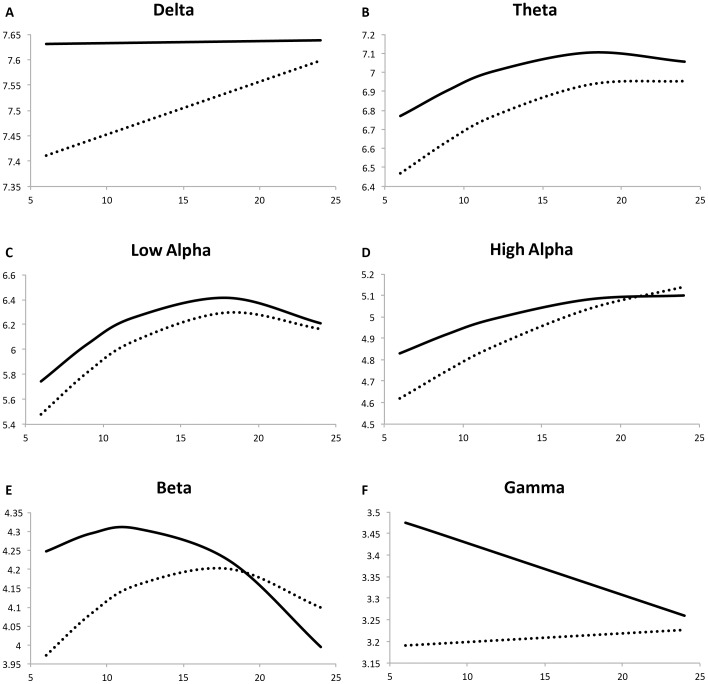
Current research suggests that autism spectrum disorder (ASD) is characterized by asynchronous neural oscillations. However, it is unclear whether changes in neural oscillations represent an index of the disorder or are shared more broadly among both affected and unaffected family members. Additionally, it remains unclear how early these differences emerge in development and whether they remain constant or change over time. In this study we examined developmental trajectories in spectral power in infants at high- or low-risk for ASD. Spectral power was extracted from resting EEG recorded over frontal regions of the scalp when infants were 6, 9, 12, 18 and 24 months of age. We used multilevel modeling to assess change over time between risk groups in the delta, theta, low alpha, high alpha, beta, and gamma frequency bands. The results indicated that across all bands, spectral power was lower in high-risk infants as compared to low-risk infants at 6-months of age. Furthermore high-risk infants showed different trajectories of change in spectral power in the subsequent developmental window indicating that not only are the patterns of change different, but that group differences are dynamic within the first two years of life. These findings remained the same after removing data from a subset of participants who displayed ASD related behaviors at 24 or 36 months. These differences in the nature of the trajectories of EEG power represent important endophenotypes of ASD.
Overview
The claims and statistics of this paper haven’t been checked yet.
Free: it reads the open-access text and checks the first 5 claims that cite a source we can check. Create a free account to check every claim.
Integrity signals
Registry
Cites
Statistics
Figures
Verification
Claims the paper makes
The claims and statistics of this paper haven’t been checked yet.
Free: it reads the open-access text and checks the first 5 claims that cite a source we can check. Create a free account to check every claim.
Claims other papers make about this one
Each is checked against this paper’s own text: does it say what the citing paper says it does?
The cited source says what the claim attributes to it.
In the citing paper
“Furthermore, EEG spectral power has been suggested as a marker to differentiate between low- and high-risk ASD infants at 6 months of age (Tierney et al. 2012), as well as a marker of disease severity in girls with Rett syndrome (Roche et al. 2019).”
From Autism Spectrum Disorder and auditory sensory alterations: a systematic review on the integrity of cognitive and neuronal functions related to auditory processing (2023) · cites this paper as Tierney et al. 2012
The check wasn’t confident either way, so it gives no verdict — never disputed.
In the citing paper
“One theory proposing a specific failure in ASD of the ability of the brain to ' mirror ' observed actions of another person (thereby named the 'broken mirror' theory ) was based on altered μ -wave suppression in ASD 93 but was later questioned both theoretically 94,95 and empirically 96,97 , pointing toward a more complex picture of dysfunctional executive functions and visual attention 98”
From Autism spectrum disorder (2020) · cites this paper as [96]
Experimental — accuracy not yet measuredIn the citing paper
“For example, at 6 months of age, high-risk infants show reduced frontal EEG power across all frequency bands compared to low-risk infants [20].”
From EEG power at 3 months in infants at high familial risk for autism (2017) · cites this paper as [20]
In the citing paper
“At 3 months, we see reduced average-referenced, binned frontal power in high-risk infants only in the high alpha and beta bands, whereas a prior study suggested that by 6 months, this pattern is seen across all frequency bands [20].”
From EEG power at 3 months in infants at high familial risk for autism (2017) · cites this paper as [20]
In the citing paper
“Differences in patterns of head growth 29 and aberrant white matter organization 30 have been occurred in some cases during the first year of life, and differences in event-related potential to face processing 31 and in electroencephalographic activity 32 have been detected at as early as 6-10 months of age.”
From Progress toward treatments for synaptic defects in autism (2013) · cites this paper as [31]
Self-check
Percentages, sums and reported differences re-computed from the paper’s own numbers.
The self-check needs the paper’s full text.
Citations
Cites
Delorme, A., & Makeig, S. (2004) · Journal of Neuroscience Methods · doi:10.1016/j.jneumeth.2003.10.009 · Cited by 24,371 · cited 2×
“6 and using EEGLAB [48] data were visually inspected; movement and electrical artifact (as evidenced by large amplitude fluctuations that exceeded +100 mV) were removed.”
MethodInfluentialApplied Longitudinal Data Analysis: Modeling Change and Event Occurrence
Singer, J. D., & Willett, J. B. (2003) · doi:10.1093/acprof:oso/9780195152968.001.0001 · Cited by 10,647 · cited 2×
“However, the multilevel model for change is well suited for dealing with longitudinal data that is unbalanced [54].”
BackgroundMethodA Handbook of Child Psychology
(1932) · Nature · doi:10.1038/130331a0 · Cited by 10,101
Lord, C., Risi, S., Lambrecht, L., Cook, E. H., Leventhal, B. L., DiLavore, P. C., Pickles, A., & Rutter, M. (2000) · Journal of Autism and Developmental Disorders · doi:10.1023/a:1005592401947 · Cited by 7,520 · cited 2×
“The Autism Diagnostic Observation Scale (ADOS) [55], a standardized and semi-structured assessment of ASD, was scored by a trained and reliable study staff member.”
MethodThe Endophenotype Concept in Psychiatry: Etymology and Strategic Intentions
Gottesman, I. I., & Gould, T. D. (2003) · American Journal of Psychiatry · doi:10.1176/appi.ajp.160.4.636 · Cited by 5,615 · cited 1×
“Particularly in instances where the genetic and neurological etiology of the disorder is not well characterized, endophenotypes serve as ‘intermediate phenotypes,’ which form a bridge between the biological and the psychological aspects of neuropsychiatric phenomena [1].”
BackgroundModel of autism: increased ratio of excitation/inhibition in key neural systems
Rubenstein, J. L. R., & Merzenich, M. M. (2003) · Genes, Brain and Behavior · doi:10.1034/j.1601-183x.2003.00037.x · Cited by 2,768 · cited 1×
“Furthermore, Rubenstein and Merzenich [80] describe ASD as a disorder in the ratio of excitatory/ inhibitory activity in cortical networks.”
BackgroundDriving fast-spiking cells induces gamma rhythm and controls sensory responses
Cardin, J. A., Carlén, M., Meletis, K., Knoblich, U., Zhang, F., Deisseroth, K., Tsai, L.-H., & Moore, C. I. (2009) · Nature · doi:10.1038/nature08002 · Cited by 2,603 · cited 1×
“In terms of gamma power, there is some genetic evidence that implicates inhibitory interneurons in generation and regulation of oscillations in this frequency range [70], [71].”
BackgroundAutism as a strongly genetic disorder: evidence from a British twin study
Bailey, A., Le Couteur, A., Gottesman, I., Bolton, P., Simonoff, E., Yuzda, E., & Rutter, M. (1995) · Psychological Medicine · doi:10.1017/s0033291700028099 · Cited by 2,461 · cited 1×
“These infants are considered to be at high-risk for developing ASD given the high heritability and sibling recurrence rates of ASD [9], [10].”
BackgroundMullen Scales of Early Learning
Bradley-Johnson, S. (1997) · Psychology in the Schools · doi:10.1002/(sici)1520-6807(199710)34:4<379::aid-pits14>3.0.co;2-e · Cited by 2,325
Neural synchrony in brain disorders: Relevance for cognitive dysfunctions and pathophysiology
Uhlhaas, P. J., & Singer, W. (2006) · Neuron · doi:10.1016/j.neuron.2006.09.020 · Cited by 2,194
Cited by
Items 201–252 of 252
Peters, S. E. (2017) · doi:10.7282/t35142bt · Cited by 1
Li, X., Cai, E., Qin, L., & Kang, J. (2018) · PubMed · doi:10.7507/1001-5515.201705067 · Cited by 1
Allely, C. S., Hadjikhani, N. K., Toro, R., & Gillberg, C. (2015) · Elsevier eBooks · doi:10.1016/b978-0-12-397025-1.00131-7 · Cited by 1
The effects of reciprocal imitation training on behaviour and brain activity in children with autism
Malik, S. (2016) · University of Birmingham Institutional Research Archive (University of Birmingham) · Cited by 1
Simulations of language in individuals with and without Autism Spectrum Disorder (ASD)
Tresh, M. A. (2016) · Kent Academic Repository (University of Kent) · Cited by 1
Electrophysiological biomarkers of neurodevelopmental disorders: Discoveries from Dup15q syndrome
Saravanapandian, V. (2021) · eScholarship (California Digital Library) · Cited by 1
The Impact of a Monthly Unconditional Cash Transfer on Child Brain Activity: A 4-Year Follow-upPreprint
Troller‐Renfree, S. V., Costanzo, M. A., Duncan, G. J., Magnuson, K., Gennetian, L. A., Yoshikawa, H., Black, S., Karhson, D. S., Georgieff, M., Nelson, J. M., et al. (2025) · SSRN Electronic Journal · doi:10.2139/ssrn.5433785 · Cited by 1
Experience-based specialisation: underpinnings of communication in typical and atypical development
Kolesnik, A. (2020) · BIROn (Birkbeck, University of London) · doi:10.18743/pub.00045818 · Cited by 1
Rico‐Picó, J. (2024) · Institutional Repository of the University of Granada (University of Granada) · Cited by 1
Neurophysiological, behavioural and genetic markers of behavioural problems in early childhood
Christou, A. I. (2016) · University of Birmingham Institutional Research Archive (University of Birmingham)
BCI applications regarding the perception of emotions in healthy individuals and autism
Monteiro, R. (2016) · Portuguese National Funding Agency for Science, Research and Technology (RCAAP Project by FCT)
Atypical Functional Connectivity in Autism Spectrum Disorder Children—A Resting-State EEG Study
徐, 昕. (2019) · Advances in Psychology · doi:10.12677/ap.2019.95103
Multimodal Approach to Endophenotype Discovery in Disorders with Genetic Liability
Devitt, N. M. (2019) · Arrow@dit (Dublin Institute of Technology)
Automatic Detection and Assessment of Autism Spectrum Disorder: A Systematic Review
Manoharan, T. A., Menaka, R., & Karthik, R. (2021) · Advances in early childhood and K-12 education · doi:10.4018/978-1-7998-7630-4.ch020
Key, A. P. F., Ibañez, L. V., Henderson, H. A., Warren, Z. E., Messinger, D. S., & Stone, W. L. (2014) · Journal of Autism and Developmental Disorders · doi:10.1007/s10803-014-2213-8
“Further, recent studies suggest that tracking individual trajectories of growth (or lack thereof) in children’s behavioral or physiological processing may provide an important index of relative risk for ASD (e.g., Dereu et al. 2012; Ibanez et al. 2012; Tierney et al. 2012).”
BackgroundDifferences in cortical processing of facial emotions in broader autism phenotypePreprint
Soto‐Icaza, P., Beffara, B., Vargas, L., Aboitiz, F., & Billeke, P. B. (2020) · PsyArXiv (OSF Preprints) · doi:10.31234/osf.io/582vf
The Neurological Perspective: Autism Spectrum Disorders and Other Developmental Disabilities
Raza, S. A., Ansari, J., & Riel-Romero, R. M. S. (2022) · Autism and child psychopathology series · doi:10.1007/978-3-031-06120-2_16
Wilkinson, C. L., Pierce, L. J., Sideridis, G., Wade, M., & Nelson, C. A. (2023) · SSRN Electronic Journal · doi:10.2139/ssrn.4340689
Self-citationEeg and Eye Tracking Multimodality Approach for Early Diagnosis of Autism Spectrum DisorderPreprint
Sun, B., Calvert, E. I., Wang, R., Wei, Z., Wu, Z.-L., Wang, X., & Kong, X. (2023) · SSRN Electronic Journal · doi:10.2139/ssrn.4510913
Modeling longitudinal trends in event-related potentials
Şentürk, D., & Scheffler, A. (2023) · Handbook of statistics · doi:10.1016/bs.host.2023.10.001
Early screening of autism spectrum disorders: from cellular pathway to neural marker
Zhao, W., & Li, J. (2024) · Scientia Sinica Vitae · doi:10.1360/ssv-2023-0217
Physical and Medical Conditions Associated with Autism
(2024) · Frontiers research topics · doi:10.3389/978-2-8325-5106-6
U-Shaped and Gaussian EEG Power Profiles: Mathematical and Neurobiological UnderpinningsPreprint
Eroğlu, G. (2025) · Preprints.org · doi:10.20944/preprints202505.0333.v1
Aphasia and Autism Spectrum Disorders
Andrews, E., & Kiran, S. (2025) · Cambridge University Press eBooks · doi:10.1017/9781009202336.019
Variations of Language Representations in the Brain
Andrews, E., & Kiran, S. (2025) · Cambridge University Press eBooks · doi:10.1017/9781009202336.013
NEUROBIOLOŠKE OSNOVE I FAKTORI RIZIKA POREMEĆAJA IZ SPEKTRA AUTIZMA
Ivanović, I., & Milovančević, M. P. (2020) · Zenodo (CERN European Organization for Nuclear Research) · doi:10.5281/zenodo.3952522
Papageorgopoulou, E. (2025) · BIROn (Birkbeck, University of London) · doi:10.18743/pub.00055026
Pierce, S., Kadlaskar, G., Edmondson, D. A., Keehn, R. M., Dydak, U., & Keehn, B. (2021) · Figshare · doi:10.6084/m9.figshare.13534348
van Noordt, S. J. R., Desjardins, J. A., Huberty, S., Abou-Abbas, L., Webb, S. J., Levin, A. R., Segalowitz, S. J., Evans, A. C., & Elsabbagh, M. (2020) · Figshare · doi:10.6084/m9.figshare.12270278
Gurau, O. (2017) · Oxford University Research Archive (ORA) (University of Oxford) · doi:10.5287/ora-j0vb2dbe4
Spatiotemporal Dynamics of Functional Brain Networks in Autism Spectrum Disorder
Mash, L. E. (2021) · eScholarship (California Digital Library)
Mixed Membership Models with Applications to Neuroimaging
Marco, N. D. (2023) · eScholarship (California Digital Library)
Enguix Chiral, V. (2022) · PolyPublie (École Polytechnique de Montréal)
Language Development in Emerging Autism: Neural and Behavioral Mechanisms of Risk and Resilience
Cohenour, T. (2024) · eScholarship (California Digital Library)
Les processus d'apprentissage fondamentaux sont-ils prédicteurs du neurodéveloppement?
Deguire, F. (2023) · Papyrus : Institutional Repository (Université de Montréal) · doi:10.71781/18598
Lauttia, J. (2016) · Tampere University Institutional Repository (Tampere University)
Huberty, S. (2021) · eScholarship@McGill (McGill) · doi:10.82308/24361
Kousha, K. Y., Krzeczkowski, J. E., Mortaji, N., Atkinson, S. A., Schmidt, L. A., & Lieshout, R. J. V. (2026) · Early Human Development · doi:10.1016/j.earlhumdev.2026.106540
La mémoire chez l’adolescent avec autisme : électrophysiologie, cognition et prise en charge
Wantzen, P. (2019) · theses.fr (ABES) · doi:10.70675/14f5cf3dz8c44z4e1ezb486z5ecae3619a17
Altérations sexe-dépendantes de la nociception dans un modèle d’autisme induit par le valproate
Glaunec, L. R. (2023) · theses.fr (ABES) · doi:10.70675/3d445796ze7caz426ezaafaza54d2130e2a3
Papageorgopoulou, E., Ali, J. B., Pasco, G., Goodwin, A., Mason, L., Johnson, M. H., Charman, T., Timmer, K., Jones, E. J. H., & STAARS Team (2026) · Developmental Science · doi:10.1111/desc.70194
“This early group differentiation aligns with prior findings reporting differences between EL and TL infants in EEG power across different frequency bands, including alpha (Levin et al. 2017 ; Tierney et al. 2012 ).”
InfluentialRhythm in Language Acquisition
Meyer, L., & Strauß, A. (2026) · Cambridge University Press eBooks · doi:10.1017/9781009295888.041
Zhao, Y., Jia, M., Bai, Q., Wang, R., Wang, H., & Jia, M. (2026) · Psychiatry Research · doi:10.1016/j.psychres.2026.117316
Williams, O. O. F., Manduca, J. D., Coulombe, A. Y., Smith, S. N., Rock, T. M., Holahan, M. R., & Perreault, M. L. (2026) · Neuropharmacology · doi:10.1016/j.neuropharm.2026.111150
Ramakrishnan, A. B., NavaneethaKrishnan, N., Mahler, W., Schoech, A., & Cruz, M. V. (2026) · Brain Sciences · doi:10.3390/brainsci16090912
“…infants (0–2 years), EEG patterns are dominated by delta (0.5–3.5 Hz) waves, shifting into the theta range (4–7 Hz) in early childhood (2–6 years); in contrast, individuals with autism have been reported to exhibit atypical neural synchronization and EEG patterns during these stages [12].”
InfluentialSong, J. Y., Sandre, A., Noble, K. G., & Troller‐Renfree, S. V. (2026) · Developmental Psychology · doi:10.1037/dev0002253
Garoli, A., & Alessandro, G. (2026) · ALPHA PSYCHIATRY · doi:10.31083/ap53282
“At the oscillatory level, the most common findings include: reduced delta amplitude [4] and reduced oscillatory coherence in the mu rhythm (8–13 Hz ).”
InfluentialWidespread oscillatory suppression in autism persists in the absence of psychotropic medicationPreprint
Amorim, A. K. J., Alves, G. M., Pontes, G. C. L., Dias, L., Hondermann, B. M. F., Silva, M. C. C., Costa, L., Ceriatte, C., Pereira, A., Brasil, L. M. B. F., et al. (2026) · bioRxiv (Cold Spring Harbor Laboratory) · doi:10.64898/2026.11.07.764864
Sebaiti, M. A. (2026) · Frontiers in Systems Neuroscience · doi:10.3389/fnsys.2026.1993506
Supporting information 1 of A biomarker discovery framework for childhood anxiety
Bosl, W. J., Enlow, M. B., Lock, E. F., & Nelson, C. A. (2023) · doi:10.3389/fpsyt.2023.1158569.s001
Self-citation
Metadata
- Authors
- Tierney, A. L., Gabard-Durnam, L., Vogel-Farley, V., Tager-Flusberg, H., & Nelson, C. A.
- Affiliations
- Boston Children's Hospital (US)
- University of California, Los Angeles (US)
- Boston University (US)
- Corresponding author
- Tierney, Adrienne L.
- Venue
- PLoS ONE
- Publisher
- Public Library of Science (PLoS)
- Published
- 2012-06-20
- Volume
- 7
- Issue
- 6
- Pages
- e39127
- ISSN
- 1932-6203 (ISSN-L)
- PMC
- PMC3380047
- OpenAlex
- W2138284783
- Cited by
- 226
- References
- 83
- Citations by year
- 2026: 10 · 2025: 22 · 2024: 14 · 2023: 20 · 2022: 16 · 2021: 17 · 2020: 14 · 2019: 23 · 2018: 18 · 2017: 18 · 2016: 12 · 2015: 11 · 2014: 10 · 2013: 18 · 2012: 3
- FWCI
- 6.87
- Type
- journal article
- Language
- en
- Open access
- gold
- doi.org
- Locations
- PLoS ONE (publishedVersion, cc-by)
- Europe PMC (PubMed Central) (publishedVersion, cc-by)
- PubMed Central (publishedVersion, cc-by)
- PubMed (publishedVersion)
- Digital Access to Scholarship at Harvard (DASH) (Harvard University) (submittedVersion, cc-by)
- DOAJ (DOAJ: Directory of Open Access Journals) (submittedVersion, cc-by-sa)
- OpenBU (Boston University) (submittedVersion, cc-by)
- Funders
- Autism Speaks (AS1323)
- National Institute on Deafness and Other Communication Disorders (R01 DC10290, DC10290, R21 DC 08637, R01DC010290, RO1 DC 10290, R21DC008637)
- Topics
- Life Sciences › Neuroscience › Cognitive Neuroscience › Autism Spectrum Disorder Research
- Life Sciences › Biochemistry, Genetics and Molecular Biology › Genetics › Genetics and Neurodevelopmental Disorders
- Life Sciences › Neuroscience › Cognitive Neuroscience › Neural dynamics and brain function
- Keywords
- autism spectrum disorder, endophenotypes, resting-state EEG, spectral power, developmental trajectories, infants, high-risk infants, neural oscillations, frontal EEG, familial risk
- MeSH terms
- Child Development Disorders, Pervasive, Child, Preschool, Cognition, Electroencephalography, Female, Humans, Infant, Male, Endophenotypes
About these checks
Registry, retraction, Cites and statistics results are computed, not judged, with one exception: a printed reference that no index lists is read once by a model before it counts as a citation error. Claims are extracted by a model and kept only when their quote appears verbatim in the text; each cited source is then checked, with a model’s help, for whether it says what the claim relies on. Those verdicts can be wrong — read the claim’s quote and the cited source before relying on one.
Statistics and arithmetic are recomputed, not judged.
Confidence bands are shown only for fields calibrated on our annotated test set. None is calibrated yet, so no band is shown.
What counts as a claim ›How we measure confidence ›How we check this ›
Are you an author, or do you see a problem with this page? Request a review
Data sources
Bibliographic data: Semantic Scholar, OpenAlex, Crossref.
Contains information from the Semantic Scholar Academic Graph Datasets, made available under the ODC Attribution License (ODC-BY 1.0).
Semantic Scholar’s data is described in: Kinney, R., et al. (2023). The Semantic Scholar Open Data Platform. arXiv:2301.10140.
