

The DOI matches its Crossref record; 49 of the 50 references it cites were found in a registry or an index.
Telomeres, Age and Reproduction in a Long-Lived Reptile
Open accessAbstract
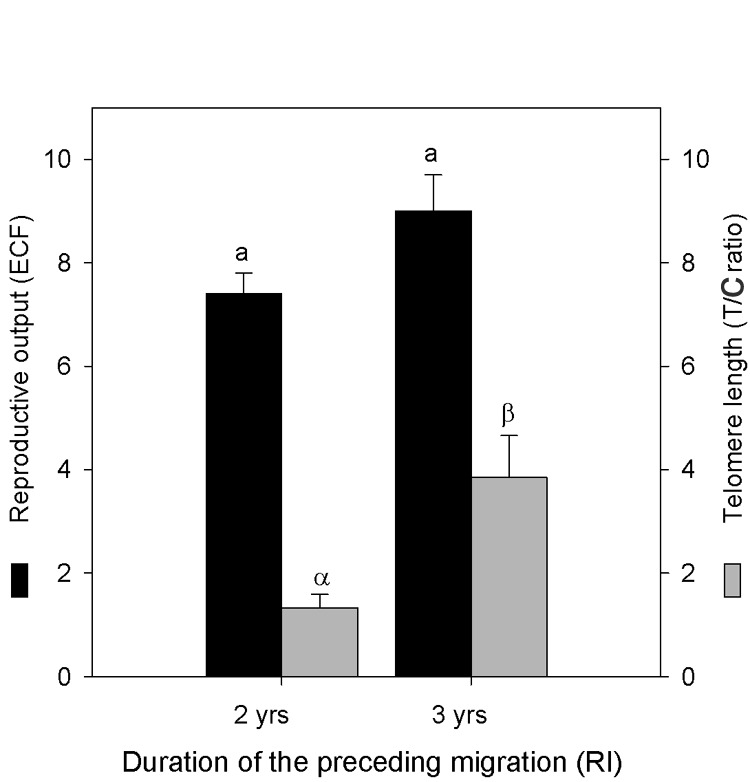
A major interest has recently emerged in understanding how telomere shortening, mechanism triggering cell senescence, is linked to organism ageing and life history traits in wild species. However, the links between telomere length and key history traits such as reproductive performances have received little attention and remain unclear to date. The leatherback turtle Dermochelys coriacea is a long-lived species showing rapid growth at early stages of life, one of the highest reproductive outputs observed in vertebrates and a dichotomised reproductive pattern related to migrations lasting 2 or 3 years, supposedly associated with different environmental conditions. Here we tested the prediction of blood telomere shortening with age in this species and investigated the relationship between blood telomere length and reproductive performances in leatherback turtles nesting in French Guiana. We found that blood telomere length did not differ between hatchlings and adults. The absence of blood telomere shortening with age may be related to an early high telomerase activity. This telomere-restoring enzyme was formerly suggested to be involved in preventing early telomere attrition in early fast-growing and long-lived species, including squamate reptiles. We found that within one nesting cycle, adult females having performed shorter migrations prior to the considered nesting season had shorter blood telomeres and lower reproductive output. We propose that shorter blood telomeres may result from higher oxidative stress in individuals breeding more frequently (i.e., higher costs of reproduction) and/or restoring more quickly their body reserves in cooler feeding areas during preceding migration (i.e., higher foraging costs). This first study on telomeres in the giant leatherback turtle suggests that blood telomere length predicts not only survival chances, but also reproductive performances. Telomeres may therefore be a promising new tool to evaluate individual reproductive quality which could be useful in such species of conservation concern.
Overview
The claims and statistics of this paper haven’t been checked yet.
Run the check — free, no account needed. It reads the open-access text and checks the sources it cites.
Integrity signals
Registry
Cites
Statistics
Figures
Verification
Claims the paper makes
The claims and statistics of this paper haven’t been checked yet.
Run the check — free, no account needed. It reads the open-access text and checks the sources it cites.
Claims other papers make about this one
Each is checked against this paper’s own text: does it say what the citing paper says it does?
The source backs part of the claim, not all of it — or backs it for a different population, condition or comparison.
In the citing paper
“Inhibition of ROS and unique telomerase and perhaps DNA repair mechanisms make turtles’ longevity possible.317”
From Inflammation and aging: signaling pathways and intervention therapies (2023) · cites this paper as [317]
Experimental — accuracy not yet measured
Self-check
Percentages, sums and reported differences re-computed from the paper’s own numbers.
The self-check needs the paper’s full text.
Citations
Cites
Crawley, M. J. (2007) · Medical Entomology and Zoology · Cited by 5,431
Extension of Life-Span by Introduction of Telomerase into Normal Human Cells
Bodnar, A. G., Ouellette, M., Frolkis, M., Holt, S. E., Chiu, C.-P., Morin, G. B., Harley, C. B., Shay, J. W., Lichtsteiner, S., & Wright, W. E. (1998) · Science · doi:10.1126/science.279.5349.349 · Cited by 4,975
Telomere measurement by quantitative PCR
Cawthon, R. (2002) · Nucleic Acids Research · doi:10.1093/nar/30.10.e47 · Cited by 3,550
Accelerated telomere shortening in response to life stress
Epel, E. S., Blackburn, E. H., Lin, J., Dhabhar, F. S., Adler, N. E., Morrow, J. D., & Cawthon, R. M. (2004) · Proceedings of the National Academy of Sciences · doi:10.1073/pnas.0407162101 · Cited by 3,002
Oxidative stress shortens telomeres
von Zglinicki, T. (2002) · Trends in Biochemical Sciences · doi:10.1016/s0968-0004(02)02110-2 · Cited by 2,524
Telomere states and cell fates
Blackburn, E. H. (2000) · Nature · doi:10.1038/35040500 · Cited by 1,396
The Biology of Sea Turtles, Volume I
(2017) · CRC Press eBooks · doi:10.1201/9780203737088 · Cited by 728
Telomere length in early life predicts lifespan
Heidinger, B. J., Blount, J. D., Boner, W., Griffiths, K., Metcalfe, N. B., & Monaghan, P. (2012) · Proceedings of the National Academy of Sciences · doi:10.1073/pnas.1113306109 · Cited by 713
Telomere Length as an Indicator of Biological Aging
Bénétos, A., Okuda, K., Lajemi, M., Kimura, M., Thomas, F., Skurnick, J., Labat, C., Bean, K., & Aviv, A. (2001) · Hypertension · doi:10.1161/01.hyp.37.2.381 · Cited by 628
Metcalfe, N. B., & Alonso‐Álvarez, C. (2010) · Functional Ecology · doi:10.1111/j.1365-2435.2010.01750.x · Cited by 559
Research works printed but not linked: 1
- MJ Crawley, 2007, The R book. J. Wiley & Sons Ltd, Chichester, UK.
Cited by
Sorted by citations
Inflammation and aging: signaling pathways and intervention therapies
Li, X., Li, C., Zhang, W., Wang, Y., Qian, P., & Huang, H. (2023) · Signal Transduction and Targeted Therapy · doi:10.1038/s41392-023-01502-8 · Cited by 1,443
“Inhibition of ROS and unique telomerase and perhaps DNA repair mechanisms make turtles’ longevity possible.(317) Centenarian human models Unlike artificial models, the centenarian model, as a naturally occurring model, has become an indispensable tool for human beings to decipher longevity.”
BackgroundAre we working towards global research priorities for management and conservation of sea turtles?
Rees, A., Alfaro‐Shigueto, J., Barata, P. C. R., Bjorndal, K. A., Bolten, A. B., Bourjea, J., Broderick, A. C., Campbell, L. M., Cardona, L., Carreras, C., et al. (2016) · Endangered Species Research · doi:10.3354/esr00801 · Cited by 268
“However, while telomere length analysis has been promising in some cases (Hatase et al. 2008), others have found no link with age (Girondot & Garcia 1999, Plot et al. 2012).”
BackgroundSomatic growth and telomere dynamics in vertebrates: relationships, mechanisms and consequences
Monaghan, P., & Ozanne, S. E. (2018) · Philosophical Transactions of the Royal Society B Biological Sciences · doi:10.1098/rstb.2016.0446 · Cited by 248
The association between stressors and telomeres in non‐human vertebrates: a meta‐analysis
Chatelain, M., Drobniak, S. M., & Szulkin, M. (2019) · Ecology Letters · doi:10.1111/ele.13426 · Cited by 237
Angelier, F., Costantini, D., Blévin, P., & Chastel, O. (2017) · General and Comparative Endocrinology · doi:10.1016/j.ygcen.2017.07.007 · Cited by 174
Metadata
- Authors
- Plot, V., Criscuolo, F., Zahn, S., & Georges, J.-Y.
- Affiliations
- Centre National de la Recherche Scientifique (FR)
- Corresponding author
- Plot, Virginie
- Venue
- PLoS ONE
- Publisher
- Public Library of Science (PLoS)
- Published
- 2012-07-13
- Volume
- 7
- Issue
- 7
- Pages
- e40855
- ISSN
- 1932-6203 (ISSN-L)
- PMC
- PMC3396605
- OpenAlex
- W2048943014
- Cited by
- 80
- References
- 50
- Citations by year
- 2026: 1 · 2025: 7 · 2024: 6 · 2023: 4 · 2022: 4 · 2021: 7 · 2020: 12 · 2019: 6 · 2018: 6 · 2017: 10 · 2016: 7 · 2015: 6 · 2014: 2 · 2013: 2
- FWCI
- 3.16
- Type
- journal article
- Language
- en
- Open access
- gold
- doi.org
- Locations
- PLoS ONE (publishedVersion, cc-by)
- Europe PMC (PubMed Central) (publishedVersion, cc-by)
- PubMed Central (publishedVersion, cc-by)
- PubMed (publishedVersion)
- HAL (submittedVersion)
- DOAJ (DOAJ: Directory of Open Access Journals) (submittedVersion)
- Funders
- Agence Nationale de la Recherche (ANR-07-JCJC-0122)
- Topics
- Physical Sciences › Environmental Science › Nature and Landscape Conservation › Turtle Biology and Conservation
- Life Sciences › Biochemistry, Genetics and Molecular Biology › Cell Biology › Telomeres, Telomerase, and Senescence
- Life Sciences › Agricultural and Biological Sciences › Ecology, Evolution, Behavior and Systematics › Animal Behavior and Reproduction
- Keywords
- telomere length, Dermochelys coriacea, aging, reproductive output, telomerase activity, cellular senescence, sea turtle migration, oxidative stress, foraging costs, life-history traits
- MeSH terms
- Animals, DNA, Female, French Guiana, Longevity, Models, Biological, Reproduction, Turtles, Telomere, Clutch Size, Telomere Homeostasis
About these checks
Registry, retraction, Cites and statistics results are computed, not judged, with one exception: a printed reference that no index lists is read once by a model before it counts as a citation error. Claims are extracted by a model and kept only when their quote appears verbatim in the text; each cited source is then checked, with a model’s help, for whether it says what the claim relies on. Those verdicts can be wrong — read the claim’s quote and the cited source before relying on one.
Statistics and arithmetic are recomputed, not judged.
Confidence bands are shown only for fields calibrated on our annotated test set. None is calibrated yet, so no band is shown.
What counts as a claim ›How we measure confidence ›How we check this ›
Are you an author, or do you see a problem with this page? Request a review
