

Making Robust Policy Decisions Using Global Biodiversity Indicators
Open accessThe DOI matches its Crossref record; 68 of the 70 references it cites were found in a registry or an index.
Abstract
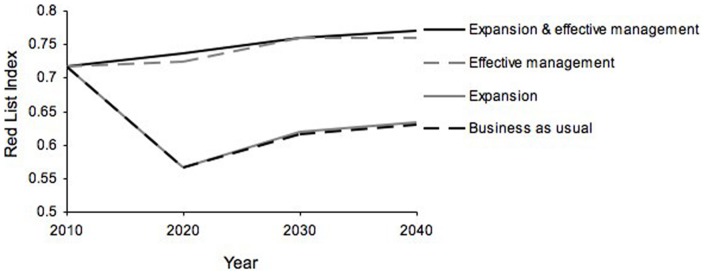
In order to influence global policy effectively, conservation scientists need to be able to provide robust predictions of the impact of alternative policies on biodiversity and measure progress towards goals using reliable indicators. We present a framework for using biodiversity indicators predictively to inform policy choices at a global level. The approach is illustrated with two case studies in which we project forwards the impacts of feasible policies on trends in biodiversity and in relevant indicators. The policies are based on targets agreed at the Convention on Biological Diversity (CBD) meeting in Nagoya in October 2010. The first case study compares protected area policies for African mammals, assessed using the Red List Index; the second example uses the Living Planet Index to assess the impact of a complete halt, versus a reduction, in bottom trawling. In the protected areas example, we find that the indicator can aid in decision-making because it is able to differentiate between the impacts of the different policies. In the bottom trawling example, the indicator exhibits some counter-intuitive behaviour, due to over-representation of some taxonomic and functional groups in the indicator, and contrasting impacts of the policies on different groups caused by trophic interactions. Our results support the need for further research on how to use predictive models and indicators to credibly track trends and inform policy. To be useful and relevant, scientists must make testable predictions about the impact of global policy on biodiversity to ensure that targets such as those set at Nagoya catalyse effective and measurable change.
Overview
The claims and statistics of this paper haven’t been checked yet.
Free: it reads the open-access text and checks the first 5 claims that cite a source we can check. Create a free account to check every claim.
Integrity signals
Registry
Cites
Statistics
Figures
Verification
Claims the paper makes
The claims and statistics of this paper haven’t been checked yet.
Free: it reads the open-access text and checks the first 5 claims that cite a source we can check. Create a free account to check every claim.
Claims other papers make about this one
Each is checked against this paper’s own text: does it say what the citing paper says it does?
The cited source says what the claim attributes to it.
In the citing paper
“Furthermore, the performance of biodiversity indicators such as the LPI can be compromised by the presence of bias in the data and limited in effectiveness as tools in measuring progress towards specific policy targets [1,14].”
From The Diversity-Weighted Living Planet Index: Controlling for Taxonomic Bias in a Global Biodiversity Indicator (2017) · cites this paper as [14]
Self-check
Percentages, sums and reported differences re-computed from the paper’s own numbers.
The self-check needs the paper’s full text.
Citations
Cites
Global Biodiversity: Indicators of Recent Declines
Butchart, S. H. M., Walpole, M., Collen, B., van Strien, A., Scharlemann, J. P. W., Almond, R. E. A., Baillie, J. E. M., Bomhard, B., Brown, C., Bruno, J., et al. (2010) · Science · doi:10.1126/science.1187512 · Cited by 4,892 · cited 2×
“Instead, indicators have principally been used to track the status of and trends in biodiversity and drivers of loss, from which the impact of actions is inferred [3,10].”
Self-citationAdaptive Management of Renewable Resources.
Rutherford, A. A., & Walters, C. (1987) · Biometrics · doi:10.2307/2531565 · Cited by 3,308 · cited 1×
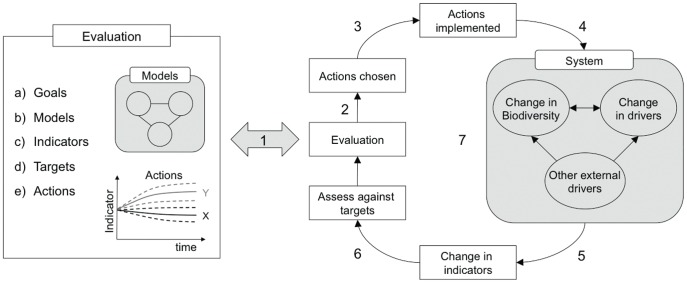
“We argue that indicators should be used within an indicatorpolicy cycle (Figure 1) that places monitoring with biodiversity indicators within an decision analytic framework [19,20], drawing on adaptive management [21,22], management strategy evaluation [23], and optimal monitoring [24,25], where monitoring is Figure 1.”
Scenarios for Global Biodiversity in the 21st Century
Pereira, H. M., Leadley, P. W., Proença, V., Alkemade, R., Scharlemann, J. P. W., Fernandez-Manjarrés, J. F., Araújo, M. B., Balvanera, P., Biggs, R., Cheung, W. W. L., et al. (2010) · Science · doi:10.1126/science.1196624 · Cited by 2,077 · cited 2×
“A key reason for the development of global biodiversity indicators was their potential to evaluate actions and develop understanding of underlying processes and drivers of loss [4,7,8], but this is virtually never done [7,9].”
Ecopath with Ecosim: Methods, capabilities and limitations
Christensen, V., & Walters, C. J. (2004) · Ecological Modelling · doi:10.1016/j.ecolmodel.2003.09.003 · Cited by 1,914 · cited 2×
“Therefore, EwE modelling allows the direct as well as indirect effects of fisheries to be quantified [65].”
Jones, K. E., Bielby, J., Cardillo, M., Fritz, S. A., O'Dell, J., Orme, C. D. L., Safi, K., Sechrest, W., Boakes, E. H., Carbone, C., et al. (2009) · Ecology · doi:10.1890/08-1494.1 · Cited by 1,654
Self-citationMonitoring of biological diversity in space and time
Yoccoz, N. G., Nichols, J. D., & Boulinier, T. (2001) · Trends in Ecology & Evolution · doi:10.1016/s0169-5347(01)02205-4 · Cited by 1,432 · cited 1×
“We argue that indicators should be used within an indicatorpolicy cycle (Figure 1) that places monitoring with biodiversity indicators within an decision analytic framework [19,20], drawing on adaptive management [21,22], management strategy evaluation [23], and optimal monitoring [24,25], where monitoring is Figure 1.”
Quantification of Extinction Risk: IUCN's System for Classifying Threatened Species
MACE, G. M., COLLAR, N. J., GASTON, K. J., HILTON‐TAYLOR, C., AKÇAKAYA, H. R., LEADER‐WILLIAMS, N., MILNER‐GULLAND, E. J., & STUART, S. N. (2008) · Conservation Biology · doi:10.1111/j.1523-1739.2008.01044.x · Cited by 1,400 · cited 1×
“Both indices relate to extinction risk: the LPI through one symptom of risk, geometric mean abundance, and the RLI by using a suite of symptoms of risk [51].”
Self-citationCollapse and conservation of shark populations in the Northwest Atlantic
Baum, J. K., Myers, R. A., Kehler, D. G., Worm, B., Harley, S. J., & Doherty, P. A. (2003) · Science · doi:10.1126/science.1079777 · Cited by 1,197 · cited 1×
“Direct effects might include the reduction of threats inside a newly implemented protected area; indirect effects include displacement of fishing activity from a marine protected area [39].”
Chape, S., Harrison, J., Spalding, M., & Lysenko, I. (2005) · Philosophical Transactions of the Royal Society B: Biological Sciences · doi:10.1098/rstb.2004.1592 · Cited by 1,124 · cited 2×
“However, the extent of PA coverage alone gives little information on how well PAs are performing in protecting biodiversity [17].”
NICHOLS, J., & WILLIAMS, B. (2006) · Trends in Ecology & Evolution · doi:10.1016/j.tree.2006.08.007 · Cited by 1,104
Research works printed but not linked: 4
- CoP10 2010 Conference Of The Parties To The Convention On Biological Diversity: Updating And Revision Of The Strategic Plan For The Post-2010 Period, Nagoya, Japan, 18–29 October. Nagoya, Japan: Convention On Biological Diversity
- CoP10 2010 Conference Of The Parties To The Convention On Biological Diversity: Revised And Updated Strategic Plan: Technical Rationale And Suggested Milestones And Indicators UNEP/CBD/COP/10/9. Nagoya, Japan: Convention On Biological Diversity
- IUCN 2001 IUCN Red List Categories and Criteria: Version 3.1. Gland, Switzerland and Cambridge, U.K.: IUCN Species Survival Commission
- Cruz-Escalona VH 2005 Interdependencia ecotrófica entre la laguna de Alvarado, Veracruz y la plataforma continental adyacente. Tesis de Doctorado (PhD thesis). La Paz, Baja California Sur, Mexico: Centro interdisciplinario de Ciencias Marinas del IPN
Cited by
Items 101–144 of 144
Hamano, E., Nishimura, M., Mori, H., Satow, T., & TAKAHASHI, J. C. (2020) · BMC Neurology · doi:10.1186/s12883-020-01923-w · Cited by 6
Hawkins, I., zu Ermgassen, S., Grub, H., Treweek, J., & Milner‐Gulland, E. J. (2022) · Oxford University Research Archive (ORA) (University of Oxford) · Cited by 6
Self-citationGlobal tropical forest types as support for the consideration of biodiversity under REDD+
Schmitt, C. B. (2013) · Carbon Management · doi:10.4155/cmt.13.51 · Cited by 6
Pouwels, R., Bilt, V. D. W., van Hinsberg, A., Knegt, D. B., Reijnen, R., Verboom, J., & Jones-Walters, L. (2016) · Wageningen University & Research Publications · Cited by 6
Georgescu, I. A., & Băncescu, M. (2025) · Land · doi:10.3390/land14101946 · Cited by 5
Stimpson, B., Raymond, S., Bull, J. W., & Milner‐Gulland, E. J. (2025) · Business Strategy and the Environment · doi:10.1002/bse.70404 · Cited by 5
Self-citationA Control Software Framework for Wearable Mechatronic Devices
Desplenter, T., & Trejos, A. L. (2020) · Journal of Intelligent & Robotic Systems · doi:10.1007/s10846-019-01144-5 · Cited by 5
Tendencias en las evaluaciones de riesgo al colapso de ecosistemas terrestres y humedales
Masés-García, C. A., Herrera-Fernández, B., & Briones-Salas, M. A. (2021) · Madera y Bosques · doi:10.21829/myb.2021.2732133 · Cited by 5
Latham, J. (2013) · White Rose eTheses Online (University of Leeds, The University of Sheffield, University of York) · Cited by 5
Stability metrics behave predictably across data qualities but are sensitive to community size
O’Brien, D. A., & Clements, C. F. (2025) · Biological Conservation · doi:10.1016/j.biocon.2025.111191 · Cited by 4
Intra-amoebal killing of Mycobacterium ulcerans by Acanthamoeba griffini: A co-culture model
Bouam, A., Ghigo, É., & Drancourt, M. (2017) · Microbial Pathogenesis · doi:10.1016/j.micpath.2017.11.022 · Cited by 4
Impedance Control in the Rehabilitation Robotics
Jelačić, Z. (2018) · Lecture notes in networks and systems · doi:10.1007/978-3-319-71321-2_85 · Cited by 4
Fonseca, E. C. N. F., Williams, B. A., Guerrero, A. M., Tedesco, A. M., Budhathoki, N. K., Wilson, K. A., & TULLOCH, A. I. T. (2026) · People and Nature · doi:10.1002/pan3.70278 · Cited by 3
Beyond area: Evaluating Australia's contribution to Aichi Target 11 and implications for 30 × 30
Watson, J. E. M., Li, R. V., Ward, M., FITZSIMONS, J. A., Possingham, H. P., Hockings, M. T., Leverington, F., Grantham, H. S., Vine, S., Gunn, J., et al. (2026) · Conservation Science and Practice · doi:10.1111/csp2.70256 · Cited by 3
Self-citationComplexity and spatial structuring of fish communities across urbanized watersheds and waterfronts
Theis, S., Chin, A. T. M., Wallace, A. M., Cartwright, L. A., Fortin, M., Poesch, M. S., & Ruppert, J. L. W. (2024) · Urban Ecosystems · doi:10.1007/s11252-024-01640-z · Cited by 3
Yeast-based high-throughput screens for discovery of kinase inhibitors for neglected diseases
Tavella, T. A., Cassiano, G. C., Costa, F. T. M., Sunnerhagen, P., & Bilsland, E. (2020) · Advances in protein chemistry and structural biology · doi:10.1016/bs.apcsb.2020.09.007 · Cited by 3
Sistema de Avaliação de Projetos de Educação Ambiental para Gestão de Recursos Hídricos (SAPEA-Água)
Chacon-Pereira, A., de Castro, E. M. N. V., & da Silva, L. P. (2022) · Ambiente & sociedade · doi:10.1590/1809-4422asoc20210061r1vu2022l2ao · Cited by 3
Erlandsson, K., Lindgren, H. E., Kallner, H. K., Ådén, U., Friberg, I. O., Elinder, L. S., Hajeebhoy, N., & Gemzell‐Danielsson, K. (2022) · Sexual & Reproductive Healthcare · doi:10.1016/j.srhc.2022.100763 · Cited by 3
Better practices for reporting on conservation
Tanentzap, A. J., Walker, S., & Stephens, R. T. T. (2016) · Conservation Letters · doi:10.1111/conl.12229 · Cited by 3
Koehler, L. (2023) · PEARL (University of Plymouth) · doi:10.24382/5054 · Cited by 3
Gutiérrez‐Arellano, C., Newbold, T., & Hodgson, J. A. (2025) · Global Ecology and Biogeography · doi:10.1111/geb.70170 · Cited by 2
Roy, S., & Bhattacharya, K. R. (2024) · World Journal of Advanced Research and Reviews · doi:10.30574/wjarr.2024.21.2.0366 · Cited by 2
Species Population Trends in Protected Areas
Collen, B., McRae, L., Nicholson, E., Craigie, I. D., Milner‐Gulland, E. J., Loh, J. X. Y., & Whitmee, S. (2016) · Wiley eBooks · doi:10.1002/9781118338117.ch6 · Cited by 2
Self-citationMetcalfe, K. (2013) · Institutional Archive of Ifremer (French Research Institute for Exploitation of the Sea) · Cited by 2
Effective monitoring for biodiversity conservation
Bal, P. (2017) · The University of Queensland · doi:10.14264/uql.2017.560 · Cited by 2
An Approach for Supporting Space Orientation of the Blind Using Ontologically-Based Object Map
Mikułowski, D., & Pilski, M. (2020) · Advances in intelligent systems and computing · doi:10.1007/978-3-030-49932-7_72 · Cited by 1
Reporting on success in threatened species conservation: the national policy context
Latch, P. (2018) · CSIRO Publishing eBooks · doi:10.1071/9781486307425.bk07705_ch31 · Cited by 1
Gray, C. L., McRae, L., Deinet, S., Ledger, S. E. H., Benham, C., Burfield, I. J., Eaton, M. A., Scott‐Gatty, K., Puleston, H., Rutherford, C., et al. (2022) · bioRxiv (Cold Spring Harbor Laboratory) · doi:10.1101/2022.09.01.506271 · Cited by 1
Self-citationThe Global Biodiversity Framework supports global assessment of One Health actionsPreprint
Banville, F., Burnel, C., Carlson, C., Eiffener, E., Acevedo, G. M., Paz, A., & Poisot, T. (2026) · doi:10.32942/x2kx1k · Cited by 1
Smit, K. P. (2020) · Nelson Mandela University Research Repository · Cited by 1
An assessment of the potential biodiversity impacts from biofuel production in South Africa
Blanchard, R. (2014) · SUNScholar (Stellenbosch University)
Berg, T. L. (2017) · Arca (British Columbia Electronic Library Network) · doi:10.14288/1.0343999
Remembering Dr. Ben Collen, an exemplary conservation biologist
Mace, G. M., Milner‐Gulland, E. J., & Nicholson, E. (2018) · Conservation Biology · doi:10.1111/cobi.13201
Self-citationEffective design and use of indicators for marine conservation
Burgass, M. J. (2019) · doi:10.25560/76025
An Indicator of the Impact of Climate Change on North American Bird Populations
Alison, J. (2015) · Durham e-Theses (Durham University)
Koehler, L. (2024) · SSRN Electronic Journal · doi:10.2139/ssrn.4863743
Koehler, L. (2024) · SSRN Electronic Journal · doi:10.2139/ssrn.4875232
McRae, L. (2024) · CentAUR (University of Reading) · doi:10.48683/1926.00119657
Self-citationHonorato, P. A. D. R. (2024) · LA Referencia (Red Federada de Repositorios Institucionales de Publicaciones Científicas)
Supporting Biodiversity in Cities
Mosca, F. (2026) · SpringerBriefs in applied sciences and technology · doi:10.1007/978-3-032-28039-8_7
Campos, F. S., David, J., Lourenço‐de‐Moraes, R., Fuzessy, L., Sillero, N., Cabral, P., & Retana, J. (2026) · People and Nature · doi:10.1002/pan3.70401
“Biodiversity indicator groups have been proposed as practical tools to inform conservation where species-specific data are scarce (Bal et al., 2018 ; Campos et al., 2014; Caro, 2010 ; Nicholson et al., 2012 ).”
von Staden, L., Raimondo, D. C., der Colff, D. V., Skowno, A. L., Smith, D. A. E., Jordaan, M. S., Lee, A. T., Tarrant, J., Weeber, J., & Driver, A. (2026) · Environmental Science & Policy · doi:10.1016/j.envsci.2026.104515
Data from: Reliable, verifiable and efficient monitoring of biodiversity via metabarcoding
Ji, Y., Ashton, L., Pedley, S. M., Edwards, D. P., Tang, Y., Nakamura, A., Kitching, R., Dolman, P. M., Woodcock, P., Edwards, F. A., et al. (2013) · Data Archiving and Networked Services (DANS) · doi:10.5061/dryad.t3v71.1
From microhabitat to metapopulations : a model system for conservation under climate change
Lawson, C. R. (2013) · Figshare
Metadata
- Authors
- Nicholson, E., Collen, B., Barausse, A., Blanchard, J. L., Costelloe, B. T., Sullivan, K. M. E., Underwood, F. M., Burn, R. W., Fritz, S., Jones, J. P. G., McRae, L., Possingham, H. P., & Milner-Gulland, E. J.
- Affiliations
- The University of Melbourne (AU)
- Zoological Society of London (GB)
- University of Padua (IT)
- Imperial College London (GB)
- University of Reading (GB)
- International Institute for Applied Systems Analysis (AT)
- Bangor University (GB)
- The University of Queensland (AU)
- Corresponding author
- Nicholson, Emily
- ORCID
- Venue
- PLoS ONE
- Publisher
- Public Library of Science (PLoS)
- Published
- 2012-07-18
- Volume
- 7
- Issue
- 7
- Pages
- e41128
- ISSN
- 1932-6203 (ISSN-L)
- PMC
- PMC3399804
- OpenAlex
- W1968283375
- Cited by
- 128
- References
- 70
- Citations by year
- 2026: 5 · 2025: 9 · 2024: 8 · 2023: 2 · 2022: 9 · 2021: 8 · 2020: 14 · 2019: 8 · 2018: 11 · 2017: 14 · 2016: 16 · 2015: 9 · 2014: 7 · 2013: 8
- FWCI
- 6.36
- Type
- journal article
- Language
- en
- Open access
- gold
- doi.org
- Locations
- PLoS ONE (publishedVersion, cc-by)
- Europe PMC (PubMed Central) (publishedVersion, cc-by)
- PubMed Central (publishedVersion, cc-by)
- PubMed (publishedVersion)
- CentAUR (University of Reading) (acceptedVersion)
- White Rose Research Online (University of Leeds, The University of Sheffield, University of York) (acceptedVersion)
- IIASA PURE (International Institute of Applied Systems Analysis) (acceptedVersion)
- Minerva Access (University of Melbourne) (submittedVersion, cc-by)
- Padua Research Archive (University of Padova) (submittedVersion, cc-by)
- eCite Digital Repository (University of Tasmania) (submittedVersion, cc-by)
- DOAJ (DOAJ: Directory of Open Access Journals) (submittedVersion, cc-by-sa)
- UCL Discovery (University College London) (submittedVersion)
- Figshare (submittedVersion, cc-by)
- Funders
- Rufford Foundation
- Centre of Excellence for Environmental Decisions, Australian Research Council
- Imperial College London
- University of Melbourne
- WWF International
- Natural Environment Research Council
- Australian Research Council
- Topics
- Physical Sciences › Environmental Science › Global and Planetary Change › Conservation, Biodiversity, and Resource Management
- Physical Sciences › Environmental Science › Nature and Landscape Conservation › Ecology and Vegetation Dynamics Studies
- Physical Sciences › Environmental Science › Management, Monitoring, Policy and Law › Sustainable Development and Environmental Policy
- Keywords
- biodiversity indicators, protected area policy, Red List Index, Living Planet Index, African mammals, bottom trawling, fisheries impacts, biodiversity policy, trophic interactions
- MeSH terms
- Africa, Animals, Conservation of Natural Resources, Environment, Humans, International Cooperation, Models, Theoretical, Public Policy, Research, Science, Time Factors, Ecosystem, Biomass, Biodiversity
About these checks
Registry, retraction, Cites and statistics results are computed, not judged, with one exception: a printed reference that no index lists is read once by a model before it counts as a citation error. Claims are extracted by a model and kept only when their quote appears verbatim in the text; each cited source is then checked, with a model’s help, for whether it says what the claim relies on. Those verdicts can be wrong — read the claim’s quote and the cited source before relying on one.
Statistics and arithmetic are recomputed, not judged.
Confidence bands are shown only for fields calibrated on our annotated test set. None is calibrated yet, so no band is shown.
What counts as a claim ›How we measure confidence ›How we check this ›
Are you an author, or do you see a problem with this page? Request a review
Data sources
Bibliographic data: Semantic Scholar, OpenAlex, Crossref.
Contains information from the Semantic Scholar Academic Graph Datasets, made available under the ODC Attribution License (ODC-BY 1.0).
Semantic Scholar’s data is described in: Kinney, R., et al. (2023). The Semantic Scholar Open Data Platform. arXiv:2301.10140.
