

The DOI matches its Crossref record; 41 of the 41 references it cites were found in a registry or an index.
Transposable Elements in TDP-43-Mediated Neurodegenerative Disorders
Open accessAbstract
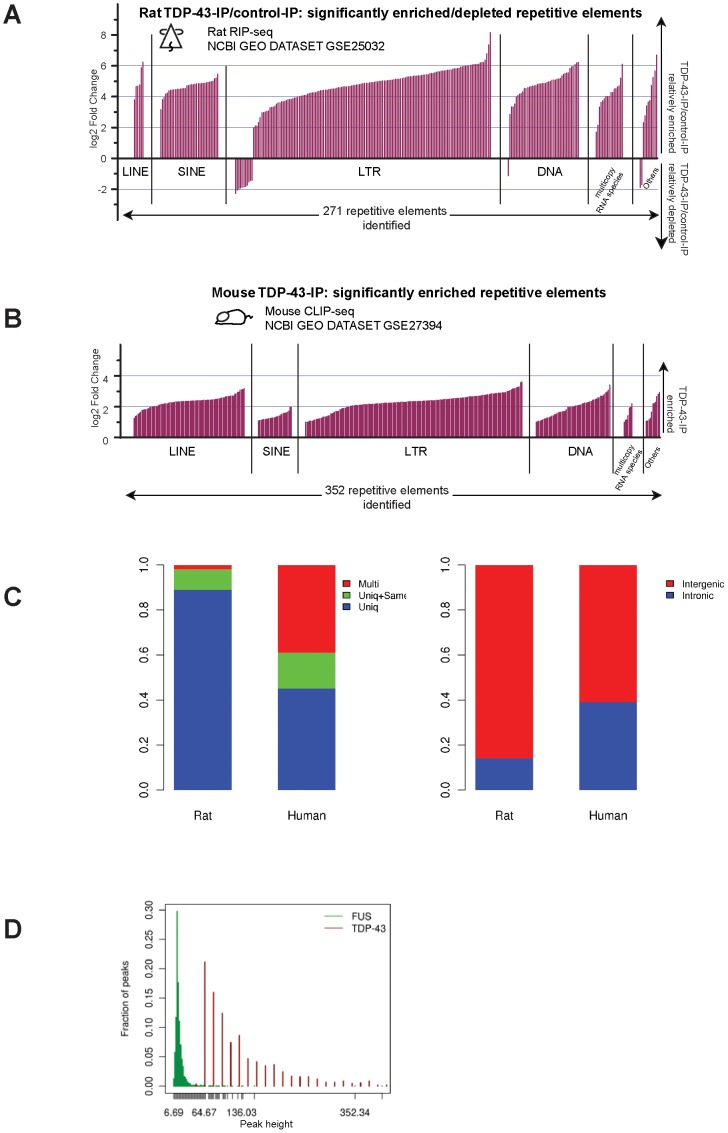
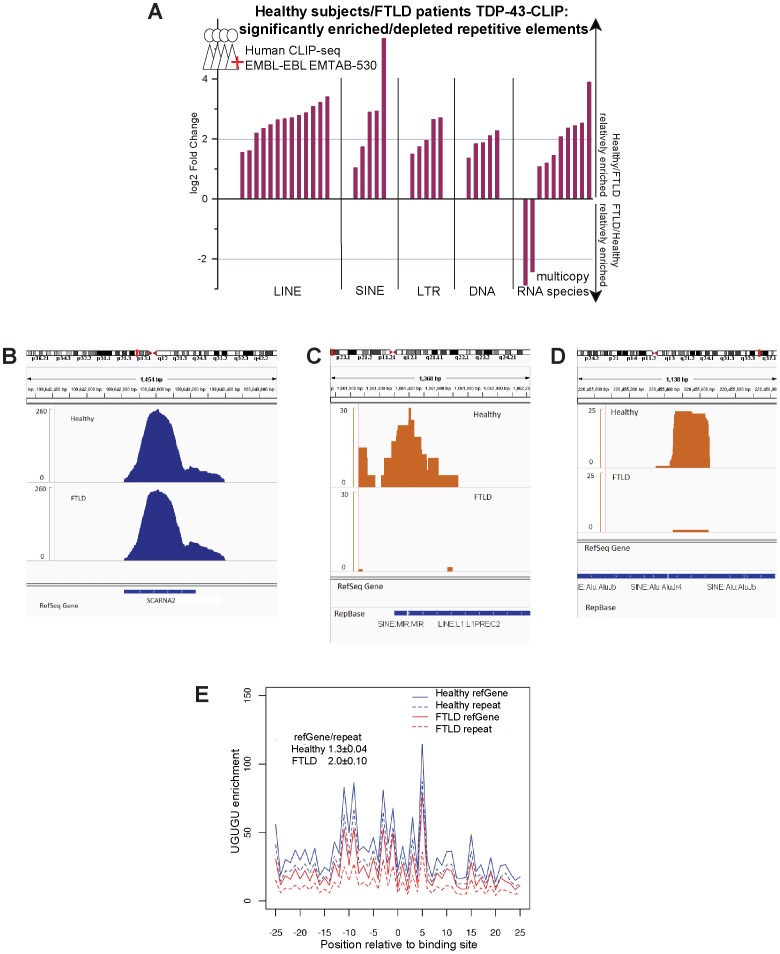
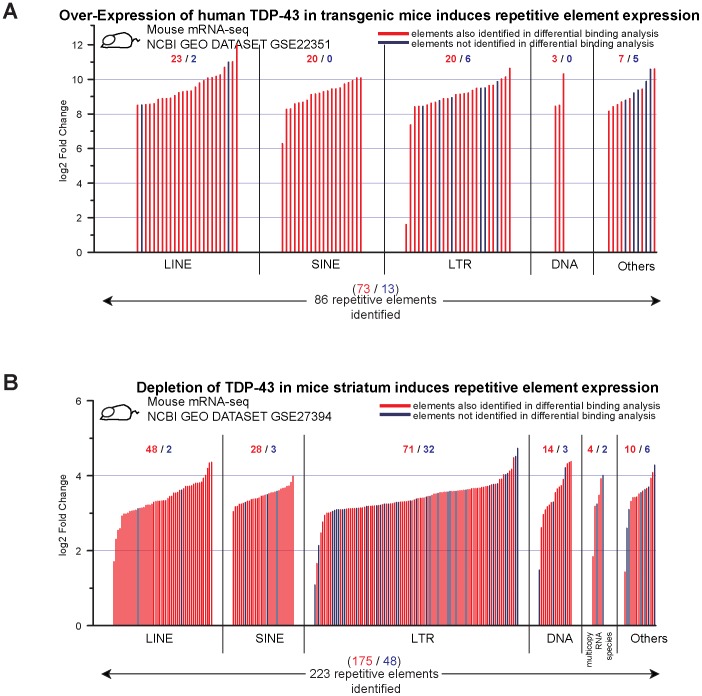
Elevated expression of specific transposable elements (TEs) has been observed in several neurodegenerative disorders. TEs also can be active during normal neurogenesis. By mining a series of deep sequencing datasets of protein-RNA interactions and of gene expression profiles, we uncovered extensive binding of TE transcripts to TDP-43, an RNA-binding protein central to amyotrophic lateral sclerosis (ALS) and frontotemporal lobar degeneration (FTLD). Second, we find that association between TDP-43 and many of its TE targets is reduced in FTLD patients. Third, we discovered that a large fraction of the TEs to which TDP-43 binds become de-repressed in mouse TDP-43 disease models. We propose the hypothesis that TE mis-regulation contributes to TDP-43 related neurodegenerative diseases.
Overview
The claims and statistics of this paper haven’t been checked yet.
Run the check — free, no account needed. It reads the open-access text and checks the sources it cites.
Integrity signals
Registry
Cites
Statistics
Figures
Verification
Claims the paper makes
The claims and statistics of this paper haven’t been checked yet.
Run the check — free, no account needed. It reads the open-access text and checks the sources it cites.
Claims other papers make about this one
Each is checked against this paper’s own text: does it say what the citing paper says it does?
The cited source says what the claim attributes to it.
In the citing paper
“While transposable element activation has also been implicated in cancer6, and TDP-43 mediated neurodegeneration7–9, the extent to which transposable elements are involved in human disorders and drive disease pathogenesis is currently unknown.”
From Pathogenic tau-induced piRNA depletion promotes neuronal death through transposable element dysregulation in neurodegenerative tauopathies (2018) · cites this paper as [7]
Self-check
Percentages, sums and reported differences re-computed from the paper’s own numbers.
The self-check needs the paper’s full text.
Citations
Cites
Initial sequencing and analysis of the human genome
International Human Genome Sequencing Consortium, Whitehead Institute for Biomedical Research, C. F. G. R., Lander, E. S., Linton, L. M., Birren, B., Nusbaum, C., Zody, M. C., Baldwin, J., Devon, K., Dewar, K., et al. (2001) · Nature · doi:10.1038/35057062 · Cited by 24,216
Ultrafast and memory-efficient alignment of short DNA sequences to the human genome.
Langmead, B., Trapnell, C., Pop, M., & Salzberg, S. L. (2009) · Genome Biology · doi:10.1186/gb-2009-10-3-r25 · Cited by 21,849
Model-based Analysis of ChIP-Seq (MACS)
Zhang, Y., Liu, T., Meyer, C. A., Eeckhoute, J., Johnson, D. S., Bernstein, B. E., Nusbaum, C., Myers, R. M., Brown, M., Li, W., et al. (2008) · Genome Biology · doi:10.1186/gb-2008-9-9-r137 · Cited by 18,386
Self-citationProceedings of the National Academy of Sciences of the United States of America
Dowling, J. E., & Wald, G. (2009) · Nutrition Reviews · doi:10.1111/j.1753-4887.1981.tb06752.x · Cited by 17,937
Differential expression analysis for sequence count data
Anders, S., & Huber, W. (2010) · Genome Biology · doi:10.1186/gb-2010-11-10-r106 · Cited by 15,581
Repbase Update, a database of eukaryotic repetitive elements
Jurka, J., Kapitonov, V. V., Pavlíček, A., Klonowski, P., Kohany, O., & Walichiewicz, J. (2005) · Cytogenetic and Genome Research · doi:10.1159/000084979 · Cited by 3,413
Mutations in FUS, an RNA Processing Protein, Cause Familial Amyotrophic Lateral Sclerosis Type 6
Vance, C. A., Rogelj, B., Hortobágyi, T., Vos, K. J. D., Nishimura, A. L., Sreedharan, J., Hu, X., Smith, B. N., Ruddy, D., Wright, P. D., et al. (2009) · Science · doi:10.1126/science.1165942 · Cited by 2,625
The UCSC Genome Browser database: update 2011
Fujita, P. A., Rhead, B., Zweig, A. S., Hinrichs, A. S., Karolchik, D., Cline, M., Goldman, M. J., Barber, G. P., Clawson, H., Coelho, A., et al. (2010) · Nucleic Acids Research · doi:10.1093/nar/gkq963 · Cited by 1,843
MEME-ChIP: motif analysis of large DNA datasets
Machanick, P., & Bailey, T. L. (2011) · Bioinformatics · doi:10.1093/bioinformatics/btr189 · Cited by 1,815
Repetitive DNA and next-generation sequencing: computational challenges and solutions
Treangen, T. J., & Salzberg, S. L. (2012) · Nature Reviews Genetics · doi:10.1038/nrg3117 · Cited by 1,597
Cited by
Sorted by citations
Jin, Y., Tam, O. H., Paniagua, E., & Hammell, M. (2015) · Bioinformatics · doi:10.1093/bioinformatics/btv422 · Cited by 753
Self-citationHuman endogenous retrovirus-K contributes to motor neuron disease
Li, W., Lee, M.-H., Henderson, L., Tyagi, R., Bachani, M., Steiner, J., Campanac, E., Hoffman, D. A., von Geldern, G., Johnson, K., et al. (2015) · Science Translational Medicine · doi:10.1126/scitranslmed.aac8201 · Cited by 482
Self-citationPhysiological functions and pathobiology of TDP ‐43 and FUS / TLS proteins
Ratti, A., & Buratti, E. (2016) · Journal of Neurochemistry · doi:10.1111/jnc.13625 · Cited by 417
CLIP and complementary methods
Hafner, M., Katsantoni, M., Köster, T., Marks, J., Mukherjee, J., Staiger, D., Ule, J., & Zavolan, M. (2021) · Nature Reviews Methods Primers · doi:10.1038/s43586-021-00018-1 · Cited by 406
ALS Genetics: Gains, Losses, and Implications for Future Therapies
Kim, G., Gautier, O., Tassoni-Tsuchida, E., Ma, X. R., & Gitler, A. D. (2020) · Neuron · doi:10.1016/j.neuron.2020.08.022 · Cited by 370
Metadata
- Authors
- Li, W., Jin, Y., Prazak, L., Hammell, M., & Dubnau, J.
- Affiliations
- Cold Spring Harbor Laboratory (US)
- Corresponding author
- Hammell, Molly
- Dubnau, Josh
- Venue
- PLoS ONE
- Publisher
- Public Library of Science (PLoS)
- Published
- 2012-09-05
- Volume
- 7
- Issue
- 9
- Pages
- e44099
- ISSN
- 1932-6203 (ISSN-L)
- PMC
- PMC3434193
- OpenAlex
- W2023453519
- Cited by
- 195
- References
- 41
- Citations by year
- 2026: 7 · 2025: 12 · 2024: 15 · 2023: 13 · 2022: 22 · 2021: 22 · 2020: 23 · 2019: 20 · 2018: 18 · 2017: 16 · 2016: 6 · 2015: 8 · 2014: 10 · 2013: 3
- FWCI
- 4.39
- Type
- journal article
- Language
- en
- Open access
- gold
- doi.org
- Locations
- PLoS ONE (publishedVersion, cc-by)
- Europe PMC (PubMed Central) (publishedVersion, cc-by)
- PubMed Central (publishedVersion, cc-by)
- PubMed (publishedVersion)
- Cold Spring Harbor Laboratory Institutional Repository (Cold Spring Harbor Laboratory) (acceptedVersion)
- DOAJ (DOAJ: Directory of Open Access Journals) (submittedVersion, cc-by-sa)
- Figshare (submittedVersion, cc-by)
- Funders
- National Institutes of Health
- National Institute of Neurological Disorders and Stroke (TR01 5R01NS067690-03, R01NS067690)
- Topics
- Health Sciences › Medicine › Clinical Neurology › Amyotrophic Lateral Sclerosis Research
- Life Sciences › Neuroscience › Cellular and Molecular Neuroscience › Alzheimer's disease research and treatments
- Life Sciences › Biochemistry, Genetics and Molecular Biology › Molecular Biology › RNA Research and Splicing
- Keywords
- transposable elements, TDP-43, amyotrophic lateral sclerosis, frontotemporal lobar degeneration, neurodegenerative diseases, RNA-protein interactions, gene expression dysregulation, RNA-binding proteins
- MeSH terms
- Animals, DNA Transposable Elements, DNA-Binding Proteins, Frontal Lobe, Humans, Molecular Sequence Data, Neurons, Protein Binding, RNA, Models, Statistical, Case-Control Studies, Genome, Neurodegenerative Diseases, Gene Expression Profiling, Mice, Rats
About these checks
Registry, retraction, Cites and statistics results are computed, not judged, with one exception: a printed reference that no index lists is read once by a model before it counts as a citation error. Claims are extracted by a model and kept only when their quote appears verbatim in the text; each cited source is then checked, with a model’s help, for whether it says what the claim relies on. Those verdicts can be wrong — read the claim’s quote and the cited source before relying on one.
Statistics and arithmetic are recomputed, not judged.
Confidence bands are shown only for fields calibrated on our annotated test set. None is calibrated yet, so no band is shown.
What counts as a claim ›How we measure confidence ›How we check this ›
Are you an author, or do you see a problem with this page? Request a review
