

The DOI matches its Crossref record; 72 of the 76 references it cites were found in a registry or an index.
The Diversity and Biogeography of Western Indian Ocean Reef-Building Corals
Open accessAbstract
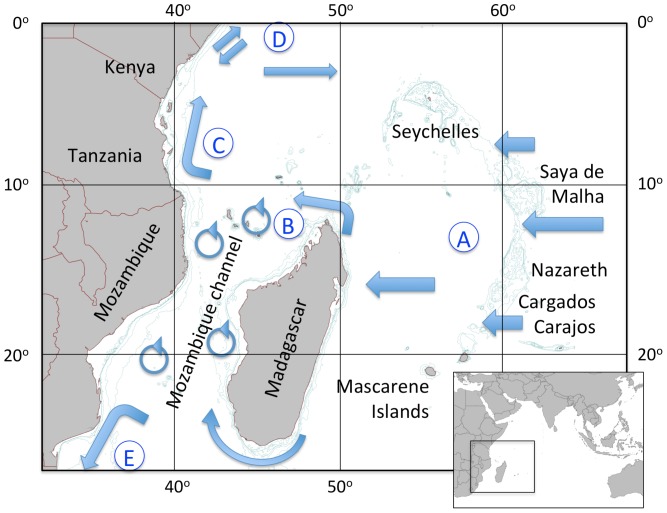
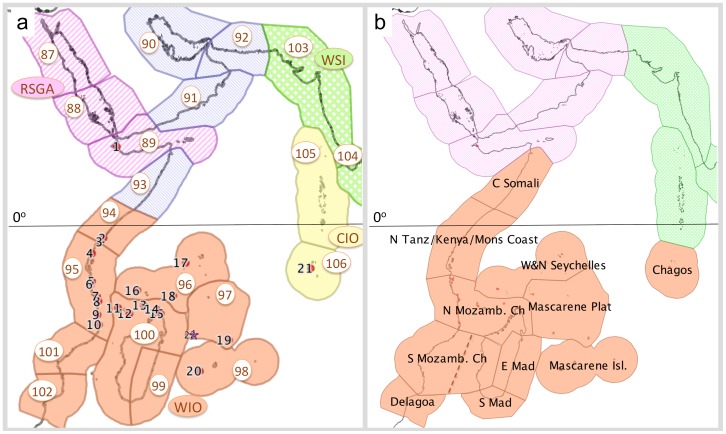
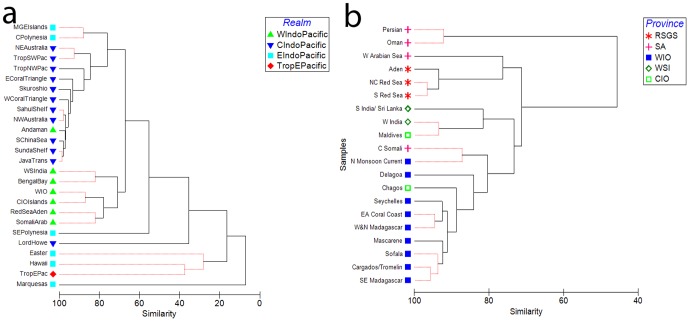
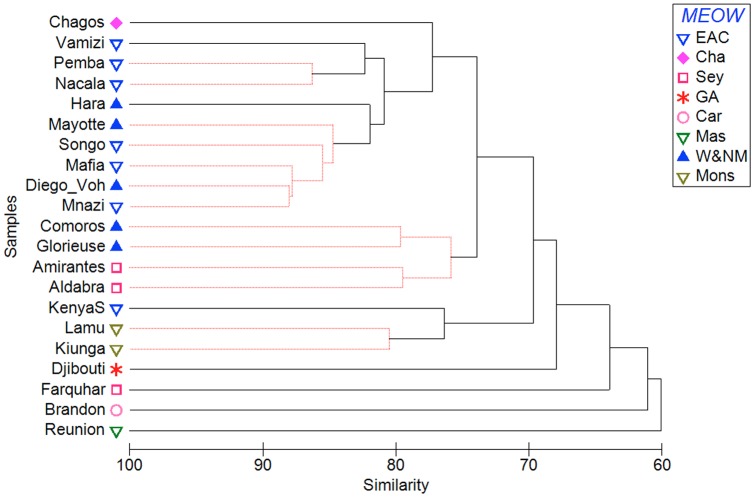
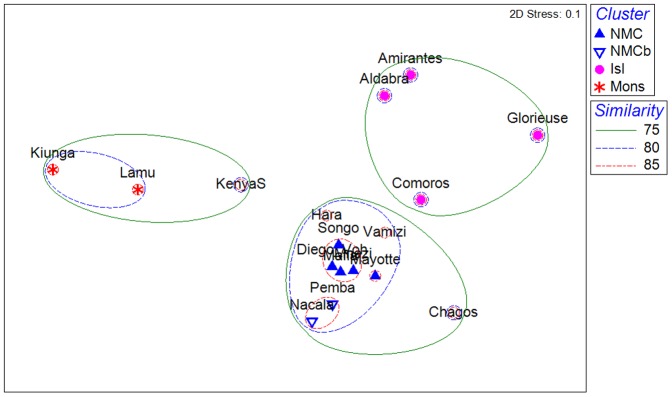
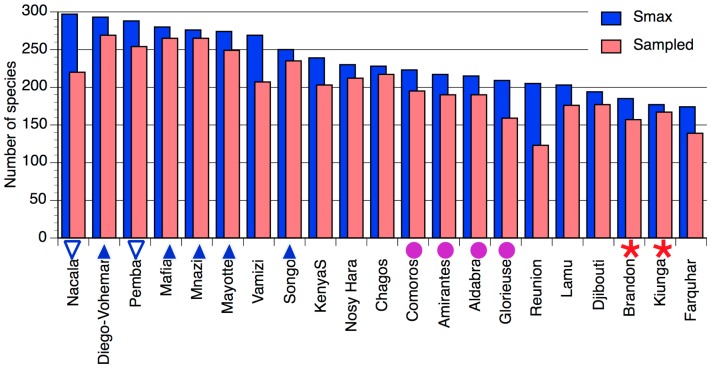
This study assesses the biogeographic classification of the Western Indian Ocean (WIO) on the basis of the species diversity and distribution of reef-building corals. Twenty one locations were sampled between 2002 and 2011. Presence/absence of scleractinian corals was noted on SCUBA, with the aid of underwater digital photographs and reference publications for species identification. Sampling effort varied from 7 to 37 samples per location, with 15 to 45 minutes per dive allocated to species observations, depending on the logistics on each trip. Species presence/absence was analyzed using the Bray-Curtis similarity coefficient, followed by cluster analysis and multi-dimensional scaling. Total (asymptotic) species number per location was estimated using the Michaelis-Menten equation. Three hundred and sixty nine coral species were named with stable identifications and used for analysis. At the location level, estimated maximum species richness ranged from 297 (Nacala, Mozambique) to 174 (Farquhar, Seychelles). Locations in the northern Mozambique Channel had the highest diversity and similarity, forming a core region defined by its unique oceanography of variable meso-scale eddies that confer high connectivity within this region. A distinction between mainland and island fauna was not found; instead, diversity decreased radially from the northern Mozambique Channel. The Chagos archipelago was closely related to the northern Mozambique Channel region, and analysis of hard coral data in the IUCN Red List found Chagos to be more closely related to the WIO than to the Maldives, India and Sri Lanka. Diversity patterns were consistent with primary oceanographic drivers in the WIO, reflecting inflow of the South Equatorial Current, maintenance of high diversity in the northern Mozambique Channel, and export from this central region to the north and south, and to the Seychelles and Mascarene islands.
Overview
The claims and statistics of this paper haven’t been checked yet.
Run the check — free, no account needed. It reads the open-access text and checks the sources it cites.
Integrity signals
Registry
Cites
Statistics
Figures
Verification
Claims the paper makes
The claims and statistics of this paper haven’t been checked yet.
Run the check — free, no account needed. It reads the open-access text and checks the sources it cites.
Claims other papers make about this one
Each is checked against this paper’s own text: does it say what the citing paper says it does?
In the citing paper
“These results are consistent with the higher coral cover and diversity found in the NMC, which can be explained by current patterns (such as the inflow of the SEC transporting larvae) combined with the high connectivity caused by mixing in the NMC eddies, and lower environmental stress than north of the NMC (McClanahan et al. 2014;Obura 2012).”
From Population genetics of the brooding coral Seriatopora hystrix reveals patterns of strong genetic differentiation in the Western Indian Ocean (2021) · cites this paper as Obura 2012
In the citing paper
“This pattern was also suggested for A. tenuis (van der Ven et al. 2016) and is supported by the strong resemblance in coral species diversity between these sites (Obura 2012).”
From Population genetics of the brooding coral Seriatopora hystrix reveals patterns of strong genetic differentiation in the Western Indian Ocean (2021) · cites this paper as Obura 2012
In the citing paper
“The NMC is considered a priority region for conservation and management efforts, as this region is high in coral cover and species richness, probably caused by historical high connectivity and low or geographically variable levels of environmental stress (McClanahan et al. 2007a(McClanahan et al. , 2014;;Obura 2012).”
From Population genetics of the brooding coral Seriatopora hystrix reveals patterns of strong genetic differentiation in the Western Indian Ocean (2021) · cites this paper as Obura 2012
Self-check
Percentages, sums and reported differences re-computed from the paper’s own numbers.
The self-check needs the paper’s full text.
Citations
Cites
Non‐parametric multivariate analyses of changes in community structure
Clarke, K. R. (1993) · Australian Journal of Ecology · doi:10.1111/j.1442-9993.1993.tb00438.x · Cited by 14,449
The Theory of Island Biogeography
MacArthur, R. H., & Wilson, E. O. (2001) · Princeton University Press eBooks · doi:10.1515/9781400881376 · Cited by 13,298
IUCN Red List of Threatened Species
(2012) · Choice Reviews Online · doi:10.5860/choice.49-6872 · Cited by 12,829
Change in marine communities : an approach to statistical analysis and interpretation
Clarke, K. R., & Warwick, R. M. (2001) · OpenGrey (Institut de l'Information Scientifique et Technique) · Cited by 12,075
The Theory of Island Biogeography
Kirkby, M. J., MacArthur, R. H., & Wilson, E. O. (1968) · Geographical Journal · doi:10.2307/1796430 · Cited by 11,589
Marine Ecoregions of the World: A Bioregionalization of Coastal and Shelf Areas
Spalding, M. D., Fox, H. E., Allen, G. R., Davidson, N., Ferdaña, Z. A., Finlayson, M., Halpern, B. S., Jorge, M. A., Lombana, A., Lourie, S. A., et al. (2007) · BioScience · doi:10.1641/b570707 · Cited by 4,084
The monsoon circulation of the Indian Ocean
Schott, F. A., & McCreary, J. P. (2001) · Progress in Oceanography · doi:10.1016/s0079-6611(01)00083-0 · Cited by 1,798
Carpenter, K. E., Abrar, M., Aeby, G. S., Aronson, R. B., Banks, S., Bruckner, A. W., Chiriboga, A. I., Cortés, J., Delbeek, J. C., DeVantier, L. M., et al. (2008) · Science · doi:10.1126/science.1159196 · Cited by 1,412
Self-citationClarke, K. R., Somerfield, P. J., & Chapman, M. G. (2006) · Journal of Experimental Marine Biology and Ecology · doi:10.1016/j.jembe.2005.12.017 · Cited by 1,180
The Natural history of Madagascar
(2004) · Choice Reviews Online · doi:10.5860/choice.41-6524 · Cited by 803
Research works printed but not linked: 5
- [5]Rosen BR (1971) The distribution of reef coral genera in the Indian Ocean. In: Stoddart DR, Yonge CM (eds) Regional Variation in Indian Ocean. Coral Reefs Symp Zool Soc London no 28 Academic Press pp 263–299.
- [47]Lieske E, Myers R (1996) Coral reef fishes of the Indo-Pacific and Caribbean. 2nd edition Collins ISBN0 00 219974 2.
- [49]Mortimer JA, Day M, Broderick D (2002) Sea turtle populations of the Chagos Archipelago, British Indian Ocean Territory. In: Proceedings of the Twentieth Annual Symposium on Sea Turtle Biology and Conservation. Mosier A, Foley A, Brost B (compilers) NOAA Technical Memorandum NMFS SEFSC-477: 47–49.
- [86]Wells JW (1956) Scleractinia. In: Moore RC (ed) Treatise on Invertebrate Paleontology. Geological Society of America and Univ. Kansas Press. F:328–440.
- [93]Colwell R, Coddington J (1994) Estimating species richness. Phil Trans Royal Soc of London (B) 345: 101– 118. 7972351
Cited by
Sorted by citations
Global Biogeography of Reef Fishes: A Hierarchical Quantitative Delineation of Regions
Kulbicki, M., Parravicini, V., Bellwood, D. R., Arias‐González, J. E., Chabanet, P., Floeter, S. R., Friedlander, A. M., McPherson, J. M., Myers, R. E., Vigliola, L., et al. (2013) · PLoS ONE · doi:10.1371/journal.pone.0081847 · Cited by 264
Overview of distribution patterns of zooxanthellate Scleractinia
Veron, J. E. N., Stafford-Smith, M. G., DeVantier, L. M., & Turak, E. (2015) · Frontiers in Marine Science · doi:10.3389/fmars.2014.00081 · Cited by 227
Extraordinary diversity of reef corals in the South China Sea
Huang, D., Licuanan, W. Y., Hoeksema, B. W., Chen, C. A., Ang, P. O., Huang, H., Lane, D. J. W., Vo, S. T., Waheed, Z., Affendi, Y. A., et al. (2014) · Marine Biodiversity · doi:10.1007/s12526-014-0236-1 · Cited by 214
Towards A Network of Locally Managed Marine Areas (LMMAs) in the Western Indian Ocean
Rocliffe, S., Peabody, S., Samoilys, M., & Hawkins, J. P. (2014) · PLoS ONE · doi:10.1371/journal.pone.0103000 · Cited by 149
Diz, D., Johnson, D. E., Riddell, M., Rees, S. E., Battle, J., Gjerde, K. M., Hennige, S., & Roberts, J. M. (2017) · Marine Policy · doi:10.1016/j.marpol.2017.08.019 · Cited by 128
Metadata
- Authors
- Obura, D.
- Affiliations
- Coastal Oceans Research and Development in the Indian Ocean (KE)
- Corresponding author
- Obura, David
- ORCID
- Obura, David
- Venue
- PLoS ONE
- Publisher
- Public Library of Science (PLoS)
- Published
- 2012-09-19
- Volume
- 7
- Issue
- 9
- Pages
- e45013
- ISSN
- 1932-6203 (ISSN-L)
- PMC
- PMC3446983
- OpenAlex
- W1996588356
- Cited by
- 228
- References
- 76
- Citations by year
- 2026: 11 · 2025: 12 · 2024: 24 · 2023: 17 · 2022: 16 · 2021: 18 · 2020: 19 · 2019: 18 · 2018: 23 · 2017: 15 · 2016: 19 · 2015: 20 · 2014: 9 · 2013: 6 · 2012: 1
- FWCI
- 10.17
- Type
- journal article
- Language
- en
- Open access
- gold
- doi.org
- Locations
- PLoS ONE (publishedVersion, cc-by)
- PubMed Central (publishedVersion, cc-by)
- PubMed (publishedVersion)
- DOAJ (DOAJ: Directory of Open Access Journals) (submittedVersion, cc-by-sa)
- Greater South Information System
- Funders
- National Geographic Society
- Western Indian Ocean Marine Science Association
- Topics
- Physical Sciences › Environmental Science › Ecology › Coral and Marine Ecosystems Studies
- Physical Sciences › Earth and Planetary Sciences › Oceanography › Marine Biology and Ecology Research
- Physical Sciences › Environmental Science › Global and Planetary Change › Marine Ecology and Invasive Species
- Keywords
- reef-building corals, scleractinian corals, coral species diversity, biogeography, Western Indian Ocean, Mozambique Channel, Chagos Archipelago, oceanographic drivers, South Equatorial Current
- MeSH terms
- Animals, Data Collection, Species Specificity, Water Movements, Cluster Analysis, Indian Ocean, Anthozoa, Biodiversity, Coral Reefs, Phylogeography
About these checks
Registry, retraction, Cites and statistics results are computed, not judged, with one exception: a printed reference that no index lists is read once by a model before it counts as a citation error. Claims are extracted by a model and kept only when their quote appears verbatim in the text; each cited source is then checked, with a model’s help, for whether it says what the claim relies on. Those verdicts can be wrong — read the claim’s quote and the cited source before relying on one.
Statistics and arithmetic are recomputed, not judged.
Confidence bands are shown only for fields calibrated on our annotated test set. None is calibrated yet, so no band is shown.
What counts as a claim ›How we measure confidence ›How we check this ›
Are you an author, or do you see a problem with this page? Request a review
