

Role of Catecholate Siderophores in Gram-Negative Bacterial Colonization of the Mouse Gut
Open accessThe DOI matches its Crossref record; 61 of the 61 references it cites were found in a registry or an index.
Abstract
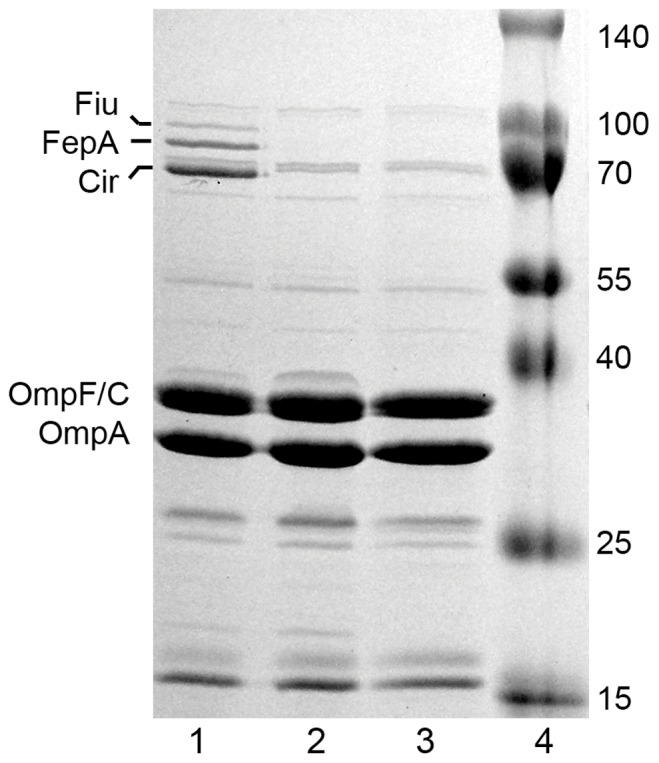
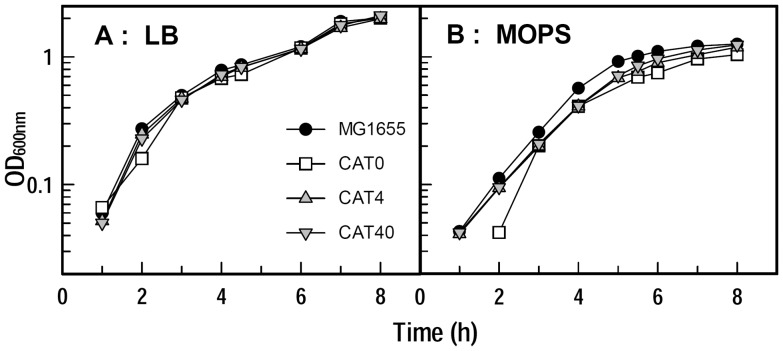
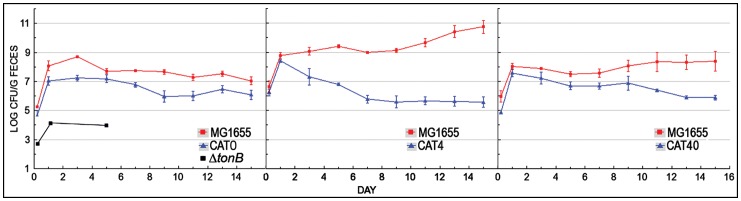
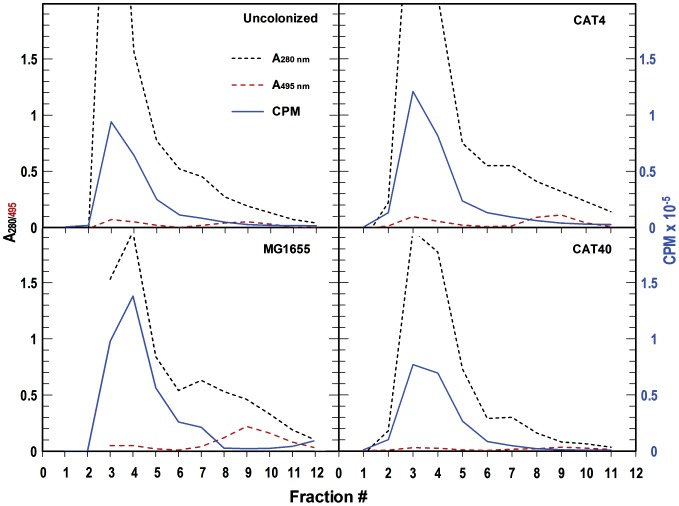
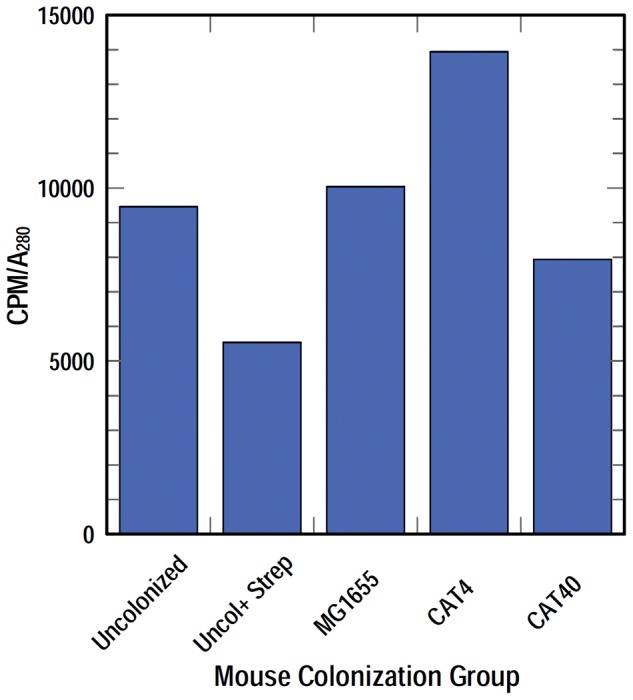
We investigated the importance of the production of catecholate siderophores, and the utilization of their iron (III) complexes, to colonization of the mouse intestinal tract by Escherichia coli. First, a ΔtonB strain was completely unable to colonize mice. Next, we compared wild type E. coli MG1655 to its derivatives carrying site-directed mutations of genes for enterobactin synthesis (ΔentA::Cm; strain CAT0), ferric catecholate transport (Δfiu, ΔfepA, Δcir, ΔfecA::Cm; CAT4), or both (Δfiu, ΔfepA, ΔfecA, Δcir, ΔentA::Cm; CAT40) during colonization of the mouse gut. Competitions between wild type and mutant strains over a 2-week period in vivo showed impairment of all the genetically engineered bacteria relative to MG1655. CAT0, CAT4 and CAT40 colonized mice 10(1)-, 10(5)-, and 10(2)-fold less efficiently, respectively, than MG1655. Unexpectedly, the additional inability of CAT40 to synthesize enterobactin resulted in a 1000-fold better colonization efficiency relative to CAT4. Analyses of gut mucus showed that CAT4 hyperexcreted enterobactin in vivo, effectively rendering the catecholate transport-deficient strain iron-starved. The results demonstrate that, contrary to prior reports, iron acquisition via catecholate siderophores plays a fundamental role in bacterial colonization of the murine intestinal tract.
Overview
The claims and statistics of this paper haven’t been checked yet.
Free: it reads the open-access text and checks the first 5 claims that cite a source we can check. Create a free account to check every claim.
Integrity signals
Registry
Cites
Statistics
Figures
Verification
Claims the paper makes
The claims and statistics of this paper haven’t been checked yet.
Free: it reads the open-access text and checks the first 5 claims that cite a source we can check. Create a free account to check every claim.
Claims other papers make about this one
Each is checked against this paper’s own text: does it say what the citing paper says it does?
The source backs part of the claim, not all of it — or backs it for a different population, condition or comparison.
In the citing paper
“The exploitation of these uptake mechanisms with antibiotics may suffer less from resistance, because bacteria with altered TonB, or completely lacking TonB, do not thrive in iron-deficient host environments (12,13).”
From Siderophore-mediated iron acquisition by Klebsiella pneumoniae (2024) · cites this paper as [13]
Experimental — accuracy not yet measuredThe cited source says what the claim attributes to it.
In the citing paper
“During the colonization in human and animal hosts, microbes must acquire iron for growth and proliferation (13), and it is noteworthy that K. pneumoniae pro duces several siderophores that promote invasiveness and pathogenesis: aerobactin, yersiniabactin, and the catecholate compound, glucosylated enterobactin.”
From Siderophore-mediated iron acquisition by Klebsiella pneumoniae (2024) · cites this paper as [13]
Self-check
Percentages, sums and reported differences re-computed from the paper’s own numbers.
The self-check needs the paper’s full text.
Citations
Cites
One-step inactivation of chromosomal genes in Escherichia coli K-12 using PCR products
Datsenko, K. A., & Wanner, B. L. (2000) · Proceedings of the National Academy of Sciences · doi:10.1073/pnas.120163297 · Cited by 14,782
MICROBIAL ECOLOGY OF THE GASTROINTESTINAL TRACT
Savage, D. C. (1977) · Annual Review of Microbiology · doi:10.1146/annurev.mi.31.100177.000543 · Cited by 2,436
Lipocalin 2 mediates an innate immune response to bacterial infection by sequestrating iron
Flo, T. H., Smith, K. D., Sato, S., Rodriguez, D. J., Holmes, M. A., Strong, R. K., Akira, S., & Aderem, A. (2004) · Nature · doi:10.1038/nature03104 · Cited by 1,877 · cited 1×
“3–5) derived from FeEnt that associated with host proteins (albumin [28], lipocalin [29,30]), and the second peak (fr.”
BackgroundSiderophores: Structure and Function of Microbial Iron Transport Compounds
Neilands, J. B. (1995) · Journal of Biological Chemistry · doi:10.1074/jbc.270.45.26723 · Cited by 1,653
Goetz, D. H., Holmes, M. A., Borregaard, N., Bluhm, M. E., Raymond, K. N., & Strong, R. K. (2002) · Molecular Cell · doi:10.1016/s1097-2765(02)00708-6 · Cited by 1,355 · cited 1×
“3–5) derived from FeEnt that associated with host proteins (albumin [28], lipocalin [29,30]), and the second peak (fr.”
BackgroundMetalloproteins and metal sensing
Waldron, K. J., Rutherford, J. C., Ford, D., & Robinson, N. J. (2009) · Nature · doi:10.1038/nature08300 · Cited by 1,269
Bacterial Iron Sources: From Siderophores to Hemophores
Wandersman, C., & Delepelaire, P. (2004) · Annual Review of Microbiology · doi:10.1146/annurev.micro.58.030603.123811 · Cited by 930
Stoichiometric and site characteristics of the binding of iron to human transferrin
Aisen, P., Leibman, A., & Zweier, J. (1978) · Journal of Biological Chemistry · doi:10.1016/s0021-9258(19)62337-9 · Cited by 601 · cited 2×
“Both proteins bind the metal with strong affinity: the association constants for the equilibria between Fe+++ and transferrin or lactoferrin are 1023 M21 [54] and 361025 M21 [55], respectively.”
BackgroundPassage of Heme-Iron Across the Envelope of Staphylococcus aureus
Mazmanian, S. K., Skaar, E. P., Gaspar, A. H., Humayun, M., Gornicki, P., Jelenska, J., Joachmiak, A., Missiakas, D. M., & Schneewind, O. (2003) · Science · doi:10.1126/science.1081147 · Cited by 593
Iron availability and infection
Weinberg, E. D. (2009) · Biochimica et Biophysica Acta (BBA) - General Subjects · doi:10.1016/j.bbagen.2008.07.002 · Cited by 516 · cited 2×
“saturation of transferrin drops to less than 5% [16,56].”
Background
Cited by
Porcheron, G., Garénaux, A., Proulx, J., Sabri, M., & Dozois, C. M. (2013) · Frontiers in Cellular and Infection Microbiology · doi:10.3389/fcimb.2013.00090 · Cited by 366
Nutritional iron turned inside out: intestinal stress from a gut microbial perspective
Kortman, G. A. M., Raffatellu, M., Swinkels, D. W., & Tjalsma, H. (2014) · FEMS Microbiology Reviews · doi:10.1111/1574-6976.12086 · Cited by 291
“coli mutants that were affected in the production or uptake of catechol-type siderophores showed impaired colonisation of the mouse intestine compared with the wild-type strain (Pi et al., 2012).”
BackgroundResultInfluentialMicrobiota Metabolites in Health and Disease
McCarville, J. L., Chen, G. Y., Cuevas, V. D., Troha, K., & Ayres, J. S. (2020) · Annual Review of Immunology · doi:10.1146/annurev-immunol-071219-125715 · Cited by 241
Escherichia coli Residency in the Gut of Healthy Human Adults
Martinson, J. N. V., & Walk, S. T. (2020) · EcoSal Plus · doi:10.1128/ecosalplus.esp-0003-2020 · Cited by 197
“coli with siderophore genes removed were found to have reduced ability to colonize compared to their wildtype counterparts (93).”
BackgroundSiderophore-mediated iron acquisition and modulation of host-bacterial interactions
Ellermann, M., & Arthur, J. C. (2017) · Free Radical Biology and Medicine · doi:10.1016/j.freeradbiomed.2016.10.489 · Cited by 186
Zheng, T., & Nolan, E. M. (2014) · Journal of the American Chemical Society · doi:10.1021/ja503911p · Cited by 166
Klebba, P. E., Newton, S. M. C., Six, D. A., Kumar, A., Yang, T., Nairn, B. L., Munger, C., & Chakravorty, S. (2021) · Chemical Reviews · doi:10.1021/acs.chemrev.0c01005 · Cited by 150
Self-citationSearle, L. J., Méric, G., Porcelli, I., Sheppard, S. K., & Lucchini, S. (2015) · PLOS ONE · doi:10.1371/journal.pone.0117906 · Cited by 80
Bacterial Siderophores Hijack Neutrophil Functions
Saha, P., Yeoh, B. S., Olvera, R. A., Xiao, X., Singh, V., Awasthi, D., Subramanian, B. C., Chen, Q., Dikshit, M., Wang, Y., et al. (2017) · The Journal of Immunology · doi:10.4049/jimmunol.1700261 · Cited by 74
Confirmed and Potential Roles of Bacterial T6SSs in the Intestinal Ecosystem
Chen, C., Yang, X., & Shen, X. (2019) · Frontiers in Microbiology · doi:10.3389/fmicb.2019.01484 · Cited by 77
The impact of iron and heme availability on the healthy human gut microbiome in vivo and in vitro
Celis, A. I., Relman, D. A., & Huang, K. C. (2023) · Cell chemical biology · doi:10.1016/j.chembiol.2022.12.001 · Cited by 64
The bacterial siderophore enterobactin confers survival advantage to Salmonella in macrophages
Saha, P., Xiao, X., Yeoh, B. S., Chen, Q., Katkere, B., Kirimanjeswara, G. S., & Vijay–Kumar, M. (2018) · Gut Microbes · doi:10.1080/19490976.2018.1546519 · Cited by 60
Uropathogenic E. coli induces DNA damage in the bladder
Chagneau, C. V., Massip, C., Bossuet‐Greif, N., Fremez, C., Motta, J., Shima, A., Besson‐Fournier, C., Faouder, P. L., Cénac, N., Roth, M., et al. (2021) · PLoS Pathogens · doi:10.1371/journal.ppat.1009310 · Cited by 53
Bogomolnaya, L. M., Tilvawala, R. R., Elfenbein, J. R., Cirillo, J. D., & Andrews‐Polymenis, H. L. (2020) · mBio · doi:10.1128/mbio.00528-20 · Cited by 48
Siderophore-mediated iron acquisition by Klebsiella pneumoniae
Kumar, A., Chakravorty, S., Yang, T., Russo, T. A., Newton, S. M., & Klebba, P. E. (2024) · Journal of Bacteriology · doi:10.1128/jb.00024-24 · Cited by 42
Self-citationCuisiniere, T., Calvé, A., Fragoso, G., Oliero, M., Hajjar, R., González, E., & Santos, M. M. (2021) · BMC Microbiology · doi:10.1186/s12866-021-02320-0 · Cited by 38
Rocha, E. R., & Krykunivsky, A. S. (2017) · MicrobiologyOpen · doi:10.1002/mbo3.479 · Cited by 38
Saha, P., Yeoh, B. S., Xiao, X., Golonka, R. M., Abokor, A. A., Wenceslau, C. F., Shah, Y. M., Joe, B., & Vijay‐Kumar, M. (2020) · Gut Microbes · doi:10.1080/19490976.2020.1841548 · Cited by 32
Fluorescence High-Throughput Screening for Inhibitors of TonB Action
Nairn, B. L., Eliasson, O. S., Hyder, D. R., Long, N. J., Majumdar, A., Chakravorty, S., McDonald, P., Roy, A., Newton, S. M., & Klebba, P. E. (2017) · Journal of Bacteriology · doi:10.1128/jb.00889-16 · Cited by 29
Self-citationThe Parkinson’s disease drug entacapone disrupts gut microbiome homeostasis via iron sequestration
Pereira, F. C., Ge, X., Kristensen, J. M., Kirkegaard, R. H., Maritsch, K., Szamosvári, D., Imminger, S., Seki, D., Shazzad, J. B., Zhu, Y., et al. (2024) · Nature Microbiology · doi:10.1038/s41564-024-01853-0 · Cited by 30
Mahalhal, A., Burkitt, M. D., Duckworth, C. A., Hold, G. L., Campbell, B. J., Pritchard, D. M., & Probert, C. S. (2021) · International Journal of Molecular Sciences · doi:10.3390/ijms22073646 · Cited by 29
Fluorescent sensors of siderophores produced by bacterial pathogens
Kumar, A., Yang, T., Chakravorty, S., Majumdar, A., Nairn, B. L., Six, D. A., Marcondes dos Santos, N., Price, S. L., Lawrenz, M. B., Actis, L. A., et al. (2022) · Journal of Biological Chemistry · doi:10.1016/j.jbc.2022.101651 · Cited by 28
Self-citationInsect Gut Bacteria: A Novel Source for Siderophore Production
Sonawane, M. S., Chaudhary, R., Shouche, Y. S., & Sayyed, R. Z. (2016) · Proceedings of the National Academy of Sciences India Section B Biological Sciences · doi:10.1007/s40011-016-0785-0 · Cited by 26
Zeng, X., Xu, F., & Lin, J. (2013) · FEMS Microbiology Letters · doi:10.1111/1574-6968.12221 · Cited by 25
Enterobactin-Specific Antibodies Induced by a Novel Enterobactin Conjugate Vaccine
Wang, H., Zeng, X., Mo, Y., He, B., Lin, H., & Lin, J. (2019) · Applied and Environmental Microbiology · doi:10.1128/aem.00358-19 · Cited by 23
Consentino, L., Réjasse, A., Crapart, N., Bevilacqua, C., & Nielsen‐LeRoux, C. (2021) · Virulence · doi:10.1080/21505594.2021.1959790 · Cited by 18
The Role of Egg Yolk in Modulating the Virulence of Salmonella Enterica Serovar Enteritidis
Xu, Y., Abdelhamid, A. G., Sabag-Daigle, A., Sovic, M. G., Ahmer, B. M. M., & Yousef, A. E. (2022) · Frontiers in Cellular and Infection Microbiology · doi:10.3389/fcimb.2022.903979 · Cited by 17
Transition metals and host-microbe interactions in the inflamed intestine
Zhu, W., Spiga, L., & Winter, S. (2019) · BioMetals · doi:10.1007/s10534-019-00182-8 · Cited by 17
Serum iron and A(2)DS(2) score in stroke-associated pneumonia.
Lü, Y., Liu, X., Chen, Y., Yu, J., & Yin, S. (2015) · PubMed Central · Cited by 16
Radford, D. R., Strange, P., Lepp, D., Hernandez, M., Rehman, M. A., Diarra, M. S., & Balamurugan, S. (2018) · Frontiers in Microbiology · doi:10.3389/fmicb.2018.02123 · Cited by 15
Rodríguez-Daza, M.-C., Boeren, S. A., Tytgat, H. L. P., Desjardins, Y., & de Vos, W. M. (2025) · Nature Communications · doi:10.1038/s41467-025-64477-w · Cited by 14
Dhuldhaj, U. P., & Pandya, U. (2021) · Microorganisms for sustainability · doi:10.1007/978-981-15-9912-5_10 · Cited by 14
Segura, A., Auffret, P., Klopp, C., Bertin, Y., & Forano, É. (2017) · Standards in Genomic Sciences · doi:10.1186/s40793-017-0272-0 · Cited by 14
Life with Boron: Microbial Boron-Binding Siderophores, Adaptation, and Function
Dembitsky, V. M., Terent'ev, A. O., & Baranin, S. V. (2026) · Microbiology Research · doi:10.3390/microbiolres17030057 · Cited by 13
Ammendola, S., Secli, V., Pacello, F., Bortolami, M., Pandolfi, F., Messore, A., Santo, R. D., Scipione, L., & Battistoni, A. (2021) · International Journal of Molecular Sciences · doi:10.3390/ijms221910217 · Cited by 13
Universal fluorescent sensors of high-affinity iron transport, applied to ESKAPE pathogens
Chakravorty, S., Shipelskiy, Y., Kumar, A., Majumdar, A., Yang, T., Nairn, B. L., Newton, S. M., & Klebba, P. E. (2019) · Journal of Biological Chemistry · doi:10.1074/jbc.ra118.006921 · Cited by 11
“TonB is ubiquitous in Gram-negative bacteria and a determinant of their pathogenesis (12, 14, 19).”
BackgroundSelf-citationCatechol-Loading Nanofibrous Membranes for Eco-Friendly Iron Nutrition of Plants
Cesare, F. D., Pietrini, F., Zacchini, M., Mugnozza, G. S., & Macagnano, A. (2019) · Nanomaterials · doi:10.3390/nano9091315 · Cited by 11
Catecholamine-Directed Epithelial Cell Interactions with Bacteria in the Intestinal Mucosa
Brown, D. R. (2016) · Advances in experimental medicine and biology · doi:10.1007/978-3-319-20215-0_3 · Cited by 11
Antibiotic resistance and siderophores production by clinical Escherichia coli strains
Khazaal, M. T., El-Hendawy, H. H., Mabrouk, M. I., Faraag, A. H. I., & Bakkar, M. R. (2022) · Biotechnologia · doi:10.5114/bta.2022.116211 · Cited by 11
Elst, N. V., Breyne, K., Steenbrugge, J., Gibson, A. J., Smith, D. G., Germon, P., Werling, D., & Meyer, E. (2020) · Frontiers in Veterinary Science · doi:10.3389/fvets.2020.576583 · Cited by 10
Cao, Y., Ibrahim, K. S., Li, X., Wong, A., Wu, Y., Yu, X., Zhou, X., Tan, Z., He, Z., Craft, J. A., et al. (2023) · Frontiers in Immunology · doi:10.3389/fimmu.2023.1274401 · Cited by 8
Aerobactin is a key driver of hypervirulent Klebsiella pneumoniae translocation and virulence
Hernandez, G. E., Valencia‐Bacca, J. D., Bennett, E., Islam, M. M., Maiti, S., Nutter, N. A., Young, T. M., Caudell, D. L., Costa-Terryll, A., Skelly, J. J., et al. (2026) · PLoS Pathogens · doi:10.1371/journal.ppat.1014122 · Cited by 7
A Metabolite Produced by Gut Microbes Represses Phage Infections in Vibrio cholerae
Zang, Z., Park, K. J., & Gerdt, J. P. (2022) · ACS Chemical Biology · doi:10.1021/acschembio.2c00422 · Cited by 6
Isolation and Characterization of a Highly Siderophore Producing Bacillus subtilis Strain
Zhu, H., & Yang, H. (2015) · Lecture notes in electrical engineering · doi:10.1007/978-3-662-45657-6_10 · Cited by 6
Yan, X., Tao, R., Zhou, H., Zhang, Y., Chen, D., Ma, L., & Bai, Y. (2025) · International Journal of Food Microbiology · doi:10.1016/j.ijfoodmicro.2025.111189 · Cited by 4
White, R. T., Ashcroft, M. M., Bauer, M. J., Bell, J. M., Butkiewicz, D., Álvarez-Fraga, L., Gibson, J. S., Kidsley, A. K., Mollinger, J. L., Peters, K. M., et al. (2024) · Access Microbiology · doi:10.1099/acmi.0.000894.v3 · Cited by 4
Hajihosein-Tabrizi, A., Habibi, M., Tabasi, M., & Karam, M. R. A. (2018) · Journal of Medical Microbiology and Infectious Diseases · doi:10.29252/jommid.6.1.25 · Cited by 3
Segura, A. (2018) · theses.fr (ABES) · doi:10.70675/d947cfadz1e7dz44b7z9a04z6b76ed9848e9 · Cited by 3
Ewunkem, A. J., Godbolt, J. T., Dixon, J., Queenie, J., Kiki, L. C., Ntonifor, M., & Iloghalu, U. B. (2026) · Nanomaterials · doi:10.3390/nano16120730 · Cited by 1
Jordan, L. D. (2015) · K-State Research Exchange (Kansas State University) · Cited by 1
Self-citationConsentino, L. (2019) · theses.fr (ABES) · doi:10.70675/4a901b49zd8e6z4959z8269z91f50d015164 · Cited by 1
Insights into Campylobacter jejuni Desulforubrerythrin catalytic mechanism
Vaz, D. P. (2013) · Portuguese National Funding Agency for Science, Research and Technology (RCAAP Project by FCT)
Population structure and siderophore production in commensal Escherichia coli
Searle, L. J. (2015) · UEA Digital Repository (University of East Anglia)
Li, Y. (2017) · DR-NTU (Nanyang Technological University) · doi:10.32657/10356/70627
정시윤 (2018) · Seoul National University Open Repository (Seoul National University)
Role of micronutrients in inflammatory bowel disease
Song, W.-X., Yu, Z., Ren, X.-F., Chen, J., & Chen, X. (2023) · World Chinese Journal of Digestology · doi:10.11569/wcjd.v31.i17.711
Cuisiniere, T., Calvé, A., Fragoso, G., Oliero, M., Hajjar, R., Gonzalez, E., & Santos, M. M. (2021) · Figshare · doi:10.6084/m9.figshare.16696296
Fluorescence measurement of metal uptake by pathogenic bacteria
Kumar, A. (2021) · K-State Research Exchange (Kansas State University)
Le fer comme modulateur de l'écosystème microbien du fromage
Shoukat, M. (2025) · theses.fr (ABES) · doi:10.70675/a90be66fz1736z4623zab80ze9f6b937b2cb
Déterminants mécanistiques et génétiques du mode d'action de sidéromycines synthétiques
Lacasse, E. (2026) · Knowledge UdeS (Institutional Deposit of the University of Sherbrooke) · doi:10.71892/11143/1902
Vicente‐Pazos, M., López‐Siles, M., & McConnell, M. J. (2026) · Computational and Structural Biotechnology Journal · doi:10.34133/csbj.0232
Freiberg, M., Fernández-Materán, F. V., Wang, T., Ly, L. K., Abernathy, M., Buobu, P. S., Goldberg, S., Ray, L. A., Hamm, A., Kessee, N., et al. (2026) · Research Square · doi:10.21203/rs.3.rs-11445266/v1
Cao, Y., Ibrahim, K. S., Li, X., Wong, A., Wu, Y., Yu, X.-D., Zhou, X., Tan, Z., He, Z., Craft, J. A., et al. (2023) · doi:10.3389/fimmu.2023.1274401.s001
Metadata
- Authors
- Pi, H., Jones, S. A., Mercer, L. E., Meador, J. P., Caughron, J. E., Jordan, L., Newton, S. M., Conway, T., & Klebba, P. E.
- Affiliations
- University of Oklahoma (US)
- Kansas State University (US)
- Corresponding author
- Klebba, Phillip E.
- Venue
- PLoS ONE
- Publisher
- Public Library of Science (PLoS)
- Published
- 2012-11-29
- Volume
- 7
- Issue
- 11
- Pages
- e50020
- ISSN
- 1932-6203 (ISSN-L)
- PMC
- PMC3510177
- OpenAlex
- W2073320635
- Semantic Scholar
- 14915cb9ba8d3b9a461ebe673d76c79349102dd0
- Cited by
- 53
- References
- 61
- Citations by year
- 2026: 3 · 2025: 2 · 2024: 3 · 2023: 3 · 2022: 4 · 2021: 8 · 2020: 5 · 2019: 5 · 2018: 4 · 2017: 5 · 2016: 3 · 2015: 3 · 2014: 2 · 2013: 3
- FWCI
- 1.63
- Type
- journal article
- Language
- en
- Open access
- gold
- doi.org
- Locations
- PLoS ONE (publishedVersion, cc-by)
- PubMed Central (publishedVersion, cc-by)
- PubMed (publishedVersion)
- K-State Research Exchange (Kansas State University) (submittedVersion, cc-by)
- SHAREOK (University of Oklahoma; Oklahoma State University; Central Oklahoma University) (submittedVersion, cc-by)
- DOAJ (DOAJ: Directory of Open Access Journals) (submittedVersion, cc-by-sa)
- Funders
- National Science Foundation (MCB09522999)
- National Institutes of Health
- National Institute of General Medical Sciences (GM095370, R01GM095370, GM 53836, R01GM053836)
- Topics
- Life Sciences › Immunology and Microbiology › Microbiology › Escherichia coli research studies
- Life Sciences › Biochemistry, Genetics and Molecular Biology › Genetics › Bacterial Genetics and Biotechnology
- Life Sciences › Immunology and Microbiology › Microbiology › Enterobacteriaceae and Cronobacter Research
- Keywords
- catecholate siderophores, enterobactin, Escherichia coli, bacterial colonization, mouse gut, iron acquisition, TonB-dependent receptors, FecA, FepA, CIR, iron starvation
- MeSH terms
- Animals, Enterobactin, Escherichia coli, Ferric Compounds, Gram-Negative Bacteria, Male, Siderophores, Gastrointestinal Tract, Mice
About these checks
Registry, retraction, Cites and statistics results are computed, not judged, with one exception: a printed reference that no index lists is read once by a model before it counts as a citation error. Claims are extracted by a model and kept only when their quote appears verbatim in the text; each cited source is then checked, with a model’s help, for whether it says what the claim relies on. Those verdicts can be wrong — read the claim’s quote and the cited source before relying on one.
Statistics and arithmetic are recomputed, not judged.
Confidence bands are shown only for fields calibrated on our annotated test set. None is calibrated yet, so no band is shown.
What counts as a claim ›How we measure confidence ›How we check this ›
Are you an author, or do you see a problem with this page? Request a review
Data sources
Bibliographic data: Semantic Scholar, OpenAlex, Crossref.
Contains information from the Semantic Scholar Academic Graph Datasets, made available under the ODC Attribution License (ODC-BY 1.0).
Semantic Scholar’s data is described in: Kinney, R., et al. (2023). The Semantic Scholar Open Data Platform. arXiv:2301.10140.
