

Job Preferences of Nurses and Midwives for Taking Up a Rural Job in Peru: A Discrete Choice Experiment
Open accessThe DOI matches its Crossref record; 18 of the 19 references it cites were found in a registry or an index.
Abstract
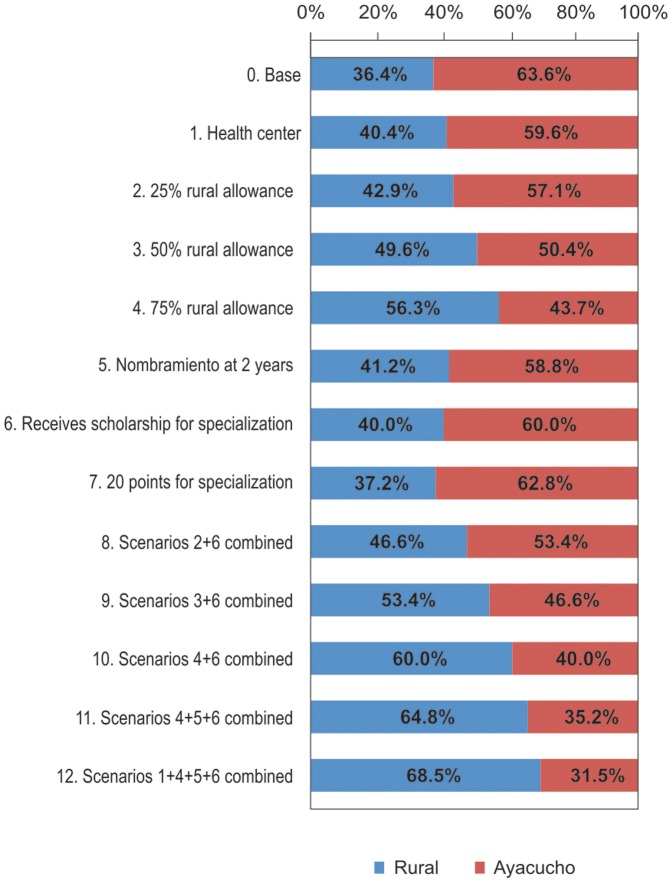
BACKGROUND: Robust evidence on interventions to improve the shortage of health workers in rural areas is needed. We assessed stated factors that would attract short-term contract nurses and midwives to work in a rural area of Peru. METHODS AND FINDINGS: A discrete choice experiment (DCE) was conducted to evaluate the job preferences of nurses and midwives currently working on a short-term contract in the public sector in Ayacucho, Peru. Job attributes, and their levels, were based on literature review, qualitative interviews and focus groups of local health personnel and policy makers. A labelled design with two choices, rural community or Ayacucho city, was used. Job attributes were tailored to these settings. Multiple conditional logistic regressions were used to assess the determinants of job preferences. Then we used the best-fitting estimated model to predict the impact of potential policy incentives on the probability of choosing a rural job or a job in Ayacucho city. We studied 205 nurses and midwives. The odds of choosing an urban post was 14.74 times than that of choosing a rural one. Salary increase, health center-type of facility and scholarship for specialization were preferred attributes for choosing a rural job. Increased number of years before securing a permanent contract acted as a disincentive for both rural and urban jobs. Policy simulations showed that the most effective attraction package to uptake a rural job included a 75% increase in salary plus scholarship for a specialization, which would increase the proportion of health workers taking a rural job from 36.4% up to 60%. CONCLUSIONS: Urban jobs were more strongly preferred than rural ones. However, combined financial and non-financial incentives could almost double rural job uptake by nurses and midwifes. These packages may provide meaningful attraction strategies to rural areas and should be considered by policy makers for implementation.
Overview
The claims and statistics of this paper haven’t been checked yet.
Free: it reads the open-access text and checks the first 5 claims that cite a source we can check. Create a free account to check every claim.
Integrity signals
Registry
Cites
Statistics
Figures
Verification
Claims the paper makes
The claims and statistics of this paper haven’t been checked yet.
Free: it reads the open-access text and checks the first 5 claims that cite a source we can check. Create a free account to check every claim.
Claims other papers make about this one
Each is checked against this paper’s own text: does it say what the citing paper says it does?
In the citing paper
“For village midwives in Indonesia, and nurse–midwives in Peru, the earning potential of moving to a city outweighed any rural government subsidy and therefore contributed to low rural retention levels [52, 54].”
From What Prevents Quality Midwifery Care? A Systematic Mapping of Barriers in Low and Middle Income Countries from the Provider Perspective (2016) · cites this paper as [54]
Self-check
Percentages, sums and reported differences re-computed from the paper’s own numbers.
The self-check needs the paper’s full text.
Citations
Cites
The World Health report 2006 1 : Working together for health 2
Guilbert, J.-J. (2006) · Education for Health: Change in Learning & Practice · doi:10.1080/13576280600937911 · Cited by 2,654
Wilson, N., Couper, I., de Vries, E., Reid, S., Fish, T., & Marais, B. (2009) · Rural and Remote Health · doi:10.22605/rrh1060 · Cited by 518
Dolea, C., Stormont, L., & Braichet, J.-M. (2010) · Bulletin of the World Health Organization · doi:10.2471/blt.09.070607 · Cited by 430
Grobler, L., Marais, B. J., & Mabunda, S. (2015) · Cochrane Database of Systematic Reviews · doi:10.1002/14651858.cd005314.pub3 · Cited by 359
de Bekker-Grob, E. W., Hol, L., Donkers, B., van Dam, L., Habbema, J. D. F., van Leerdam, M. E., Kuipers, E. J., Essink-Bot, M.-L., & Steyerberg, E. W. (2010) · Value in Health · doi:10.1111/j.1524-4733.2009.00670.x · Cited by 224
Eliciting GPs’ preferences for pecuniary and non-pecuniary job characteristics
Scott, A. (2001) · Journal of Health Economics · doi:10.1016/s0167-6296(00)00083-7 · Cited by 192
Grobler, L., Marais, B. J., Mabunda, S., Marindi, P., Reuter, H., & Volmink, J. (2009) · Cochrane Database of Systematic Reviews · doi:10.1002/14651858.cd005314.pub2 · Cited by 174
Policy interventions that attract nurses to rural areas: a multicountry discrete choice experiment
Blaauw, D., Erasmus, E., Pagaiya, N., Tangcharoensathein, V, Mullei, K., Mudhune, S., Goodman, C., English, M., & Lagarde, M. (2010) · Bulletin of the World Health Organization · doi:10.2471/blt.09.072918 · Cited by 172
Self-citationRural practice preferences among medical students in Ghana: a discrete choice experiment
Kruk, M. E., Johnson, J. C., Gyakobo, M., Agyei-Baffour, P., Asabir, K., Kotha, S. R., Kwansah, J., Nakua, E., Snow, R. C., & Dzodzomenyo, M. (2010) · Bulletin of the World Health Organization · doi:10.2471/blt.09.072892 · Cited by 165 · cited 2×
“Our findings are in agreement with results of other studies performed in other developing countries, highlighting the need to combine financial and non-financial incentives [7,8,27].”
MethodResultPedersen, D., Tremblay, J., Errázuriz, C., & Gamarra, J. (2008) · Social Science & Medicine · doi:10.1016/j.socscimed.2008.03.040 · Cited by 158
Research works printed but not linked: 1
- World Health Organization. Increasing access to health workers in remote and rural areas through improved retention: global policy recommendations (2010) Geneva. Available: http://www.who.int/hrh/retention/guidelines/en/index.html. Accessed 2012 Oct 26. 23741785
Cited by
Sample Size Requirements for Discrete-Choice Experiments in Healthcare: a Practical Guide
de Bekker-Grob, E. W., Donkers, B., Jonker, M. F., & Stolk, E. A. (2015) · The Patient - Patient-Centered Outcomes Research · doi:10.1007/s40271-015-0118-z · Cited by 925
Discrete Choice Experiments in Health Economics: A Review of the Literature
Clark, M. D., Determann, D., Petrou, S., Moro, D., & de Bekker-Grob, E. W. (2014) · PharmacoEconomics · doi:10.1007/s40273-014-0170-x · Cited by 851
Grobler, L., Marais, B. J., & Mabunda, S. (2015) · Cochrane Database of Systematic Reviews · doi:10.1002/14651858.cd005314.pub3 · Cited by 359
Filby, A., McConville, F., & Portela, A. (2016) · PLOS ONE · doi:10.1371/journal.pone.0153391 · Cited by 323
“For village midwives in Indonesia, and nurse–midwives in Peru, the earning potential of moving to a city outweighed any rural government subsidy and therefore contributed to low rural retention levels [52, 54].”
BackgroundThe use of discrete choice experiments to inform health workforce policy: a systematic review
Mandeville, K. L., Lagarde, M., & Hanson, K. (2014) · BMC Health Services Research · doi:10.1186/1472-6963-14-367 · Cited by 174
Self-citationQuality of care provided by mid-level health workers: systematic review and meta-analysis
Lassi, Z. S., Cometto, G., Huicho, L., & Bhutta, Z. A. (2013) · Bulletin of the World Health Organization · doi:10.2471/blt.13.118786 · Cited by 85
Self-citationAraújo, E., & Maeda, A. (2013) · World Bank, Washington, DC eBooks · doi:10.1596/16104 · Cited by 110
Salloum, R. G., Shenkman, E. A., Louviere, J. J., & Chambers, D. A. (2017) · Implementation Science · doi:10.1186/s13012-017-0675-8 · Cited by 87
Human resource management in post-conflict health systems: review of research and knowledge gaps
Roome, E., Raven, J., & Martineau, T. (2014) · Conflict and Health · doi:10.1186/1752-1505-8-18 · Cited by 93
Yang, J.-C., Johnson, F. R., Kilambi, V., & Mohamed, A. F. (2015) · Journal of Choice Modelling · doi:10.1016/j.jocm.2015.09.001 · Cited by 77
Effective policies for eliminating nursing workforce shortages: A systematic review
Park, H., & Yu, S. (2019) · Health Policy and Technology · doi:10.1016/j.hlpt.2019.08.003 · Cited by 69
El requisito obligatorio del servicio social en salud del Perú: discriminatorio e inconstitucional
Mayta‐Tristán, P., Poterico, J. A., Galán-Rodas, E., & Raa-Ortiz, D. (2014) · Revista Peruana de Medicina Experimental y Salud Pública · doi:10.17843/rpmesp.2014.314.134 · Cited by 48
Job preferences for medical students in China: A discrete choice experiment
Liu, S., Li, S., Yang, R., Liu, T., & Chen, G. (2018) · Medicine · doi:10.1097/md.0000000000012358 · Cited by 42
Huicho, L., Molina, C., Diez‐Canseco, F., Lema, C., Miranda, J. J., Huayanay-Espinoza, C. A., & Lescano, A. G. (2015) · Human Resources for Health · doi:10.1186/s12960-015-0091-6 · Cited by 40
Self-citationNurse career mapping: a qualitative case study of a new hospital
Sandehang, P. M., Hariyati, R. T. S., & Rachmawati, I. N. (2019) · BMC Nursing · doi:10.1186/s12912-019-0353-z · Cited by 39
Nurse practitioner job preference: A discrete choice experiment
Li, Y., Howell, J. R., & Cimiotti, J. P. (2022) · International Journal of Nursing Studies · doi:10.1016/j.ijnurstu.2022.104407 · Cited by 39
For more than money: willingness of health professionals to stay in remote Senegal
Honda, A., Krucien, N., Ryan, M., Diouf, I. S. N., Salla, M., Nagai, M., & Fujita, N. (2019) · Human Resources for Health · doi:10.1186/s12960-019-0363-7 · Cited by 38
Jiménez, M. M., Bui, A. L., Mantilla, E., & Miranda, J. J. (2017) · Human Resources for Health · doi:10.1186/s12960-017-0243-y · Cited by 35
Self-citationJob preferences for healthcare administration students in China: A discrete choice experiment
Liu, S., Li, S., Li, Y., Wang, H., Zhao, J., & Chen, G. (2019) · PLoS ONE · doi:10.1371/journal.pone.0211345 · Cited by 34
Stated job preferences of three health worker cadres in Ethiopia: a discrete choice experiment
Lamba, S., Arora, N., Keraga, D. W., Kiflie, A., Jembere, B. M., Berhanu, D., Dubale, M., Marchant, T., Schellenberg, J., Umar, N., et al. (2021) · Health Policy and Planning · doi:10.1093/heapol/czab081 · Cited by 27
Bendezú-Quispe, G., Mari-Huarache, L. F., Taype-Rondán, Á., Mejia, C. R., & Inga-Berrospi, F. (2020) · Revista Peruana de Medicina Experimental y Salud Pública · doi:10.17843/rpmesp.2020.374.5294 · Cited by 26
The attractiveness of jobs in the German care sector: results of a factorial survey
Kroczek, M., & Späth, J. A. (2022) · The European Journal of Health Economics · doi:10.1007/s10198-022-01443-z · Cited by 26
How to make hand hygiene interventions more attractive to nurses: A discrete choice experiment
Zhao, Q., Yang, M. M.-H., Huang, Y., & Chen, W.-L. (2018) · PLoS ONE · doi:10.1371/journal.pone.0202014 · Cited by 26
An Overview of Data Collection in Health Preference Research
Özdemir, S., Quaife, M., Mohamed, A. F., & Norman, R. (2024) · Patient · doi:10.1007/s40271-024-00695-6 · Cited by 18
García‐Fernández, L., Benites, C. M., & Huamán, B. (2017) · PubMed Central · doi:10.26633/rpsp.2017.23 · Cited by 17
Hilo, A. A., & McPeak, J. G. (2024) · BMC Health Services Research · doi:10.1186/s12913-024-11971-4 · Cited by 16
Goodwin, E., Hawton, A., Whitty, J. A., & Green, C. (2021) · Journal of Occupational Rehabilitation · doi:10.1007/s10926-020-09952-5 · Cited by 16
La Medicina Basada en la Evidencia: ¿mejoró la medicina que practicamos y enseñamos?
Huicho, L., Carreazo, N. Y., & Gonzales, C. (2013) · Anales de la Facultad de Medicina · doi:10.15381/anales.v74i3.2641 · Cited by 16
Self-citationHamouzadeh, P., Akbarisari, A., Olyaeemanesh, A., & Yekaninejad, M. S. (2019) · Medical Journal of the Islamic Republic of Iran · doi:10.47176/mjiri.33.83 · Cited by 16
Exploring employment preferences of nurses to improve retention in rural China
Bao, M., Wang, H., Huang, C., Wang, L., Xie, C., & Chen, G. (2023) · International Journal of Nursing Studies · doi:10.1016/j.ijnurstu.2023.104473 · Cited by 14
Nurses’ job preferences for working in deprived areas in Tehran: a discrete choice experiment
Haddadfar, A. M., Emamgholipour, S., Razani, M., & Salehnejad, M. H. (2023) · Human Resources for Health · doi:10.1186/s12960-023-00875-9 · Cited by 13
Bao, M., Huang, C., Wang, L., Yan, G., & Chen, G. (2023) · BMJ Open · doi:10.1136/bmjopen-2021-056741 · Cited by 13
Khamis, K., & Njau, B. (2015) · Tanzania journal of health research/Tanzania Journal of Health Research · doi:10.4314/thrb.v18i1.5 · Cited by 13
Tam, Y., Huicho, L., Huayanay-Espinoza, C. A., & Restrepo–Méndez, M. C. (2016) · BMC Public Health · doi:10.1186/s12889-016-3668-7 · Cited by 12
Self-citationThe experience of nurses to reduce implicit rationing of nursing care: a phenomenological study
Li, H. Q., Xie, P., Huang, X., & Luo, S. X. (2023) · BMC Nursing · doi:10.1186/s12912-023-01334-5 · Cited by 9
From classroom to workforce: a discrete choice analysis of Iranian nursing students’ job preferences
Moradi, K., Khosravi, K., Jalali, A., & Rezaei, S. (2025) · BMC Medical Education · doi:10.1186/s12909-024-06612-7 · Cited by 7
Stated preferences over job characteristics: A panel study
Doiron, D., & Yoo, H. I. (2020) · Canadian Journal of Economics/Revue canadienne d économique · doi:10.1111/caje.12431 · Cited by 6
Medical students’ interests on rural practices
Gazali, K. M., Syakurah, R. A., & Fadilah, M. (2019) · International Journal of Public Health Science (IJPHS) · doi:10.11591/ijphs.v8i2.19633 · Cited by 5
Mapping a Career Ladder as an Initial Step in the Retention of Nurses
Sandehang, P. M., & HARIYATI, R. T. S. (2017) · International Journal of Health and Medical Sciences · doi:10.20469/ijhms.3.30003-2 · Cited by 5
Widening inclusion: A discrete choice experiment of job preferences of disabled people
Derbyshire, D. W., Grosskopf, B., Blackmore, T., Goodwin, E., & Spencer, A. E. (2025) · The Economic and Labour Relations Review · doi:10.1017/elr.2025.11 · Cited by 4
Kroczek, M., & Kugler, P. (2024) · Labour Economics · doi:10.1016/j.labeco.2024.102632 · Cited by 4
Beaulieu, M., Viens, D., Gilbert‐Ouimet, M., Rossignol, S., Gagnon, M., Turmel, N., Racine, S., Cameron, M., Roy, N., Bernier, L., et al. (2024) · BMJ Open · doi:10.1136/bmjopen-2023-078518 · Cited by 3
Bennett, A. (2014) · UTS ePRESS (University of Technology Sydney) · Cited by 3
Job preference of nurse practitioners: A simulation approach
Li, Y., Howell, J. R., & Cimiotti, J. P. (2025) · International Journal of Nursing Studies Advances · doi:10.1016/j.ijnsa.2025.100406 · Cited by 2
Discrete choice experiments in nursing workforce research: A methodological review
Li, Y., Howell, J. R., & Cimiotti, J. P. (2025) · International Journal of Nursing Studies · doi:10.1016/j.ijnurstu.2025.105262 · Cited by 2
Rana, S. A. (2017) · Journal of Healthcare Communications · doi:10.4172/2472-1654.100043 · Cited by 2
Caputo, V., Kaminski, D. M., & Porter, M. (2023) · Journal of the Agricultural and Applied Economics Association · doi:10.1002/jaa2.54 · Cited by 2
Kamara, J. S. (2015) · City Research Online (City University London) · Cited by 2
Job Preferences of Frontline Health Workers in Ghana - A Discrete Choice ExperimentPreprint
Dunsch, F. A., & Velényi, E. V. (2022) · SocArXiv (OSF Preprints) · doi:10.31235/osf.io/bqx5k · Cited by 1
Emamgholipour, S., Shahraki, M., & Haddadfar, A. M. (2022) · medRxiv · doi:10.1101/2022.10.18.22281235 · Cited by 1
Guo, Y., Nie, H., Chen, H., Nicholas, S., Maitland, E., Chen, S., Huang, L., Zhang, X., & Shi, X. (2024) · Research Square · doi:10.21203/rs.3.rs-5406176/v1 · Cited by 1
Train to retain: the role of specialty training in stemming Malawi's medical brain drain.
Mandeville, K. (2016) · LSHTM Research Online (London School of Hygiene and Tropical Medicine) · doi:10.17037/pubs.02551723
“To become independent and remain independent” Living with mobility impairments in rural Peru
Rankinen, M. (2017) · NORA - Norwegian Open Research Archives
José, M. (2019) · Open University of Cape Town (University of Cape Town)
Job preferences of Japanese global health personnel: results from a discrete choice experiment
地引, 英., Bolt, T., & Sugishita, T. (2023) · Journal of Global Health Reports · doi:10.29392/001c.75463
Zegeye, E. A., Mbonigaba, J., & Strauss, M. (2024) · Research Square · doi:10.21203/rs.3.rs-4350274/v1
Haddadfar, A. M., Emamgholipour, S., Razani, M., & Salehnejad, M. H. (2023) · Figshare · doi:10.6084/m9.figshare.24647168
Chen, W. (2016) · UNSWorks (UNSW Sydney) · doi:10.26190/unsworks/2896
Lythgoe, C. (2024) · White Rose eTheses Online (University of Leeds, The University of Sheffield, University of York)
What Do Nurses Value Most? Evidence From a Discrete Choice Experiment in Indonesia’s Remote Regions
Efendi, F., Has, E. M. M., Pradipta, R. O., Chong, M. C., & Kurniati, A. (2026) · International Journal of Health Policy and Management · doi:10.34172/ijhpm.9538
Curisinche-Rojas, M., Moreno, T. M. E., Gómez, R. Y. P., Barrantes-Cruz, L. Z., Solis, G., Yupanqui-Martinez, I., Peña, L. I. C., Cabrera, C. V., Hilario, J. D. S., & Caycho‐Rodríguez, T. (2026) · Revista Latino-Americana de Enfermagem · doi:10.1590/1518-8345.8021.4972
Curisinche-Rojas, M., Moreno, T. M. E., Gómez, R. Y. P., Barrantes-Cruz, L. Z., Solis, G., Yupanqui-Martinez, I., Peña, L. I. C., Cabrera, C. V., Hilario, J. D. S., & Caycho‐Rodríguez, T. (2026) · Revista Latino-Americana de Enfermagem · doi:10.1590/1518-8345.8021.4974
Curisinche-Rojas, M., Moreno, T. M. E., Gómez, R. Y. P., Barrantes-Cruz, L. Z., Solis, G., Yupanqui-Martinez, I., Peña, L. I. C., Cabrera, C. V., Hilario, J. D. S., & Caycho‐Rodríguez, T. (2026) · Revista Latino-Americana de Enfermagem · doi:10.1590/1518-8345.8021.4973
Metadata
- Authors
- Huicho, L., Miranda, J. J., Diez-Canseco, F., Lema, C., Lescano, A. G., Lagarde, M., & Blaauw, D.
- Affiliations
- National University of San Marcos (PE)
- Universidad Peruana Cayetano Heredia (PE)
- University of the Witwatersrand (ZA)
- Corresponding author
- Huicho, Luis
- Venue
- PLoS ONE
- Publisher
- Public Library of Science (PLoS)
- Published
- 2012-12-20
- Volume
- 7
- Issue
- 12
- Pages
- e50315
- ISSN
- 1932-6203 (ISSN-L)
- PMC
- PMC3527463
- OpenAlex
- W2111387245
- Cited by
- 57
- References
- 19
- Citations by year
- 2026: 3 · 2025: 4 · 2024: 6 · 2023: 7 · 2022: 4 · 2021: 2 · 2020: 2 · 2019: 7 · 2018: 2 · 2017: 5 · 2016: 2 · 2015: 5 · 2014: 5 · 2013: 3
- FWCI
- 7.14
- Type
- journal article
- Language
- en
- Open access
- gold
- doi.org
- Licence
- Locations
- PLoS ONE (publishedVersion, public-domain)
- Europe PMC (PubMed Central) (publishedVersion, other-oa)
- PubMed Central (publishedVersion, public-domain)
- PubMed (publishedVersion)
- LSHTM Research Online (London School of Hygiene and Tropical Medicine) (acceptedVersion)
- RePEc: Research Papers in Economics (submittedVersion)
- DOAJ (DOAJ: Directory of Open Access Journals) (submittedVersion, cc-by-sa)
- Universidad Peruana Cayetano Heredia Institutional Repository (submittedVersion, cc-by-nc-nd)
- Greater South Information System
- Funders
- U.S. Department of Health and Human Services (HHSN268200900033C)
- National Institutes of Health (HHSN268200900033C)
- Alliance for Health Policy and Systems Research
- National Heart, Lung, and Blood Institute (HHSN268200900033C)
- Fogarty International Center (2D43 TW000393, HHSN268200900033C, D43TW007393)
- Topics
- Health Sciences › Medicine › Public Health, Environmental and Occupational Health › Global Health Workforce Issues
- Health Sciences › Nursing › Research and Theory › Nursing education and management
- Social Sciences › Education › Education in Rural Contexts
- Keywords
- rural health workforce shortage, nurses, midwives, job preferences, rural-urban migration, health workforce recruitment, performance-based pay, health workforce policy, Ayacucho
- MeSH terms
- Adult, Career Choice, Female, Humans, Midwifery, Nurses, Peru, Rural Population
About these checks
Registry, retraction, Cites and statistics results are computed, not judged, with one exception: a printed reference that no index lists is read once by a model before it counts as a citation error. Claims are extracted by a model and kept only when their quote appears verbatim in the text; each cited source is then checked, with a model’s help, for whether it says what the claim relies on. Those verdicts can be wrong — read the claim’s quote and the cited source before relying on one.
Statistics and arithmetic are recomputed, not judged.
Confidence bands are shown only for fields calibrated on our annotated test set. None is calibrated yet, so no band is shown.
What counts as a claim ›How we measure confidence ›How we check this ›
Are you an author, or do you see a problem with this page? Request a review
Data sources
Bibliographic data: Semantic Scholar, OpenAlex, Crossref.
Contains information from the Semantic Scholar Academic Graph Datasets, made available under the ODC Attribution License (ODC-BY 1.0).
Semantic Scholar’s data is described in: Kinney, R., et al. (2023). The Semantic Scholar Open Data Platform. arXiv:2301.10140.
