

Symbolic Metal Bit and Saddlebag Fastenings in a Middle Bronze Age Donkey Burial
Open accessThe DOI matches its Crossref record; 22 of the 24 references it cites were found in a registry or an index; none of the 78 sources its claims cite is checked for support yet.
Abstract
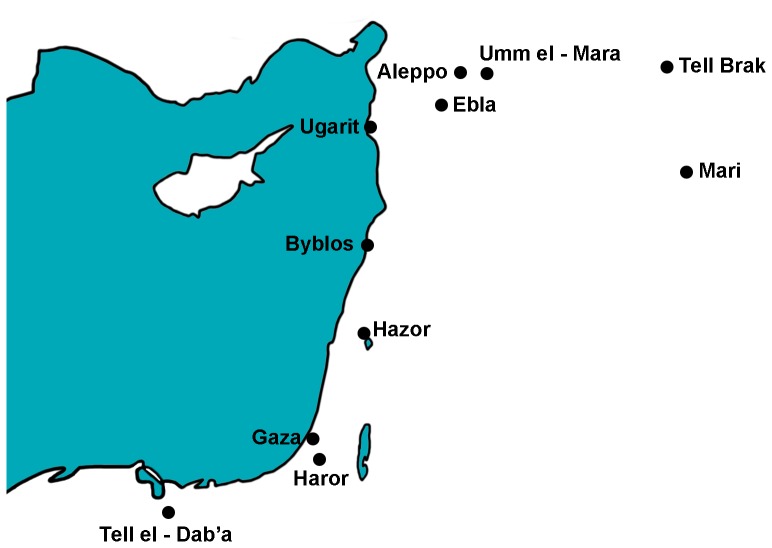
Here we report the unprecedented discovery of the skeleton of a ritually interred donkey with a metal horse bit in association with its teeth and saddlebag fastenings on its back. This discovery in the Middle Bronze Age III sacred precinct (1700/1650-1550 BCE) at Tel Haror, Israel, presents a unique combination of evidence for the early employment of equid harnessing equipment, both for chariot bridling (horse bit) and pack animals (saddlebags). The ritually deposited donkey with its unique accoutrements advances our understanding of the broad social and religious significance of equids in the Levantine Bronze Age, previously known mainly from textual and iconographical sources.
Overview
CoChat Summary
TL;DR
The paper reports a ritually interred ~4-year-old donkey from the MBA III sacred precinct at Tel Haror, Israel (1700/1650–1550 BCE), buried with a copper horse bit in its mouth and 12 copper saddlebag fasteners on its back. The authors argue the defective bit and absence of bit wear indicate symbolic harnessing, and that the find is the earliest secure MBA metal bit and earliest pre-Iron Age saddlebag evidence in the Levant/Egypt.
Key findings
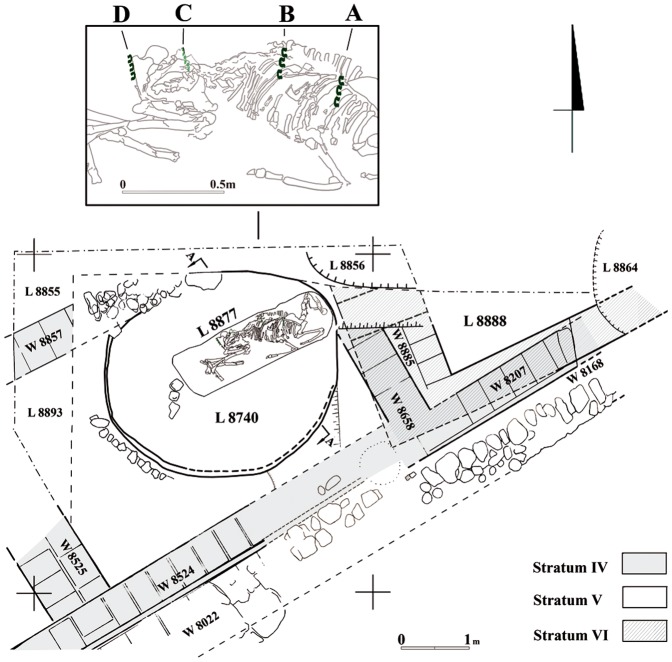
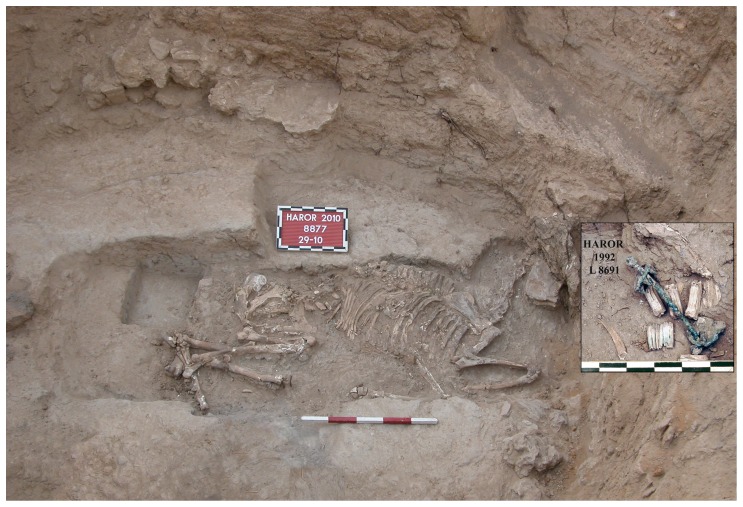
- A fully articulated young donkey (*Equus asinus*), approximately 4 years old, was buried in a pit within a circular installation in the MBA III sacred precinct; it was laid on its left side with three limbs bent, and its left hind leg seems to have been intentionally broken to fit the pit.
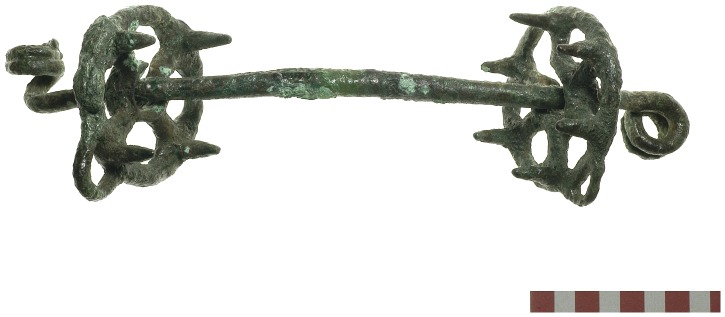
- A copper bridle bit was found in association with its teeth: a solid-forged, round-sectioned (1.1 cm) mouthpiece 24.0 cm long, with cast discoid cheekpieces 6.3 cm in diameter, studded/spoke-wheeled, non-matching (four and six studs/spokes), and assembled from three parts; it was defective and lacked rings or headstall/rein fittings.
- No bit wear was found on the lower premolars, and the donkey’s young age suggests it was not a trained draught animal; the authors conclude the bit had symbolic significance. They state it is the earliest known metal bit from a secure MBA context and the only Bronze Age metal bit recorded in context in an equid’s mouth.
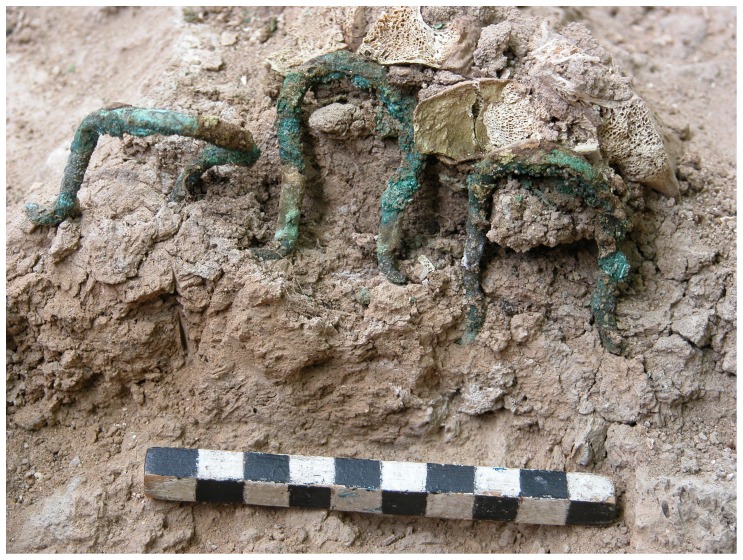
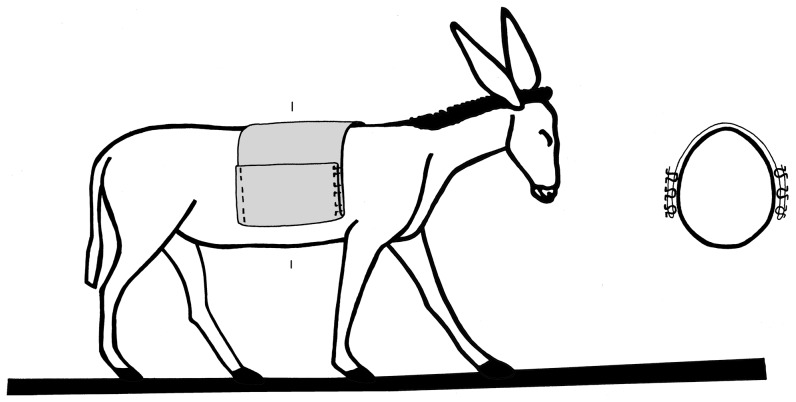
- Twelve corroded copper omega-shaped fittings (0.4 cm thick; ~4.0 × 4.0 cm; circular section 3.0 cm diameter) were arranged in four rows of three, ca. 2.0 cm apart, with row lengths of 14.0–16.0 cm; these are interpreted as saddlebag fasteners, reconstructing a saddle width of ca. 30.0 cm and bag size of ca. 35.0 × 20.0 cm, and are called the earliest archaeological evidence for saddlebags in the Levant and Egypt prior to the Iron Age.
Methods
- Excavation was directed by E.D. Oren, P. Nahshoni, and G. Bar-Oz on behalf of Ben-Gurion University of the Negev under Israel Antiquities Authority license no. G-61/2010; fragile bones were exposed by removing adjacent sediment and measured in situ.
- Identification as *Equus asinus* was first carried out by J. Klenck, R.H. Meadow, and J. Clutton-Brock based on cheek-tooth enamel patterns, later approved by limb-bone size and proportions; age was determined via tooth wear/eruption and epiphyseal closure.
- Bones were examined under a 10× Olympus stereomicroscope with oblique light for surface modifications (butchery, burning, carnivore puncture, scoring, digestion) and pathological alteration; dating relied on site stratigraphy, pottery assemblages, and regional ceramic sequences.
Limitations
- Stated in the paper: direct radiometric dating of the donkey skeleton and associated finds was not possible due to poor preservation of bone collagen and a dearth of datable organic material, a situation broadly characteristic of MBA sites in the region.
- Stated in the paper: most typologically similar metal bits are of uncertain date or unknown provenance, limiting secure comparative chronology; the Haror bit itself was defective, reassembled, and lacked rings/headstall fittings, so the authors infer symbolic rather than functional use.
- Evident from the text: the saddlebag reconstruction depends on the position, grouping, and dimensions of 12 copper fittings and on the assumption that metal fasteners were needed for leather; no organic saddlebag remains are reported.
Model-written summary. Check it against the paper before relying on it.
Integrity signals
Registry
Cites
Statistics
Figures
Verification
Claims the paper makes
0 Valid · 0 Not valid · 40 Not checked · 75 Own results and interpretations
A result the paper reports from its own data — it cites no other source for it, so there is none to check. The quote shows it is in the paper.
In the paper
“Dental wear and eruption and bone fusion of the donkey indicate that it was a young individual, approximately 4 years old.”
§ Symbolic Metal Bit and Saddlebag Fastenings in a Middle Bronze Age Donkey Burial > Results > Archaeological Context of the Donkey Interment
hedgedstates a causeSingle case- Asserted: passes — The authors put it forward as true.
- Checkable: passes — It can be checked against evidence.
- Load-bearing: unclear — It is unclear whether the paper’s conclusions depend on it.
- Based: passes — The paper gives a reason why it holds.
- Rests on an assumption not shown here.
A result the paper reports from its own data — it cites no other source for it, so there is none to check. The quote shows it is in the paper.
In the paper
“The distance between rows A and D is ca. 90.0 cm.”
§ Symbolic Metal Bit and Saddlebag Fastenings in a Middle Bronze Age Donkey Burial > Results > Saddlebags on the Donkey's Back
plainSingle case- Asserted: passes — The authors put it forward as true.
- Checkable: passes — It can be checked against evidence.
- Load-bearing: passes — The paper’s conclusions depend on it.
- Based: passes — The paper gives a reason why it holds.
A result the paper states — it cites no source for it, so there is none to check. The quote shows it is in the paper.
In the paper
“The presence of local and imported wares within the deposit establishes links with the late 2nd intermediate period in Egypt and Middle Bronze Age in Syria that provide a restricted chronological range.”
§ Symbolic Metal Bit and Saddlebag Fastenings in a Middle Bronze Age Donkey Burial > Results > Archaeological Context of the Donkey Interment
plainstates an associationSingle case- Asserted: passes — The authors put it forward as true.
- Checkable: passes — It can be checked against evidence.
- Load-bearing: passes — The paper’s conclusions depend on it.
- Based: passes — The paper gives a reason why it holds.
A result the paper reports from its own data — it cites no other source for it, so there is none to check. The quote shows it is in the paper.
In the paper
“This reassembly was achieved by reshaping one end of the bit, which resulted in an imperfect spiraled loop and producing an uneven finish with one spiral at a 90° plane relative to the other.”
§ Symbolic Metal Bit and Saddlebag Fastenings in a Middle Bronze Age Donkey Burial > Results > Symbolic Bit in the Donkey's Mouth
plainstates a causeSingle case- Asserted: passes — The authors put it forward as true.
- Checkable: passes — It can be checked against evidence.
- Load-bearing: passes — The paper’s conclusions depend on it.
- Based: passes — The paper gives a reason why it holds.
A result the paper reports from its own data — it cites no other source for it, so there is none to check. The quote shows it is in the paper.
In the paper
“Excavations of the donkey skeleton exposed a most unusual grouping of 12 corroded copper fittings placed on the upper part of the animal's rib cage (Figure 5, Figures S6 and S7; inventory numbers of Tel Haror expedition, Ben-Gurion University, Beer-Sheva 45151-45162).”
§ Symbolic Metal Bit and Saddlebag Fastenings in a Middle Bronze Age Donkey Burial > Results > Saddlebags on the Donkey's Back
plainSingle case- Asserted: passes — The authors put it forward as true.
- Checkable: passes — It can be checked against evidence.
- Load-bearing: passes — The paper’s conclusions depend on it.
- Based: passes — The paper gives a reason why it holds.
64 more claims
Create a free account to see all 115 claims and to verify the 75 references still open.
- Probably not a substantial claim. 18
- It may state two separate claims as one. 33
Self-check
Percentages, sums and reported differences re-computed from the paper’s own numbers.
Each contradiction between two passages listed here was confirmed by an independent check.
Rated minor: it would not touch a result — a value no result rests on, a p-value that stays on the same side of the significance level, or a conflict that is clerical, resolved elsewhere in the paper, or outside its own findings.
In the paper
§ Symbolic Metal Bit and Saddlebag Fastenings in a Middle Bronze Age Donkey Burial > Results > Archaeological Context of the Donkey Interment
“(1700/1650-1550 BCE; described in [16]: 252–283)”
§ Symbolic Metal Bit and Saddlebag Fastenings in a Middle Bronze Age Donkey Burial > References
“16. Oren ED (1997) The ‘kingdom of Sharuhen’ and the Hyksos kingdom. In: Oren ED, editor. The Hyksos: New historical and archaeological perspectives. Philadelphia: University of Pennsylvania Museum. 253–283.”
Rated minor: it would not touch a result — a value no result rests on, a p-value that stays on the same side of the significance level, or a conflict that is clerical, resolved elsewhere in the paper, or outside its own findings.
In the paper
§ Symbolic Metal Bit and Saddlebag Fastenings in a Middle Bronze Age Donkey Burial > Results > Saddlebags on the Donkey's Back
“Two rows designated A–B in Figure 4 were found on the upper, right side of the animal”
§ Symbolic Metal Bit and Saddlebag Fastenings in a Middle Bronze Age Donkey Burial > Results > Symbolic Bit in the Donkey's Mouth
“Figure: Figure 4 The bridle bit (Specimen IAA # 2009-951, The Israel Museum, Jerusalem).”
Citations
Cites
Lyman, R. L. (1994) · Cambridge University Press eBooks · doi:10.1017/cbo9781139878302 · Cited by 1,612
Domestication of the donkey: Timing, processes, and indicators
Rossel, S., Marshall, F., Peters, J., Pilgram, T., Adams, M. D., & O'Connor, D. (2008) · Proceedings of the National Academy of Sciences · doi:10.1073/pnas.0709692105 · Cited by 325
Prehistoric steppe adaptation and the horse
(2004) · Choice Reviews Online · doi:10.5860/choice.42-1655 · Cited by 235
The emergence of the light, horse‐drawn chariot in the Near‐East c. 2000–1500 B.C.
Moorey, P. R. S. (1986) · World Archaeology · doi:10.1080/00438243.1986.9979998 · Cited by 107
Kutschera, W., Bietak, M., Wild, E. M., Ramsey, C. B., Dee, M., Golser, R., Kopetzky, K., Stadler, P., Steier, P., Thanheiser, U., et al. (2012) · Radiocarbon · doi:10.1017/s0033822200047172 · Cited by 58
From Urban Origins to Imperial Integration in Western Syria: Umm el-Marra 2006, 2008
Schwartz, G. M., Curvers, H. H., Dunham, S. S., & Weber, J. A. (2011) · American Journal of Archaeology · doi:10.3764/aja.116.1.0157 · Cited by 42
Assessing Sacred Asses: Bronze Age Donkey Burials in the Near East
Way, K. C. (2010) · Levant · doi:10.1179/175638010x12797246583852 · Cited by 40
Horse power: a history of the horse and the donkey in human societies
(1993) · Choice Reviews Online · doi:10.5860/choice.30-3275 · Cited by 37
Die Pferdetrensen des alten Orient
Potratz, H. A. (1966) · Cited by 35
Littauer, M. A. (1969) · Antiquity · doi:10.1017/s0003598x00040734 · Cited by 27
Donkeys in the Biblical World: Ceremony and Symbol
Way, K. C. (2011) · Project Muse (Johns Hopkins University) · doi:10.1515/9781575066431 · Cited by 20
The Canaanite Cultic Milieu: The zooarchaeological evidence from Tel Haror, Israel
Klenck, J. D. (2002) · doi:10.30861/9781841714073 · Cited by 19
A Dog and a Donkey Excavated at Tell Brak
Clutton-Brock, J. (1989) · Iraq · doi:10.2307/4200305 · Cited by 16
Clutton-Brock, J., & Davies, S. (1993) · Iraq · doi:10.2307/4200377 · Cited by 13
The Buhen Horse: Fifty Years after Its Discovery (1958–2008)
Clutton-Brock, J., & Raulwing, P. (2009) · Journal of Egyptian History · doi:10.1163/187416509x12492786609122 · Cited by 10
The Earliest Evidence for Metal Bridle Parts
Littauer, M. A., & Crouwel, J. H. (2001) · Oxford Journal of Archaeology · doi:10.1111/1468-0092.00140 · Cited by 7
A Pair of Horse Bits of the Second Millennium B.C. from Iraq
Littauer, M. A., & Crouwel, J. H. (1988) · Iraq · doi:10.2307/4200291 · Cited by 1
Weber, J. A. (2008) · Travaux de la Maison de l'Orient et de la Méditerranée · doi:10.3406/mom.2008.2721
(2004) · White Rose eTheses Online (University of Leeds, The University of Sheffield, University of York)
(2000) · Persée
(2001)
(2004)
Research works printed but not linked: 13
- Bietak M (1996) Avaris, the capital of the Hyksos: recent excavations at Tell el-Dab'a. London: British Museum p 98.
- Holladay JSJ (1997) The Eastern Nile Delta during the Hyksos and Pre-Hyksos periods: towards a systemic/socioeconomic understanding. In: Oren ED, editor. The Hyksos: New Historical and Archaeological Perspectives. pp. 183–252. Philadelphia: The University Museum.
- Van den Brink ECM (1982) Tombs and burial customs at Tell el-Dab'a. Vienna: Beitrage zur Agyptologie p 140.
- Brownrigg G (2006) Horse control and the bit. In: Olsen SL, Grant S, Choyke AM, Bartosiewicz L, editors. Horses and humans: The evolution of human-equine relationship. Oxford: BAR International Series 1560:. 165–171.
- Dietz UL (2003) Horseback riding: man's access to speed? In: Levine M, Renfrew C, Boyle K, editors. Prehistoric steppe adaptation and the horse. Cambridge: McDonald Institute of Archaeology. 189–199.
- Postgate JN (1992) Early Mesopotamia: Society and economy at the dawn of history. London: Routledge. p. 367.
- Oates D, Oates J, McDonald H (2001) Excavations at Tell Brak. Vol. 2, Nagar in the third millennium BC. Cambridge: McDonald Institute of Archaeology. p. 642.
- Oates J (2003) A note on the early evidence for the horse and the riding of equids in Western Asia. In: Levine M, Renfrew C, Boyle K, editors. Prehistoric steppe adaptation and the horse. Cambridge: McDonald Institute of Archaeology. 115–125.
- Staubli T (2001) Stabile politik – florierende wirtschaft und umgekehrt: eine rechteckige, beidseitig gravierte platte der Hyksoszeit. ZDPV 117: 97– 115.
- Baines J, Malek J (1982) Atlas of ancient Egypt. Oxford: Equinox. p.240.
- Shaw I (1998) Exploiting the desert frontier: The logistics and politics of ancient Egyptian mining expeditions. In: Knapp AB, Pigott VC, Herbert EW, editors. Social approaches to an industrial past: The archaeology and anthropology of mining. London: Routledge. 242–258.
- Binford LR (1981) Bones: ancient men and modern myths. New York: New York Academic Press. p. 312.
- Levine MA (1982) The use of crown height measurements and eruption-wear sequences to age horse teeth. In: Wilson B, Grigson C, Payne S, editors. Ageing and sexing animal bones from archaeological sites. Oxford: BAR British Series vol. 109:. 223–250.
Cited by
The Archaeology of the Bronze Age Levant
Greenberg, R. (2019) · doi:10.1017/9781316275993 · Cited by 110
Identifying donkey domestication through changes in cross-sectional geometry of long bones
Shackelford, L., Marshall, F. B., & Peters, J. (2013) · Journal of Archaeological Science · doi:10.1016/j.jas.2013.06.006 · Cited by 55
M iddle B ronze A ge Burials in the Southern Levant: Spartan Warriors or Ordinary People?
Kletter, R., & Levy, Y. (2016) · Oxford Journal of Archaeology · doi:10.1111/ojoa.12076 · Cited by 43
González, F. J. N., Jordana, J., Jurado, J. M. L., McLean, A., & Bermejo, J. V. D. (2019) · Journal of Veterinary Behavior · doi:10.1016/j.jveb.2019.06.007 · Cited by 36
Grigson, C. (2015) · Levant · doi:10.1179/0075891415z.00000000055 · Cited by 31
Metadata
- Authors
- Bar-Oz, G., Nahshoni, P., Motro, H., & Oren, E. D.
- Affiliations
- Ben-Gurion University of the Negev (IL)
- Hebrew University of Jerusalem (IL)
- ORCID
- Oren, Eliezer D.
- Venue
- PLoS ONE
- Publisher
- Public Library of Science (PLoS)
- Published
- 2013-03-06
- Volume
- 8
- Issue
- 3
- Pages
- e58648
- ISSN
- 1932-6203 (ISSN-L)
- PMC
- PMC3590166
- OpenAlex
- W2021227478
- Semantic Scholar
- b7ff566ecc045d7a34391cc1b714f8fb73c3de64
- Cited by
- 37
- References
- 24
- Citations by year
- 2026: 10 · 2025: 1 · 2023: 1 · 2022: 1 · 2021: 2 · 2020: 1 · 2019: 14 · 2018: 3 · 2017: 1 · 2016: 1 · 2015: 1 · 2013: 1
- FWCI
- 3.86
- Type
- journal article
- Language
- en
- Open access
- gold
- doi.org
- Locations
- PLoS ONE (publishedVersion, cc-by)
- Europe PMC (PubMed Central) (publishedVersion, cc-by)
- PubMed Central (publishedVersion, cc-by)
- PubMed (publishedVersion)
- DOAJ (DOAJ: Directory of Open Access Journals) (submittedVersion)
- Figshare (submittedVersion, cc-by)
- Funders
- Israel Science Foundation (52/10)
- Ben-Gurion University of the Negev
- Topics
- Social Sciences › Arts and Humanities › Archeology (arts and humanities) › Ancient and Medieval Archaeology Studies
- Social Sciences › Archeology › Archaeology and ancient environmental studies
- Social Sciences › Arts and Humanities › Archeology (arts and humanities) › Ancient Mediterranean Archaeology and History
- Keywords
- horse bits, pack animals, ritual deposition, Middle Bronze Age, sacred precinct, animal sacrifice
- MeSH terms
- Animals, Archaeology, Burial, Humans, Israel, Metals, Symbolism, Equidae, History, Ancient
About these checks
Registry, retraction, Cites and statistics results are computed, not judged, with one exception: a printed reference that no index lists is read once by a model before it counts as a citation error. Claims are extracted by a model and kept only when their quote appears verbatim in the text; each cited source is then checked, with a model’s help, for whether it says what the claim relies on. Those verdicts can be wrong — read the claim’s quote and the cited source before relying on one.
A language model drew the claims from the paper on 2026-11-27, under version 3 of the claim definition (model deepseek-v4.1-flash, prompt extract-v3).
A second model labelled each claim on 2026-11-27 (model jev-1.13-20260917, definition revision gold-guideline-v0.2).
Statistics and arithmetic are recomputed, not judged.
Confidence bands are shown only for fields calibrated on our annotated test set. None is calibrated yet, so no band is shown.
What counts as a claim ›How we measure confidence ›How we check this ›
Are you an author, or do you see a problem with this page? Request a review
Data sources
Bibliographic data: Semantic Scholar, OpenAlex, Crossref.
Contains information from the Semantic Scholar Academic Graph Datasets, made available under the ODC Attribution License (ODC-BY 1.0).
Semantic Scholar’s data is described in: Kinney, R., et al. (2023). The Semantic Scholar Open Data Platform. arXiv:2301.10140.
