

The DOI matches its Crossref record; 82 of the 82 references it cites were found in a registry or an index.
Phylogenetic analysis reveals a cryptic species Blastomyces gilchristii, sp. nov. within the human pathogenic fungus Blastomyces dermatitidis.
Open accessAbstract
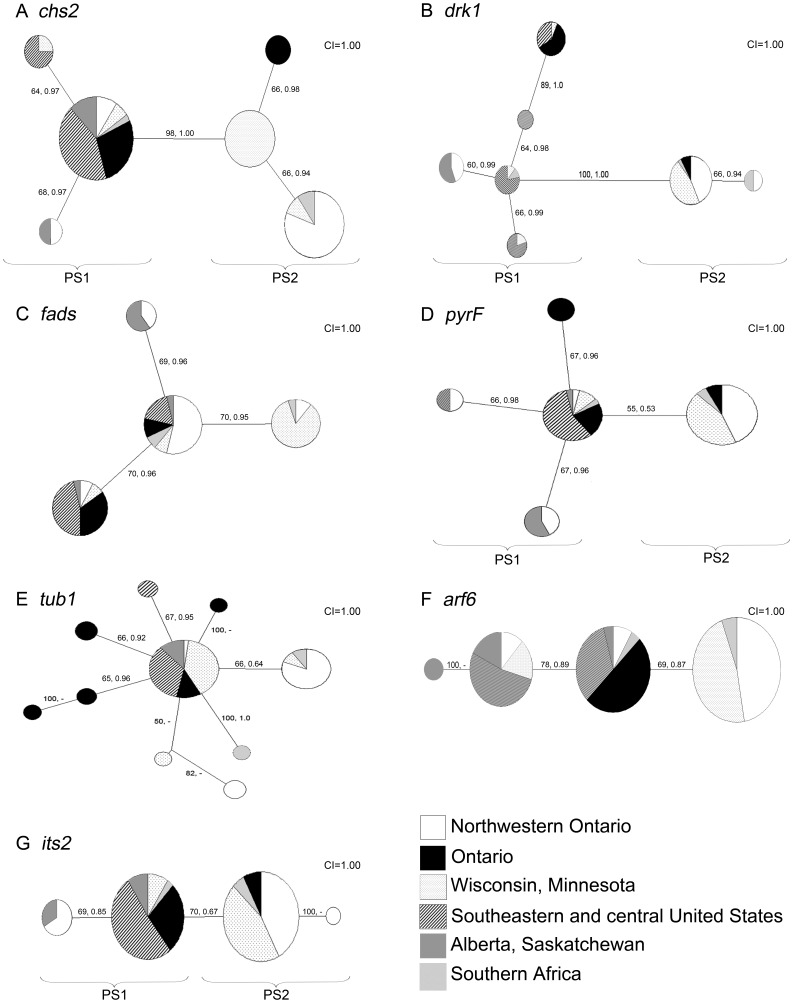
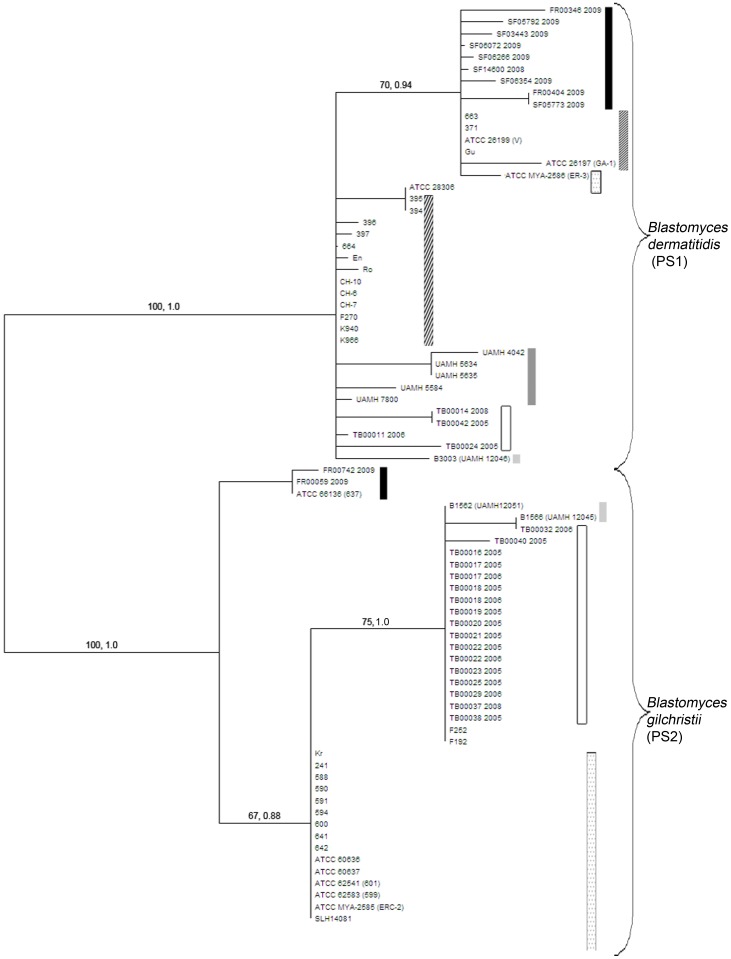
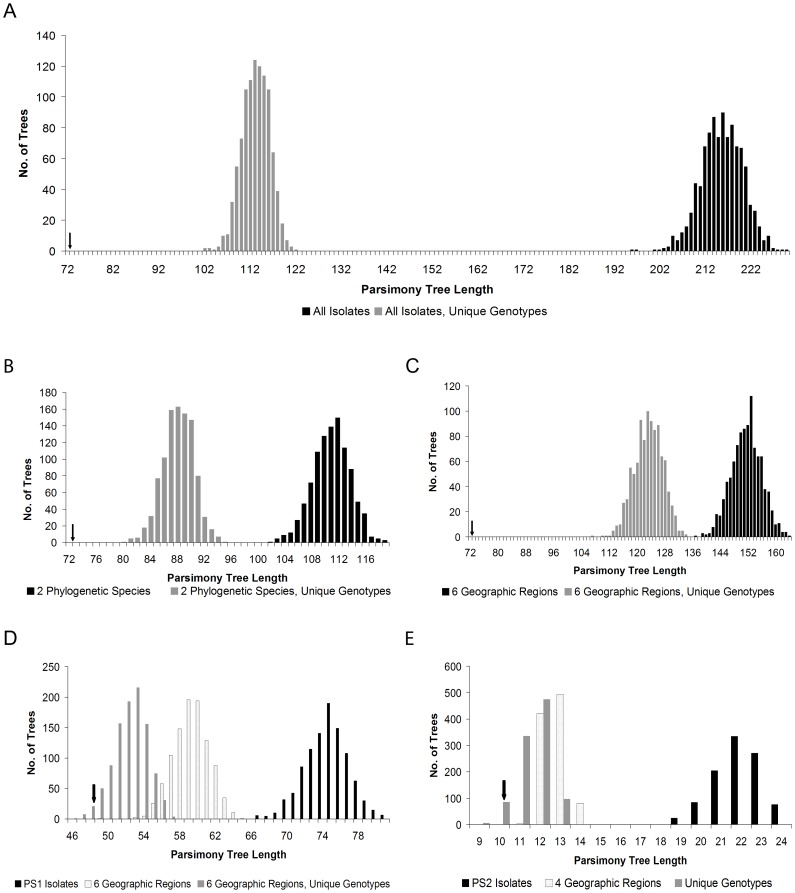
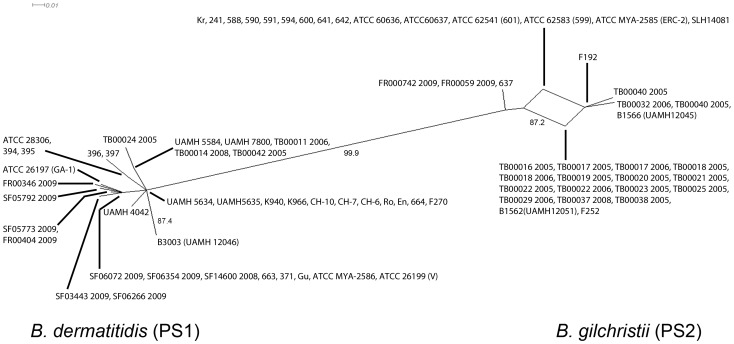
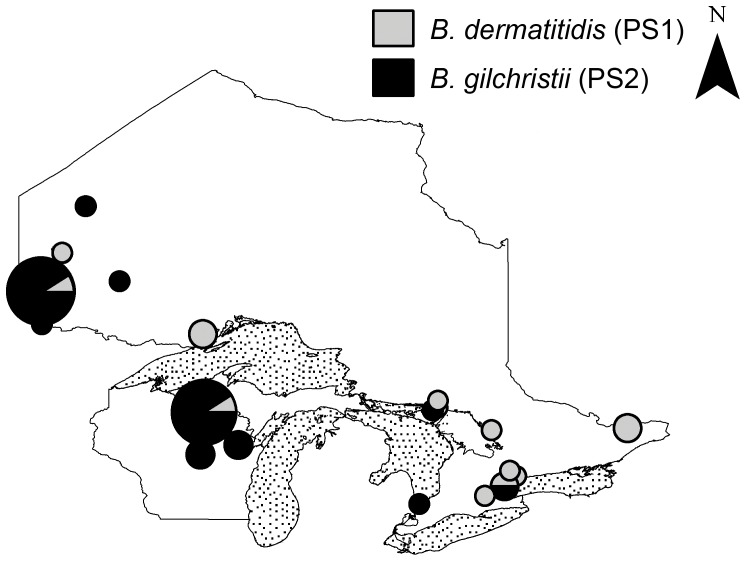
BACKGROUND: Analysis of the population genetic structure of microbial species is of fundamental importance to many scientific disciplines because it can identify cryptic species, reveal reproductive mode, and elucidate processes that contribute to pathogen evolution. Here, we examined the population genetic structure and geographic differentiation of the sexual, dimorphic fungus Blastomyces dermatitidis, the causative agent of blastomycosis. METHODOLOGY/PRINCIPAL FINDINGS: Criteria for Genealogical Concordance Phylogenetic Species Recognition (GCPSR) applied to seven nuclear loci (arf6, chs2, drk1, fads, pyrF, tub1, and its-2) from 78 clinical and environmental isolates identified two previously unrecognized phylogenetic species. Four of seven single gene phylogenies examined (chs2, drk1, pyrF, and its-2) supported the separation of Phylogenetic Species 1 (PS1) and Phylogenetic Species 2 (PS2) which were also well differentiated in the concatenated chs2-drk1-fads-pyrF-tub1-arf6-its2 genealogy with all isolates falling into one of two evolutionarily independent lineages. Phylogenetic species were genetically distinct with interspecific divergence 4-fold greater than intraspecific divergence and a high Fst value (0.772, P<0.001) indicative of restricted gene flow between PS1 and PS2. Whereas panmixia expected of a single freely recombining population was not observed, recombination was detected when PS1 and PS2 were assessed separately, suggesting reproductive isolation. Random mating among PS1 isolates, which were distributed across North America, was only detected after partitioning isolates into six geographic regions. The PS2 population, found predominantly in the hyper-endemic regions of northwestern Ontario, Wisconsin, and Minnesota, contained a substantial clonal component with random mating detected only among unique genotypes in the population. CONCLUSIONS/SIGNIFICANCE: These analyses provide evidence for a genetically divergent clade within Blastomyces dermatitidis, which we use to describe a novel species, Blastomyces gilchristii sp. nov. In addition, we discuss the value of population genetic and phylogenetic analyses as a foundation for disease surveillance, understanding pathogen evolution, and discerning phenotypic differences between phylogenetic species.
Overview
The claims and statistics of this paper haven’t been checked yet.
Run the check — free, no account needed. It reads the open-access text and checks the sources it cites.
Integrity signals
Registry
Cites
Statistics
Figures
Verification
Claims the paper makes
The claims and statistics of this paper haven’t been checked yet.
Run the check — free, no account needed. It reads the open-access text and checks the sources it cites.
Claims other papers make about this one
Each is checked against this paper’s own text: does it say what the citing paper says it does?
In the citing paper
“Blastomycosis is an uncommon but underdiagnosed and potentially life-threatening infection caused by the dimorphic fungi Blastomyces dermatitidis, which includes at least 1 cryptic subspecies, B. gilchristii [170].”
From Race and ethnicity: Risk factors for fungal infections? (2023) · cites this paper as [170]
Self-check
Percentages, sums and reported differences re-computed from the paper’s own numbers.
The self-check needs the paper’s full text.
Citations
Cites
Amplification and direct sequencing of fungal ribosomal RNA genes for phylogenetics
White, T. J., Bruns, T., Lee, S., & Taylor, J. (1990) · PCR Protocols · doi:10.1016/b978-0-12-372180-8.50042-1 · Cited by 36,648
MrBayes 3: Bayesian phylogenetic inference under mixed models
Ronquist, F., & Huelsenbeck, J. P. (2003) · Bioinformatics · doi:10.1093/bioinformatics/btg180 · Cited by 29,194
DnaSP v5: a software for comprehensive analysis of DNA polymorphism data
Librado, P., & Rozas, J. (2009) · Bioinformatics · doi:10.1093/bioinformatics/btp187 · Cited by 16,147
jModelTest: Phylogenetic Model Averaging
Posada, D. (2008) · Molecular Biology and Evolution · doi:10.1093/molbev/msn083 · Cited by 10,578
Application of Phylogenetic Networks in Evolutionary Studies
Huson, D. H., & Bryant, D. (2005) · Molecular Biology and Evolution · doi:10.1093/molbev/msj030 · Cited by 8,895
Simple methods for estimating the numbers of synonymous and nonsynonymous nucleotide substitutions.
Nei, M., & Gojobori, T. (1986) · Molecular Biology and Evolution · doi:10.1093/oxfordjournals.molbev.a040410 · Cited by 4,904
Prokaryotes: The unseen majority
Whitman, W. B., Coleman, D. C., & Wiebe, W. J. (1998) · Proceedings of the National Academy of Sciences · doi:10.1073/pnas.95.12.6578 · Cited by 4,871
United Nations Environment Programme
Miller, N. N. (1987) · Brill | Nijhoff eBooks · doi:10.1163/9789004634169_010 · Cited by 3,699
White, T. C., Bruns, T. D., Lee, S., Taylor, F. J. R., White, T., Lee, S., Taylor, D. L., & Shawe‐Taylor, J. (1990) · Cited by 2,604
Phylogenetic Species Recognition and Species Concepts in Fungi
Taylor, J. W., Jacobson, D. J., Kroken, S., Kasuga, T., Geiser, D. M., Hibbett, D. S., & Fisher, M. C. (2000) · Fungal Genetics and Biology · doi:10.1006/fgbi.2000.1228 · Cited by 1,904
Research works printed but not linked: 1
- TC Gilchrist, 1894, Protozoan dermatitis, J Cutan Gen Dis, 12, 496
Cited by
Sorted by citations
Donnelly, J. P., Chen, S. C.-J., Kauffman, C. A., Steinbach, W. J., Baddley, J. W., Verweij, P. E., Clancy, C. J., Wingard, J. R., Lockhart, S. R., Groll, A. H., et al. (2019) · Clinical Infectious Diseases · doi:10.1093/cid/ciz1008 · Cited by 2,987
Self-citationFungal Diversity Revisited: 2.2 to 3.8 Million Species
Hawksworth, D. L., & Lücking, R. (2017) · Microbiology Spectrum · doi:10.1128/microbiolspec.funk-0052-2016 · Cited by 1,346
A pan-cancer mycobiome analysis reveals fungal involvement in gastrointestinal and lung tumors
Dohlman, A. B., Klug, J., Mesko, M., Gao, I. H., Lipkin, S. M., Shen, X., & Iliev, I. D. (2022) · Cell · doi:10.1016/j.cell.2022.09.015 · Cited by 429
Emerging Fungal Infections: New Patients, New Patterns, and New Pathogens
Friedman, D. Z. P., & Schwartz, I. S. (2019) · Journal of Fungi · doi:10.3390/jof5030067 · Cited by 369
Wijayawardene, N. N., Hyde, K. D., Rajeshkumar, K. C., Hawksworth, D. L., Hugo Madrid, L., Kirk, P. M., Braun, U., Singh, R. V., Crous, P. W., Kukwa, M., et al. (2017) · Fungal Diversity · doi:10.1007/s13225-017-0386-0 · Cited by 335
Metadata
- Authors
- Brown, E. M., McTaggart, L. R., Zhang, S. X., Low, D. E., Stevens, D. A., & Richardson, S. E.
- Affiliations
- Mount Sinai Hospital (CA)
- Public Health Ontario (CA)
- Johns Hopkins University (US)
- Santa Clara Valley Medical Center (US)
- University of Toronto (CA)
- Corresponding author
- McTaggart, Lisa R.
- ORCID
- Venue
- PLoS ONE
- Publisher
- Public Library of Science (PLoS)
- Published
- 2013-03-22
- Volume
- 8
- Issue
- 3
- Pages
- e59237
- ISSN
- 1932-6203 (ISSN-L)
- PMC
- PMC3606480
- OpenAlex
- W2033915514
- Cited by
- 148
- References
- 81
- Citations by year
- 2026: 5 · 2025: 6 · 2024: 13 · 2023: 17 · 2022: 8 · 2021: 11 · 2020: 14 · 2019: 10 · 2018: 12 · 2017: 8 · 2016: 21 · 2015: 10 · 2014: 10 · 2013: 3
- FWCI
- 10.71
- Type
- journal article
- Language
- en
- Update notices
- correction (2016-12-09)
- Open access
- gold
- doi.org
- Locations
- PLoS ONE (publishedVersion, cc-by)
- Europe PMC (PubMed Central) (publishedVersion, cc-by)
- PubMed Central (publishedVersion, cc-by)
- PubMed (publishedVersion)
- DOAJ (DOAJ: Directory of Open Access Journals) (submittedVersion, cc-by-sa)
- Figshare (submittedVersion, cc-by)
- Funders
- Northwestern University
- Topics
- Health Sciences › Medicine › Infectious Diseases › Fungal Infections and Studies
- Life Sciences › Biochemistry, Genetics and Molecular Biology › Genetics › Genetic diversity and population structure
- Life Sciences › Agricultural and Biological Sciences › Plant Science › Plant Pathogens and Fungal Diseases
- Keywords
- Blastomyces dermatitidis, cryptic species, blastomycosis, population structure, phylogenetic species recognition, territorial differentiation, recombination, reproductive isolation, clonal populations, nuclear loci, pathogen evolution, disease surveillance
- MeSH terms
- Blastomyces, DNA, Fungal, Genetics, Population, Humans, Phylogeny, Evolution, Molecular
About these checks
Registry, retraction, Cites and statistics results are computed, not judged, with one exception: a printed reference that no index lists is read once by a model before it counts as a citation error. Claims are extracted by a model and kept only when their quote appears verbatim in the text; each cited source is then checked, with a model’s help, for whether it says what the claim relies on. Those verdicts can be wrong — read the claim’s quote and the cited source before relying on one.
Statistics and arithmetic are recomputed, not judged.
Confidence bands are shown only for fields calibrated on our annotated test set. None is calibrated yet, so no band is shown.
What counts as a claim ›How we measure confidence ›How we check this ›
Are you an author, or do you see a problem with this page? Request a review
