

Topological Strata of Weighted Complex Networks
Open accessThe DOI matches its Crossref record; 64 of the 64 references it cites were found in a registry or an index.
Abstract
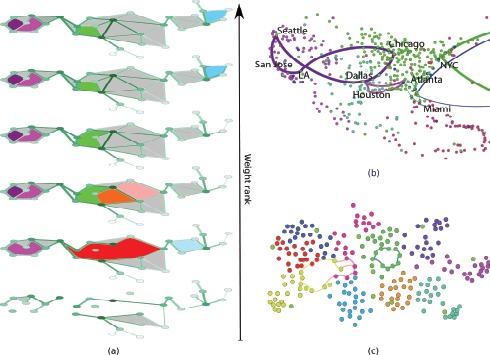
The statistical mechanical approach to complex networks is the dominant paradigm in describing natural and societal complex systems. The study of network properties, and their implications on dynamical processes, mostly focus on locally defined quantities of nodes and edges, such as node degrees, edge weights and -more recently- correlations between neighboring nodes. However, statistical methods quickly become cumbersome when dealing with many-body properties and do not capture the precise mesoscopic structure of complex networks. Here we introduce a novel method, based on persistent homology, to detect particular non-local structures, akin to weighted holes within the link-weight network fabric, which are invisible to existing methods. Their properties divide weighted networks in two broad classes: one is characterized by small hierarchically nested holes, while the second displays larger and longer living inhomogeneities. These classes cannot be reduced to known local or quasilocal network properties, because of the intrinsic non-locality of homological properties, and thus yield a new classification built on high order coordination patterns. Our results show that topology can provide novel insights relevant for many-body interactions in social and spatial networks. Moreover, this new method creates the first bridge between network theory and algebraic topology, which will allow to import the toolset of algebraic methods to complex systems.
Overview
The claims and statistics of this paper haven’t been checked yet.
Free: it reads the open-access text and checks the first 5 claims that cite a source we can check. Create a free account to check every claim.
Integrity signals
Registry
Cites
Statistics
Figures
Verification
Claims the paper makes
The claims and statistics of this paper haven’t been checked yet.
Free: it reads the open-access text and checks the first 5 claims that cite a source we can check. Create a free account to check every claim.
Claims other papers make about this one
Each is checked against this paper’s own text: does it say what the citing paper says it does?
The cited source says what the claim attributes to it.
In the citing paper
“In particular a new way to define a filtration on weighted networks has been recently proposed [24,25], where the filtrations correspond to different thresholds imposed to the weights of the links.”
From Interdisciplinary and physics challenges of network theory (2015) · cites this paper as [24]
The cited source says what the claim attributes to it.
In the citing paper
“The topological analysis that results is able to extract new information from network datasets that is not possible to extract using other less recent techniques of network theory.”
From Interdisciplinary and physics challenges of network theory (2015) · cites this paper as [24]
Self-check
Percentages, sums and reported differences re-computed from the paper’s own numbers.
The self-check needs the paper’s full text.
Citations
Cites
Collective dynamics of ‘small-world’ networks
Watts, D. J., & Strogatz, S. H. (1998) · Nature · doi:10.1038/30918 · Cited by 43,060 · cited 1×
“The network is available at http://cdg.columbia. edu/cdg/datasets and reports a weighted, directed representation of the C. Elegans’s neuronal network [40].”
BackgroundEmergence of Scaling in Random Networks
Barabási, A.-L., & Albert, R. (1999) · Science · doi:10.1126/science.286.5439.509 · Cited by 36,135
The Structure and Function of Complex Networks
Newman, M. E. J. (2003) · SIAM Review · doi:10.1137/s003614450342480 · Cited by 18,719 · cited 1×
“Complex networks have become one of the prominent tools in the study of social, technological and biological systems [1–3].”
MethodComplex networks: structure and dynamics
BOCCALETTI, S., LATORA, V, MORENO, Y., CHAVEZ, M., & HWANG, D. (2006) · Physics Reports · doi:10.1016/j.physrep.2005.10.009 · Cited by 11,010
Network motifs: simple building blocks of complex networks.
Milo, R., Shen-Orr, S., Itzkovitz, S., Kashtan, N., Chklovskii, D., & Alon, U. (2002) · Science · doi:10.1126/science.298.5594.824 · Cited by 7,368
The structure of scientific collaboration networks
Newman, M. E. J. (2001) · Proceedings of the National Academy of Sciences · doi:10.1073/pnas.98.2.404 · Cited by 4,482 · cited 1×
“The networks analysed are the weighted co-authorship networks of the Condensed Matter E-print Archive between 1995 and 1999 (cond-mat) and the High-Energy Theory E-print Archive between 1995 and 1999 (hep-th) [44].”
The architecture of complex weighted networks
Barrat, A., Barthélemy, M., Pastor-Satorras, R., & Vespignani, A. (2004) · Proceedings of the National Academy of Sciences · doi:10.1073/pnas.0400087101 · Cited by 4,218 · cited 1×
“Real-world networks display however intricate patterns of redundant links with edge weights and node degrees usually ranging over various orders of magnitudes [4,5].”
BackgroundPenrose, M. (2003) · doi:10.1093/acprof:oso/9780198506263.001.0001 · Cited by 2,480
Barthélemy, M. (2011) · Physics Reports · doi:10.1016/j.physrep.2010.11.002 · Cited by 2,469 · cited 1×
“A simple artificial network helps illustrating this point: Random Geometric Graphs (RGG) have been recently shown to display long-range many-body correlations [25,26].”
BackgroundCarlsson, G. (2009) · Bulletin of the American Mathematical Society · doi:10.1090/s0273-0979-09-01249-x · Cited by 2,302 · cited 1×
“It allows to recover complete and accurate long-range information from noisy redundant network data, by building on persistent homology [16], a recent theory developed in computational topology [17], which we extend to the case of networks.”
Background
Research works printed but not linked: 2
- Vázquez A, Dobrin R, Sergi D, Eckmann JP, Oltvai ZN, et al. Proc Nat Acad Sci USA 101: 17940– 17945. PMC539752 15598746
- Barthélemy M (2011) Spatial networks. Phys Rep 499. · DOI · Paper page
Cited by
Networks beyond pairwise interactions: Structure and dynamics
Battiston, F., Cencetti, G., Iacopini, I., Latora, V., Lucas, M., Patania, A., Young, J.-G., & Petri, G. (2020) · Physics Reports · doi:10.1016/j.physrep.2020.05.004 · Cited by 1,602
“There is in fact clear evidence that non-trivial higher-order topologies emerge in social [724, 725] as well as in biological systems [598, 625, 626], but very little understanding of how or why they do emerge.”
BackgroundSelf-citationNetworks beyond pairwise interactions: Structure and dynamics
Battiston, F., Cencetti, G., Iacopini, I., Latora, V., Lucas, M., Patania, A., Young, J., & Petri, G. (2020) · UCL Discovery (University College London) · Cited by 1,179
Self-citationSimplicial models of social contagion
Iacopini, I., Petri, G., Barrat, A., & Latora, V. (2019) · Nature Communications · doi:10.1038/s41467-019-10431-6 · Cited by 879
Self-citationA roadmap for the computation of persistent homology
Otter, N., Porter, M. A., Tillmann, U., Grindrod, P., & Harrington, H. A. (2017) · EPJ Data Science · doi:10.1140/epjds/s13688-017-0109-5 · Cited by 760
“We refer the reader to [104] for an application of this method.”
InfluentialHomological scaffolds of brain functional networks
Petri, G., Expert, P., Turkheimer, F., Carhart-Harris, R., Nutt, D., Hellyer, P. J., & Vaccarino, F. (2014) · Journal of The Royal Society Interface · doi:10.1098/rsif.2014.0873 · Cited by 675
“The method that we adopt was introduced in references [29,30] and relies on an extension of the metrical persistent homology theory originally introduced by references [31,32].”
Self-citation
Metadata
- Authors
- Petri, G., Scolamiero, M., Donato, I., & Vaccarino, F.
- Affiliations
- Institute for Scientific Interchange (IT)
- Corresponding author
- Petri, Giovanni
- Venue
- PLoS ONE
- Publisher
- Public Library of Science (PLoS)
- Published
- 2013-06-21
- Volume
- 8
- Issue
- 6
- Pages
- e66506
- ISSN
- 1932-6203 (ISSN-L)
- PMC
- PMC3689815
- OpenAlex
- W2137556660
- Cited by
- 214
- References
- 63
- Citations by year
- 2026: 11 · 2025: 10 · 2024: 9 · 2023: 20 · 2022: 17 · 2021: 28 · 2020: 28 · 2019: 28 · 2018: 18 · 2017: 15 · 2016: 9 · 2015: 16 · 2014: 4
- FWCI
- 10.57
- Type
- journal article
- Language
- en
- Open access
- gold
- doi.org
- Locations
- PLoS ONE (publishedVersion, cc-by)
- Europe PMC (PubMed Central) (publishedVersion, other-oa)
- PubMed Central (publishedVersion, cc-by)
- PubMed (publishedVersion)
- arXiv (Cornell University) (submittedVersion)
- PORTO Publications Open Repository TOrino (Politecnico di Torino) (submittedVersion, other-oa)
- RePEc: Research Papers in Economics (submittedVersion)
- DOAJ (DOAJ: Directory of Open Access Journals) (submittedVersion, cc-by-sa)
- PORTO@Iris (submittedVersion, other-oa)
- arXiv (Cornell University)
- Funders
- European Commission (318121)
- Topics
- Physical Sciences › Computer Science › Computational Theory and Mathematics › Topological and Geometric Data Analysis
- Physical Sciences › Physics and Astronomy › Statistical and Nonlinear Physics › Complex Network Analysis Techniques
- Physical Sciences › Mathematics › Discrete Mathematics and Combinatorics › Graph theory and applications
- Keywords
- weighted complex networks, persistent homology, network classification, algebraic topology, many-body interactions, social networks, spatial networks
- MeSH terms
- Humans, Models, Theoretical, Social Support
About these checks
Registry, retraction, Cites and statistics results are computed, not judged, with one exception: a printed reference that no index lists is read once by a model before it counts as a citation error. Claims are extracted by a model and kept only when their quote appears verbatim in the text; each cited source is then checked, with a model’s help, for whether it says what the claim relies on. Those verdicts can be wrong — read the claim’s quote and the cited source before relying on one.
Statistics and arithmetic are recomputed, not judged.
Confidence bands are shown only for fields calibrated on our annotated test set. None is calibrated yet, so no band is shown.
What counts as a claim ›How we measure confidence ›How we check this ›
Are you an author, or do you see a problem with this page? Request a review
How to cite
Cite CoChat for the checks on this page, and the paper for its own findings.
- This page
- CoChat. (2026). Citation check: Topological Strata of Weighted Complex Networks. https://app.cochat.ai/papers/10.1371/journal.pone.0066506
- The paper
- Petri, G., Scolamiero, M., Donato, I., & Vaccarino, F. (2013). Topological Strata of Weighted Complex Networks. PLoS ONE. https://doi.org/10.1371/journal.pone.0066506
Data sources
Bibliographic data: Semantic Scholar, OpenAlex, Crossref.
Contains information from the Semantic Scholar Academic Graph Datasets, made available under the ODC Attribution License (ODC-BY 1.0).
Semantic Scholar’s data is described in: Kinney, R., et al. (2023). The Semantic Scholar Open Data Platform. arXiv:2301.10140.
