

Similarly Potent Inhibition of Adenylyl Cyclase by P-Site Inhibitors in Hearts from Wild Type and AC5 Knockout Mice
Open accessThe DOI matches its Crossref record; 47 of the 47 references it cites were found in a registry or an index.
Abstract
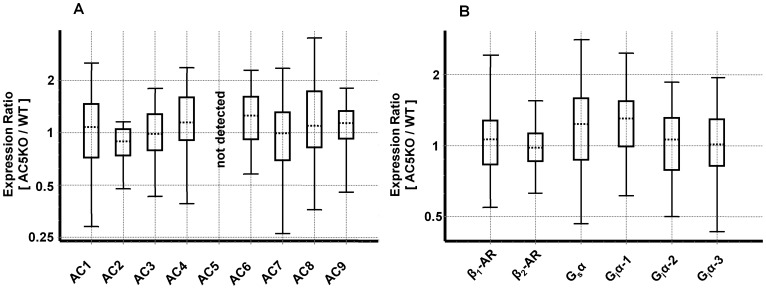
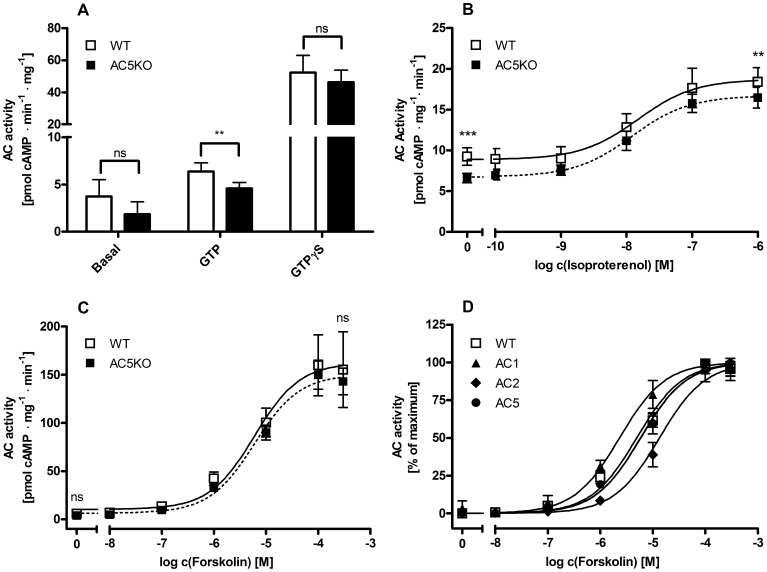
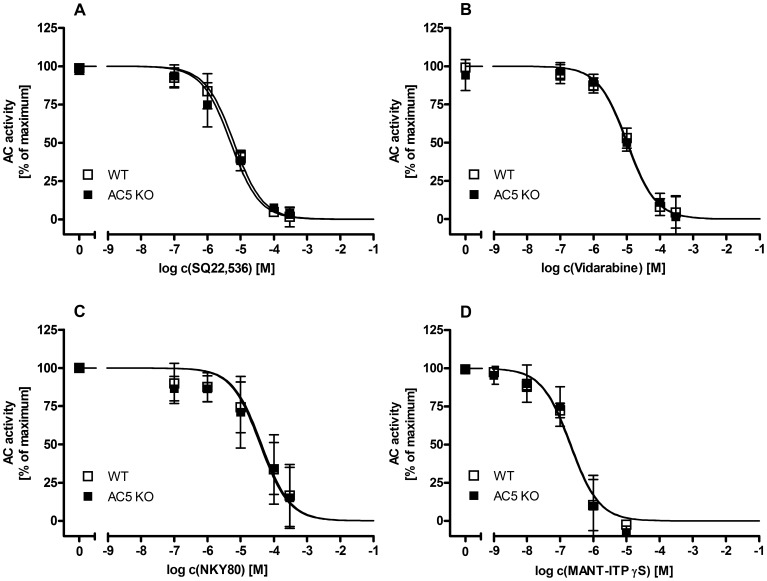
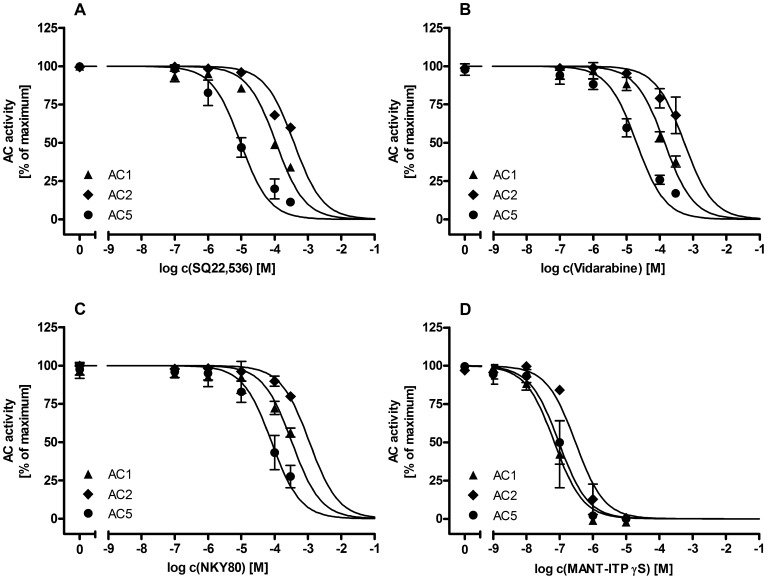
Adenylyl cyclase type 5 (AC5) was described as major cardiac AC isoform. The knockout of AC5 (AC5KO) exerted cardioprotective effects in heart failure. Our study explored the impact of AC5KO on mouse heart AC activities and evaluated putative AC5-selective inhibitors. In cardiac membranes from AC5KO mice, basal AC activity was decreased, while AC stimulation was intact. The putative AC5-selective P-site inhibitors SQ22,536 [9-(tetra-hydro-2-furanyl)-9H-purin-6-amine], vidarabine (9-β-D-arabinosyladenine) and NKY80 [2-amino-7-(2-furanyl)-7,8-dihydro-5(6H)-quinazolinone] inhibited recombinant AC5 more potently than AC2 and AC1, but selectivity was only modest (∼4-40-fold). These compounds inhibited cardiac AC from WT and AC5KO mice with similar potencies. In conclusion, AC regulation in AC5KO hearts was unimpaired, questioning the supposed dominant role of AC5 in the heart. Moreover, the AC inhibitors SQ22,536, NKY80 and vidarabine lack adequate selectivity for AC5 and, therefore, do not present suitable tools to study AC5-specific functions.
Overview
The claims and statistics of this paper haven’t been checked yet.
Free: it reads the open-access text and checks the first 5 claims that cite a source we can check. Create a free account to check every claim.
Integrity signals
Registry
Cites
Statistics
Figures
Verification
Claims the paper makes
The claims and statistics of this paper haven’t been checked yet.
Free: it reads the open-access text and checks the first 5 claims that cite a source we can check. Create a free account to check every claim.
Claims other papers make about this one
Each is checked against this paper’s own text: does it say what the citing paper says it does?
In the citing paper
“Indeed, it was elegantly determined that loss of FMRP leads to increased AC1 mRNA and protein levels (227).”
From Physiological roles of mammalian transmembrane adenylyl cyclase isoforms (2022) · cites this paper as [227]
In the citing paper
“Genetic and pharmacological inhibition of AC1 in this mouse model not only reduced the molecular pathology but reversed several of the autism-like behaviors in these mice (227).”
From Physiological roles of mammalian transmembrane adenylyl cyclase isoforms (2022) · cites this paper as [227]
Self-check
Percentages, sums and reported differences re-computed from the paper’s own numbers.
The self-check needs the paper’s full text.
Citations
Cites
Bradford, M. M. (1976) · Analytical Biochemistry · doi:10.1016/0003-2697(76)90527-3 · Cited by 255,302 · cited 1×
“Membrane protein concentration was measured using the Bradford method [32] with the RotiQuant quantitation assay (Roth, Karlsruhe, Germany).”
MethodPfaffl, M. W. (2002) · Nucleic Acids Research · doi:10.1093/nar/30.9.e36 · Cited by 7,376 · cited 4×
“The relative expression levels of components of the b-AR-G-proteinAC signaling cascade in LVs from WT vs. AC5KO were analyzed applying a D-Ct relative quantification model with PCR efficiency correction using the relative expression software tool REST [36] (V2.”
MethodInfluentialG PROTEINS: TRANSDUCERS OF RECEPTOR-GENERATED SIGNALS
Gilman, A. G. (1987) · Annual Review of Biochemistry · doi:10.1146/annurev.bi.56.070187.003151 · Cited by 6,381 · cited 4×
“When assess- PLOS ONE | www.plosone.org 2 July 2013 | Volume 8 | Issue 7 | e68009 ing b-AR mediated AC activation, 10 mM GTP was added to the reaction buffer, while AC inhibition experiments were performed under stimulation with 100 mM FS and 10 mM GTPcS. Due to high hydrophobicity of FS and the AC inhibitors SQ22,536…”
BackgroundInfluentialAssumption-free analysis of quantitative real-time polymerase chain reaction (PCR) data
Ramakers, C., Ruijter, J. M., Deprez, R. H. L., & Moorman, A. F. M. (2003) · Neuroscience Letters · doi:10.1016/s0304-3940(02)01423-4 · Cited by 3,709
Amplification efficiency: linking baseline and bias in the analysis of quantitative PCR data
Ruijter, J. M., Ramakers, C., Hoogaars, W. M. H., Karlen, Y., Bakker, O., van den Hoff, M. J. B., & Moorman, A. F. M. (2009) · Nucleic Acids Research · doi:10.1093/nar/gkp045 · Cited by 3,043
Regulation and Role of Adenylyl Cyclase Isoforms
Hanoune, J., & Defer, N. (2001) · Annual Review of Pharmacology and Toxicology · doi:10.1146/annurev.pharmtox.41.1.145 · Cited by 691
Isoforms of Mammalian Adenylyl Cyclase: Multiplicities of Signaling
Sunahara, R. K. (2002) · Molecular Interventions · doi:10.1124/mi.2.3.168 · Cited by 406 · cited 1×
“Even the preference ratios of the most ‘selective’ AC5 inhibitor SQ22,536 over AC1 and AC2 were not compelling considering that AC1, AC2 and AC5 belong to different AC families [3,7,8] and are likely to possess more different pharmacological properties than members of the same AC family [19].”
BackgroundSadana, R., & Dessauer, C. W. (2009) · Neurosignals · doi:10.1159/000166277 · Cited by 361 · cited 1×
“Even the preference ratios of the most ‘selective’ AC5 inhibitor SQ22,536 over AC1 and AC2 were not compelling considering that AC1, AC2 and AC5 belong to different AC families [3,7,8] and are likely to possess more different pharmacological properties than members of the same AC family [19].”
BackgroundType 5 Adenylyl Cyclase Disruption Increases Longevity and Protects Against Stress
Yan, L., Vatner, D. E., O'Connor, J. P., Ivessa, A., Ge, H., Chen, W., Hirotani, S., Ishikawa, Y., Sadoshima, J., & Vatner, S. F. (2007) · Cell · doi:10.1016/j.cell.2007.05.038 · Cited by 353
Rohrer, D. K., Desai, K. H., Jasper, J. R., Stevens, M. E., Regula, D. P., Barsh, G. S., Bernstein, D., & Kobilka, B. K. (1996) · Proceedings of the National Academy of Sciences · doi:10.1073/pnas.93.14.7375 · Cited by 310 · cited 1×
“Mouse heart membranes were prepared by differential centrifugation as previously described [28,29], with minor modifications.”
MethodCapturing adenylyl cyclases as potential drug targets
Pierre, S., Eschenhagen, T., Geisslinger, G., & Scholich, K. (2009) · Nature Reviews Drug Discovery · doi:10.1038/nrd2827 · Cited by 224 · cited 4×
“Accordingly, the treatment of chronic HF with b1-AR antagonists reduces morbidity and mortality, while positive inotropic drugs that increase b-AR signaling or cAMP levels such as catecholamines or phosphodiesterase inhibitors are detrimental [2,3].”
BackgroundInfluentialMyocyte Adrenoceptor Signaling Pathways
Xiang, Y., & Kobilka, B. K. (2003) · Science · doi:10.1126/science.1079206 · Cited by 214
β-Adrenergic stimulation and myocardial function in the failing heart
El-Armouche, A., & Eschenhagen, T. (2009) · Heart Failure Reviews · doi:10.1007/s10741-008-9132-8 · Cited by 202 · cited 2×
“Accordingly, the treatment of chronic HF with b1-AR antagonists reduces morbidity and mortality, while positive inotropic drugs that increase b-AR signaling or cAMP levels such as catecholamines or phosphodiesterase inhibitors are detrimental [2,3].”
BackgroundDisruption of type 5 adenylyl cyclase gene preserves cardiac function against pressure overload
Okumura, S., Takagi, G., Kawabe, J.-I., Yang, G., Lee, M.-C., Hong, C., Liu, J., Vatner, D. E., Sadoshima, J., Vatner, S. F., et al. (2003) · Proceedings of the National Academy of Sciences · doi:10.1073/pnas.1733772100 · Cited by 199
Tuomi, J. M., Voorbraak, F., Jones, D. L., & Ruijter, J. M. (2010) · Methods · doi:10.1016/j.ymeth.2010.02.003 · Cited by 167
Impaired D2 Dopamine Receptor Function in Mice Lacking Type 5 Adenylyl Cyclase
Lee, K.-W., Hong, J.-H., Choi, I. Y., Che, Y., Lee, J.-K., Yang, S.-D., Song, C.-W., Kang, H. S., Lee, J.-H., Noh, J. S., et al. (2002) · The Journal of Neuroscience · doi:10.1523/jneurosci.22-18-07931.2002 · Cited by 163 · cited 3×
“[27] and were backcrossed to C57BL/6J over more than 10 generations.”
BackgroundMethodSelf-citationOkumura, S., Kawabe, J.-I., Yatani, A., Takagi, G., Lee, M.-C., Hong, C., Liu, J., Takagi, I., Sadoshima, J., Vatner, D. E., et al. (2003) · Circulation Research · doi:10.1161/01.res.0000086986.35568.63 · Cited by 124 · cited 3×
“This finding is in accordance with previous reports [11,29].”
BackgroundResultOkumura, S., Vatner, D. E., Kurotani, R., Bai, Y., Gao, S., Yuan, Z., Iwatsubo, K., Ulucan, C., Kawabe, J.-I., Ghosh, K., et al. (2007) · Circulation · doi:10.1161/circulationaha.107.698662 · Cited by 122
Li, Y., Chen, L., Kass, R. S., & Dessauer, C. W. (2012) · Journal of Biological Chemistry · doi:10.1074/jbc.m112.380568 · Cited by 114
Type-specific Regulation of Adenylyl Cyclase
Onda, T., Hashimoto, Y., Nagai, M., Kuramochi, H., Saito, S., Yamazaki, H., Toya, Y., Sakai, I., Homcy, C. J., Nishikawa, K., et al. (2001) · Journal of Biological Chemistry · doi:10.1074/jbc.m107233200 · Cited by 112 · cited 2×
“Nucleoside-based P-site inhibitors such as SQ22,536 and vidarabine, which is also a virustatic drug [46], are very likely to influence DNA polymerases and purine metabolism at concentrations that inhibit AC [3,5,19,23].”
BackgroundMolecular Basis for P-Site Inhibition of Adenylyl Cyclase,
Tesmer, J. J. G., Dessauer, C. W., Sunahara, R. K., Murray, L. D., Johnson, R. A., Gilman, A. G., & Sprang, S. R. (2000) · Biochemistry · doi:10.1021/bi0015562 · Cited by 112 · cited 1×
“There are two major classes of AC inhibitors; compounds that act non-competitively, mimicking the cAMP ? PPi transition state [16,17] (so-called P-site inhibitors) and compounds that compete with ATP at the catalytic site such as MANT [29(39)-O-(Nmethylanthraniloyl]- substituted nucleotides [18–22].”
BackgroundThe interactions of adenylate cyclases with P-site inhibitors
DESSAUER, C. W., Tesmer, J. J. G., Sprang, S. R., & Gilman, A. G. (1999) · Trends in Pharmacological Sciences · doi:10.1016/s0165-6147(99)01310-3 · Cited by 105 · cited 1×
“There are two major classes of AC inhibitors; compounds that act non-competitively, mimicking the cAMP ? PPi transition state [16,17] (so-called P-site inhibitors) and compounds that compete with ATP at the catalytic site such as MANT [29(39)-O-(Nmethylanthraniloyl]- substituted nucleotides [18–22].”
BackgroundWhitley, R. J., Alford, C., Hess, F., & Buchanan, R. (1980) · Drugs · doi:10.2165/00003495-198020040-00002 · Cited by 104
Inhibitors of membranous adenylyl cyclases
Seifert, R., Lushington, G. H., Mou, T.-C., Gille, A., & Sprang, S. R. (2012) · Trends in Pharmacological Sciences · doi:10.1016/j.tips.2011.10.006 · Cited by 104 · cited 7×
“It will be essential for the development of truly AC isoform-selective inhibitors that compounds are examined on all ACs (AC1-9), which has not been achieved so far [19].”
BackgroundSelf-citationIwatsubo, K., Minamisawa, S., Tsunematsu, T., Nakagome, M., Toya, Y., Tomlinson, J. E., Umemura, S., Scarborough, R. M., Levy, D. E., & Ishikawa, Y. (2004) · Journal of Biological Chemistry · doi:10.1074/jbc.m314238200 · Cited by 103 · cited 1×
“The P-site inhibitors SQ22,536 [9-(tetra-hydro-2-furanyl)-9H-purin-6-amine, THFA], NKY80 [2-amino-7-(2-furanyl)-7,8-dihydro-5(6H)-quinazolinone] and vidarabine (9-b-D-arabinosyladenine, AraAde) exhibit selectivity for AC5 relative to ACs 1, 2 and 3 [6,19,23,24].”
BackgroundSeifert, R., Lee, T. W., Lam, V. T., & Kobilka, B. K. (1998) · European Journal of Biochemistry · doi:10.1046/j.1432-1327.1998.2550369.x · Cited by 102
Self-citationLudwig, M.-G., & Seuwen, K. (2002) · Journal of Receptors and Signal Transduction · doi:10.1081/rrs-120014589 · Cited by 102
Tobise, K., Ishikawa, Y., Holmer, S. R., Im, M. J., Newell, J. B., Yoshie, H., Fujita, M., Susannie, E. E., & Homcy, C. J. (1994) · Circulation Research · doi:10.1161/01.res.74.4.596 · Cited by 96 · cited 1×
“We cannot exclude that differences in age caused differences in AC5 expression [37,40,41].”
BackgroundJohnson, R. A., Désaubry, L., Bianchi, G., Shoshani, I., Lyons, E., Taussig, R., Watson, P. A., Cali, J. J., Krupinski, J., Pieroni, J. P., et al. (1997) · Journal of Biological Chemistry · doi:10.1074/jbc.272.14.8962 · Cited by 88
Adenylyl cyclases as innovative therapeutic goals
Pavan, B., Biondi, C., & Dalpiaz, A. (2009) · Drug Discovery Today · doi:10.1016/j.drudis.2009.07.007 · Cited by 87 · cited 2×
“Nucleoside-based P-site inhibitors such as SQ22,536 and vidarabine, which is also a virustatic drug [46], are very likely to influence DNA polymerases and purine metabolism at concentrations that inhibit AC [3,5,19,23].”
BackgroundEspinasse, I., Iourgenko, V., Defer, N., Samson, F., Hanoune, J., & Mercadier, J.-J. (1995) · Journal of Molecular and Cellular Cardiology · doi:10.1016/0022-2828(95)90002-0 · Cited by 75 · cited 1×
“We cannot exclude that differences in age caused differences in AC5 expression [37,40,41].”
BackgroundMou, T.-C., Gille, A., Fancy, D. A., Seifert, R., & Sprang, S. R. (2005) · Journal of Biological Chemistry · doi:10.1074/jbc.m409076200 · Cited by 73
Self-citationHo, D., Yan, L., Iwatsubo, K., Vatner, D. E., & Vatner, S. F. (2010) · Heart Failure Reviews · doi:10.1007/s10741-010-9183-5 · Cited by 68
Mou, T., Gille, A., Suryanarayana, S., Richter, M. L., Seifert, R., & Sprang, S. R. (2006) · Molecular Pharmacology · doi:10.1124/mol.106.026427 · Cited by 66
Self-citationAdenylyl Cyclase Isoform V Mediates Renin Release From Juxtaglomerular Cells
Ortiz-Capisano, M. C., Ortiz, P. A., Harding, P., Garvin, J. L., & Beierwaltes, W. H. (2007) · Hypertension · doi:10.1161/01.hyp.0000255172.84842.d2 · Cited by 62 · cited 13×
“The aim of the present study was to investigate the impact of AC5KO on mouse heart AC activities and to evaluate the selectivity of SQ22,536, NKY80 and vidarabine.”
BackgroundInfluentialHouston, C., Wenzel‐Seifert, K., Bürckstümmer, T., & Seifert, R. (2002) · Journal of Neurochemistry · doi:10.1046/j.0022-3042.2001.00746.x · Cited by 58 · cited 1×
“Sf9-cell membranes expressing recombinant ACs 1, 2 and 5 were prepared according to established protocols for Sf9-infection [30] and -membrane preparation [31].”
MethodSelf-citationGille, A., & Seifert, R. (2003) · Journal of Biological Chemistry · doi:10.1074/jbc.m211292200 · Cited by 53
Self-citationStimulation of Renin Secretion by Catecholamines Is Dependent on Adenylyl Cyclases 5 and 6
Aldehni, F., Tang, T., Madsen, K., Plattner, M., Schreiber, A., Friis, U. G., Hammond, H. K., Han, P. L., & Schweda, F. (2011) · Hypertension · doi:10.1161/hypertensionaha.110.167130 · Cited by 52
Self-citationIwatsubo, K., Bravo, C., Uechi, M., Baljinnyam, E., Nakamura, T., Umemura, M., Lai, L., Gao, S., Yan, L., Zhao, X., et al. (2012) · American Journal of Physiology-Heart and Circulatory Physiology · doi:10.1152/ajpheart.00190.2012 · Cited by 50 · cited 4×
“Vidarabine was employed to mimic cardioprotective effects induced by AC5 disruption in a model of chronic catecholamine stress [42].”
BackgroundResultInfluentialCharacterization of Mouse Heart Adenylyl Cyclase
Göttle, M., Geduhn, J., König, B., Gille, A., Höcherl, K., & Seifert, R. (2009) · Journal of Pharmacology and Experimental Therapeutics · doi:10.1124/jpet.109.150953 · Cited by 47 · cited 5×
“This finding is in accordance with previous reports [11,29].”
BackgroundMethodResultSelf-citationTang, T., Lai, N. C., Roth, D. M., Drumm, J., Guo, T., Lee, K., Han, P., Dalton, N., & Gao, M. H. (2005) · Basic Research in Cardiology · doi:10.1007/s00395-005-0559-y · Cited by 46
Self-citationAdenylyl cyclase type 5 protein expression during cardiac development and stress
Hu, C.-L., Chandra, R., Ge, H., Pain, J., Yan, L., Babu, G., Depre, C., Iwatsubo, K., Ishikawa, Y., Sadoshima, J., et al. (2009) · American Journal of Physiology-Heart and Circulatory Physiology · doi:10.1152/ajpheart.00050.2009 · Cited by 45 · cited 2×
“We cannot exclude that differences in age caused differences in AC5 expression [37,40,41].”
BackgroundDifferential expression of adenylyl cyclase subtypes in human cardiovascular system
Wang, T., & Mj, B. (2004) · Molecular and Cellular Endocrinology · doi:10.1016/j.mce.2004.05.012 · Cited by 41
A New Site and Mechanism of Action for the Widely Used Adenylate Cyclase Inhibitor SQ22,536
Emery, A. C., Eiden, M. V., & Eiden, L. E. (2012) · Molecular Pharmacology · doi:10.1124/mol.112.081760 · Cited by 40 · cited 1×
“SQ22,536 inhibits extracellular signal-regulated kinase signal transduction in an ACindependent manner [47].”
BackgroundCellular Localisation of Adenylyl Cyclase: A Post-genome Perspective
Antoni, F. A., Wiegand, U. K., Black, J. W., & Simpson, J. (2006) · Neurochemical Research · doi:10.1007/s11064-005-9019-1 · Cited by 22 · cited 1×
“Due to poor isoform specificity of commercially available AC antibodies, the analysis of AC isoform expression at the protein level is very problematic [19,29,37,38].”
BackgroundPinto, C., Lushington, G. H., Richter, M., Gille, A., Geduhn, J., König, B., Mou, T.-C., Sprang, S. R., & Seifert, R. (2011) · Biochemical Pharmacology · doi:10.1016/j.bcp.2011.05.010 · Cited by 19
Self-citationRaimundo, S., Giray, J., Volff, J., Schwab, M. G., Altenbuchner, J., Ratge, D., & Wisser, H. (1999) · Clinica Chimica Acta · doi:10.1016/s0009-8981(99)00067-4 · Cited by 8 · cited 1×
“Quantitative data about mRNA expression levels of AC5 and AC6 in human hearts are conflicting [43,44].”
Background
Cited by
Dessauer, C. W., Watts, V. J., Ostrom, R. S., Conti, M., Dove, S., & Seifert, R. (2017) · Pharmacological Reviews · doi:10.1124/pr.116.013078 · Cited by 201
“…is controversy with regard to the relative expression of AC5 versus AC6 in the heart as well as the changes in expression that occur during development or stress (Tobise et al., 1994; Espinasse et al., 1995, 1999; Scarpace et al., 1996; Wang and Brown, 2004; Hu et al., 2009; Braeunig et al., 2013).”
BackgroundSelf-citationPhysiological roles of mammalian transmembrane adenylyl cyclase isoforms
Ostrom, K. F., LaVigne, J. E., Brust, T. F., Seifert, R., Dessauer, C. W., Watts, V. J., & Ostrom, R. S. (2022) · Physiological Reviews · doi:10.1152/physrev.00013.2021 · Cited by 131
Self-citationPharmacological Distinction between Soluble and Transmembrane Adenylyl Cyclases
Bitterman, J. L., Ramos-Espiritu, L. S., Diaz, A., Levin, L. R., & Buck, J. (2013) · Journal of Pharmacology and Experimental Therapeutics · doi:10.1124/jpet.113.208496 · Cited by 95
“For tmACs, inhibitors believed to be isoform specific are proving to be non-specific in cellular assays (Braeunig et al., 2013), and their relatively This article has not been copyedited and formatted.”
BackgroundInfluentialIsoform Selectivity of Adenylyl Cyclase Inhibitors: Characterization of Known and Novel Compounds
Brand, C. S., Hocker, H. J., Gorfe, A. A., Cavasotto, C. N., & Dessauer, C. W. (2013) · The Journal of Pharmacology and Experimental Therapeutics · doi:10.1124/jpet.113.208157 · Cited by 87
“The lack of selectivity of SQ22,536, NKY80, and Ara-A that we observed between AC5 and AC6 is consistent with recent studies showing identical inhibition of cardiac AC from wildtype andAC5knockout animals (Braeunig et al., 2013).”
ResultCyclic AMP synthesis and hydrolysis in the normal and failing heart
Guellich, A., Mehel, H., & Fischmeister, R. (2014) · Pflügers Archiv - European Journal of Physiology · doi:10.1007/s00424-014-1515-1 · Cited by 91
“However, the specificity of this compound was recently questioned by two independent groups [14, 15] who showed that this inhibitor was unable to discriminate between AC5 and AC6.”
Background
Metadata
- Authors
- Braeunig, J. H., Schweda, F., Han, P.-L., & Seifert, R.
- Affiliations
- Medizinische Hochschule Hannover (DE)
- University of Regensburg (DE)
- Ewha Womans University (KR)
- Corresponding author
- Seifert, Roland
- Venue
- PLoS ONE
- Publisher
- Public Library of Science (PLoS)
- Published
- 2013-07-01
- Volume
- 8
- Issue
- 7
- Pages
- e68009
- ISSN
- 1932-6203 (ISSN-L)
- PMC
- PMC3698094
- OpenAlex
- W2118640006
- Cited by
- 19
- References
- 47
- Citations by year
- 2022: 1 · 2021: 1 · 2018: 2 · 2017: 1 · 2016: 3 · 2015: 1 · 2014: 5 · 2013: 5
- FWCI
- 2.09
- Type
- journal article
- Language
- en
- Open access
- gold
- doi.org
- Locations
- PLoS ONE (publishedVersion, cc-by)
- Europe PMC (PubMed Central) (publishedVersion, other-oa)
- PubMed Central (publishedVersion, cc-by)
- PubMed (publishedVersion)
- DOAJ (DOAJ: Directory of Open Access Journals) (submittedVersion, cc-by-sa)
- Figshare (submittedVersion, cc-by)
- Funders
- Deutsche Forschungsgemeinschaft (529/5-2)
- Topics
- Life Sciences › Biochemistry, Genetics and Molecular Biology › Molecular Biology › Phosphodiesterase function and regulation
- Life Sciences › Biochemistry, Genetics and Molecular Biology › Molecular Biology › Receptor Mechanisms and Signaling
- Life Sciences › Biochemistry, Genetics and Molecular Biology › Molecular Biology › Protein Kinase Regulation and GTPase Signaling
- Keywords
- adenylyl cyclase type 5, SQ22536, vidarabine, enzyme selectivity, heart failure, cardioprotection
- MeSH terms
- Adenylyl Cyclase Inhibitors, Adenylyl Cyclases, Animals, Cell Line, Enzyme Inhibitors, Heart, Male, Mice, Inbred C57BL, Myocardium, Recombinant Proteins, Mice, Knockout, Mice
About these checks
Registry, retraction, Cites and statistics results are computed, not judged, with one exception: a printed reference that no index lists is read once by a model before it counts as a citation error. Claims are extracted by a model and kept only when their quote appears verbatim in the text; each cited source is then checked, with a model’s help, for whether it says what the claim relies on. Those verdicts can be wrong — read the claim’s quote and the cited source before relying on one.
Statistics and arithmetic are recomputed, not judged.
Confidence bands are shown only for fields calibrated on our annotated test set. None is calibrated yet, so no band is shown.
What counts as a claim ›How we measure confidence ›How we check this ›
Are you an author, or do you see a problem with this page? Request a review
Data sources
Bibliographic data: Semantic Scholar, OpenAlex, Crossref.
Contains information from the Semantic Scholar Academic Graph Datasets, made available under the ODC Attribution License (ODC-BY 1.0).
Semantic Scholar’s data is described in: Kinney, R., et al. (2023). The Semantic Scholar Open Data Platform. arXiv:2301.10140.
