

Effect of socioeconomic status on mortality after bacteremia in working-age patients. A Danish population-based cohort study.
Open accessThe DOI matches its Crossref record; 33 of the 33 references it cites were found in a registry or an index.
Abstract
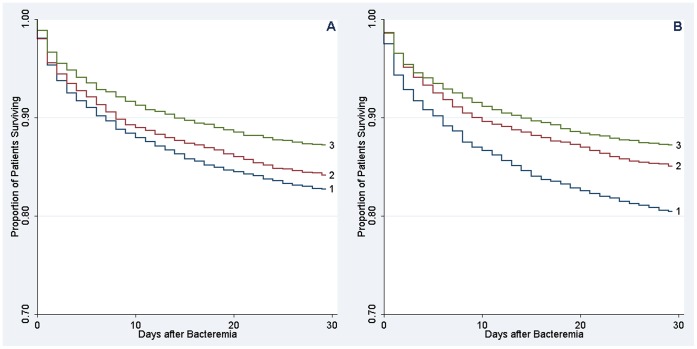
OBJECTIVES: To examine the effect of socioeconomic status (SES) on mortality in patients with bacteremia and the underlying factors that may mediate differences in mortality. METHODS: We conducted a population-based cohort study in two Danish regions. All patients 30 to 65 years of age with first time bacteremia from 2000 through 2008 were identified in a population-based microbiological bacteremia database (n = 8,653). Individual-level data on patients' SES (educational level and personal income) and comorbid conditions were obtained from public and medical registries. We used Cox regression to examine mortality within 30 days after bacteremia with and without cumulative adjustment for potential mediators. RESULTS: Bacteremia patients of low SES were more likely to live alone and be unmarried than patients of high SES. They also had more pre-existing comorbidity, more substance abuse, more Staphylococcus aureus and nosocomial infections, and more admissions to small nonteaching hospitals. Overall, 1,374 patients (15.9%) died within 30 days of follow-up. Patients of low SES had consistently higher mortality after bacteremia than those of high SES crude hazard ratio for low vs. high education, 1.38 [95% confidence interval (CI), 1.18-1.61]; crude hazard ratio for low-income vs. high-income tertile, 1.58 [CI, 1.39-1.80]. Adjustment for differences in social support, pre-existing comorbidity, substance abuse, place of acquisition of the infection, and microbial agent substantially attenuated the effect of SES on mortality (adjusted hazard ratio for low vs. high education, 1.15 [95% CI, 0.98-1.36]; adjusted hazard ratio for low-income vs. high-income tertile, 1.29 [CI, 1.12-1.49]). Further adjustment for characteristics of the admitting hospital had minimal effect on observed mortality differences. CONCLUSIONS: Low SES was strongly associated with increased 30-day mortality after bacteremia. Less social support, more pre-existing comorbidity, more substance abuse, and differences in place of acquisition and agent of infection appeared to mediate much of the observed disparities in mortality.
Overview
The claims and statistics of this paper haven’t been checked yet.
Free: it reads the open-access text and checks the first 5 claims that cite a source we can check. Create a free account to check every claim.
Integrity signals
Registry
Cites
Statistics
Figures
Verification
Claims the paper makes
The claims and statistics of this paper haven’t been checked yet.
Free: it reads the open-access text and checks the first 5 claims that cite a source we can check. Create a free account to check every claim.
Claims other papers make about this one
Each is checked against this paper’s own text: does it say what the citing paper says it does?
The check wasn’t confident either way, so it gives no verdict — never disputed.
In the citing paper
“Observational studies of structured handoff process have demonstrated mixed effects, with some finding reductions in unexpected clinical events (569), or ICU readmission (570, 571) and others without impact upon length of stay (572), mortality (572, 573) or hospital readmission (572, 573).”
From Surviving Sepsis Campaign: International Guidelines for Management of Sepsis and Septic Shock 2021. (2021) · cites this paper as [573]
Experimental — accuracy not yet measuredIn the citing paper
“Additionally, living in neighborhoods with low SES is associated with an increased risk of sepsis [575], community-acquired bacteremia [575] and death from bacteremia [576] and worse outcomes [577].”
From Surviving sepsis campaign: international guidelines for management of sepsis and septic shock 2021 (2021) · cites this paper as [576]
Self-check
Percentages, sums and reported differences re-computed from the paper’s own numbers.
The self-check needs the paper’s full text.
Citations
Cites
Charlson, M. E., Pompei, P., Ales, K. L., & MacKenzie, C. R. (1987) · Journal of Chronic Diseases · doi:10.1016/0021-9681(87)90171-8 · Cited by 49,742 · cited 1×
“Pre-existing comorbidity was summarized according to the Charlson Comorbidity Index, which was originally developed to predict 1-year mortality in hospitalized medical patients [25].”
MethodThe Danish Civil Registration System
Pedersen, C. B. (2011) · Scandinavian Journal of Public Health · doi:10.1177/1403494810387965 · Cited by 4,632 · cited 1×
“We obtained data on each patient’s vital status from the Danish Civil Registration System [28].”
MethodIndicators of socioeconomic position (part 1): Figure 1
Galobardes, B., Shaw, M., Lawlor, D. A., Lynch, J. W., & Davey Smith, G. (2006) · Journal of Epidemiology and Community Health · doi:10.1136/jech.2004.023531 · Cited by 2,867 · cited 1×
“In contrast, income can change over a life course, but may better capture aspects of SES later in life [18,19].”
BackgroundThe natural history of the systemic inflammatory response syndrome (SIRS). A prospective study
Rangel-Frausto, M. S. (1995) · JAMA · doi:10.1001/jama.273.2.117 · Cited by 2,104 · cited 1×
“However, since less than 50% of patients with sepsis have documented bacteremia, our findings cannot necessarily be generalised to sepsis patients [33,34].”
BackgroundThe Danish National Hospital Register. A valuable source of data for modern health sciences.
Andersen, T. F., Madsen, M., Jørgensen, J. O. L., Mellemkjoer, L., & Olsen, J. H. (1999) · PubMed · Cited by 2,026
How to measure comorbiditya critical review of available methods
DEGROOT, V, BECKERMAN, H., LANKHORST, G., & BOUTER, L. (2003) · Journal of Clinical Epidemiology · doi:10.1016/s0895-4356(02)00585-1 · Cited by 1,757
Jensen, V. M., & Rasmussen, A. W. (2011) · Scandinavian Journal of Public Health · doi:10.1177/1403494810394715 · Cited by 1,471 · cited 1×
“In 2008 the register contained valid information on education for 97% of the Danish population born from 1945 to 1990 [20].”
BackgroundThygesen, S. K., Christiansen, C. F., Christensen, S., Lash, T. L., & Sørensen, H. T. (2011) · BMC Medical Research Methodology · doi:10.1186/1471-2288-11-83 · Cited by 1,195
Danish registers on personal income and transfer payments
Baadsgaard, M., & Quitzau, J. (2011) · Scandinavian Journal of Public Health · doi:10.1177/1403494811405098 · Cited by 968 · cited 1×
“Data in the register are primarily supplied by tax authorities and the income data are assumed to equal the real income [21].”
BackgroundGeyer, S., Hemström, Ö., Peter, R., & Vågerö, D. (2006) · Journal of Epidemiology and Community Health · doi:10.1136/jech.2005.041319 · Cited by 683 · cited 1×
“In contrast, income can change over a life course, but may better capture aspects of SES later in life [18,19].”
Background
Cited by
Surviving sepsis campaign: international guidelines for management of sepsis and septic shock 2021
Evans, L., Rhodes, A., Alhazzani, W., Antonelli, M., Coopersmith, C. M., French, C., Machado, F. R., Mcintyre, L., Ostermann, M., Prescott, H. C., et al. (2021) · Intensive Care Medicine · doi:10.1007/s00134-021-06506-y · Cited by 5,082
Surviving Sepsis Campaign: International Guidelines for Management of Sepsis and Septic Shock 2021.
Evans, L., Rhodes, A., Alhazzani, W., Antonelli, M., Coopersmith, C. M., French, C., Machado, F. R., Mcintyre, L., Ostermann, M., Prescott, H. C., et al. (2021) · Critical Care Medicine · doi:10.1097/ccm.0000000000005337 · Cited by 2,935
(2018) · Acta bio-medica dell'Ateneo parmense/Acta biomedica · doi:10.23750/abm.v89i2.7404 · Cited by 329
Where does a Staphylococcus aureus vaccine stand?
Fowler, V. G., & Proctor, R. A. (2014) · Clinical Microbiology and Infection · doi:10.1111/1469-0691.12570 · Cited by 241
“Invasive disease is associated with a 20% and higher mortality [2-5] due to a combination of antibiotic resistance and multiple virulence factors (Table 1).”
BackgroundSchnegelsberg, A., Mackenhauer, J., Nibro, H. L., Dreyer, P., Koch, K., & Kirkegaard, H. (2015) · Acta Anaesthesiologica Scandinavica · doi:10.1111/aas.12644 · Cited by 61
Self-citation
Metadata
- Authors
- Koch, K., Nørgaard, M., Schønheyder, H. C., Thomsen, R. W., Søgaard, M., & the Danish Collaborative Bacteremia Network (DACOBAN)
- Affiliations
- Aalborg University Hospital (DK)
- Aarhus University Hospital (DK)
- Corresponding author
- Koch, Kristoffer
- Venue
- PLoS ONE
- Publisher
- Public Library of Science (PLoS)
- Published
- 2013-07-25
- Volume
- 8
- Issue
- 7
- Pages
- e70082
- ISSN
- 1932-6203 (ISSN-L)
- PMC
- PMC3723741
- OpenAlex
- W2026400738
- Cited by
- 30
- References
- 33
- Citations by year
- 2026: 1 · 2025: 1 · 2023: 1 · 2022: 1 · 2021: 6 · 2020: 2 · 2019: 1 · 2018: 4 · 2017: 3 · 2016: 2 · 2015: 3 · 2014: 5
- FWCI
- 3.79
- Type
- journal article
- Language
- en
- Open access
- gold
- doi.org
- Locations
- PLoS ONE (publishedVersion, cc-by)
- Europe PMC (PubMed Central) (publishedVersion, cc-by)
- PubMed Central (publishedVersion, cc-by)
- PubMed (publishedVersion)
- RePEc: Research Papers in Economics (submittedVersion)
- DOAJ (DOAJ: Directory of Open Access Journals) (submittedVersion, cc-by-sa)
- VBN Forskningsportal (Aalborg Universitet) (submittedVersion)
- Funders
- Aarhus Universitet
- Aarhus Universitetshospital
- Aalborg Universitet
- Gentofte Hospital
- Herlev Hospital
- Odense Universitetshospital
- Rigshospitalet
- Aalborg Universitetshospital
- Hvidovre Hospital
- Topics
- Social Sciences › Health › Health disparities and outcomes
- Health Sciences › Medicine › Critical Care and Intensive Care Medicine › Sepsis Diagnosis and Treatment
- Social Sciences › Health › Public Health and Social Inequalities
- Keywords
- socioeconomic status, bacteremia, mortality, health disparities, social support, comorbidities, substance abuse, Staphylococcus aureus, nosocomial infections, educational attainment, income, hospital characteristics, working-age adults
- MeSH terms
- Adult, Aged, Cardiovascular Diseases, Denmark, Educational Status, Female, Gastrointestinal Diseases, Humans, Income, Liver Diseases, Male, Middle Aged, Neoplasms, Social Class, Social Support, Staphylococcal Infections, Staphylococcus aureus, Cohort Studies, Comorbidity, Survival Analysis, Bacteremia, Substance-Related Disorders
About these checks
Registry, retraction, Cites and statistics results are computed, not judged, with one exception: a printed reference that no index lists is read once by a model before it counts as a citation error. Claims are extracted by a model and kept only when their quote appears verbatim in the text; each cited source is then checked, with a model’s help, for whether it says what the claim relies on. Those verdicts can be wrong — read the claim’s quote and the cited source before relying on one.
Statistics and arithmetic are recomputed, not judged.
Confidence bands are shown only for fields calibrated on our annotated test set. None is calibrated yet, so no band is shown.
What counts as a claim ›How we measure confidence ›How we check this ›
Are you an author, or do you see a problem with this page? Request a review
Data sources
Bibliographic data: Semantic Scholar, OpenAlex, Crossref.
Contains information from the Semantic Scholar Academic Graph Datasets, made available under the ODC Attribution License (ODC-BY 1.0).
Semantic Scholar’s data is described in: Kinney, R., et al. (2023). The Semantic Scholar Open Data Platform. arXiv:2301.10140.
