

The DOI matches its Crossref record; 45 of the 45 references it cites were found in a registry or an index.
Early PTSD Symptom Trajectories: Persistence, Recovery, and Response to Treatment: Results from the Jerusalem Trauma Outreach and Prevention Study (J-TOPS)
Open accessAbstract
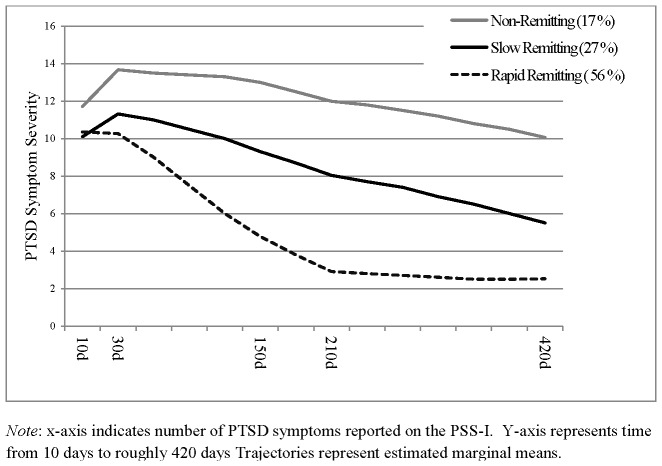
CONTEXT: Uncovering heterogeneities in the progression of early PTSD symptoms can improve our understanding of the disorder's pathogenesis and prophylaxis. OBJECTIVES: To describe discrete symptom trajectories and examine their relevance for preventive interventions. DESIGN: Latent Growth Mixture Modeling (LGMM) of data from a randomized controlled study of early treatment. LGMM identifies latent longitudinal trajectories by exploring discrete mixture distributions underlying observable data. SETTING: Hadassah Hospital unselectively receives trauma survivors from Jerusalem and vicinity. PARTICIPANTS: Adult survivors of potentially traumatic events consecutively admitted to the hospital's emergency department (ED) were assessed ten days and one-, five-, nine- and fifteen months after ED admission. Participants with data at ten days and at least two additional assessments (n = 957) were included; 125 received cognitive behavioral therapy (CBT) between one and nine months. APPROACH: We used LGMM to identify latent parameters of symptom progression and tested the effect of CBT on these parameters. CBT consisted of 12 weekly sessions of either cognitive therapy (n = 41) or prolonged exposure (PE, n = 49), starting 29.8±5.7 days after ED admission, or delayed PE (n = 35) starting at 151.8±42.4 days. CBT effectively reduced PTSD symptoms in the entire sample. MAIN OUTCOME MEASURE: Latent trajectories of PTSD symptoms; effects of CBT on these trajectories. RESULTS: THREE TRAJECTORIES WERE IDENTIFIED: Rapid Remitting (rapid decrease in symptoms from 1- to 5-months; 56% of the sample), Slow Remitting (progressive decrease in symptoms over 15 months; 27%) and Non-Remitting (persistently elevated symptoms; 17%). CBT accelerated the recovery of the Slow Remitting class but did not affect the other classes. CONCLUSIONS: The early course of PTSD symptoms is characterized by distinct and diverging response patterns that are centrally relevant to understanding the disorder and preventing its occurrence. Studies of the pathogenesis of PTSD may benefit from using clustered symptom trajectories as their dependent variables.
Overview
The claims and statistics of this paper haven’t been checked yet.
Run the check — free, no account needed. It reads the open-access text and checks the sources it cites.
Integrity signals
Registry
Cites
Statistics
Figures
Verification
Claims the paper makes
The claims and statistics of this paper haven’t been checked yet.
Run the check — free, no account needed. It reads the open-access text and checks the sources it cites.
Claims other papers make about this one
Each is checked against this paper’s own text: does it say what the citing paper says it does?
In the citing paper
“The presence of divergent extinction trajectories as described above represents an exciting new avenue of study and has recently been introduced in the rodent literature (43), which may be analogous to heterogeneous responses to trauma in PTSD (44).”
From Conditioned fear associated phenotypes as robust, translational indices of trauma-, stressor-, and anxiety-related behaviors (2014) · cites this paper as [44]
Self-check
Percentages, sums and reported differences re-computed from the paper’s own numbers.
The self-check needs the paper’s full text.
Citations
Cites
Statistical power analysis for the behavioral sciences
Cohen, J. (1990) · Computers Environment and Urban Systems · doi:10.1016/0198-9715(90)90050-4 · Cited by 65,417
Kessler, R. C., Berglund, P., Demler, O., Jin, R., Merikangas, K. R., & Walters, E. E. (2005) · Archives of General Psychiatry · doi:10.1001/archpsyc.62.6.593 · Cited by 20,391
Nylund, K. L., Asparouhov, T., & Muthén, B. O. (2007) · Structural Equation Modeling: A Multidisciplinary Journal · doi:10.1080/10705510701575396 · Cited by 11,415
Posttraumatic Stress Disorder in the National Comorbidity Survey
Kessler, R. C. (1995) · Archives of General Psychiatry · doi:10.1001/archpsyc.1995.03950240066012 · Cited by 10,379
KESSLER, R. C., ANDREWS, G., COLPE, L. J., HIRIPI, E., MROCZEK, D. K., NORMAND, S.-L. T., WALTERS, E. E., & ZASLAVSKY, A. M. (2002) · Psychological Medicine · doi:10.1017/s0033291702006074 · Cited by 10,327
Meta-analysis of risk factors for posttraumatic stress disorder in trauma-exposed adults
Brewin, C. R., Andrews, B., & Valentine, J. D. (2000) · Journal of Consulting and Clinical Psychology · doi:10.1037/0022-006x.68.5.748 · Cited by 5,243
The development of a Clinician-Administered PTSD Scale
Blake, D. D., Weathers, F. W., Nagy, L. M., Kaloupek, D. G., Gusman, F. D., Charney, D. S., & Keane, T. M. (1995) · Journal of Traumatic Stress · doi:10.1002/jts.2490080106 · Cited by 5,024
Combat Duty in Iraq and Afghanistan, Mental Health Problems, and Barriers to Care
Hoge, C. W., Castro, C. A., Messer, S. C., McGurk, D., Cotting, D. I., & Koffman, R. L. (2004) · New England Journal of Medicine · doi:10.1056/nejmoa040603 · Cited by 4,778
Predictors of posttraumatic stress disorder and symptoms in adults: a meta-analysis
Ozer, E. J., Best, S. R., Lipsey, T. L., & Weiss, D. S. (2003) · Psychological Bulletin · doi:10.1037/0033-2909.129.1.52 · Cited by 3,322 · cited 1×
“Subsequent meta-analyses of risk factors for PTSD [16,17] are based on that approach.”
MethodMuthén, B., & Muthén, L. K. (2000) · Alcoholism Clinical and Experimental Research · doi:10.1111/j.1530-0277.2000.tb02070.x · Cited by 3,161
Research works printed but not linked: 2
- TA deRoon-Cassini, 2010, Psychopathology and resilience following traumatic injury: A latent growth mixture model analysis, Rehabilitation Psychology, 55, 1, 10.1037/a0018601 · DOI
- IR Galatzer-Levy, 2013, Heterogeneity in Rodents' Fear Extinction Learning: Implications for Translational Models of Stress Responses, Submitted
Cited by
Sorted by citations
Galatzer-Levy, I. R., Huang, S. H., & Bonanno, G. A. (2018) · Clinical Psychology Review · doi:10.1016/j.cpr.2018.05.008 · Cited by 878
Self-citationThe GRoLTS-Checklist: Guidelines for Reporting on Latent Trajectory Studies
van de Schoot, R., Sijbrandij, M., Winter, S. D., Depaoli, S., & Vermunt, J. K. (2017) · Structural Equation Modeling: A Multidisciplinary Journal · doi:10.1080/10705511.2016.1247646 · Cited by 721
Prevention of Post-Traumatic Stress Disorder After Trauma: Current Evidence and Future Directions
Qi, W., Gevonden, M. J., & Shalev, A. Y. (2016) · Current Psychiatry Reports · doi:10.1007/s11920-015-0655-0 · Cited by 209
Self-citationShalev, A. Y., Gevonden, M., Ratanatharathorn, A., Laska, E., van der Mei, W. F., Qi, W., Lowe, S., Lai, B. S., Bryant, R. A., Delahanty, D., et al. (2019) · World Psychiatry · doi:10.1002/wps.20608 · Cited by 201
Self-citationQuantitative forecasting of PTSD from early trauma responses: A Machine Learning application
Galatzer-Levy, I. R., Karstoft, K.-I., Statnikov, A., & Shalev, A. Y. (2014) · Journal of Psychiatric Research · doi:10.1016/j.jpsychires.2014.08.017 · Cited by 195
Self-citation
Metadata
- Authors
- Galatzer-Levy, I. R., Ankri, Y., Freedman, S., Israeli-Shalev, Y., Roitman, P., Gilad, M., & Shalev, A. Y.
- Affiliations
- Hadassah Medical Center (IL)
- Bar-Ilan University (IL)
- Venue
- PLoS ONE
- Publisher
- Public Library of Science (PLoS)
- Published
- 2013-08-22
- Volume
- 8
- Issue
- 8
- Pages
- e70084
- ISSN
- 1932-6203 (ISSN-L)
- PMC
- PMC3750016
- OpenAlex
- W2056633716
- Cited by
- 137
- References
- 45
- Citations by year
- 2026: 1 · 2025: 5 · 2024: 14 · 2023: 9 · 2022: 12 · 2021: 8 · 2020: 13 · 2019: 15 · 2018: 17 · 2017: 11 · 2016: 10 · 2015: 11 · 2014: 11
- FWCI
- 11.87
- Type
- journal article
- Language
- en
- Update notices
- correction (2013-08-27)
- Open access
- gold
- doi.org
- Locations
- PLoS ONE (publishedVersion, cc-by)
- Europe PMC (PubMed Central) (publishedVersion, other-oa)
- PubMed Central (publishedVersion, cc-by)
- PubMed (publishedVersion)
- DOAJ (DOAJ: Directory of Open Access Journals) (submittedVersion, cc-by-sa)
- Funders
- H. Lundbeck A/S
- Topics
- Social Sciences › Psychology › Clinical Psychology › Posttraumatic Stress Disorder Research
- Health Sciences › Medicine › Clinical Neurology › Traumatic Brain Injury Research
- Social Sciences › Psychology › Experimental and Cognitive Psychology › Sleep and related disorders
- Keywords
- post-traumatic stress disorder, PTSD symptom trajectories, symptom remission, cognitive behavioral therapy, prolonged exposure therapy, cognitive therapy, early intervention, trauma survivors, emergency department, growth mixture modeling, PTSD prevention, symptom persistence
- MeSH terms
- Adolescent, Adult, Aged, Data Interpretation, Statistical, Female, Humans, Israel, Male, Middle Aged, Psychometrics, Stress Disorders, Post-Traumatic, Time Factors, Models, Statistical, Cohort Studies, Cognitive Behavioral Therapy, Likelihood Functions, Treatment Outcome, Disease Progression, Symptom Assessment
About these checks
Registry, retraction, Cites and statistics results are computed, not judged, with one exception: a printed reference that no index lists is read once by a model before it counts as a citation error. Claims are extracted by a model and kept only when their quote appears verbatim in the text; each cited source is then checked, with a model’s help, for whether it says what the claim relies on. Those verdicts can be wrong — read the claim’s quote and the cited source before relying on one.
Statistics and arithmetic are recomputed, not judged.
Confidence bands are shown only for fields calibrated on our annotated test set. None is calibrated yet, so no band is shown.
What counts as a claim ›How we measure confidence ›How we check this ›
Are you an author, or do you see a problem with this page? Request a review
