

The DOI matches its Crossref record; 44 of the 45 references it cites were found in a registry or an index.
A Smartphone Ecological Momentary Assessment/Intervention “App” for Collecting Real-Time Data and Promoting Self-Awareness
Open accessAbstract
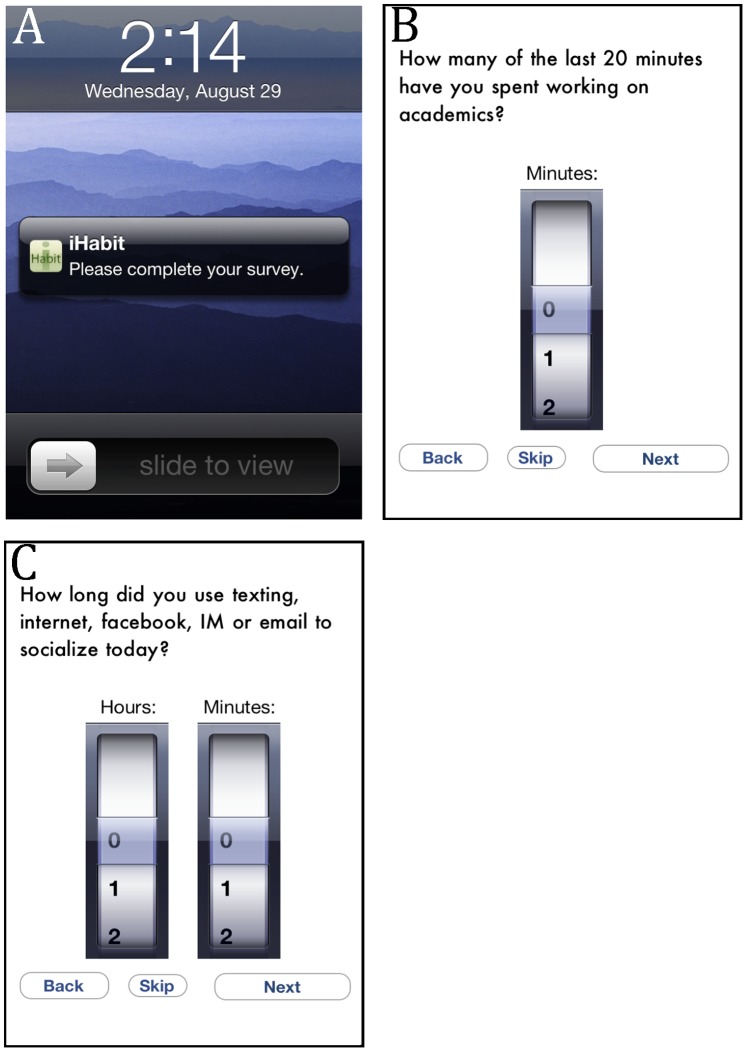
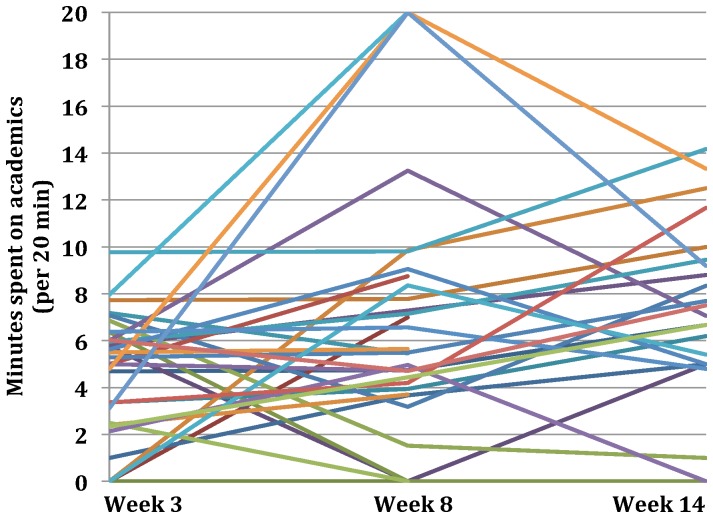
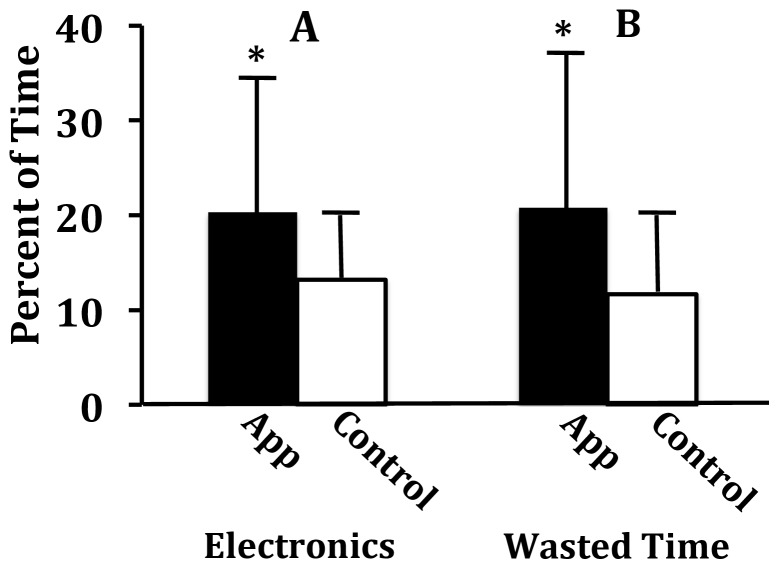
We have designed a flexible ecological momentary assessment/intervention smartphone (EMA/EMI) "app". We examine the utility of this app for collecting real-time data, and assessing intra-subject variability, by using it to assess how freshman undergraduates spend their time. We also explore whether its use can promote greater self-awareness. Participants were randomly divided into an experimental group, who used the app, and a control group, who did not. We used the app to collect both randomized in-the-moment data as well as end-of-day data to assess time use. Using a posttest survey we asked participants questions about how they spent time throughout the school semester. We also asked the experimental group about their experience with the app. Among other findings, 80.49% participants indicated that they became more aware of how they spent their time using the app. Corroborating this report, among the experimental group, end-of-semester self-assessment of time spent wasted, and time spent using electronics recreationally, predicted semester GPA at a strength comparable to high school GPA and ACT score (two of the best single predictors for first semester college GPA), but had no correlation among controls. We discuss the advantages and limitations of using apps, such as ours, for EMA and/or EMI.
Overview
The claims and statistics of this paper haven’t been checked yet.
Run the check — free, no account needed. It reads the open-access text and checks the sources it cites.
Integrity signals
Registry
Cites
Statistics
Figures
Verification
Claims the paper makes
The claims and statistics of this paper haven’t been checked yet.
Run the check — free, no account needed. It reads the open-access text and checks the sources it cites.
Claims other papers make about this one
Each is checked against this paper’s own text: does it say what the citing paper says it does?
In the citing paper
“Mobile apps provide a means to more accurately record symptoms (e.g., depressive mood, anxious mood or fatigue) through real-time assessments that can be administered outside of the clinic and accurate recall and time of recording [94,95].”
From Wearables and the Medical Revolution (2018) · cites this paper as [94]
Self-check
Percentages, sums and reported differences re-computed from the paper’s own numbers.
The self-check needs the paper’s full text.
Citations
Cites
The Transtheoretical Model of Health Behavior Change.
Prochaska, J. O., & Velicer, W. F. (1997) · American Journal of Health Promotion · doi:10.4278/0890-1171-12.1.38 · Cited by 7,782
Ecological momentary assessment
Shiffman, S., Stone, A. A., & Hufford, M. R. (2008) · Annual Review of Clinical Psychology · doi:10.1146/annurev.clinpsy.3.022806.091415 · Cited by 6,454
Diary Methods: Capturing Life as it is Lived
Bolger, N., Davis, A., & Rafaeli, E. (2003) · Annual Review of Psychology · doi:10.1146/annurev.psych.54.101601.145030 · Cited by 3,843
Handbook of research methods for studying daily life
Mehl, M. R., Conner, T. S., & Csíkszentmihályi, M. (2012) · Choice Reviews Online · doi:10.5860/choice.50-1159 · Cited by 2,121
Representative design and probabilistic theory in a functional psychology.
Brunswik, E. (1955) · Psychological Review · doi:10.1037/h0047470 · Cited by 1,600
Experience sampling research in psychopathology: opening the black box of daily life
Myin-Germeys, I., Oorschot, M., Collip, D., Lataster, J., Delespaul, P., & van Os, J. (2009) · Psychological Medicine · doi:10.1017/s0033291708004947 · Cited by 817
Patient non-compliance with paper diaries
Stone, A. A., Shiffman, S., Schwartz, J. E., Broderick, J. E., & Hufford, M. R. (2002) · BMJ · doi:10.1136/bmj.324.7347.1193 · Cited by 810
Ecological momentary assessment (EMA) in studies of substance use.
Shiffman, S. S. (2009) · Psychological Assessment · doi:10.1037/a0017074 · Cited by 764
Trull, T. J., & Ebner-Priemer, U. (2013) · Annual Review of Clinical Psychology · doi:10.1146/annurev-clinpsy-050212-185510 · Cited by 761
The Smartphone Psychology Manifesto
Miller, G. F. (2012) · Perspectives on Psychological Science · doi:10.1177/1745691612441215 · Cited by 671
Cited by
Sorted by citations
Sung, Y.-T., Chang, K.-E., & Liu, T.-C. (2016) · Computers & Education · doi:10.1016/j.compedu.2015.11.008 · Cited by 1,574
Wearables and the Medical Revolution
Dunn, J., Runge, R., & Snyder, M. (2018) · Personalized Medicine · doi:10.2217/pme-2018-0044 · Cited by 654
Does monitoring goal progress promote goal attainment? A meta-analysis of the experimental evidence.
Harkin, B., Webb, T. L., Chang, B. P. I., Prestwich, A., Conner, M., Kellar, I., Benn, Y., & Sheeran, P. (2016) · Psychological Bulletin · doi:10.1037/bul0000025 · Cited by 564
Social media and depression symptoms: A network perspective.
Aalbers, G., McNally, R. J., Heeren, A., de Wit, S., & Fried, E. I. (2018) · Journal of Experimental Psychology General · doi:10.1037/xge0000528 · Cited by 330
Clinical Child and Family Psychology Review
(2013) · Clinical Child and Family Psychology Review · doi:10.1007/10567.1573-2827 · Cited by 268
Metadata
- Authors
- Runyan, J. D., Steenbergh, T. A., Bainbridge, C., Daugherty, D. A., Oke, L., & Fry, B. N.
- Affiliations
- Indiana Wesleyan University (US)
- Corresponding author
- Runyan, Jason D.
- Venue
- PLoS ONE
- Publisher
- Public Library of Science (PLoS)
- Published
- 2013-08-14
- Volume
- 8
- Issue
- 8
- Pages
- e71325
- ISSN
- 1932-6203 (ISSN-L)
- PMC
- PMC3743745
- OpenAlex
- W2133044419
- Cited by
- 179
- References
- 45
- Citations by year
- 2026: 6 · 2025: 14 · 2024: 9 · 2023: 12 · 2022: 12 · 2021: 19 · 2020: 13 · 2019: 15 · 2018: 25 · 2017: 12 · 2016: 15 · 2015: 21 · 2014: 5 · 2013: 1
- FWCI
- 18.92
- Type
- journal article
- Language
- en
- Open access
- gold
- doi.org
- Locations
- PLoS ONE (publishedVersion, cc-by)
- Europe PMC (PubMed Central) (publishedVersion, cc-by)
- PubMed Central (publishedVersion, cc-by)
- PubMed (publishedVersion)
- RePEc: Research Papers in Economics (submittedVersion)
- DOAJ (DOAJ: Directory of Open Access Journals) (submittedVersion, cc-by-sa)
- Funders
- Eli Lilly and Company
- Topics
- Social Sciences › Psychology › Experimental and Cognitive Psychology › Mental Health Research Topics
- Social Sciences › Psychology › Applied Psychology › Digital Mental Health Interventions
- Health Sciences › Health Professions › General Health Professions › Mobile Health and mHealth Applications
- Keywords
- ecological momentary assessment, ecological momentary intervention, mobile application, self-awareness, time use, within-person variability, GPA prediction, time waste, mobile health
- MeSH terms
- Adolescent, Awareness, Data Collection, Female, Humans, Male, Surveys and Questionnaires, Self-Assessment, Space Perception, Task Performance and Analysis, Time Perception, Time Management, Cell Phone, Young Adult, Mobile Applications
About these checks
Registry, retraction, Cites and statistics results are computed, not judged, with one exception: a printed reference that no index lists is read once by a model before it counts as a citation error. Claims are extracted by a model and kept only when their quote appears verbatim in the text; each cited source is then checked, with a model’s help, for whether it says what the claim relies on. Those verdicts can be wrong — read the claim’s quote and the cited source before relying on one.
Statistics and arithmetic are recomputed, not judged.
Confidence bands are shown only for fields calibrated on our annotated test set. None is calibrated yet, so no band is shown.
What counts as a claim ›How we measure confidence ›How we check this ›
Are you an author, or do you see a problem with this page? Request a review
