

Neonatal Intensive Care in a Karen Refugee Camp: A 4 Year Descriptive Study
Open accessThe DOI matches its Crossref record; 19 of the 19 references it cites were found in a registry or an index; 1 of the 5 sources its claims cite were checked for support.
Abstract
BACKGROUND: A third of all deaths in children aged <5 years occur in the neonatal period. Neonatal intensive care is often considered too complex and expensive to be implemented in resource poor settings. Consequently the reductions that have been made in infant mortality in the poorest countries have not been made in the neonatal period. This manuscript describes the activities surrounding the introduction of special care baby unit (SCBU) in a refugee setting and the resulting population impact. METHODS: A SCBU was developed in Maela refugee camp on the Thailand-Myanmar border. This unit comprised of a dedicated area, basic equipment, drugs and staff training. Training was built around neonatal guidelines, comprising six clinical steps: recognition, resuscitation, examination, supportive medical care, specialised medical care, and counselling of parents with sick newborns. RESULTS: From January 2008 until December 2011, 952 infants were admitted to SCBU. The main admission diagnoses were early onset neonatal sepsis, jaundice and prematurity. Early prematurity (<34 weeks) carried the highest risk of mortality (OR 9.5, 95% CI 5.4-16.5, p<0.001). There was a significant decrease in mortality from 19.3% (2008) to 4.8% (2011) among the infants admitted for prematurity (p=0.03). The neonatal mortality in Maela camp as a whole declined by 51% from 21.8 to 10.7 deaths per 1000 live births over the corresponding period (p=0.04). Staff expressed more confidence in their ability to take care of neonates and there was a more positive attitude towards premature infants. CONCLUSION: Neonatal mortality can be reduced in a resource poor setting by introduction of a simple low cost unit specialising in care of sick neonates and run by local health workers following adequate training. Training in recognition and provision of simple interventions at a high standard can increase staff confidence and reduce fatalistic attitudes towards premature neonates.
Overview
CoChat Summary
TL;DR
A special care baby unit (SCBU) was introduced in Maela refugee camp on the Thailand-Myanmar border and provided low-cost neonatal care run by local health workers from 2008 to 2011. Over this period, SCBU admissions increased, mortality among admitted infants fell, and camp-wide neonatal mortality declined by 51%.
Key findings
- Among 952 infants admitted to SCBU (970 admissions), the main admission diagnoses were early onset neonatal sepsis, jaundice, and prematurity; early prematurity (<34 weeks) carried the highest mortality risk (OR 9.5, 95% CI 5.4–16.5, p<0.001).
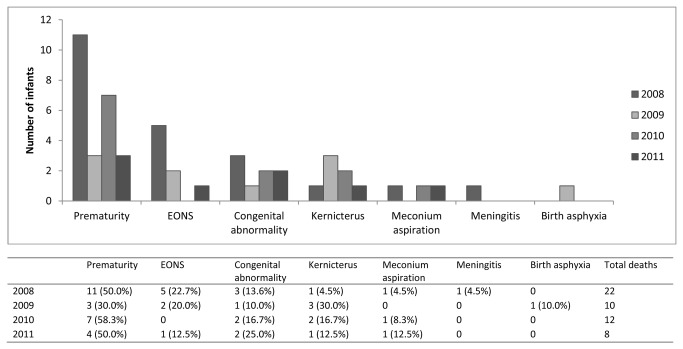
- Mortality among infants admitted for prematurity fell from 19.3% (11/57) in 2008 to 4.8% (3/63) in 2011 (p=0.03), and overall SCBU mortality fell from 12.2% (22/181) to 3.1% (8/259) (p<0.001).
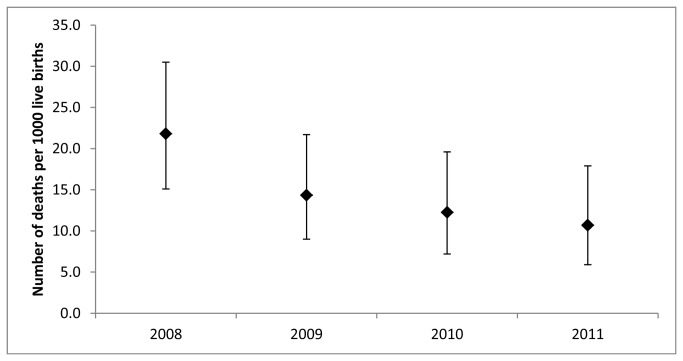
- Neonatal mortality in Maela camp as a whole declined by 51%, from 21.8 to 10.7 deaths per 1000 live births (p=0.03 in Results; the abstract states p=0.04).
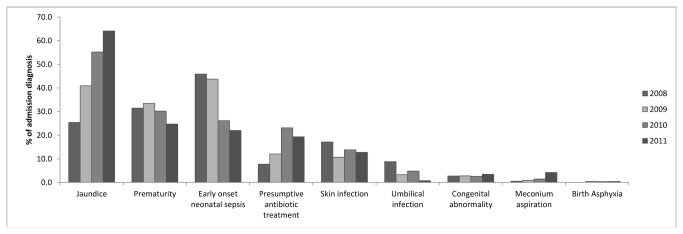
- Phototherapy use increased from 25.4% (46/181) to 64.1% (166/259) of admissions (p<0.001); G6PD deficiency was found in 113/1,571 infants tested (7.2%), and 54/113 (47.8%) of deficient infants needed SCBU admission for jaundice.
Methods
- Retrospective descriptive study of a newly established SCBU in Maela refugee camp, Thailand-Myanmar border, from January 2008 to December 2011; the unit used basic equipment, drugs, standardized neonatal guidelines, and six-step staff training.
- During the period there were 5,799 births and 5,732 live births in Maela camp; analysis of SCBU outcomes was restricted to infants ≥28 weeks gestation born to mothers who followed antenatal care in Maela camp (n=923).
- Data were entered into Access and analyzed in Stata using logistic regression, chi-squared for trend, Kruskal-Wallis and Wilcoxon rank sum tests; informal staff interviews and a cost estimate for preterm infant care were also conducted.
Limitations
- Stated: this is a retrospective descriptive study, so significant P-values require cautious interpretation because other unidentified factors may have contributed; reductions in home deliveries and in multiple births in 2011 may also have affected neonatal mortality.
- Stated: there was no formal measurement of staff knowledge, attitude, or confidence, and long-term developmental outcomes are not reported because follow-up is ongoing.
- Evident from the text: the SCBU had no ventilatory support, infants born before 28 weeks were given palliative care and excluded from the main analysis, the cost estimate excluded expatriate paediatrician salary and unit overheads, and the staff interviews used purposive sampling of a small number of experienced English-speaking staff.
Model-written summary. Check it against the paper before relying on it.
Integrity signals
Registry
Cites
Statistics
Figures
Verification
Claims the paper makes
0 Valid · 1 Not valid · 4 Not checked · 58 Own results and interpretations
A result the paper reports from its own data — it cites no other source for it, so there is none to check. The quote shows it is in the paper.
In the paper
“The proportion of infants who died following admission to SCBU fell from 12.2% (22/181) in 2008 to 3.1% (8/259) in 2011 (p<0.001).”
§ Neonatal Intensive Care in a Karen Refugee Camp: A 4 Year Descriptive Study > Results > Mortality
plainstates an association- Asserted: passes — The authors put it forward as true.
- Checkable: passes — It can be checked against evidence.
- Load-bearing: passes — The paper’s conclusions depend on it.
- Based: passes — The paper gives a reason why it holds.
A result the paper reports from its own data — it cites no other source for it, so there is none to check. The quote shows it is in the paper.
In the paper
“There was a significant decrease in mortality from 19.3% (2008) to 4.8% (2011) among the infants admitted for prematurity (p=0.03).”
§ Neonatal Intensive Care in a Karen Refugee Camp: A 4 Year Descriptive Study > Abstract > Results
plainstates an association- Asserted: passes — The authors put it forward as true.
- Checkable: passes — It can be checked against evidence.
- Load-bearing: passes — The paper’s conclusions depend on it.
- Based: passes — The paper gives a reason why it holds.
A result the paper states — it cites no source for it, so there is none to check. The quote shows it is in the paper.
In the paper
“The cost of providing care to a preterm infant while in the SCBU at SMRU was approximately $7 a day.”
§ Neonatal Intensive Care in a Karen Refugee Camp: A 4 Year Descriptive Study > Discussion
hedged- Asserted: passes — The authors put it forward as true.
- Checkable: passes — It can be checked against evidence.
- Load-bearing: unclear — It is unclear whether the paper’s conclusions depend on it.
- Based: passes — The paper gives a reason why it holds.
A result the paper reports from its own data — it cites no other source for it, so there is none to check. The quote shows it is in the paper.
In the paper
“Infants with G6PD deficiency needed significantly longer phototherapy treatment than those who had normal G6PD activity (a median of 49 hours compared with 24 hours, p=0.001).”
§ Neonatal Intensive Care in a Karen Refugee Camp: A 4 Year Descriptive Study > Results > Jaundice
plainstates an association- Asserted: passes — The authors put it forward as true.
- Checkable: passes — It can be checked against evidence.
- Load-bearing: passes — The paper’s conclusions depend on it.
- Based: passes — The paper gives a reason why it holds.
A result the paper reports from its own data — it cites no other source for it, so there is none to check. The quote shows it is in the paper.
In the paper
“Early prematurity (<34 weeks) carried the highest risk of mortality (OR 9.5, 95% CI 5.4–16.5, p<0.001).”
§ Neonatal Intensive Care in a Karen Refugee Camp: A 4 Year Descriptive Study > Abstract > Results
plainstates an associationn = 952 ·- Asserted: passes — The authors put it forward as true.
- Checkable: passes — It can be checked against evidence.
- Load-bearing: passes — The paper’s conclusions depend on it.
- Based: passes — The paper gives a reason why it holds.
23 more claims
Create a free account to see all 63 claims and to verify the 4 references still open.
- Probably not a substantial claim. 23
- It may state two separate claims as one. 21
- The quote only partly states this claim. 1
Claims other papers make about this one
Each is checked against this paper’s own text: does it say what the citing paper says it does?
The source backs part of the claim, not all of it — or backs it for a different population, condition or comparison.
In the citing paper
“The incidence of G6PD deficiency is 7.2–13.7% [25, 26] in this population”
From A Survey of Practice and Knowledge of Refugee and Migrant Pregnant Mothers Surrounding Neonatal Jaundice on the Thailand–Myanmar Border (2017) · cites this paper as [26]
Experimental — accuracy not yet measuredThe source backs part of the claim, not all of it — or backs it for a different population, condition or comparison.
In the citing paper
“Examples of the quality of health care delivered by the staff (medic, nurse, midwife) has been assessed regularly. 23 – 25”
From Cohort Profile: the SMRU Refugee and Migrant Pregnancy Study in Western Thailand and Eastern Myanmar (2026) · cites this paper as [25]
Experimental — accuracy not yet measuredIn the citing paper
“Prematurity and its complications (birth asphyxia, sepsis in neonates) contributed to the deaths and are similar to the results from another border camp (Turner et al., 2013a) and reported globally (UNICEF et al., 2017).”
From Mother, child and adolescent health outcomes in two long-term refugee camp settings at the Thai-Myanmar border 2000–2018: a retrospective analysis (2024) · cites this paper as Turner et al., 2013a
In the citing paper
“In 2008, SMRU established Special Baby Care Units (SCBUs) within its facilities for specialized care of preterm, small, or sick neonates (40); the first such unit for refugees and migrants outside the Thai hospital system.”
In the citing paper
“Accurate estimation of gestational age has always been an integral part of the antenatal care and since 2001 dating is based on ultrasound (37–40).”
5 more claims about this paper
Create a free account to see every claim other papers make about this one.
Self-check
Percentages, sums and reported differences re-computed from the paper’s own numbers.
Each contradiction between two passages listed here was confirmed by an independent check.
Rated minor: it would not touch a result — a value no result rests on, a p-value that stays on the same side of the significance level, or a conflict that is clerical, resolved elsewhere in the paper, or outside its own findings.
In the paper
§ Neonatal Intensive Care in a Karen Refugee Camp: A 4 Year Descriptive Study > Abstract > Results
“The neonatal mortality in Maela camp as a whole declined by 51% from 21.8 to 10.7 deaths per 1000 live births over the corresponding period (p=0.04).”
§ Neonatal Intensive Care in a Karen Refugee Camp: A 4 Year Descriptive Study > Results > Mortality
“From 2008 until 2011 neonatal mortality within Maela camp significantly decreased from 21.8 deaths per 1000 live births to 10.7 deaths per 1000 live births (p =0.03) (Figure 3).”
Rated minor: it would not touch a result — a value no result rests on, a p-value that stays on the same side of the significance level, or a conflict that is clerical, resolved elsewhere in the paper, or outside its own findings.
In the paper
“| Early premature (% admissions) | 26 (13.6) | 37 (17.0) | 26 (9.6) | 17 (6.4) |”
§ Neonatal Intensive Care in a Karen Refugee Camp: A 4 Year Descriptive Study > Results > Admission characteristics of SCBU neonates
Reported 13.6 · recomputed 14.364641
Rated minor: it would not touch a result — a value no result rests on, a p-value that stays on the same side of the significance level, or a conflict that is clerical, resolved elsewhere in the paper, or outside its own findings.
In the paper
“85/181 (45.7%) in 2008”
§ Neonatal Intensive Care in a Karen Refugee Camp: A 4 Year Descriptive Study > Results > Neonatal sepsis and presumptive antibiotic administration
Reported 45.7 · recomputed 46.961326
Rated minor: it would not touch a result — a value no result rests on, a p-value that stays on the same side of the significance level, or a conflict that is clerical, resolved elsewhere in the paper, or outside its own findings.
In the paper
“from 12.0% (181/1513) of all live births in 2008 to 19.8% (215/1306) in 2011.”
§ Neonatal Intensive Care in a Karen Refugee Camp: A 4 Year Descriptive Study > Results > Admission characteristics of SCBU neonates
Reported 19.8 · recomputed 16.462481
Rated minor: it would not touch a result — a value no result rests on, a p-value that stays on the same side of the significance level, or a conflict that is clerical, resolved elsewhere in the paper, or outside its own findings.
In the paper
“| Oxygen | 49 (27.1) | 49 (22.8) | 55 (20.9) | 43 (20.5) |”
§ Neonatal Intensive Care in a Karen Refugee Camp: A 4 Year Descriptive Study > Results > Diagnosis and treatment of infants admitted to SCBU
Reported 20.9 · recomputed 20.522388
1 more finding
Create a free account to see every finding of this check.
Citations
Cites
Liu, L., Johnson, H. L., Cousens, S., Perin, J., Scott, S., Lawn, J. E., Rudan, I., Campbell, H., Cibulskis, R., Li, M., et al. (2012) · The Lancet · doi:10.1016/s0140-6736(12)60560-1 · Cited by 3,934
4 million neonatal deaths: When? Where? Why?
Lawn, J. E., Cousens, S., & Zupan, J. (2005) · The Lancet · doi:10.1016/s0140-6736(05)71048-5 · Cited by 3,670 · cited 1×
“The majority of deaths occur in the first week of life and occur in the developing world [2,3].”
BackgroundGlobal, regional, and national causes of child mortality in 2008: a systematic analysis
Black, R. E., Cousens, S., Johnson, H. L., Lawn, J. E., Rudan, I., Bassani, D. G., Jha, P., Campbell, H., Walker, C. F., Cibulskis, R., et al. (2010) · The Lancet · doi:10.1016/s0140-6736(10)60549-1 · Cited by 3,058 · cited 1×
“As 2015 approaches, strides have been made in working toward the fourth millennium development goal, the two thirds reduction in childhood mortality [4].”
BackgroundWhere and why are 10 million children dying every year?
Black, R. E., Morris, S. S., & Bryce, J. (2003) · The Lancet · doi:10.1016/s0140-6736(03)13779-8 · Cited by 2,460
Born too soon : the Global action report on preterm birth
Howson, C. P., Kinney, M., & Lawn, J. E. (2012) · Cited by 1,928
Evidence-based, cost-effective interventions: How many newborn babies can we save?
Darmstadt, G. L., Bhutta, Z. A., Cousens, S., Adam, T., Walker, N., & de Bernis, L. (2005) · The Lancet · doi:10.1016/s0140-6736(05)71088-6 · Cited by 1,541 · cited 1×
“Intensive neonatal care in resource constrained settings, is often considered too difficult and too expensive [6].”
BackgroundIams, J. D., Romero, R., Culhane, J. F., & Goldenberg, R. L. (2008) · The Lancet · doi:10.1016/s0140-6736(08)60108-7 · Cited by 500 · cited 1×
“Good neonatal care begins before birth with good antenatal care: improving nutrition in the mother, treating infections and providing tetanus immunisation [8].”
BackgroundNeonatal survival: a call for action
Martines, J., Paul, V. K., Bhutta, Z. A., Koblinsky, M., Soucat, A., Walker, N., Bahl, R., Fogstad, H., & Costello, A. (2005) · The Lancet · doi:10.1016/s0140-6736(05)71882-1 · Cited by 314 · cited 1×
“However, effective neonatal care of very sick babies does not need to be highly technical and beneficial effects from training local health workers to provide skilled care has been reported [7].”
BackgroundBEUTLER, E., & MITCHELL, M. (1968) · Blood · doi:10.1182/blood.v32.5.816.816 · Cited by 212
Reduction in child mortality in Niger: a Countdown to 2015 country case study
Amouzou, A., Habi, O., & Bensaïd, K. (2012) · The Lancet · doi:10.1016/s0140-6736(12)61376-2 · Cited by 150 · cited 1×
“However this reduction has occurred mostly in children outside of the neonatal period [5].”
Background
Cited by
Olusanya, B. O., Ogunlesi, T. A., & Slusher, T. M. (2014) · Archives of Disease in Childhood · doi:10.1136/archdischild-2013-305506 · Cited by 171
Delivering maternal and neonatal health interventions in conflict settings: a systematic review
Munyuzangabo, M., Gaffey, M. F., Khalifa, D. S., Als, D., Ataullahjan, A., Kamali, M., Jain, R. P., Meteke, S., Radhakrishnan, A., Shah, S., et al. (2021) · BMJ Global Health · doi:10.1136/bmjgh-2020-003750 · Cited by 91
Singh, N. S., Smith, J., Aryasinghe, S., Khosla, R., Say, L., & Blanchet, K. (2018) · PLOS ONE · doi:10.1371/journal.pone.0199300 · Cited by 89
“03), while cause-specific mortality also fell in relation to the four main causes of neonatal death: prematurity, early onset neonatal sepsis, congenital abnormalities, and jaundice.[50] HIV and STIs A study conducted by Médecins Sans Frontières (MSF) in the conflict-affected region of Bukavu, eastern Democratic Repub…”
BackgroundOlusanya, B. O., Emokpae, A. A., Zamora, T., & Slusher, T. M. (2014) · Acta Paediatrica · doi:10.1111/apa.12735 · Cited by 82
Bancone, G., Gornsawun, G., Chu, C. S., Porn, P., Pal, S., Bansil, P., Domingo, G. J., & Nosten, F. (2018) · PLOS ONE · doi:10.1371/journal.pone.0196716 · Cited by 65
Self-citationThielemans, L., Gornsawun, G., Hanboonkunupakarn, B., Paw, M. K., Porn, P., Moo, P. K., Van Overmeire, B., Proux, S., Nosten, F., McGready, R., et al. (2018) · Wellcome Open Research · doi:10.12688/wellcomeopenres.13373.1 · Cited by 49
Self-citationDiala, U. M., Usman, F., Appiah, D., Hassan, L., Ogundele, T., Abdullahi, F., Satrom, K. M., Bakker, C., Lee, B. W., & Slusher, T. M. (2023) · Journal of Clinical Medicine · doi:10.3390/jcm12113738 · Cited by 114
“Statistical Analysis The summary estimate for the meta-analysis was prevalence/proportion, which was transformed using Freeman–Tukey double arcsine transformation to enable them to correspond to probabilities under the standard normal distribution and enhance significance testing [99].”
MethodBancone, G., Chu, C. S., Chowwiwat, N., Somsakchaicharoen, R., Wilaisrisak, P., Charunwatthana, P., Bansil, P., McGray, S., Domingo, G. J., & Nosten, F. H. (2015) · The American Society of Tropical Medicine and Hygiene · doi:10.4269/ajtmh.14-0696 · Cited by 34
“Previous data collected in the SMRU in the last 4 years showed that the test was reliable, even when performed in field-based simple laboratories.(21) Nonetheless, its main limita-”
MethodSelf-citationWastnedge, E., Waters, D., Murray, S. R., McGowan, B. S., Chipeta, E. K., Mipando, A. L. N., Gadama, L. A., Gadama, G. M., Masamba, M., Malata, M. P., et al. (2021) · Journal of Global Health · doi:10.7189/jogh.11.04050 · Cited by 56
White, A. L., Min, T. H., Gross, M. M., Kajeechiwa, L., Thwin, M. M., Hanboonkunupakarn, B., Than, H. H., Zin, T. W., Rijken, M. J., Hoogenboom, G., et al. (2016) · PLoS ONE · doi:10.1371/journal.pone.0164363 · Cited by 29
Self-citationThielemans, L., Trip-Hoving, M., Landier, J., Turner, C., Prins, T. J., Wouda, E. M. N., Hanboonkunupakarn, B., Po, C., Beau, C., Mu, M., et al. (2018) · BMC Pediatrics · doi:10.1186/s12887-018-1165-0 · Cited by 34
“A standardized newborn examination sheet was completed and any suspected abnormal findings on surface examination and/or auscultation of the praecordium (heart and lungs) was confirmed by a medical doctor [13].”
BackgroundMethodInfluentialSelf-citationTurner, C., Pol, S., Suon, K., Neou, L., Day, N. P. J., Parker, M., & Kingori, P. (2017) · BMC Pregnancy and Childbirth · doi:10.1186/s12884-017-1305-9 · Cited by 29
“Another perceived barrier to providing neonatal care, particularly in remote areas, is the misconception that neonatal care is difficult and expensive [6].”
BackgroundSelf-citationBrummaier, T., Kabeer, B. S. A., Lindow, S. W., Konje, J. C., Pukrittayaamee, S., Utzinger, J., Toufiq, M., Antoniou, A., Marr, A. K., Suriyakan, S., et al. (2019) · BMJ Open · doi:10.1136/bmjopen-2018-023417 · Cited by 27
“3) is not significantly different.(8) The aetiology of PTB is variable.”
BackgroundSelf-citationBierhoff, M., Angkurawaranon, C., Min, A. M., Gilder, M. E., Tun, N. W., Keereevijit, A., Win, A. K., Win, E., Carrara, V. I., Brummaier, T., et al. (2019) · Journal of Pregnancy · doi:10.1155/2019/8435019 · Cited by 30
“Every newborn had a physical examination conducted by trained clinical staff with results recorded on a standard reporting form [28].”
MethodSelf-citationCollateral damage: the overlooked reproductive health crisis in conflict zones
Okeke, S. R., Okeke-Obayemi, D. O., Njoroge, M. R., & Yaya, S. (2024) · Reproductive Health · doi:10.1186/s12978-024-01941-8 · Cited by 28
Data collection tools for maternal and child health in humanitarian emergencies: a systematic review
Pyone, T., Dickinson, F. M., Kerr, R. S., Boschi-Pinto, C., Mathai, M., & van den Broek, N. R. (2015) · Bulletin of the World Health Organization · doi:10.2471/blt.14.148429 · Cited by 31
Burkardt, A. D., Krause, N., & Velarde, M. R. (2019) · Human Resources for Health · doi:10.1186/s12960-019-0435-8 · Cited by 36
Sustainability in refugee camps: a systematic review and Meta-analysis
Wardeh, M., & Marques, R. C. (2021) · Sustainability · doi:10.3390/su13147686 · Cited by 22
“[25] Claudia Turner, Verena Carrara, Naw Aye Mya Thein, Naw Chit Mo Mo Win, Paul Turner, Germana Bancone, Nicholas J.”
BackgroundStanley, L., Min, T. H., Than, H. H., Stolbrink, M., McGregor, K., Chu, C., Nosten, F. H., & McGready, R. (2015) · Conflict and Health · doi:10.1186/s13031-015-0041-x · Cited by 18
“Score, median [range] 12 [5-21] 20 [12-24] 21 [14-25] P < 0.”
BackgroundInfluentialSelf-citationThielemans, L., Peerawaranun, P., Mukaka, M., Paw, M. K., Wiladphaingern, J., Landier, J., Bancone, G., Proux, S., Elsinga, H., Trip-Hoving, M., et al. (2021) · PLOS ONE · doi:10.1371/journal.pone.0258127 · Cited by 20
Self-citationBancone, G., Gilder, M. E., Win, E., Gornsawun, G., Penpitchaporn, P., Moo, P. K., Archasuksan, L., Wai, N. S., Win, S., Aung, K. K., et al. (2022) · BMJ Open · doi:10.1136/bmjopen-2022-066529 · Cited by 20
“…Burman populations along the Thailand–Myanmar border (9%–18% in males 12 ), where it is associated with an increased risk of developing NH requiring photo-therapy both in G6PD-deficient (over fourfold 13 ) and in heterozygous females (over twofold 5 ) as compared with wild-type genotype neonates.”
Self-citationForced Migration in Southeast Asia
Stange, G., Sakdapolrak, P., Sasiwongsaroj, K., & Kourek, M. (2019) · Advances in Southeast Asian Studies · doi:10.14764/10.aseas-0024 · Cited by 16
Bancone, G., Gornsawun, G., Peerawaranun, P., Penpitchaporn, P., Paw, M. K., Poe, D. D., Win, D., Cicelia, N., Mukaka, M., Archasuksan, L., et al. (2022) · PLOS Global Public Health · doi:10.1371/journal.pgph.0000475 · Cited by 14
“The first phototherapy units were set up in the clinics in 2009 [15] and by the time of this study they were well accepted by the mothers who could sleep near the cot, breastfeed, and care for their newborn.”
BackgroundSelf-citationPrins, T. J., Trip-Hoving, M., Paw, M. K., Ka, M. L., Win, N. N., Htoo, G., Hser, M. K., Chotivanich, K., Nosten, F., & McGready, R. (2017) · Journal of Tropical Pediatrics · doi:10.1093/tropej/fmw055 · Cited by 12
“7% [25, 26] in this population, and between 2008 and 2011 eight neonates died of kernicterus, four of whom were G6PD deficient [26].”
BackgroundMethodSelf-citationThielemans, L., Trip-Hoving, M., Bancone, G., Turner, C. L., Simpson, J. A., Hanboonkunupakarn, B., van Hensbroek, M. B., van Rheenen, P., Paw, M. K., Nosten, F. H., et al. (2017) · BMC Pediatrics · doi:10.1186/s12887-017-0798-8 · Cited by 15
“It will confirm clinical experience that a high proportion (25%) of newborns requiring phototherapy are G6PD-deficiency and that these newborns require a longer phototherapy duration [21].”
BackgroundSelf-citationA systematic review of newborn health interventions in humanitarian settings
Rodo, M., Duclos, D., DeJong, J., Akik, C., & Singh, N. S. (2022) · BMJ Global Health · doi:10.1136/bmjgh-2022-009082 · Cited by 11
Gilder, M. E., Tun, N. W., Carter, A., Tan, F. F. S. L., Min, A. M., Eh, H., Aye, P., Carrara, V. I., Angkurawaranon, C., & McGready, R. M. (2021) · BMC Pregnancy and Childbirth · doi:10.1186/s12884-021-03610-1 · Cited by 14
“From 2008 onwards phototherapy units [29], total serum bilirubin (SBR) measurement and G6PD assessment were available for jaundiced newborns.”
MethodSelf-citationGilder, M. E., Pateekhum, C., Hashmi, A., Aramrat, C., Aung, K. K., Miket, W., Chu, C. S., Win, D., Bierhoff, M., Wiwattanacharoen, W., et al. (2022) · International Journal for Equity in Health · doi:10.1186/s12939-022-01802-5 · Cited by 9
“These free clinics offer contraception, antenatal, delivery [24, 25] and neonatal care [26], as well as general medical services.”
BackgroundSelf-citationCarrara, V. I., Darakamon, M. C., Thin, N. W. W., Paw, N. T. K., Wah, N., Wah, H. G., Helen, N., Keereecharoen, S., Paw, N. T. M., Jittamala, P., et al. (2016) · PLoS ONE · doi:10.1371/journal.pone.0157087 · Cited by 9
“The SCBU provides essential neonatal care but is a facility without capacity for ventilation [18].”
BackgroundSelf-citationMcGready, R., Paw, M. K., Wiladphaingern, J., Min, A. M., Carrara, V. I., Moore, K. A., Pukrittayakamee, S., & Nosten, F. H. (2018) · Wellcome Open Research · doi:10.12688/wellcomeopenres.10352.2 · Cited by 18
“Number of ANC visits, median{25th-75th percentile}, [min-max] 6 {3-11}, [1-22]”
Self-citationSexual and reproductive health implementation research in humanitarian contexts: a scoping review
Norton, A., & Tappis, H. (2024) · Reproductive Health · doi:10.1186/s12978-024-01793-2 · Cited by 11
Extreme neonatal hyperbilirubinaemia in refugee and migrant populations: retrospective cohort
Wouda, E. M. N., Thielemans, L., Darakamon, M. C., Nge, A. A., Say, W., Khing, S., Hanboonkunupakarn, B., Ngerseng, T., Landier, J., van Rheenen, P. F., et al. (2020) · BMJ Paediatrics Open · doi:10.1136/bmjpo-2020-000641 · Cited by 7
“Three SMRU SCBU facilities contributed to the data in refugees (1 January 2009–31 December 2014 17 ) and in migrants (1 January 2011–31 December 2014) (figure 1).”
Self-citationContext matters: a systematic review of neonatal care in humanitarian emergencies
McBride, S., & Morgan, A. (2022) · Journal of International Humanitarian Action · doi:10.1186/s41018-022-00121-2 · Cited by 9
“A retrospective descriptive study at the Maela refugee camp on the Thailand-Myanmar boarder identified that the creation of separate newborn areas in the health facility, employing a specific staffing team for newborn care during labour and delivery, creating locally appropriate standardised newborn guidelines, and co…”
BackgroundInfluentialFox-Lewis, S., Genasci Smith, W., Lor, V., McKellar, G., Phal, C., Fox-Lewis, A., Turner, P., Neou, L., & Turner, C. (2019) · Journal of Tropical Pediatrics · doi:10.1093/tropej/fmy030 · Cited by 4
“A special care baby unit (SCBU) established at the Maela Camp for Displaced Persons on the Thailand–Myanmar border resulted in halving the neonatal mortality rate within four years [5].”
BackgroundSelf-citationHashmi, A., Darakamon, M. C., Aung, K. K., Mu, M., Misa, P., Jittamala, P., Chu, C., Phyo, A. P., Turner, C., Nosten, F., et al. (2023) · Frontiers in Public Health · doi:10.3389/fpubh.2023.1144642 · Cited by 4
“Alluded to in the “Materials and methods,” facility-based care for preterm newborns was initially provided to refugees and later expanded to migrant communities (40).”
BackgroundMethodInfluentialSelf-citationBashir, H. A., Lufting-Leeffrers, D., Min, A. M., Win, H. H., Tun, N. W., Wah, T. G., Gilder, M. E., Paw, M. K., Carrara, V. I., Meeyai, A. C., et al. (2023) · Wellcome Open Research · doi:10.12688/wellcomeopenres.19396.1 · Cited by 9
“Neonatal intensive care has been available in the refugee camp from 2008 20 and in migrant camps from 2009 in Wang Pha and 2010 in Maw Ker Thai.”
Self-citationBenner, M. T., Mohr, O., Kaloy, W., Sansoenboon, A., Moungsookjarean, A., Kaiser, P., Carrara, V. I., & McGready, R. (2024) · Primary Health Care Research & Development · doi:10.1017/s146342362400015x · Cited by 3
“This was achieved by the introduction of simple low-cost unit specializing in care of sick neonates run by local refugee health workers with training support to increase staff competency (Turner et al. , 2013a).”
MethodResultSelf-citationBancone, G., Gilder, M. E., Win, E., Gornsawun, G., Penpitchaporn, P., Moo, P. K., Archasuksan, L., Wai, N. S., Win, S., Aung, K. K., et al. (2022) · medRxiv · doi:10.1101/2022.07.03.22277173 · Cited by 3
“G6PD deficiency is very common among the Karen and Burman population along the Thailand91 Myanmar border (9-18% in males, [12]) where it is associated with an increased risk to develop NH 92 requiring phototherapy both in G6PD deficient (over 4-fold [13]) and in heterozygous females (over 293 fold [5]) as compared to…”
ResultSelf-citation(2024) · doi:10.1186/s12884-024-06841-0 · Cited by 2
Self-citationPatel, K., Say, S., Leng, D., Prak, M., Lo, K., Mukaka, M., Riedel, A., & Turner, C. L. (2021) · BMC Pediatrics · doi:10.1186/s12887-021-02833-7 · Cited by 2
“Cambodia has one of the highest neonatal mortality rates in South-East Asia [2].”
BackgroundMethodInfluentialSelf-citationCohort Profile: the SMRU Refugee and Migrant Pregnancy Study in Western Thailand and Eastern Myanmar
McGready, R., J White, N., Nosten, F. H., & Collaborators, S. R. A. M. P. S. (2026) · Wellcome Open Research · doi:10.12688/wellcomeopenres.25582.2 · Cited by 2
Self-citationOlusanya, B. O., Mabogunje, C. A., Imam, Z. O., & Emokpae, A. A. (2017) · Acta Paediatrica · doi:10.1111/apa.14045
The profile of a life-saving researcher
Knightly, R. (2018) · Education for Primary Care · doi:10.1080/14739879.2018.1437570
Syrian Refugees in a Container City in Turkey: Retrospective Evaluation of Primary Care Admissions
Döner, P., Kahveci, R., Şencan, İ., Ayhan, D., & Özkara, A. (2019) · Turkish Journal of Family Medicine & Primary Care · doi:10.21763/tjfmpc.651567
Innovative Education Pathways for Refugees to Strengthen Health Systems
Velarde, M. R. (2022) · Oxford University Press eBooks · doi:10.1093/oso/9780198799498.003.0013
Effectiveness of E-Health Emergency Neonates on Increasing Mother Awareness
Dewi, M. U. K., Indrawati, N. D., Ulviyana, S., Dhani, E. N. R., & Andini, R. D. (2023) · Advances in health sciences research/Advances in Health Sciences Research · doi:10.2991/978-94-6463-132-6_25
Norton, A., & Tappis, H. (2024) · Figshare · doi:10.6084/m9.figshare.25815092
Gilder, M. E., Pateekhum, C., Hashmi, A., Aramrat, C., Aung, K. K., Miket, W., Chu, C. S., Win, D., Bierhoff, M., Wiwattanacharoen, W., et al. (2023) · Figshare · doi:10.6084/m9.figshare.22616914
Self-citationMcBride, S., & Morgan, A. (2022) · Figshare · doi:10.6084/m9.figshare.19980628
Use of the “STANDARD G6PDTM” quantitative point-of-care test in neonates and infants
Gornsawun, G., Moo, E., Htoo, K., Chalermvisutkul, S., Gilder, M. E., Moo, P. K., Archusuksan, L., Prins, T. J., Hanboonkunupakarn, B., McGready, R., et al. (2026) · PLoS ONE · doi:10.1371/journal.pone.0346837
Self-citation
Metadata
- Authors
- Turner, C., Carrara, V., Aye Mya Thein, N., Chit Mo Mo Win, N., Turner, P., Bancone, G., White, N. J., McGready, R., & Nosten, F.
- Affiliations
- University of Oxford (GB)
- Shoklo Malaria Research Unit (TH)
- Corresponding author
- Turner, Claudia
- ORCID
- Venue
- PLoS ONE
- Publisher
- Public Library of Science (PLoS)
- Published
- 2013-08-22
- Volume
- 8
- Issue
- 8
- Pages
- e72721
- ISSN
- 1932-6203 (ISSN-L)
- PMC
- PMC3749980
- OpenAlex
- W2155219847
- Cited by
- 52
- References
- 19
- Citations by year
- 2026: 2 · 2024: 6 · 2023: 5 · 2022: 8 · 2021: 6 · 2020: 1 · 2019: 5 · 2018: 7 · 2017: 3 · 2016: 4 · 2015: 3 · 2014: 2
- FWCI
- 5.43
- Type
- journal article
- Language
- en
- Open access
- gold
- doi.org
- Locations
- PLoS ONE (publishedVersion, cc-by)
- Europe PMC (PubMed Central) (publishedVersion, other-oa)
- PubMed Central (publishedVersion, cc-by)
- PubMed (publishedVersion)
- DOAJ (DOAJ: Directory of Open Access Journals) (submittedVersion, cc-by-sa)
- Figshare (submittedVersion, cc-by)
- Greater South Information System
- Funders
- Wellcome Trust (077166, 089275, 093956, 093956/Z/10/Z, 077166/Z/05)
- University of Oxford
- Mahidol University
- Faculty of Tropical Medicine, Mahidol University
- Topics
- Health Sciences › Medicine › Pediatrics, Perinatology and Child Health › Maternal and Neonatal Healthcare
- Health Sciences › Medicine › Pediatrics, Perinatology and Child Health › Global Maternal and Child Health
- Health Sciences › Medicine › Pediatrics, Perinatology and Child Health › Infant Development and Preterm Care
- Keywords
- neonatal intensive care, special care baby unit, refugee camps, Karen refugees, neonatal mortality, preterm infants, neonatal sepsis, neonatal jaundice, neonatal resuscitation, health professions education, resource-limited settings, infant mortality reduction
- MeSH terms
- Myanmar, Female, Humans, Infant Mortality, Infant, Newborn, Male, Refugees, Thailand, Intensive Care, Neonatal
About these checks
Registry, retraction, Cites and statistics results are computed, not judged, with one exception: a printed reference that no index lists is read once by a model before it counts as a citation error. Claims are extracted by a model and kept only when their quote appears verbatim in the text; each cited source is then checked, with a model’s help, for whether it says what the claim relies on. Those verdicts can be wrong — read the claim’s quote and the cited source before relying on one.
The claim verdicts this report counts are experimental: their accuracy is not yet measured.
A language model drew the claims from the paper on 2026-10-06, under version 3 of the claim definition (model deepseek-v4.1-flash, prompt extract-v3).
A second model labelled each claim on 2026-10-06 (model jev-1.13-20260917, definition revision gold-guideline-v0.2).
Statistics and arithmetic are recomputed, not judged.
Confidence bands are shown only for fields calibrated on our annotated test set. None is calibrated yet, so no band is shown.
What counts as a claim ›How we measure confidence ›How we check this ›
Are you an author, or do you see a problem with this page? Request a review
Data sources
Bibliographic data: Semantic Scholar, OpenAlex, Crossref.
Contains information from the Semantic Scholar Academic Graph Datasets, made available under the ODC Attribution License (ODC-BY 1.0).
Semantic Scholar’s data is described in: Kinney, R., et al. (2023). The Semantic Scholar Open Data Platform. arXiv:2301.10140.
