

The DOI matches its Crossref record; 108 of the 108 references it cites were found in a registry or an index.
Neural Correlates of Psychotherapy in Anxiety and Depression: A Meta-Analysis
Open accessAbstract
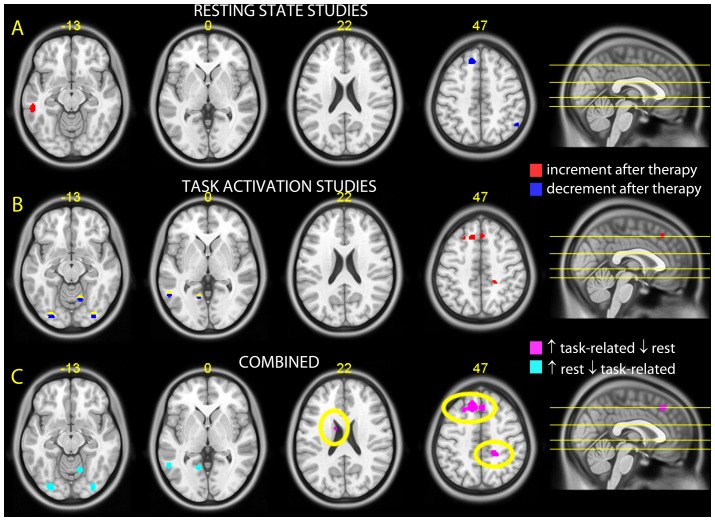
Several studies have used neuroimaging methods to identify neural change in brain networks associated to emotion regulation after psychotherapy of depression and anxiety. In the present work we adopted a meta-analytic technique specific to neuroimaging data to evaluate the consistence of empirical findings and assess models of therapy that have been proposed in the literature. Meta-analyses were conducted with the Activation Likelihood Estimation technique, which evaluates the overlap between foci of activation across studies. The analysis included 16 studies found in Pubmed (200 foci of activation and 193 patients). Separate meta-analyses were conducted on studies of 1) depression, post-traumatic stress disorder and panic disorder investigated with rest state metabolism (6 studies, 70 patients); 2) depression, post-traumatic stress disorder and panic disorder investigated with task-related activation studies (5 studies, 65 patients); 3) the previous studies considered jointly; and 4) phobias investigated with studies on exposure-related activation (5 studies, 57 patients). Studies on anxiety and depression gave partially consistent results for changes in the dorsomedial prefrontal cortex and in the posterior cingulated gyrus/precuneus. Several areas of change in the temporal lobes were also observed. Studies on the therapy of phobia were consistent with a reduction of activity in medial temporal areas. The cluster of change in the prefrontal cortex may refer to increased recruitment of control processes, as hypothesized by influential models of emotion regulation changes due to psychotherapy. However, not all areas associated with controlled emotion regulation were detected in the meta-analysis, while involvement of midline structures suggested changes in self-related information processing. Changes in phobia were consistent with reduced reactivity to phobic stimuli.
Overview
The claims and statistics of this paper haven’t been checked yet.
Run the check — free, no account needed. It reads the open-access text and checks the sources it cites.
Integrity signals
Registry
Cites
Statistics
Figures
Verification
Claims the paper makes
The claims and statistics of this paper haven’t been checked yet.
Run the check — free, no account needed. It reads the open-access text and checks the sources it cites.
Claims other papers make about this one
Each is checked against this paper’s own text: does it say what the citing paper says it does?
In the citing paper
“Both disorders were included due to high levels of comorbidity between the conditions (Brown et al., 2001; Kaufman and Charney, 2000), overlapping symptoms, both responding to similar therapies (Ressler and Mayberg, 2007), and the same theory being used to model therapeutic response across disorders (Messina et al., 2013).”
From Meta-analyses of the neural mechanisms and predictors of response to psychotherapy in depression and anxiety (2018) · cites this paper as Messina et al., 2013
In the citing paper
“due to evidence that paradigm type can effect results (Fu et al., 2007; Messina et al., 2013; Palmer et al., 2015; Whitfield-Gabrieli et al., 2011).”
From Meta-analyses of the neural mechanisms and predictors of response to psychotherapy in depression and anxiety (2018) · cites this paper as Messina et al., 2013
Self-check
Percentages, sums and reported differences re-computed from the paper’s own numbers.
The self-check needs the paper’s full text.
Citations
Cites
Diagnostic and Statistical Manual of Mental Disorders
Williams, J. B. W., & First, M. B. (2013) · Oxford University Press eBooks · doi:10.1093/acrefore/9780199975839.013.104 · Cited by 109,845
A default mode of brain function
Raichle, M. E., MacLeod, A. M., Snyder, A. Z., Powers, W. J., Gusnard, D. A., & Shulman, G. L. (2001) · Proceedings of the National Academy of Sciences · doi:10.1073/pnas.98.2.676 · Cited by 12,190
Kessler, R. C., Chiu, W. T., Demler, O., & Walters, E. E. (2005) · Archives of General Psychiatry · doi:10.1001/archpsyc.62.6.617 · Cited by 12,052
The Brain's Default Network: Anatomy, Function, and Relevance to Disease
Buckner, R. L., Andrews‐Hanna, J. R., & Schacter, D. L. (2008) · Annals of the New York Academy of Sciences · doi:10.1196/annals.1440.011 · Cited by 9,761
The precuneus: a review of its functional anatomy and behavioural correlates
Cavanna, A. E., & Trimble, M. R. (2006) · Brain · doi:10.1093/brain/awl004 · Cited by 5,128
Thresholding of statistical maps in functional neuroimaging using the false discovery rate
Genovese, C. R., Lazar, N. A., & Nichols, T. (2002) · NeuroImage · doi:10.1006/nimg.2001.1037 · Cited by 4,923
The cognitive control of emotion
OCHSNER, K., & GROSS, J. (2005) · Trends in Cognitive Sciences · doi:10.1016/j.tics.2005.03.010 · Cited by 4,495
Binder, J. R., Desai, R. H., Graves, W. W., & Conant, L. L. (2009) · Cerebral Cortex · doi:10.1093/cercor/bhp055 · Cited by 4,060
N-back working memory paradigm: a meta-analysis of normative functional neuroimaging studies.
Owen, A. M., McMillan, K. M., Laird, A. R., & Bullmore, E. (2005) · Human Brain Mapping · doi:10.1002/hbm.20131 · Cited by 3,560
Searching for a baseline: Functional imaging and the resting human brain
Gusnard, D. A., & Raichle, M. E. (2001) · Nature Reviews Neuroscience · doi:10.1038/35094500 · Cited by 3,371
Research works printed but not linked: 1
- Beck AT (1976). Cognitive Theory and the Emotional Disorders. New York: International University Press.
Cited by
Sorted by citations
Marwood, L., Wise, T., Perkins, A. M., & Cleare, A. J. (2018) · Neuroscience & Biobehavioral Reviews · doi:10.1016/j.neubiorev.2018.09.022 · Cited by 251
PTSD Psychotherapy Outcome Predicted by Brain Activation During Emotional Reactivity and Regulation
Fonzo, G. A., Goodkind, M. S., Oathes, D. J., Zaiko, Y. V., Harvey, M., Peng, K. K., Weiss, M. E., Thompson, A. L., Zack, S. E., Lindley, S. E., et al. (2017) · American Journal of Psychiatry · doi:10.1176/appi.ajp.2017.16091072 · Cited by 149
A systematic review of the neural bases of psychotherapy for anxiety and related disorders
Brooks, S. J., & Stein, D. J. (2015) · Dialogues in Clinical Neuroscience · doi:10.31887/dcns.2015.17.3/sbrooks · Cited by 134
Taschereau‐Dumouchel, V., Kawato, M., & Lau, H. C. (2019) · Molecular Psychiatry · doi:10.1038/s41380-019-0520-3 · Cited by 128
Selective Effects of Psychotherapy on Frontopolar Cortical Function in PTSD
Fonzo, G. A., Goodkind, M. S., Oathes, D. J., Zaiko, Y. V., Harvey, M., Peng, K. K., Weiss, M. E., Thompson, A. L., Zack, S. E., Mills-Finnerty, C. E., et al. (2017) · American Journal of Psychiatry · doi:10.1176/appi.ajp.2017.16091073 · Cited by 120
Metadata
- Authors
- Messina, I., Sambin, M., Palmieri, A., & Viviani, R.
- Affiliations
- University of Padua (IT)
- Universität Innsbruck (AT)
- Corresponding author
- Messina, Irene
- Venue
- PLoS ONE
- Publisher
- Public Library of Science (PLoS)
- Published
- 2013-09-11
- Volume
- 8
- Issue
- 9
- Pages
- e74657
- ISSN
- 1932-6203 (ISSN-L)
- PMC
- PMC3770681
- OpenAlex
- W2147566726
- Cited by
- 176
- References
- 108
- Citations by year
- 2026: 3 · 2025: 4 · 2024: 77 · 2023: 6 · 2022: 9 · 2021: 7 · 2020: 10 · 2019: 10 · 2018: 9 · 2017: 10 · 2016: 10 · 2015: 12 · 2014: 7 · 2013: 2
- FWCI
- 1.71
- Type
- journal article
- Language
- en
- Open access
- gold
- doi.org
- Locations
- PLoS ONE (publishedVersion, cc-by)
- Europe PMC (PubMed Central) (publishedVersion, other-oa)
- PubMed Central (publishedVersion, cc-by)
- PubMed (publishedVersion)
- RePEc: Research Papers in Economics (submittedVersion)
- DOAJ (DOAJ: Directory of Open Access Journals) (submittedVersion, cc-by-sa)
- Padua Research Archive (University of Padova) (submittedVersion, cc-by)
- Topics
- Social Sciences › Psychology › Experimental and Cognitive Psychology › Anxiety, Depression, Psychometrics, Treatment, Cognitive Processes
- Social Sciences › Psychology › Clinical Psychology › Psychotherapy Techniques and Applications
- Life Sciences › Neuroscience › Cognitive Neuroscience › Neural and Behavioral Psychology Studies
- Keywords
- psychotherapy, neural correlates, anxiety, depression, emotion regulation, post-traumatic stress disorder, panic disorder, phobia, exposure therapy, dorsomedial prefrontal cortex, posterior cingulate cortex, precuneus, medial temporal lobe, self-referential processing
- MeSH terms
- Anxiety, Brain, Brain Mapping, Depression, Emotions, Humans, Implosive Therapy, Phobic Disorders, Psychotherapy, Stress Disorders, Post-Traumatic, Likelihood Functions, Panic Disorder, Neuroimaging
About these checks
Registry, retraction, Cites and statistics results are computed, not judged, with one exception: a printed reference that no index lists is read once by a model before it counts as a citation error. Claims are extracted by a model and kept only when their quote appears verbatim in the text; each cited source is then checked, with a model’s help, for whether it says what the claim relies on. Those verdicts can be wrong — read the claim’s quote and the cited source before relying on one.
Statistics and arithmetic are recomputed, not judged.
Confidence bands are shown only for fields calibrated on our annotated test set. None is calibrated yet, so no band is shown.
What counts as a claim ›How we measure confidence ›How we check this ›
Are you an author, or do you see a problem with this page? Request a review
