

The DOI matches its Crossref record; 43 of the 43 references it cites were found in a registry or an index.
Generation of 3D Skin Equivalents Fully Reconstituted from Human Induced Pluripotent Stem Cells (iPSCs)
Open accessAbstract
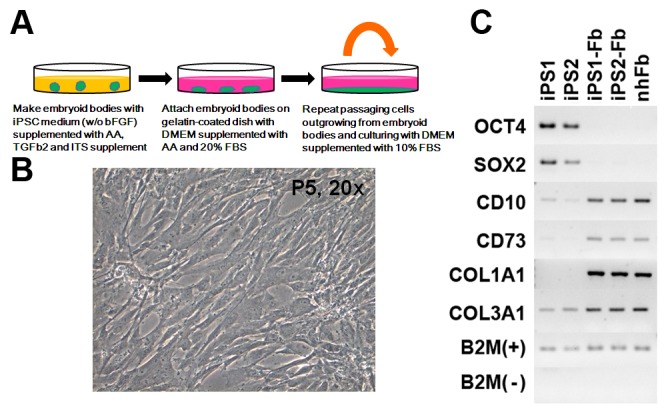
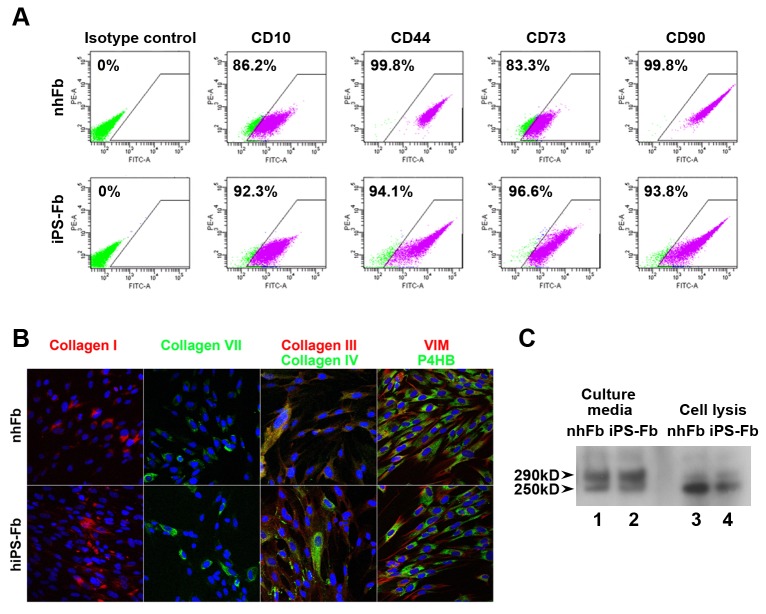
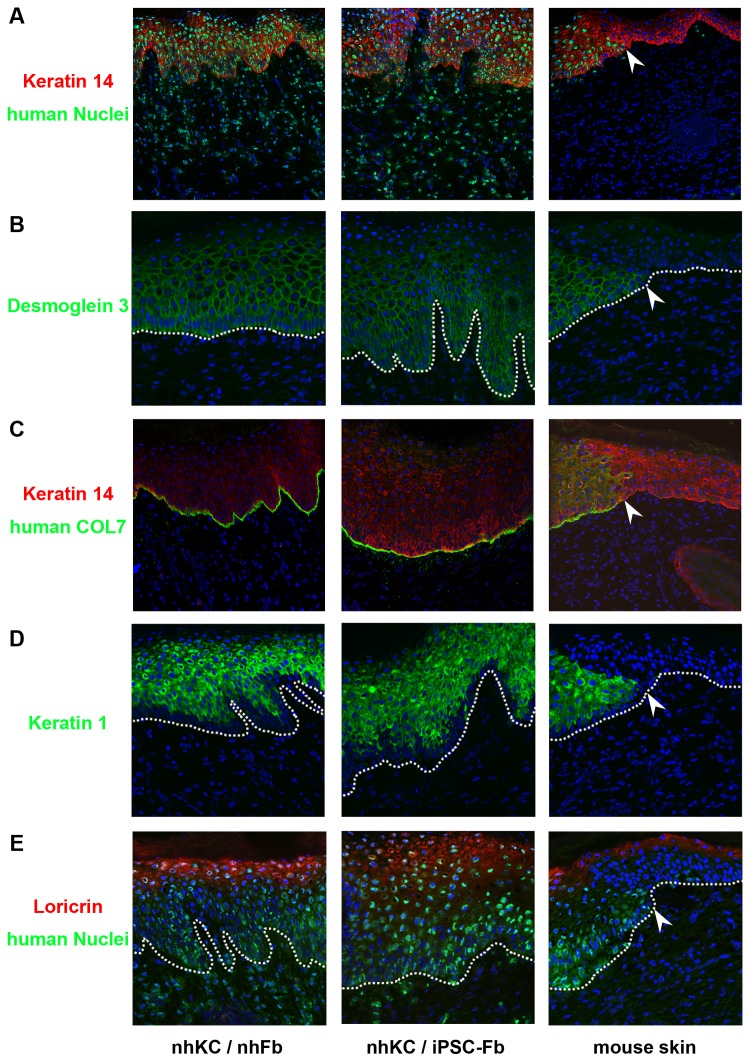
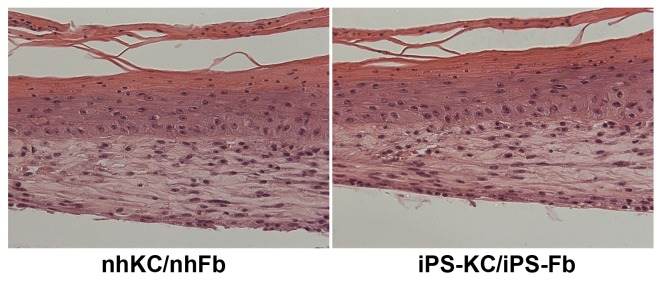
Recent generation of patient-specific induced pluripotent stem cells (PS-iPSCs) provides significant advantages for cell- and gene-based therapy. Establishment of iPSC-based therapy for skin diseases requires efficient methodology for differentiating iPSCs into both keratinocytes and fibroblasts, the major cellular components of the skin, as well as the reconstruction of skin structures using these iPSC-derived skin components. We previously reported generation of keratinocytes from human iPSCs for use in the treatment of recessive dystrophic epidermolysis bullosa (RDEB) caused by mutations in the COL7A1 gene. Here, we developed a protocol for differentiating iPSCs into dermal fibroblasts, which also produce type VII collagen and therefore also have the potential to treat RDEB. Moreover, we generated in vitro 3D skin equivalents composed exclusively human iPSC-derived keratinocytes and fibroblasts for disease models and regenerative therapies for skin diseases, first demonstrating that iPSCs can provide the basis for modeling a human organ derived entirely from two different types of iPSC-derived cells.
Overview
The claims and statistics of this paper haven’t been checked yet.
Run the check — free, no account needed. It reads the open-access text and checks the sources it cites.
Integrity signals
Registry
Cites
Statistics
Figures
Verification
Claims the paper makes
The claims and statistics of this paper haven’t been checked yet.
Run the check — free, no account needed. It reads the open-access text and checks the sources it cites.
Claims other papers make about this one
Each is checked against this paper’s own text: does it say what the citing paper says it does?
The source backs part of the claim, not all of it — or backs it for a different population, condition or comparison.
In the citing paper
“However, human skin equivalents have notable drawbacks, such as a lack of crucial skin tissue structures (e.g., hair follicles and sebaceous glands) and limited culture durations (e.g., 2–3 weeks)”
From Generation and characterization of hair-bearing skin organoids from human pluripotent stem cells (2022) · cites this paper as [19]
Experimental — accuracy not yet measuredThe cited source says what the claim attributes to it.
In the citing paper
“Furthermore, in response to challenges associated with donor variability, conventional primary cell-based HSEs have transitioned to more standardized and reproducible in vitro culture models. These models utilize either immortalized cell lines [45] or cells derived from hiPSCs [17].”
From Diversity of human skin three-dimensional organotypic cultures (2024) · cites this paper as [17]
The cited source says what the claim attributes to it.
In the citing paper
“Reconstruction of appendage-bearing skin in cultures and in bioengineered grafts remains an unmet biomedical challenge3–9.”
From Hair-bearing human skin generated entirely from pluripotent stem cells (2020) · cites this paper as [6]
The cited source says what the claim attributes to it.
In the citing paper
“To date, in vitro skin derivation strategies have focused on generating keratinocytes and fibroblasts from PSCs in separate cultures first, then combining the two types of cells to form a skin-like bilayer (Gledhill et al., 2015; Itoh et al., 2013; Oh et al., 2013; Sun et al., 2014).”
From Hair Follicle Development in Mouse Pluripotent Stem Cell-Derived Skin Organoids (2018) · cites this paper as Itoh et al., 2013
The cited source says what the claim attributes to it.
In the citing paper
“The logic of these approaches is that the individual parts can be combined to generate full-thickness skin (Itoh et al., 2013).”
From Hair Follicle Development in Mouse Pluripotent Stem Cell-Derived Skin Organoids (2018) · cites this paper as Itoh et al., 2013
In the citing paper
“and that healthy cells can be generated from reprogrammed cells from patients with RDEB (153, 154).”
From Wound repair and regeneration: Mechanisms, signaling, and translation (2014) · cites this paper as [153]
In the citing paper
“It has been shown that human skin equivalents can be created entirely from fibroblasts and keratinocytes generated from patients’ iPSCs, and that healthy cells can be generated from reprogrammed cells from patients with RDEB (153, 154).”
From Wound repair and regeneration: Mechanisms, signaling, and translation (2014) · cites this paper as [153]
Self-check
Percentages, sums and reported differences re-computed from the paper’s own numbers.
The self-check needs the paper’s full text.
Citations
Cites
Induction of Pluripotent Stem Cells from Adult Human Fibroblasts by Defined Factors
Takahashi, K., Tanabe, K., Ohnuki, M., Narita, M., Ichisaka, T., Tomoda, K., & Yamanaka, S. (2007) · Cell · doi:10.1016/j.cell.2007.11.019 · Cited by 20,221
Induction of Midbrain Dopaminergic Neurons from ES Cells by Stromal Cell–Derived Inducing Activity
Kawasaki, H., Mizuseki, K., Nishikawa, S., Kaneko, S., Kuwana, Y., Nakanishi, S., Nishikawa, S., & Sasai, Y. (2000) · Neuron · doi:10.1016/s0896-6273(00)00083-0 · Cited by 1,277
Embryonic stem cell differentiation: emergence of a new era in biology and medicinePreprint
Keller, G. M. (2005) · Genes & Development · doi:10.1101/gad.1303605 · Cited by 1,174
Genetic engineering of human pluripotent cells using TALE nucleases
Hockemeyer, D. F., Wang, H., Kiani, S., Lai, C. S., Gao, Q., Cassady, J. P., Cost, G. J., Zhang, L., Santiago, Y., Miller, J. C., et al. (2011) · Nature Biotechnology · doi:10.1038/nbt.1927 · Cited by 1,161
Schuldiner, M., Yanuka, O., Itskovitz‐Eldor, J., Melton, D. A., & Benvenisty, N. (2000) · Proceedings of the National Academy of Sciences · doi:10.1073/pnas.97.21.11307 · Cited by 1,132
Targeted gene correction of α1-antitrypsin deficiency in induced pluripotent stem cells
Yusa, K., Rashid, S. T., Strick‐Marchand, H., Varela, I., Liu, P.-Q., Paschon, D. E., Miranda, E., Ordóñez, A., Hannan, N. R. F., Rouhani, F. J., et al. (2011) · Nature · doi:10.1038/nature10424 · Cited by 647
Gene Targeting of a Disease-Related Gene in Human Induced Pluripotent Stem and Embryonic Stem Cells
Zou, J., Maeder, M. L., Mali, P., Pruett‐Miller, S. M., Thibodeau-Beganny, S., Chou, B.-K., Chen, G., Ye, Z., Park, I., Daley, G. Q., et al. (2009) · Cell stem cell · doi:10.1016/j.stem.2009.05.023 · Cited by 513
Prolyl 4-hydroxylases, the key enzymes of collagen biosynthesis
Myllyharju, J. (2003) · Matrix Biology · doi:10.1016/s0945-053x(03)00006-4 · Cited by 500
Ascorbic Acid Enhances Differentiation of Embryonic Stem Cells Into Cardiac Myocytes
Takahashi, T., Lord, B., Schulze, P. C., Fryer, R. M., Sarang, S. S., Gullans, S. R., & Lee, R. T. (2003) · Circulation · doi:10.1161/01.cir.0000064899.53876.a3 · Cited by 478
Roles of TGF-β family signaling in stem cell renewal and differentiation
Watabe, T., & Miyazono, K. (2008) · Cell Research · doi:10.1038/cr.2008.323 · Cited by 446
Fine, J., Johnson, L., Weiner, M. S., Li, K.-P., & Suchindran, C. (2008) · Journal of the American Academy of Dermatology · doi:10.1016/j.jaad.2008.09.035 · Cited by 439
Zou, J., Mali, P., Huang, X., Dowey, S. N., & Cheng, L. (2011) · Blood · doi:10.1182/blood-2011-02-335554 · Cited by 296
Itoh, M., Kiuru, M., Cairo, M. S., & Christiano, A. M. (2011) · Proceedings of the National Academy of Sciences · doi:10.1073/pnas.1100332108 · Cited by 282
Self-citationPotential of Fibroblast Cell Therapy for Recessive Dystrophic Epidermolysis Bullosa
Wong, T., Gammon, L., Liu, L., Mellerio, J. E., Dopping-Hepenstal, P. J. C., Pacy, J., Elia, G., Jeffery, R. E., Leigh, I. M., Navsaria, H. A., et al. (2008) · Journal of Investigative Dermatology · doi:10.1038/jid.2008.78 · Cited by 250
Self-citationFritsch, A., Loeckermann, S., Kern, J. S., Braun, A., Bösl, M. R., Bley, T. A., Schumann, H., von Elverfeldt, D., Paul, D., Erlacher, M., et al. (2008) · Journal of Clinical Investigation · doi:10.1172/jci34292 · Cited by 231
Xu, C., Jiang, J., Sottile, V., McWhir, J., LEBKOWSKI, J. S., & Carpenter, M. K. (2004) · Stem Cells · doi:10.1634/stemcells.22-6-972 · Cited by 205
Uitto, J., & Christiano, A. M. (1992) · Journal of Clinical Investigation · doi:10.1172/jci115938 · Cited by 156
Self-citationGenetic correction and analysis of induced pluripotent stem cells from a patient with gyrate atrophy
Howden, S. E., Gore, A., Li, Z., Fung, H.-L., Nisler, B. S., Nie, J., Chen, G., McIntosh, B. E., Gulbranson, D. R., Diol, N. R., et al. (2011) · Proceedings of the National Academy of Sciences · doi:10.1073/pnas.1103388108 · Cited by 153
Ortiz‐Urda, S., Lin, Q., Green, C. L., Keene, D. R., Marinkovich, M. P., & Khavari, P. A. (2003) · Journal of Clinical Investigation · doi:10.1172/jci17193 · Cited by 146
Ng, Y.-Z., Pourreyron, C., Salas-Alanis, J. C., Dayal, J. H. S., Cepeda‐Valdes, R., Yan, W., Wright, S. C., Chen, M., Fine, J., Hogg, F. J., et al. (2012) · Cancer Research · doi:10.1158/0008-5472.can-11-2996 · Cited by 143
Three‐Dimensional Tissue Models of Normal and Diseased Skin
Carlson, M. W., Alt‐Holland, A., Egles, C., & Garlick, J. A. (2008) · Current Protocols in Cell Biology · doi:10.1002/0471143030.cb1909s41 · Cited by 142
The Role of Ascorbic Acid in Mesenchymal Differentiation
Franceschi, R. T. (2009) · Nutrition Reviews · doi:10.1111/j.1753-4887.1992.tb01271.x · Cited by 140
Woodley, D. T., Atha, T., Huang, Y., Chen, M., Krueger, G. G., Jorgensen, C. M., Fairley, J. A., Chan, L. S., & Keene, D. R. (2003) · Journal of Investigative Dermatology · doi:10.1046/j.1523-1747.2003.12571.x · Cited by 126
Azhar, M., Runyan, R. B., Gard, C., Sanford, L. P., Miller, M. L., Andringa, A., Pawlowski, S. A., Rajan, S., & Doetschman, T. (2009) · Developmental Dynamics · doi:10.1002/dvdy.21854 · Cited by 123
Ortiz‐Urda, S., Lin, Q., Green, C. L., et al. (2003) · Journal of Clinical Investigation · doi:10.1172/jci200317193 · Cited by 122
Martins, V., Vyas, J. J., Chen, M., Purdie, K. J., Mein, C. A., South, A. P., Storey, A., McGrath, J. A., & O’Toole, E. A. (2009) · Journal of Cell Science · doi:10.1242/jcs.042895 · Cited by 120
Do, T.-V., Kubba, L. A., Du, H., Sturgis, C. D., & Woodruff, T. K. (2008) · Molecular Cancer Research · doi:10.1158/1541-7786.mcr-07-0294 · Cited by 118
Rudnicka, L., Varga, J., Christiano, A. M., Iozzo, R. V., Jiménez, S. A., & Uitto, J. (1994) · Journal of Clinical Investigation · doi:10.1172/jci117154 · Cited by 110
Self-citationInduction of collagen synthesis by ascorbic acid. A possible mechanism
Pinnel, S. R. (1987) · Archives of Dermatology · doi:10.1001/archderm.123.12.1684 · Cited by 109
Woodley, D. T., Remington, J., Huang, Y., Hou, Y., Li, W., Keene, D. R., & Chen, M. (2007) · Molecular Therapy · doi:10.1038/sj.mt.6300041 · Cited by 105
New lessons learned from disease modeling with induced pluripotent stem cells
Önder, T. T., & Daley, G. Q. (2012) · Current Opinion in Genetics & Development · doi:10.1016/j.gde.2012.05.005 · Cited by 93
Transforming growth factor-β2 enhances differentiation of cardiac myocytes from embryonic stem cells
Kumar, D. M., & Sun, B. (2005) · Biochemical and Biophysical Research Communications · doi:10.1016/j.bbrc.2005.04.098 · Cited by 83
Watt, S. A., Pourreyron, C., Purdie, K. J., Hogan, C., Cole, C. L., Foster, N. A., Pratt, N., Bourdon, J., Appleyard, V., Murray, K., et al. (2011) · Oncogene · doi:10.1038/onc.2011.180 · Cited by 75
Mauviel, A., Lapiere, J.-C., Halcin, C., Evans, C. H., & Uitto, J. (1994) · Journal of Biological Chemistry · doi:10.1016/s0021-9258(17)42303-9 · Cited by 70
Epigenetic and Phenotypic Profile of Fibroblasts Derived from Induced Pluripotent Stem Cells
Hewitt, K., Shamis, Y., Hayman, R., Margvelashvili, M., Dong, S., Carlson, M. W., & Garlick, J. (2011) · PLoS ONE · doi:10.1371/journal.pone.0017128 · Cited by 62
Novel Molecular Therapies for Heritable Skin Disorders
Uitto, J., Christiano, A. M., McLean, W. H. I., & McGrath, J. A. (2011) · Journal of Investigative Dermatology · doi:10.1038/jid.2011.389 · Cited by 60
Self-citationThree-Dimensional Epithelial Tissues Generated from Human Embryonic Stem Cells
Hewitt, K. J., Shamis, Y., Carlson, M. W., Aberdam, É., Aberdam, D., & Garlick, J. A. (2009) · Tissue Engineering Part A · doi:10.1089/ten.tea.2009.0060 · Cited by 59
Induction of Collagen Synthesis by Ascorbic Acid
Pinnell, S. R. (1987) · Archives of Dermatology · doi:10.1001/archderm.1987.01660360122023 · Cited by 54
Functional X-chromosomal mosaicism of the skin: Rudolf Happle and the lines of Alfred Blaschko
Traupe, H. (1999) · American Journal of Medical Genetics · doi:10.1002/(sici)1096-8628(19990806)85:4 · Cited by 47
Chen, H., Chuang, C.-Y., Shieh, Y.-K., Chang, H.-W., Ho, H., & Kuo, H. (2009) · Human Reproduction · doi:10.1093/humrep/dep003 · Cited by 41
Shamis, Y., Hewitt, K., Bear, S. E., Alt‐Holland, A., Qari, H., Margvelashvilli, M., Knight, E. B., Smith, A., & Garlick, J. (2012) · In vitro Cellular & Developmental Biology-Animal · doi:10.1007/s11626-011-9478-4 · Cited by 39
Lorda-Diez, C. I., Montero, J. A., García‐Porrero, J. A., & Hurlé, J. M. (2010) · BMC Developmental Biology · doi:10.1186/1471-213x-10-69 · Cited by 34
Togo, S., Sato, T., Sugiura, H., Wang, X., Basma, H., Nelson, A. J., Liu, X., Bargar, T. W., Sharp, J. G., & Rennard, S. I. (2010) · In Vitro Cellular & Developmental Biology - Animal · doi:10.1007/s11626-010-9367-2 · Cited by 19
Cited by
Sorted by citations
Wound repair and regeneration: Mechanisms, signaling, and translation
Eming, S. A., Martin, P., & Tomic-Canic, M. (2014) · Science Translational Medicine · doi:10.1126/scitranslmed.3009337 · Cited by 3,562
Wound healing: cellular mechanisms and pathological outcomes
Wilkinson, H. N., & Hardman, M. J. (2020) · Open Biology · doi:10.1098/rsob.200223 · Cited by 1,975
Innovative Treatment Strategies to Accelerate Wound Healing: Trajectory and Recent Advancements
Kolimi, P., Narala, S., Nyavanandi, D., Youssef, A. A. A., & Dudhipala, N. R. (2022) · Cells · doi:10.3390/cells11152439 · Cited by 658
Skin tissue engineering: wound healing based on stem-cell-based therapeutic strategies
Dehkordi, A. N., Mirahmadi, F., Chehelgerdi, M., & Dehkordi, S. R. (2019) · Stem Cell Research & Therapy · doi:10.1186/s13287-019-1212-2 · Cited by 561
A multi-organ chip with matured tissue niches linked by vascular flow
Ronaldson-Bouchard, K., Teles, D., Yeager, K., Tavakol, D. N., Zhao, Y., Chramiec, A., Tagore, S., Summers, M., Stylianos, S., Tamargo, M., et al. (2022) · Nature Biomedical Engineering · doi:10.1038/s41551-022-00882-6 · Cited by 512
Self-citation
Metadata
- Authors
- Itoh, M., Umegaki-Arao, N., Guo, Z., Liu, L., Higgins, C. A., & Christiano, A. M.
- Affiliations
- Columbia University (US)
- Corresponding author
- Christiano, Angela M.
- Venue
- PLoS ONE
- Publisher
- Public Library of Science (PLoS)
- Published
- 2013-10-11
- Volume
- 8
- Issue
- 10
- Pages
- e77673
- ISSN
- 1932-6203 (ISSN-L)
- PMC
- PMC3795682
- OpenAlex
- W1981286729
- Cited by
- 239
- References
- 42
- Citations by year
- 2026: 11 · 2025: 14 · 2024: 21 · 2023: 16 · 2022: 24 · 2021: 22 · 2020: 18 · 2019: 20 · 2018: 25 · 2017: 23 · 2016: 10 · 2015: 16 · 2014: 18 · 2013: 1
- FWCI
- 6.71
- Type
- journal article
- Language
- en
- Open access
- gold
- doi.org
- Locations
- PLoS ONE (publishedVersion, cc-by)
- Europe PMC (PubMed Central) (publishedVersion, cc-by)
- PubMed Central (publishedVersion, cc-by)
- PubMed (publishedVersion)
- DOAJ (DOAJ: Directory of Open Access Journals) (submittedVersion, cc-by-sa)
- Figshare (submittedVersion, cc-by)
- Columbia Academic Commons (Columbia University)
- Funders
- New York State Foundation for Science, Technology and Innovation
- Leona M. and Harry B. Helmsley Charitable Trust
- New York State Stem Cell Science
- Stanford Diabetes Research Center
- National Institutes of Health (U18TR000561)
- National Institute of Arthritis and Musculoskeletal and Skin Diseases (P30AR044535)
- National Center for Advancing Translational Sciences
- Topics
- Life Sciences › Biochemistry, Genetics and Molecular Biology › Molecular Biology › Pluripotent Stem Cells Research
- Life Sciences › Biochemistry, Genetics and Molecular Biology › Cell Biology › Skin and Cellular Biology Research
- Health Sciences › Medicine › Dermatology › Hair Growth and Disorders
- Keywords
- induced pluripotent stem cells, 3D skin equivalents, dermal fibroblasts, keratinocytes, recessive dystrophic epidermolysis bullosa, COL7A1, type VII collagen, iPSC differentiation, regenerative therapy, patient-derived iPSCs
- MeSH terms
- Cell Differentiation, Cells, Cultured, Fibroblasts, Flow Cytometry, Humans, Skin, Blotting, Western, Keratinocytes, Reverse Transcriptase Polymerase Chain Reaction, Induced Pluripotent Stem Cells
About these checks
Registry, retraction, Cites and statistics results are computed, not judged, with one exception: a printed reference that no index lists is read once by a model before it counts as a citation error. Claims are extracted by a model and kept only when their quote appears verbatim in the text; each cited source is then checked, with a model’s help, for whether it says what the claim relies on. Those verdicts can be wrong — read the claim’s quote and the cited source before relying on one.
Statistics and arithmetic are recomputed, not judged.
Confidence bands are shown only for fields calibrated on our annotated test set. None is calibrated yet, so no band is shown.
What counts as a claim ›How we measure confidence ›How we check this ›
Are you an author, or do you see a problem with this page? Request a review
