

Developmental Differences in the Structure of Executive Function in Middle Childhood and Adolescence
Open accessThe DOI matches its Crossref record; 48 of the 48 references it cites were found in a registry or an index.
Abstract
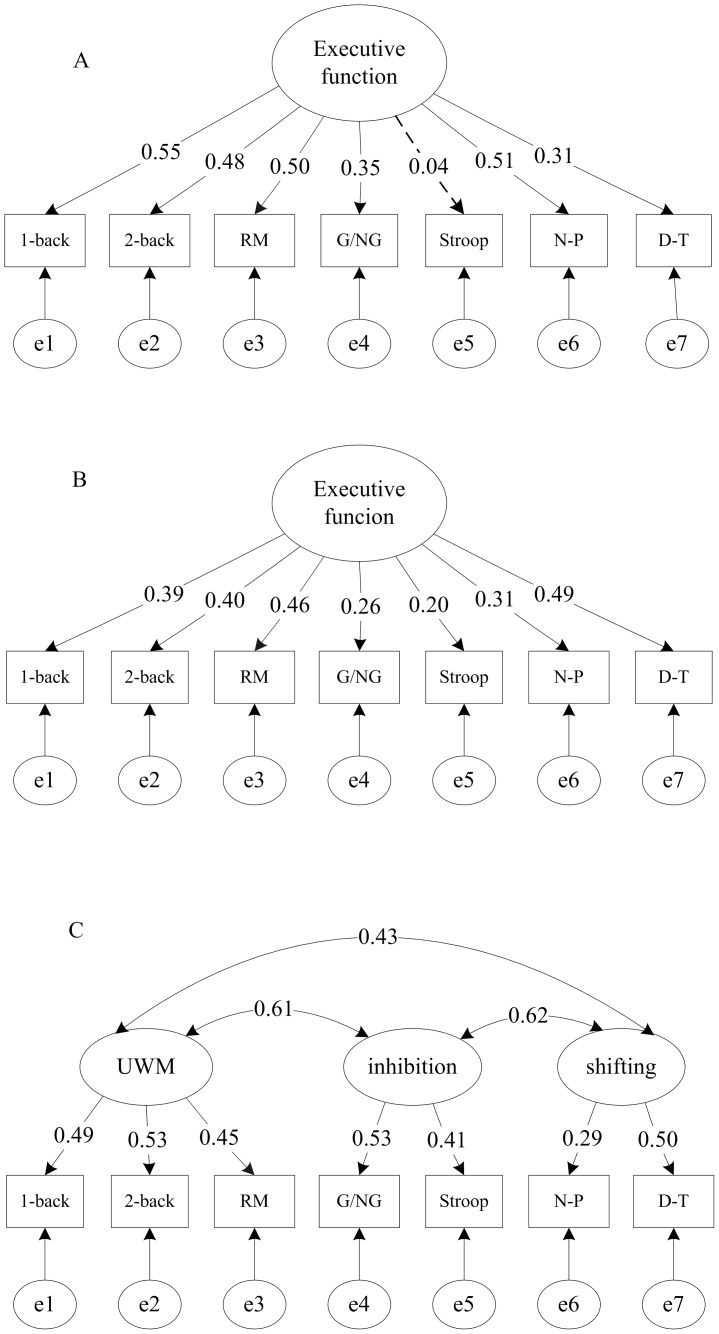
Although it has been argued that the structure of executive function (EF) may change developmentally, there is little empirical research to examine this view in middle childhood and adolescence. The main objective of this study was to examine developmental changes in the component structure of EF in a large sample (N = 457) of 7-15 year olds. Participants completed batteries of tasks that measured three components of EF: updating working memory (UWM), inhibition, and shifting. Confirmatory factor analysis (CFA) was used to test five alternative models in 7-9 year olds, 10-12 year olds, and 13-15 year olds. The results of CFA showed that a single-factor EF model best explained EF performance in 7-9-year-old and 10-12-year-old groups, namely unitary EF, though this single factor explained different amounts of variance at these two ages. In contrast, a three-factor model that included UWM, inhibition, and shifting best accounted for the data from 13-15 year olds, namely diverse EF. In sum, during middle childhood, putative measures of UWM, inhibition, and shifting may rely on similar underlying cognitive processes. Importantly, our findings suggest that developmental dissociations in these three EF components do not emerge until children transition into adolescence. These findings provided empirical evidence for the development of EF structure which progressed from unity to diversity during middle childhood and adolescence.
Overview
The claims and statistics of this paper haven’t been checked yet.
Free: it reads the open-access text and checks the first 5 claims that cite a source we can check. Create a free account to check every claim.
Integrity signals
Registry
Cites
Statistics
Figures
Verification
Claims the paper makes
The claims and statistics of this paper haven’t been checked yet.
Free: it reads the open-access text and checks the first 5 claims that cite a source we can check. Create a free account to check every claim.
Claims other papers make about this one
Each is checked against this paper’s own text: does it say what the citing paper says it does?
The source backs part of the claim, not all of it — or backs it for a different population, condition or comparison.
In the citing paper
“Since that initial study, this psychometric latent variable approach has been used in a large number of studies to show that unity and diversity of CC is evident across samples and ages (e.g., [34–41]), although there are some studies that suggest more unity (higher correlations between factors) in early childhood [35, 42–44].”
From The role of prefrontal cortex in cognitive control and executive function (2022) · cites this paper as [35]
Experimental — accuracy not yet measured
Self-check
Percentages, sums and reported differences re-computed from the paper’s own numbers.
The self-check needs the paper’s full text.
Citations
Cites
Significance tests and goodness of fit in the analysis of covariance structures.
Bentler, P. M., & Bonett, D. G. (1980) · Psychological Bulletin · doi:10.1037//0033-2909.88.3.588 · Cited by 19,023 · cited 7×
“Models were considered to be good fits with non-significant x2 values at the 0.05 level, x2/df of less than 2, CFI of more than 0.90, RMSEA of less than 0.08, and smaller AIC values [38].”
MethodInfluentialMiyake, A., Friedman, N. P., Emerson, M. J., Witzki, A. H., Howerter, A., & Wager, T. D. (2000) · Cognitive Psychology · doi:10.1006/cogp.1999.0734 · Cited by 15,798 · cited 7×
“Following the approach of Miyake and his colleagues [2,12], we used tasks that were designed to tap a single EF component while placing minimal demands on other EF components.”
BackgroundMethodResultInfluentialAn Integrative Theory of Prefrontal Cortex Function
Miller, E. K., & Cohen, J. D. (2001) · Annual Review of Neuroscience · doi:10.1146/annurev.neuro.24.1.167 · Cited by 12,803 · cited 1×
“Executive function (EF) is the ability to monitor and regulate different types of cognition and behavior to achieve specific internal goals [1–2].”
BackgroundSchermelleh-Engel, K., Moosbrugger, H., & Müller, H. (2003) · Department of Psychology - University of Koblenz-Landau · doi:10.23668/psycharchives.12784 · Cited by 8,975
Brain development during childhood and adolescence: a longitudinal MRI study
Giedd, J. N., Blumenthal, J., Jeffries, N. O., Castellanos, F. X., Liu, H., Zijdenbos, A., Paus, T., Evans, A. C., & Rapoport, J. L. (1999) · Nature Neuroscience · doi:10.1038/13158 · Cited by 5,552 · cited 1×
“From the structural perspective, longitudinal neuroimaging studies have demonstrated that gray matter in the PFC increased throughout childhood with a maximum size occurring at approximately 12 years, followed by a sharp loss after 12 years of age [44].”
BackgroundCurran, P. J., West, S. G., & Finch, J. F. (1996) · Psychological Methods · doi:10.1037/1082-989x.1.1.16 · Cited by 5,512 · cited 1×
“, absolute value of skewness ,2 and kurtosis ,7) [39].”
BackgroundCosts of a predictible switch between simple cognitive tasks.
Rogers, R. D., & Monsell, S. (1995) · Journal of Experimental Psychology: General · doi:10.1037/0096-3445.124.2.207 · Cited by 3,170 · cited 3×
“Second, we followed the same procedures used in previous studies [28,35].”
MethodResultMonsell, S. (2003) · Trends in Cognitive Sciences · doi:10.1016/s1364-6613(03)00028-7 · Cited by 2,984
Storage and Executive Processes in the Frontal Lobes
Smith, E. E., & Jonides, J. (1999) · Science · doi:10.1126/science.283.5408.1657 · Cited by 2,834
Executive function in preschoolers: A review using an integrative framework.
Garon, N., Bryson, S. E., & Smith, I. M. (2008) · Psychological Bulletin · doi:10.1037/0033-2909.134.1.31 · Cited by 2,695 · cited 2×
“EF is often linked to the functioning of the prefrontal cortex (PFC) [8–9], and the development of EF appears to be closely linked to the development of PFC [29].”
Background
Research works printed but not linked: 2
- Smith EE, Jonides J (1999) Storage and executive processes in the frontal lobes. Science 283(5408): 1657– 1661. 10073923 · DOI · Paper page
- Zhang HC, Wang XP (1898) standardization research on Raven’s standard progressice matrices in China. Acta Psychology Sinica 21(2): 113– 121.
Cited by
The role of prefrontal cortex in cognitive control and executive function
Friedman, N. P., & Robbins, T. W. (2022) · Neuropsychopharmacology · doi:10.1038/s41386-021-01132-0 · Cited by 1,737
Karr, J. E., Areshenkoff, C. N., Rast, P., Hofer, S. M., Iverson, G. L., & Garcia-Barrera, M. A. (2018) · Psychological Bulletin · doi:10.1037/bul0000160 · Cited by 637
“…used just two indicators for inhibition (Duan et al., 2010; Lambek & Shevlin, 2011; Lehto et al., 2003; Rose et al., 2012; Usai et al., 2014; Xu et al., 2013), six studies used just two indicators for updating/working memory (Agostino et al., 2010; Duan et al., 2010; Lambek & Shevlin, 2011;…”
InfluentialThompson, W. K., Barch, D. M., Bjork, J. M., Gonzalez, R., Nagel, B. J., Nixon, S. J., & Luciana, M. (2019) · Developmental Cognitive Neuroscience · doi:10.1016/j.dcn.2018.12.004 · Cited by 227
“In contrast, (8) examined a sample of 457 715 year-old Chinese children from low SES backgrounds and found that a single factor”
BackgroundMinimal coherence among varied theory of mind measures in childhood and adulthood
Warnell, K. R., & Redcay, E. (2019) · Cognition · doi:10.1016/j.cognition.2019.06.009 · Cited by 156
Normative data on the n-back task for children and young adolescents
Pelegrina, S., Lechuga, M. T., García-Madruga, J. A., Elosúa, M. R., Macizo, P., Carreiras, M., Fuentes, L. J., & Bajo, M. T. (2015) · Frontiers in Psychology · doi:10.3389/fpsyg.2015.01544 · Cited by 155
“It has been shown that executive functions component processes may develop at different rates (Huizinga et al., 2006; Best et al., 2009; Xu et al., 2013).”
Background
Metadata
- Authors
- Xu, F., Han, Y., Sabbagh, M. A., Wang, T., Ren, X., & Li, C.
- Affiliations
- Zhejiang Sci-Tech University (CN)
- Beijing Normal University (CN)
- Queen's University (CA)
- Goethe University Frankfurt (DE)
- Corresponding author
- Xu, Fen
- Han, Yan
- Venue
- PLoS ONE
- Publisher
- Public Library of Science (PLoS)
- Published
- 2013-10-29
- Volume
- 8
- Issue
- 10
- Pages
- e77770
- ISSN
- 1932-6203 (ISSN-L)
- PMC
- PMC3812181
- OpenAlex
- W2100740689
- Cited by
- 128
- References
- 48
- Citations by year
- 2026: 5 · 2025: 13 · 2024: 14 · 2023: 13 · 2022: 18 · 2021: 15 · 2020: 16 · 2019: 3 · 2018: 8 · 2017: 10 · 2016: 7 · 2015: 2 · 2014: 4
- FWCI
- 5.86
- Type
- journal article
- Language
- en
- Open access
- gold
- doi.org
- Locations
- PLoS ONE (publishedVersion, cc-by)
- Europe PMC (PubMed Central) (publishedVersion, cc-by)
- PubMed Central (publishedVersion, cc-by)
- PubMed (publishedVersion)
- RePEc: Research Papers in Economics (submittedVersion)
- DOAJ (DOAJ: Directory of Open Access Journals) (submittedVersion, cc-by-sa)
- Figshare (submittedVersion, cc-by)
- Publication Server of Goethe University Frankfurt am Main (Goethe University Frankfurt) (submittedVersion, cc-by)
- Funders
- National Natural Science Foundation of China (30528027, 31170996, 31028010)
- Natural Science Foundation of Zhejiang Province
- Topics
- Social Sciences › Psychology › Experimental and Cognitive Psychology › Cognitive Abilities and Testing
- Social Sciences › Psychology › Neuropsychology and Physiological Psychology › Developmental and Educational Neuropsychology
- Life Sciences › Neuroscience › Cognitive Neuroscience › Neural and Behavioral Psychology Studies
- Keywords
- executive function, developmental changes, middle childhood, adolescence, inhibition, cognitive flexibility, factor structure, cognitive development
- MeSH terms
- Adolescent, Aging, Attention, Child, Child Development, Female, Humans, Inhibition, Psychological, Male, Memory, Short-Term, Neuropsychological Tests, Reaction Time, Executive Function
About these checks
Registry, retraction, Cites and statistics results are computed, not judged, with one exception: a printed reference that no index lists is read once by a model before it counts as a citation error. Claims are extracted by a model and kept only when their quote appears verbatim in the text; each cited source is then checked, with a model’s help, for whether it says what the claim relies on. Those verdicts can be wrong — read the claim’s quote and the cited source before relying on one.
Statistics and arithmetic are recomputed, not judged.
Confidence bands are shown only for fields calibrated on our annotated test set. None is calibrated yet, so no band is shown.
What counts as a claim ›How we measure confidence ›How we check this ›
Are you an author, or do you see a problem with this page? Request a review
Data sources
Bibliographic data: Semantic Scholar, OpenAlex, Crossref.
Contains information from the Semantic Scholar Academic Graph Datasets, made available under the ODC Attribution License (ODC-BY 1.0).
Semantic Scholar’s data is described in: Kinney, R., et al. (2023). The Semantic Scholar Open Data Platform. arXiv:2301.10140.
