

Understanding Patients’ Adherence-Related Beliefs about Medicines Prescribed for Long-Term Conditions: A Meta-Analytic Review of the Necessity-Concerns Framework
Open accessThe DOI matches its Crossref record; 237 of the 237 references it cites were found in a registry or an index.
Abstract
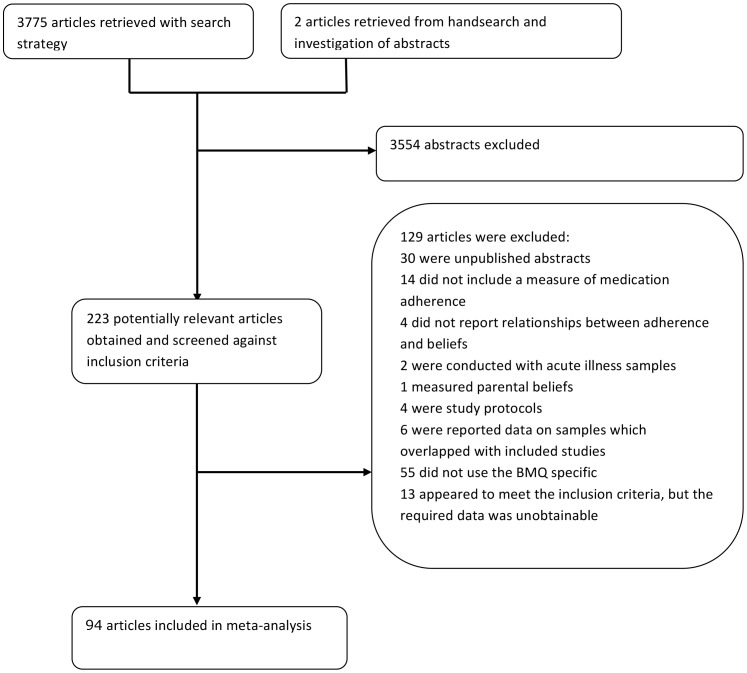
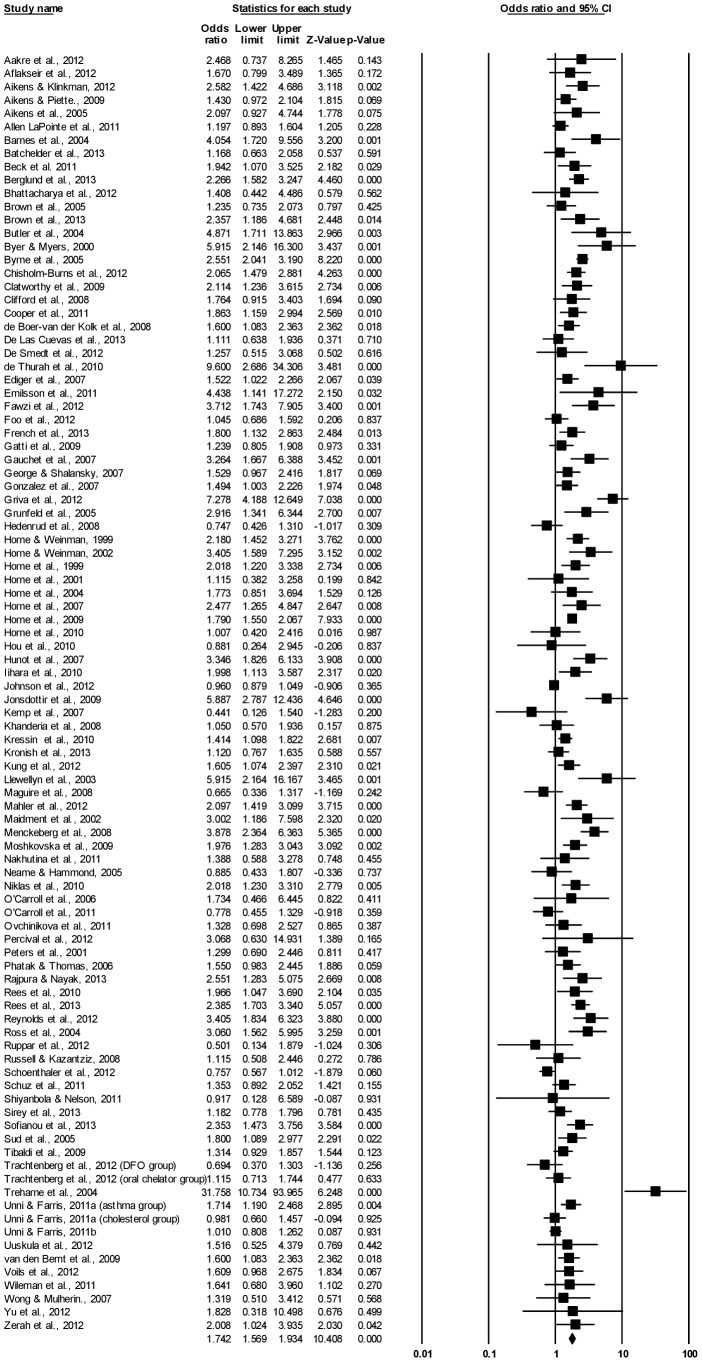
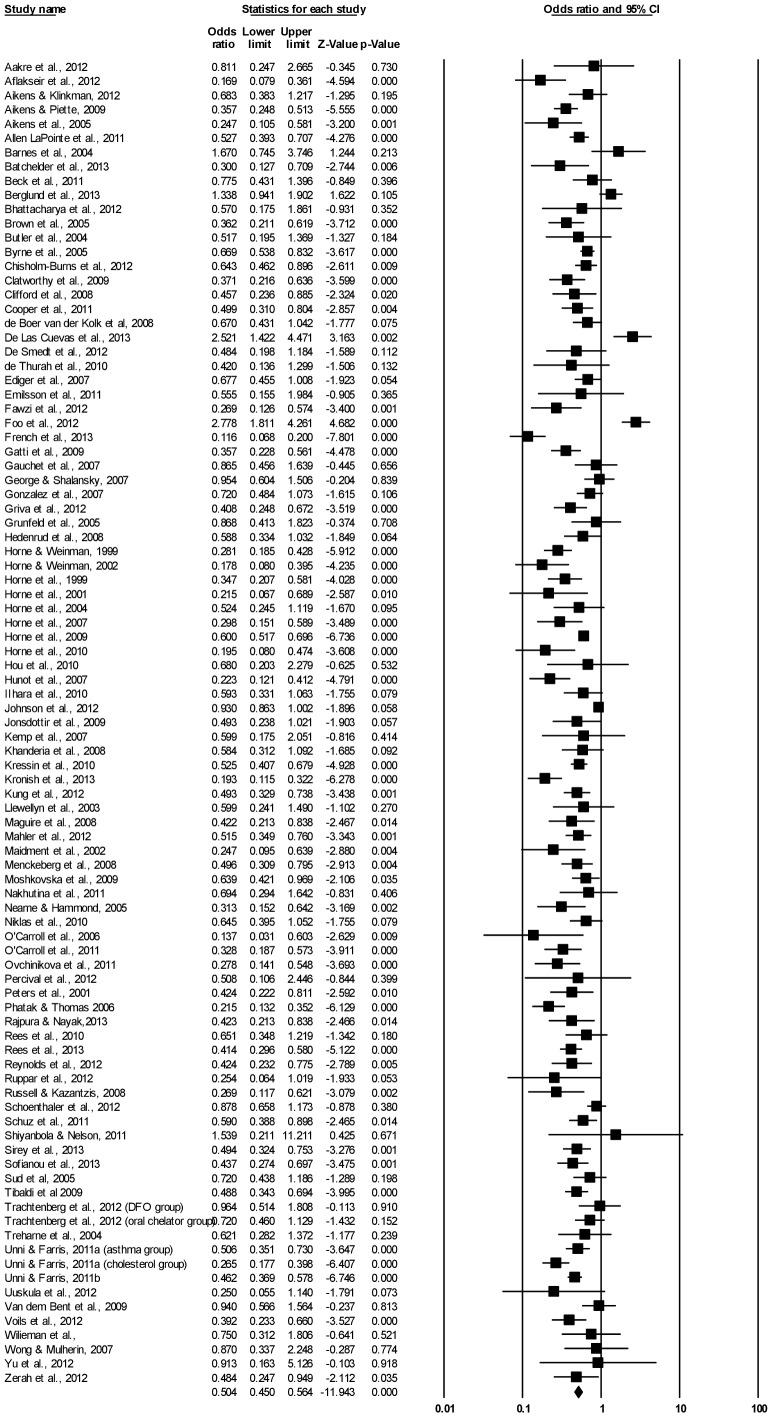
BACKGROUND: Patients' beliefs about treatment influence treatment engagement and adherence. The Necessity-Concerns Framework postulates that adherence is influenced by implicit judgements of personal need for the treatment (necessity beliefs) and concerns about the potential adverse consequences of taking it. OBJECTIVE: To assess the utility of the NCF in explaining nonadherence to prescribed medicines. DATA SOURCES: We searched EMBASE, Medline, PsycInfo, CDSR/DARE/CCT and CINAHL from January 1999 to April 2013 and handsearched reference sections from relevant articles. STUDY ELIGIBILITY CRITERIA: Studies using the Beliefs about Medicines Questionnaire (BMQ) to examine perceptions of personal necessity for medication and concerns about potential adverse effects, in relation to a measure of adherence to medication. PARTICIPANTS: Patients with long-term conditions. STUDY APPRAISAL AND SYNTHESIS METHODS: Systematic review and meta-analysis of methodological quality was assessed by two independent reviewers. We pooled odds ratios for adherence using random effects models. RESULTS: We identified 3777 studies, of which 94 (N = 25,072) fulfilled the inclusion criteria. Across studies, higher adherence was associated with stronger perceptions of necessity of treatment, OR = 1.742, 95% CI [1.569, 1.934], p<0.0001, and fewer Concerns about treatment, OR = 0.504, 95% CI: [0.450, 0.564], p<0.0001. These relationships remained significant when data were stratified by study size, the country in which the research was conducted and the type of adherence measure used. LIMITATIONS: Few prospective longitudinal studies using objective adherence measures were identified. CONCLUSIONS: The Necessity-Concerns Framework is a useful conceptual model for understanding patients' perspectives on prescribed medicines. Taking account of patients' necessity beliefs and concerns could enhance the quality of prescribing by helping clinicians to engage patients in treatment decisions and support optimal adherence to appropriate prescriptions.
Overview
The claims and statistics of this paper haven’t been checked yet.
Free: it reads the open-access text and checks the first 5 claims that cite a source we can check. Create a free account to check every claim.
Integrity signals
Registry
Cites
Statistics
Figures
Verification
Claims the paper makes
The claims and statistics of this paper haven’t been checked yet.
Free: it reads the open-access text and checks the first 5 claims that cite a source we can check. Create a free account to check every claim.
Claims other papers make about this one
Each is checked against this paper’s own text: does it say what the citing paper says it does?
The cited source says what the claim attributes to it.
In the citing paper
“This is consistent with the Necessity-Concerns Framework (Horne 1999), which posits that beliefs about the necessity of treatments, and concerns about potential adverse consequences, can influence adherence and non-adherence to treatments across a wide range of conditions and medications (Horne 2013).”
From Psychological interventions for improving adherence to inhaled therapies in people with cystic fibrosis (2023) · cites this paper as Horne 2013
In the citing paper
“In one cross-sectional report of older adults with type 2 diabetes, necessity and concern beliefs about medicines were not associated with HbA1c, although they were associated with medication underuse.30”
From Psychosocial Factors and Glycemic Control in Young Adults With Youth-Onset Type 2 Diabetes (2024) · cites this paper as [30]
Self-check
Percentages, sums and reported differences re-computed from the paper’s own numbers.
The self-check needs the paper’s full text.
Citations
Cites
Dermyshi, E., Wang, Y., Yan, C., Hong, W., Qiu, G., Gong, X., & Zhang, T. (2017) · Neonatology · doi:10.1159/000454668 · Cited by 24,451
Culture's Consequences: Comparing Values, Behaviors, Institutions, and Organizations across Nations
Bhagat, R. S., & Hofstede, G. (2002) · The Academy of Management Review · doi:10.2307/4134391 · Cited by 21,664
Meta-analysis of Observational Studies in Epidemiology<SUBTITLE>A Proposal for Reporting</SUBTITLE>
Stroup, D. F. (2000) · JAMA · doi:10.1001/jama.283.15.2008 · Cited by 20,623
The file drawer problem and tolerance for null results.
Rosenthal, R. (1979) · Psychological Bulletin · doi:10.1037/0033-2909.86.3.638 · Cited by 9,068 · cited 1×
“Orwin’s fail-safe N [35,36] was calculated to estimate the number of unpublished studies necessary to reverse any conclusion that a significant effect exists (based on the conservative assumption that unpublished studies would have effect sizes of equal magnitude but opposite direction to the overall effect size in th…”
BackgroundSterne, J. A. C., Sutton, A. J., Ioannidis, J. P. A., Terrin, N., Jones, D. R., Lau, J., Carpenter, J., Rucker, G., Harbord, R. M., Schmid, C. H., et al. (2011) · BMJ · doi:10.1136/bmj.d4002 · Cited by 7,709
Adherence to Long-Term Therapies: Evidence for Action
De Geest, S., & Sabaté, E. (2003) · European Journal of Cardiovascular Nursing · doi:10.1016/s1474-5151(03)00091-4 · Cited by 6,272
Horne, R., Weinman, J., & Hankins, M. (1999) · Psychology & Health · doi:10.1080/08870449908407311 · Cited by 2,372 · cited 5×
“later adherence as part of the self-regulation of illness [14].”
BackgroundMethodInfluentialSelf-citationHorne, R., & Weinman, J. (1999) · Journal of Psychosomatic Research · doi:10.1016/s0022-3999(99)00057-4 · Cited by 2,201
Self-citationA Fail-Safe N for Effect Size in Meta-Analysis
Orwin, R. G. (1983) · Journal of Educational Statistics · doi:10.2307/1164923 · Cited by 2,064 · cited 1×
“Orwin’s fail-safe N [35,36] was calculated to estimate the number of unpublished studies necessary to reverse any conclusion that a significant effect exists (based on the conservative assumption that unpublished studies would have effect sizes of equal magnitude but opposite direction to the overall effect size in th…”
BackgroundWeinman, J., Petrie, K. J., Moss-morris, R., & Horne, R. (1996) · Psychology & Health · doi:10.1080/08870449608400270 · Cited by 1,541 · cited 1×
“Patients (and prescribers) bring pre-existing beliefs about the illness and treatment [6,7] which influence the patient’s evaluation of the prescription, their adherence and even beneficial [8] or adverse outcomes [9].”
BackgroundSelf-citation
Research works printed but not linked: 11
- Engova D, Duggan C, MacCallum P, Bates I (2004) The role of medication adherence in warfarin anticoagulation control and its cognitive determinants. British Journal of Haematology Supplement 1S: 57.
- Skingle SJ (2004) A study to investigate factors that may be associated with patients’ decisions about starting disease modifying anti-rheumatic drugs. Rheumatology 43S: 153.
- Batchelder A, Berg K, Carter A, Gonzalez J (2010) Differences in treatment adherence, illness perceptions, and beliefs about medications in co-morbid HIV and type 2 diabetes mellitus. Journal of the International Association of Physicians in AIDS Care 9 (4): 253.
- Chisholm-Burns M, Pinsky B, Parker G, Johnson P, Buzinec P, et al (2010) Patient reported factors influencing adherence to antirejection medications. American Journal of Transplantation 10: 204.
- McCann R, Jackson J, Stevenson M, Bickerstaff D, Cupples M, et al (2010) Medication management in older people with visual impairment. International Journal of Pharmacy Practice 18: 95– 96.
- Weinberger MI, Mercado M, Sirey JA (2010) Medication beliefs and adherence among community-dwelling older adults. American Journal of Geriatric Psychiatry 1: S111.
- Foster JM, Smith L, Bosnic-Anticevich SZ, Usherwood T, Sawyer SM, et al (2010) Adherence with inhaled corticosteroids in asthma is predicted by beliefs, behaviours and side effects. Respirology 15: A29.
- Adepu R, Ari SM (2010) Influence of structured patient education on therapeutic outcomes in diabetes and hypertensive patients. Asian Journal of Pharmaceutical and Clinical Research 3: 174– 178.
- Ferreira C, Gay M, Regnier-Aeberhard F, Bricaire F (2010) Representation of illness and of treatment side effects as determinants of adherence to treatment of HIV patients. Annales Medico-Psychologiques 168: 25– 33.
- Daleboudt GM, Broadbent E, McQueen F, Kaptein AA (2011) Intentional and unintentional treatment nonadherence in patients with systemic lupus erythematosus. Arthritis Care Res (Hoboken) 63: 342– 350. 21120967 · DOI · Paper page
- Moshkovska T, Stone MA, Smith RM, Bankart J, Baker R, et al (2011) Impact of a tailored patient preference intervention in adherence to 5-aminosalicylic acid medication in ulcerative colitis: results from an exploratory randomized controlled trial. Inflamm Bowel Dis 17: 1874– 1881. 21830265 · DOI · Paper page
Cited by
Leventhal, H., Phillips, L. A., & Burns, E. (2016) · Journal of Behavioral Medicine · doi:10.1007/s10865-016-9782-2 · Cited by 1,350
Goodwin, G., Haddad, P., Ferrier, I., Aronson, J., Barnes, T., Cipriani, A., Coghill, D., Fazel, S., Geddes, Jr., Grunze, H., et al. (2016) · Journal of Psychopharmacology · doi:10.1177/0269881116636545 · Cited by 1,309
“However, adherence to prescribed medicines is poor in most chronic illness (I, (Horne et al., 2013)).”
Chan, A. H. Y., Horne, R., Hankins, M., & Chisari, C. (2020) · British Journal of Clinical Pharmacology · doi:10.1111/bcp.14193 · Cited by 523
Self-citationMcManus, R. J., Mant, J., Franssen, M., Nickless, A., Schwartz, C., Hodgkinson, J., Bradburn, P., Farmer, A., Grant, S., Greenfield, S. M., et al. (2018) · The Lancet · doi:10.1016/s0140-6736(18)30309-x · Cited by 419
Langebeek, N., Gisolf, E. H., REISS, P. C., Vervoort, S. C. J. M., Hafsteinsdøttir, T. B., Richter, C., Sprangers, M. A. G., & Nieuwkerk, P. T. (2014) · BMC Medicine · doi:10.1186/preaccept-1453408941291432 · Cited by 405
Metadata
- Authors
- Horne, R., Chapman, S. C. E., Parham, R., Freemantle, N., Forbes, A., & Cooper, V.
- Affiliations
- UCL School of Pharmacy (GB)
- University College London (GB)
- University College Hospital (GB)
- Venue
- PLoS ONE
- Publisher
- Public Library of Science (PLoS)
- Published
- 2013-12-02
- Volume
- 8
- Issue
- 12
- Pages
- e80633
- ISSN
- 1932-6203 (ISSN-L)
- PMC
- PMC3846635
- OpenAlex
- W2045685449
- Cited by
- 1,174
- References
- 234
- Citations by year
- 2026: 80 · 2025: 111 · 2024: 91 · 2023: 96 · 2022: 98 · 2021: 115 · 2020: 128 · 2019: 97 · 2018: 97 · 2017: 95 · 2016: 76 · 2015: 63 · 2014: 24 · 2013: 2
- FWCI
- 46.66
- Type
- journal article
- Language
- en
- Open access
- gold
- doi.org
- Licence
- Locations
- PLoS ONE (publishedVersion, cc-by)
- Europe PMC (PubMed Central) (publishedVersion, cc-by)
- PubMed Central (publishedVersion, cc-by)
- PubMed (publishedVersion)
- RePEc: Research Papers in Economics (submittedVersion)
- DOAJ (DOAJ: Directory of Open Access Journals) (submittedVersion, cc-by-sa)
- UCL Discovery (University College London) (submittedVersion)
- UEA Digital Repository (University of East Anglia) (submittedVersion, cc-by)
- Funders
- National Institute for Health and Care Research (RP-PG-0109-10047, NF-SI-0510-10197)
- Crohn's and Colitis UK (SP2010-3)
- Topics
- Health Sciences › Medicine › Family Practice › Medication Adherence and Compliance
- Health Sciences › Health Professions › Pharmacy › Pharmacy and Medical Practices
- Health Sciences › Health Professions › General Health Professions › Patient-Provider Communication in Healthcare
- Keywords
- medication adherence, necessity beliefs, chronic disease, Beliefs about Medicines Questionnaire, treatment engagement, prescribing quality
- MeSH terms
- Culture, Female, Humans, Male, Models, Theoretical, Medication Adherence
About these checks
Registry, retraction, Cites and statistics results are computed, not judged, with one exception: a printed reference that no index lists is read once by a model before it counts as a citation error. Claims are extracted by a model and kept only when their quote appears verbatim in the text; each cited source is then checked, with a model’s help, for whether it says what the claim relies on. Those verdicts can be wrong — read the claim’s quote and the cited source before relying on one.
Statistics and arithmetic are recomputed, not judged.
Confidence bands are shown only for fields calibrated on our annotated test set. None is calibrated yet, so no band is shown.
What counts as a claim ›How we measure confidence ›How we check this ›
Are you an author, or do you see a problem with this page? Request a review
Data sources
Bibliographic data: Semantic Scholar, OpenAlex, Crossref.
Contains information from the Semantic Scholar Academic Graph Datasets, made available under the ODC Attribution License (ODC-BY 1.0).
Semantic Scholar’s data is described in: Kinney, R., et al. (2023). The Semantic Scholar Open Data Platform. arXiv:2301.10140.
