

The DOI matches its Crossref record; 24 of the 25 references it cites were found in a registry or an index.
Reconsidering the Sedentary Behaviour Paradigm
Open accessAbstract
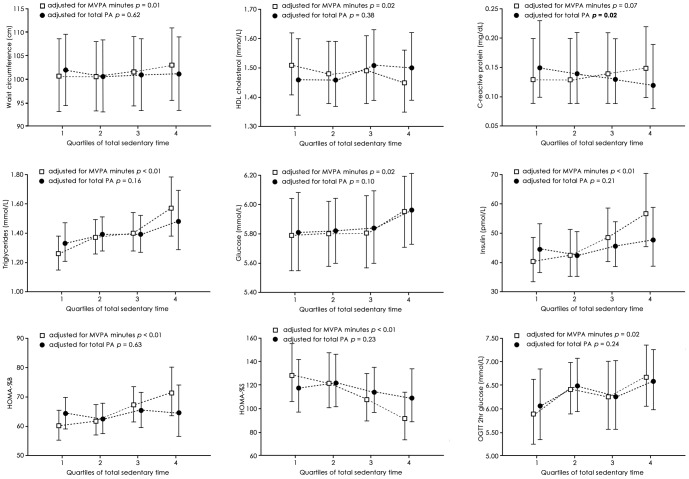
AIMS: Recent literature has posed sedentary behaviour as an independent entity to physical inactivity. This study investigated whether associations between sedentary behaviour and cardio-metabolic biomarkers remain when analyses are adjusted for total physical activity. METHODS: Cross-sectional analyses were undertaken on 4,618 adults from the 2003/04 and 2005/06 U.S. National Health and Nutrition Examination Survey. Minutes of sedentary behaviour and moderate-to-vigorous physical activity (MVPA), and total physical activity (total daily accelerometer counts minus counts accrued during sedentary minutes) were determined from accelerometry. Associations between sedentary behaviour and cardio-metabolic biomarkers were examined using linear regression. RESULTS: Results showed that sedentary behaviour was detrimentally associated with 8/11 cardio-metabolic biomarkers when adjusted for MVPA. However, when adjusted for total physical activity, the associations effectively disappeared, except for C-reactive protein, which showed a very small, favourable association (β = -0.06) and triglycerides, which showed a very small, detrimental association (β = 0.04). Standardised betas suggested that total physical activity was consistently, favourably associated with cardio-metabolic biomarkers (9/11 biomarkers, standardized β = 0.08-0.30) while sedentary behaviour was detrimentally associated with just 1 biomarker (standardized β = 0.12). CONCLUSION: There is virtually no association between sedentary behaviour and cardio-metabolic biomarkers once analyses are adjusted for total physical activity. This suggests that sedentary behaviour may not have health effects independent of physical activity.
Overview
The claims and statistics of this paper haven’t been checked yet.
Run the check — free, no account needed. It reads the open-access text and checks the sources it cites.
Integrity signals
Registry
Cites
Statistics
Figures
Verification
Claims the paper makes
The claims and statistics of this paper haven’t been checked yet.
Run the check — free, no account needed. It reads the open-access text and checks the sources it cites.
Claims other papers make about this one
Each is checked against this paper’s own text: does it say what the citing paper says it does?
In the citing paper
“The models’ fit to the data was in line with previous reports [1,6,10,14–17], with moderate amount of variance explained for systolic blood pressure (R2 adj = 0.21), HDL (R2 adj = 0.22), CRP (R2 adj = 0.26), plasma glucose (R2 adj = 0.33), insulin (R2 adj = 0.40) and HOMA (R2 adj = 0.42).”
Self-check
Percentages, sums and reported differences re-computed from the paper’s own numbers.
The self-check needs the paper’s full text.
Citations
Cites
Grundy, S. M., Bilheimer, D. W., Chait, A., Clark, L. T., Denke, M. A., Havel, R. J., Hazzard, W. R., Hulley, S. B., Hunninghake, D. B., Kreisberg, R. A., et al. (1993) · JAMA · doi:10.1001/jama.269.23.3015 · Cited by 27,944
Expert Panel on Detection, E. (2001) · JAMA: The Journal of the American Medical Association · doi:10.1001/jama.285.19.2486 · Cited by 26,011
Physical Activity in the United States Measured by Accelerometer
TROIANO, R. P., BERRIGAN, D., DODD, K. W., MÂSSE, L. C., TILERT, T., & MCDOWELL, M. (2008) · Medicine & Science in Sports & Exercise · doi:10.1249/mss.0b013e31815a51b3 · Cited by 7,638
Applied Linear Regression Models
(1997) · Technometrics · doi:10.1080/00401706.1997.10485142 · Cited by 4,640
Amick, D. J., Cooley, W. W., & Lohnes, P. R. (1972) · Contemporary Sociology A Journal of Reviews · doi:10.2307/2062821 · Cited by 2,941
Amount of Time Spent in Sedentary Behaviors in the United States, 2003-2004
Matthews, C. E., Chen, K. Y., Freedson, P. S., Buchowski, M. S., Beech, B. M., Pate, R. R., & Troiano, R. P. (2008) · American Journal of Epidemiology · doi:10.1093/aje/kwm390 · Cited by 2,631
Too Much Sitting: The Population Health Science of Sedentary Behavior
Owen, N., Healy, G. N., Matthews, C. E., & Dunstan, D. W. (2010) · Exercise and Sport Sciences Reviews · doi:10.1097/jes.0b013e3181e373a2 · Cited by 2,202
National Health and Nutrition Examination Survey
Rothwell, C. J. (2009) · Springer eBooks · doi:10.1007/978-0-387-78665-0_6177 · Cited by 2,093
Wilmot, E. G., Edwardson, C. L., Achana, F. A., Davies, M. J., Gorely, T., Gray, L. J., Khunti, K., Yates, T., & Biddle, S. J. H. (2012) · Diabetologia · doi:10.1007/s00125-012-2677-z · Cited by 1,789
Hamilton, M. T., Hamilton, D. G., & Zderic, T. W. (2007) · Diabetes · doi:10.2337/db07-0882 · Cited by 1,655
Cited by
Sorted by citations
Chastin, S. F. M., Palarea-Albaladejo, J., Dontje, M. L., & Skelton, D. A. (2015) · PLOS ONE · doi:10.1371/journal.pone.0139984 · Cited by 1,034
“Some authors claim that sedentary time has specific effects on health that are not mitigated by activity [5,28] whilst others consider it as inactivity together with LIPA which simply has an effect because it displaces active time [10,14,27].”
Compositional data analysis for physical activity, sedentary time and sleep research
Dumuid, D., Stanford, T., Fernández, J. A. M., Pedišić, Ž., Maher, C. A., Lewis, L. K., Hron, K., Katzmarzyk, P. T., Chaput, J., Fogelholm, M., et al. (2017) · Statistical Methods in Medical Research · doi:10.1177/0962280217710835 · Cited by 548
Self-citationIs sedentary behaviour just physical inactivity by another name?
van der Ploeg, H. P., & Hillsdon, M. M. (2017) · International Journal of Behavioral Nutrition and Physical Activity · doi:10.1186/s12966-017-0601-0 · Cited by 350
Matthews, C. E., Keadle, S. K., Troiano, R. P., Kahle, L., Koster, A., Brychta, R. J., Domelen, D. R. V., Caserotti, P., Chen, K. Y., Harris, T. B., et al. (2016) · American Journal of Clinical Nutrition · doi:10.3945/ajcn.116.135129 · Cited by 318
Copeland, J. L., Ashe, M. C., Biddle, S., Brown, W. J., Buman, M. P., CHASTIN, S. F. M., Gardiner, P. A., Inoue, S., Jefferis, B. J. M. H., Oka, K., et al. (2017) · British Journal of Sports Medicine · doi:10.1136/bjsports-2016-097210 · Cited by 247
Metadata
- Authors
- Maher, C., Olds, T., Mire, E., & Katzmarzyk, P. T.
- Affiliations
- University of South Australia (AU)
- Pennington Biomedical Research Center (US)
- Corresponding author
- Maher, Carol
- Venue
- PLoS ONE
- Publisher
- Public Library of Science (PLoS)
- Published
- 2014-01-15
- Volume
- 9
- Issue
- 1
- Pages
- e86403
- ISSN
- 1932-6203 (ISSN-L)
- PMC
- PMC3893290
- OpenAlex
- W1974229194
- Cited by
- 114
- References
- 25
- Citations by year
- 2026: 3 · 2025: 2 · 2023: 4 · 2022: 5 · 2021: 5 · 2020: 7 · 2019: 6 · 2018: 11 · 2017: 17 · 2016: 18 · 2015: 17 · 2014: 19
- FWCI
- 15.73
- Type
- journal article
- Language
- en
- Open access
- gold
- doi.org
- Licence
- Locations
- PLoS ONE (publishedVersion, cc-by)
- Europe PMC (PubMed Central) (publishedVersion, cc-by)
- PubMed Central (publishedVersion, cc-by)
- PubMed (publishedVersion)
- DOAJ (DOAJ: Directory of Open Access Journals) (submittedVersion, cc-by-sa)
- Figshare (submittedVersion, cc-by)
- UniSA Research Outputs Repository (University of South Australia) (submittedVersion, other-oa)
- Topics
- Health Sciences › Medicine › Public Health, Environmental and Occupational Health › Physical Activity and Health
- Physical Sciences › Computer Science › Computer Vision and Pattern Recognition › Context-Aware Activity Recognition Systems
- Health Sciences › Medicine › Public Health, Environmental and Occupational Health › Obesity, Physical Activity, Diet
- Keywords
- sedentary behavior, physical inactivity, moderate-to-vigorous physical activity, total physical activity, C-reactive protein, triglycerides, accelerometer-measured activity
- MeSH terms
- Adult, Blood Glucose, Blood Pressure, Cross-Sectional Studies, Female, Humans, Insulin, Cholesterol, HDL, Male, Middle Aged, Motor Activity, Risk Factors, Triglycerides, Biomarkers, Linear Models, Waist Circumference, Young Adult, Sedentary Behavior, Accelerometry
About these checks
Registry, retraction, Cites and statistics results are computed, not judged, with one exception: a printed reference that no index lists is read once by a model before it counts as a citation error. Claims are extracted by a model and kept only when their quote appears verbatim in the text; each cited source is then checked, with a model’s help, for whether it says what the claim relies on. Those verdicts can be wrong — read the claim’s quote and the cited source before relying on one.
Statistics and arithmetic are recomputed, not judged.
Confidence bands are shown only for fields calibrated on our annotated test set. None is calibrated yet, so no band is shown.
What counts as a claim ›How we measure confidence ›How we check this ›
Are you an author, or do you see a problem with this page? Request a review
