

The DOI matches its Crossref record; 67 of the 67 references it cites were found in a registry or an index.
Reverse Zoonotic Disease Transmission (Zooanthroponosis): A Systematic Review of Seldom-Documented Human Biological Threats to Animals
Open accessAbstract
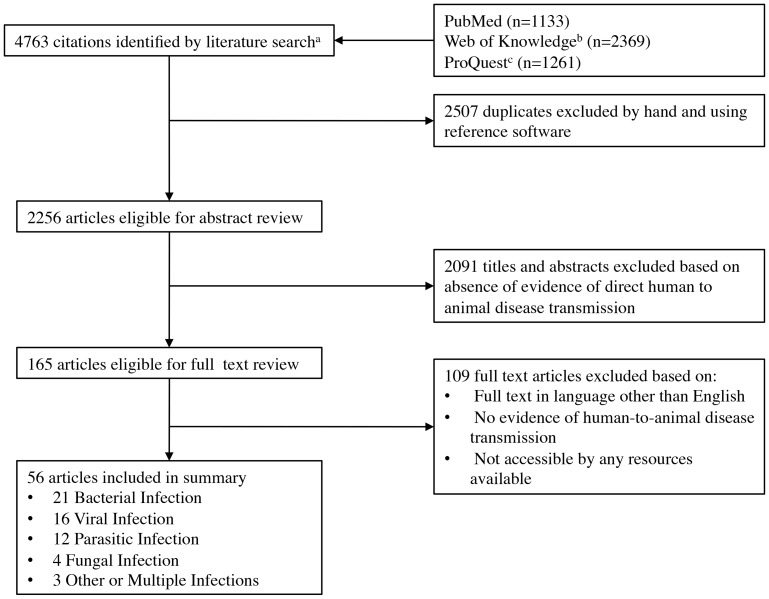
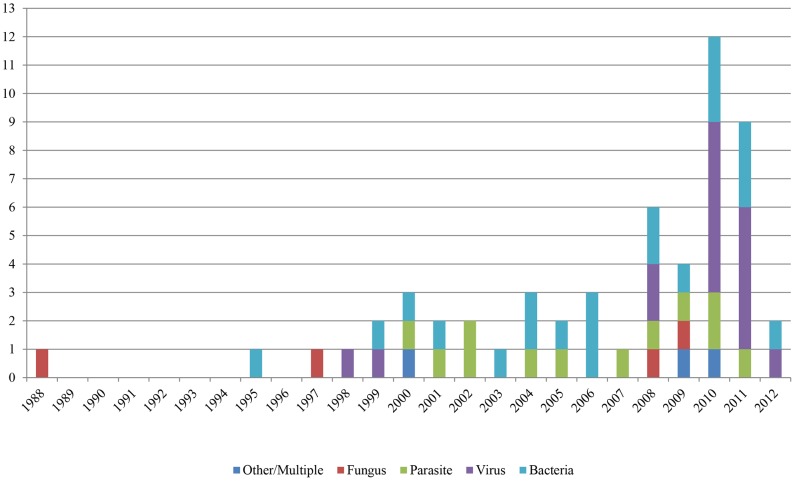
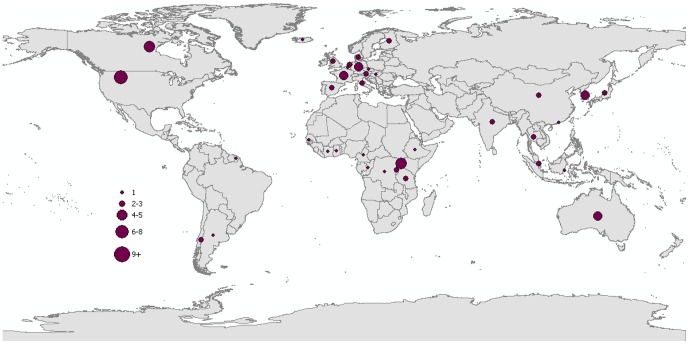
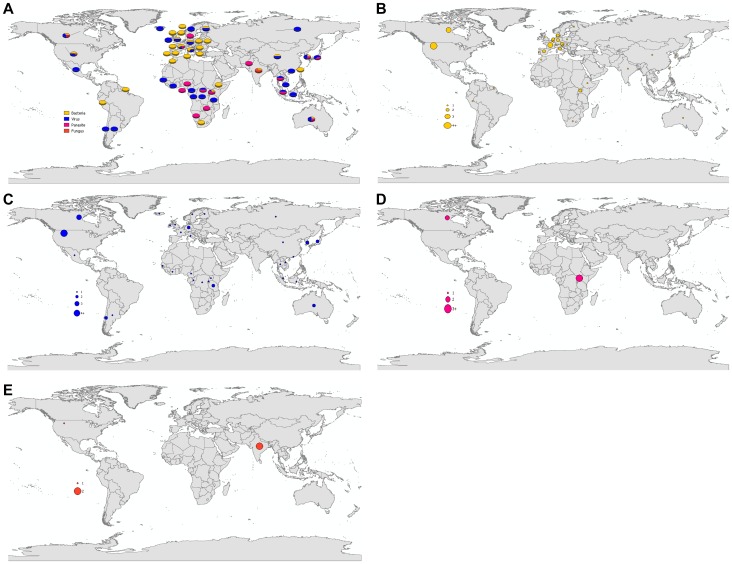
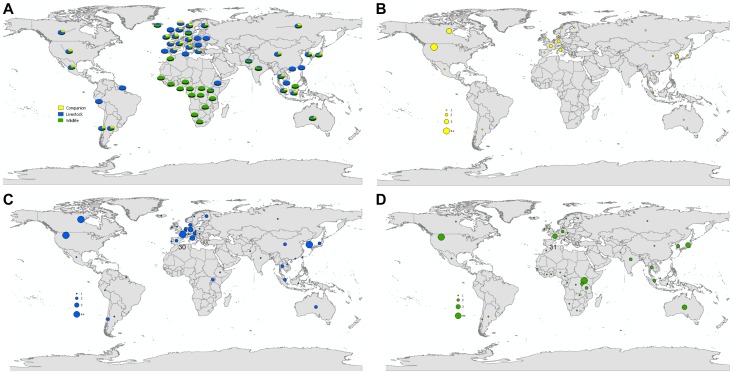
BACKGROUND: Research regarding zoonotic diseases often focuses on infectious diseases animals have given to humans. However, an increasing number of reports indicate that humans are transmitting pathogens to animals. Recent examples include methicillin-resistant Staphylococcus aureus, influenza A virus, Cryptosporidium parvum, and Ascaris lumbricoides. The aim of this review was to provide an overview of published literature regarding reverse zoonoses and highlight the need for future work in this area. METHODS: An initial broad literature review yielded 4763 titles, of which 4704 were excluded as not meeting inclusion criteria. After careful screening, 56 articles (from 56 countries over three decades) with documented human-to-animal disease transmission were included in this report. FINDINGS: In these publications, 21 (38%) pathogens studied were bacterial, 16 (29%) were viral, 12 (21%) were parasitic, and 7 (13%) were fungal, other, or involved multiple pathogens. Effected animals included wildlife (n = 28, 50%), livestock (n = 24, 43%), companion animals (n = 13, 23%), and various other animals or animals not explicitly mentioned (n = 2, 4%). Published reports of reverse zoonoses transmission occurred in every continent except Antarctica therefore indicating a worldwide disease threat. INTERPRETATION: As we see a global increase in industrial animal production, the rapid movement of humans and animals, and the habitats of humans and wild animals intertwining with great complexity, the future promises more opportunities for humans to cause reverse zoonoses. Scientific research must be conducted in this area to provide a richer understanding of emerging and reemerging disease threats. As a result, multidisciplinary approaches such as One Health will be needed to mitigate these problems.
Overview
The claims and statistics of this paper haven’t been checked yet.
Run the check — free, no account needed. It reads the open-access text and checks the sources it cites.
Integrity signals
Registry
Cites
Statistics
Figures
Verification
Claims the paper makes
The claims and statistics of this paper haven’t been checked yet.
Run the check — free, no account needed. It reads the open-access text and checks the sources it cites.
Claims other papers make about this one
Each is checked against this paper’s own text: does it say what the citing paper says it does?
The check wasn’t confident either way, so it gives no verdict — never disputed.
In the citing paper
“In one study, up to 62% of owners agreed with the statement “My dog is more important to me than any human being” [93].”
From A One Health Perspective on the Human-Companion Animal Relationship with Emphasis on Zoonotic Aspects. (2020) · cites this paper as [93]
Experimental — accuracy not yet measured
Self-check
Percentages, sums and reported differences re-computed from the paper’s own numbers.
The self-check needs the paper’s full text.
Citations
Cites
Emerging Infectious Diseases of Wildlife-- Threats to Biodiversity and Human Health
Daszak, P., Cunningham, A. A., & Hyatt, A. D. (2000) · Science · doi:10.1126/science.287.5452.443 · Cited by 4,977
Cleaveland, S., Laurenson, M. K., & Taylor, L. H. (2001) · Philosophical Transactions of the Royal Society of London. Series B: Biological Sciences · doi:10.1098/rstb.2001.0889 · Cited by 1,188
Staphylococcus aureus CC398: Host Adaptation and Emergence of Methicillin Resistance in Livestock
Price, L. B., Stegger, M., Hasman, H., Aziz, M., Larsen, J., Andersen, P. S., Pearson, T., Waters, A. E., Foster, J. T., Schupp, J. M., et al. (2012) · mBio · doi:10.1128/mbio.00305-11 · Cited by 861
Genetic and Experimental Evidence for Cross-Species Infection by Swine Hepatitis E Virus
Meng, X., Halbur, P. G., Shapiro, M., Govindarajan, S., Bruna, J. D., Mushahwar, I. K., Purcell, R. H., & Emerson, S. U. (1998) · Journal of Virology · doi:10.1128/jvi.72.12.9714-9721.1998 · Cited by 581
Three-Year Study To Assess Human Enteric Viruses in Shellfish
Guyader, F. L., Haugarreau, L., Miossec, L., Dubois, É., & Pommepuy, M. (2000) · Applied and Environmental Microbiology · doi:10.1128/aem.66.8.3241-3248.2000 · Cited by 307
Weese, J. S., Dick, H. L. N., Willey, B. M., McGeer, A., Kreiswirth, B. N., INNIS, B., & Low, D. E. (2006) · Veterinary Microbiology · doi:10.1016/j.vetmic.2006.01.004 · Cited by 302
Ewers, C., Grobbel, M., Stamm, I., Kopp, P. A., Diehl, I., Semmler, T., Fruth, A., Beutlich, J., Guerra, B., Wieler, L. H., et al. (2010) · Journal of Antimicrobial Chemotherapy · doi:10.1093/jac/dkq004 · Cited by 279
Seguin, J. C., Walker, R. D., Caron, J. P., Kloos, W. E., George, C. G., Hollis, R. J., Jones, R. N., & Pfaller, M. A. (1999) · Journal of Clinical Microbiology · doi:10.1128/jcm.37.5.1459-1463.1999 · Cited by 277
Noël, C., Dufernez, F., Gerbod, D., Edgcomb, V. P., Delgado, P., Ho, L.-C., Singh, M., Wintjens, R. T., Sogin, M. L., Capron, M., et al. (2005) · Journal of Clinical Microbiology · doi:10.1128/jcm.43.1.348-355.2005 · Cited by 269
Rwego, I. B., Isabirye–Basuta, G., Gillespie, T. R., & Goldberg, T. L. (2008) · Conservation Biology · doi:10.1111/j.1523-1739.2008.01018.x · Cited by 223
Research works printed but not linked: 2
- OJ Adejinmi, 2008, Preliminary investigation of zooanthroponosis in a Nigerian Zoological Garden, Vet Res (Pakistan), 2, 38
- M Pal, 1997, Zooanthroponotic significance of Trichophyton rubrum in a rhesus monkey (Macaca mulatta). Verh. ber. Erkrg, Zootiere, 38, 355
Cited by
Sorted by citations
Host and viral traits predict zoonotic spillover from mammals
Olival, K. J., Hosseini, P. R., Zambrana-Torrelio, C., Ross, N., Bogich, T. L., & Daszak, P. (2017) · Nature · doi:10.1038/nature22975 · Cited by 1,130
Zoonotic diseases: etiology, impact, and control
Rahman, M. T., Sobur, M. A., Islam, M. S., Ievy, S., Hossain, M. J., El Zowalaty, M. E., Rahman, A. T., & Ashour, H. M. (2020) · Microorganisms · doi:10.3390/microorganisms8091405 · Cited by 853
Why infectious disease research needs community ecology
Johnson, P. T. J., de Roode, J. C., & Fenton, A. (2015) · Science · doi:10.1126/science.1259504 · Cited by 446
From People to Panthera : Natural SARS-CoV-2 Infection in Tigers and Lions at the Bronx Zoo
McAloose, D., Laverack, M. A., Wang, L., Killian, M. L., Caserta, L. C., Yuan, F., Mitchell, P. K., Queen, K. J., Mauldin, M. R., Cronk, B. D., et al. (2020) · mBio · doi:10.1128/mbio.02220-20 · Cited by 409
Applying evolutionary biology to address global challenges
Carroll, S. P., Jørgensen, P. S., Kinnison, M. T., Bergstrom, C. T., Denison, R. F., Gluckman, P. D., Smith, T. B., Strauss, S. Y., & Tabashnik, B. E. (2014) · Science · doi:10.1126/science.1245993 · Cited by 321
Metadata
- Authors
- Messenger, A. M., Barnes, A. N., & Gray, G. C.
- Affiliations
- University of Florida Health (US)
- Corresponding author
- Gray, Gregory C.
- Venue
- PLoS ONE
- Publisher
- Public Library of Science (PLoS)
- Published
- 2014-02-28
- Volume
- 9
- Issue
- 2
- Pages
- e89055
- ISSN
- 1932-6203 (ISSN-L)
- PMC
- PMC3938448
- OpenAlex
- W2078639388
- Cited by
- 278
- References
- 67
- Citations by year
- 2026: 19 · 2025: 14 · 2024: 27 · 2023: 35 · 2022: 29 · 2021: 36 · 2020: 28 · 2019: 28 · 2018: 22 · 2017: 12 · 2016: 10 · 2015: 15 · 2014: 3
- FWCI
- 2.08
- Type
- journal article
- Language
- en
- Open access
- gold
- doi.org
- Locations
- PLoS ONE (publishedVersion, cc-by)
- Europe PMC (PubMed Central) (publishedVersion, other-oa)
- PubMed Central (publishedVersion, cc-by)
- PubMed (publishedVersion)
- National University of Singapore (submittedVersion)
- DOAJ (DOAJ: Directory of Open Access Journals) (submittedVersion, cc-by-sa)
- Zenodo (CERN European Organization for Nuclear Research)
- Funders
- University of Florida
- National Institutes of Health (7r01ai068803-05)
- National Institute of Allergy and Infectious Diseases (R01-AI068803)
- Topics
- Health Sciences › Medicine › Public Health, Environmental and Occupational Health › Zoonotic diseases and public health
- Life Sciences › Agricultural and Biological Sciences › Food Science › Salmonella and Campylobacter epidemiology
- Life Sciences › Agricultural and Biological Sciences › Animal Science and Zoology › Animal Disease Management and Epidemiology
- Keywords
- zoonotic pathogens, wildlife, livestock, companion animals, methicillin-resistant Staphylococcus aureus, influenza A virus, Cryptosporidium parvum, Ascaris lumbricoides, emerging and re-emerging diseases, One Health
- MeSH terms
- Animals, Animals, Domestic, Animals, Wild, Communicable Diseases, Humans, Influenza A virus, Zoonoses, Methicillin-Resistant Staphylococcus aureus
About these checks
Registry, retraction, Cites and statistics results are computed, not judged, with one exception: a printed reference that no index lists is read once by a model before it counts as a citation error. Claims are extracted by a model and kept only when their quote appears verbatim in the text; each cited source is then checked, with a model’s help, for whether it says what the claim relies on. Those verdicts can be wrong — read the claim’s quote and the cited source before relying on one.
Statistics and arithmetic are recomputed, not judged.
Confidence bands are shown only for fields calibrated on our annotated test set. None is calibrated yet, so no band is shown.
What counts as a claim ›How we measure confidence ›How we check this ›
Are you an author, or do you see a problem with this page? Request a review
