

The DOI matches its Crossref record; 43 of the 43 references it cites were found in a registry or an index.
MiR-132 Suppresses the Migration and Invasion of Lung Cancer Cells via Targeting the EMT Regulator ZEB2
Abstract
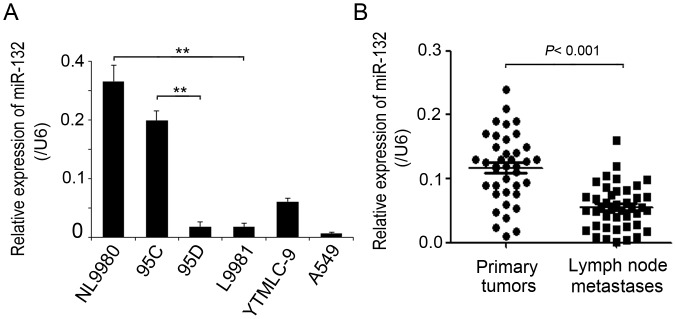
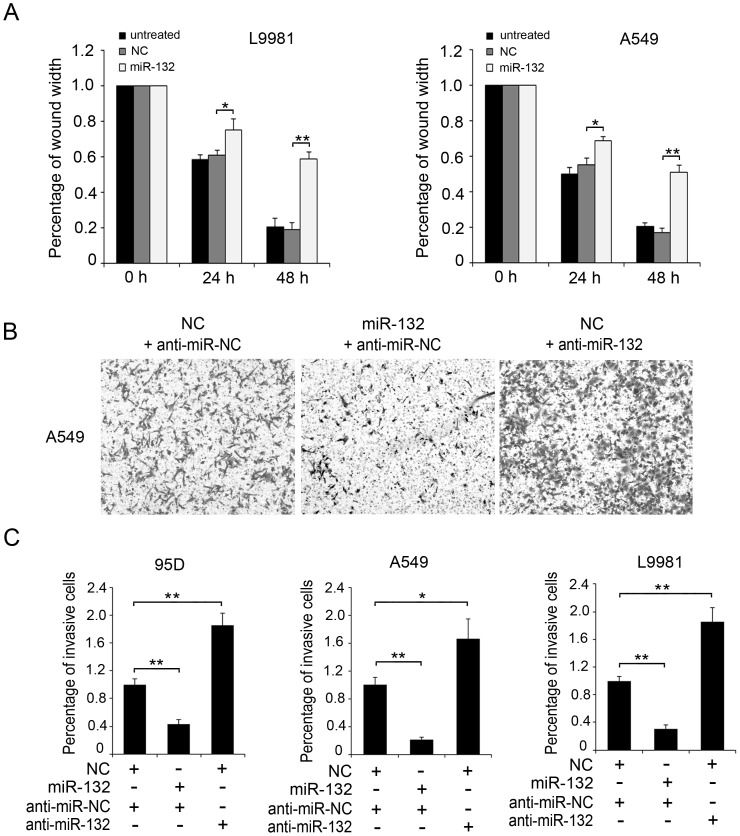
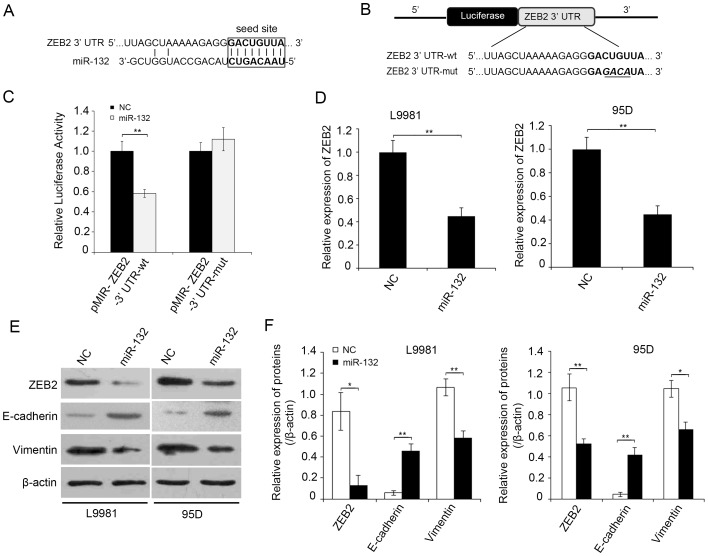
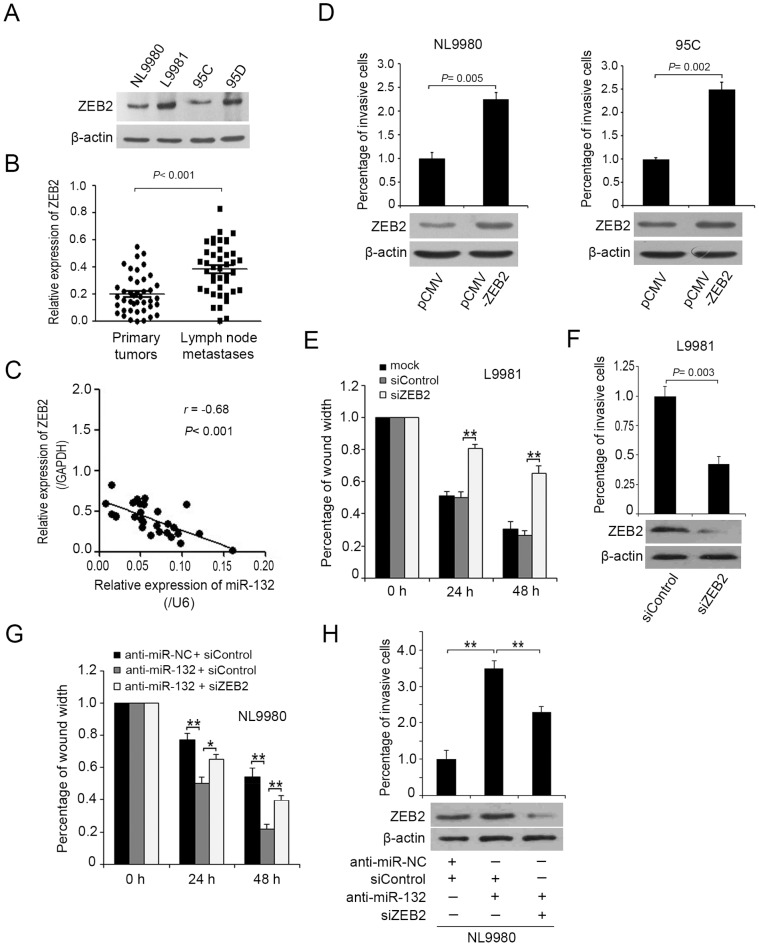
MicroRNAs (miRNAs) are small, non-coding RNAs which can function as oncogenes or tumor suppressor genes in human cancers. Emerging evidence reveals that deregulation of miRNAs contributes to the human non-small cell lung cancer (NSCLC). In the present study, we demonstrated that the expression levels of miR-132 were dramatically decreased in examined NSCLC cell lines and clinical NSCLC tissue samples. Then, we found that introduction of miR-132 significantly suppressed the migration and invasion of lung cancer cells in vitro, suggesting that miR-132 may be a novel tumor suppressor. Further studies indicated that the EMT-related transcription factor ZEB2 was one direct target genes of miR-132, evidenced by the direct binding of miR-132 with the 3' untranslated region (3' UTR) of ZEB2. Further, miR-132 could decrease the expression of ZEB2 at the levels of mRNA and protein. Notably, the EMT marker E-cadherin or vimentin, a downstream of ZEB2, was also down-regulated or up-regulated upon miR-132 treatment. Additionally, over-expressing or silencing ZEB2 was able to elevate or inhibit the migration and invasion of lung cancer cells, parallel to the effect of miR-132 on the lung cancer cells. Meanwhile, knockdown of ZEB2 reversed the enhanced migration and invasion mediated by anti-miR-132. These results indicate that miR-132 suppresses the migration and invasion of NSCLC cells through targeting ZEB2 involving the EMT process. Thus, our finding provides new insight into the mechanism of NSCLC progression. Therapeutically, miR-132 may serve as a potential target in the treatment of human lung cancer.
Overview
The claims and statistics of this paper haven’t been checked yet.
Run the check — free, no account needed. It reads the open-access text and checks the sources it cites.
Integrity signals
Registry
Cites
Statistics
Figures
Verification
Claims the paper makes
The claims and statistics of this paper haven’t been checked yet.
Run the check — free, no account needed. It reads the open-access text and checks the sources it cites.
Claims other papers make about this one
Each is checked against this paper’s own text: does it say what the citing paper says it does?
The cited source says what the claim attributes to it.
In the citing paper
“Amongst these AD-specific targets were genes like PTBP2, a previously identified miR-132 target implicated in Tau mRNA splicing [85], LYN, a kinase shown to play a role in amyloid-β-triggered neurotoxicity and TAU hyperphosphorylation [86], and NFE2L2, ZEB2, SPRED1 and RASA1, all previously shown to be regulated by miR-132 [87–89] (Fig. 5F).”
From microRNA-132 attenuates inflammation in induced pluripotent stem cell-derived microglia from Alzheimer’s disease patients (2026) · cites this paper as [87]
Self-check
Percentages, sums and reported differences re-computed from the paper’s own numbers.
The self-check needs the paper’s full text.
Citations
Cites
2 retracted
CONG, N., DU, P., Zhang, A., Shen, F.-J., Su, J., Pu, P., WANG, T., ZJANG, J., Kang, C., & Zhang, Q. (2013) · Oncology Reports · doi:10.3892/or.2013.2267 · Cited by 160
RetractedRetracted: MiR‐449c targets c‐Myc and inhibits NSCLC cell progression
Miao, L., Huang, S., Sun, Z., Gao, Z., Zhang, R., Liu, Y., & Wang, J. (2013) · FEBS Letters · doi:10.1016/j.febslet.2013.03.006 · Cited by 49
RetractedJemal, A., Bray, F., Center, M. M., Ferlay, J., Ward, E., & Forman, D. (2011) · CA: A Cancer Journal for Clinicians · doi:10.3322/caac.20107 · Cited by 54,679
Bartel (2004) · doi:10.1016/s0092-8674(04)00045-5 · Cited by 34,714
MicroRNA expression profiles classify human cancers
Lu, J., Getz, G., Miska, E. A., Alvarez-Saavedra, E., Lamb, J., Peck, D., Sweet-Cordero, A., Ebert, B. L., Mak, R. H., Ferrando, A. A., et al. (2005) · Nature · doi:10.1038/nature03702 · Cited by 9,539
A Perspective on Cancer Cell Metastasis
Chaffer, C. L., & Weinberg, R. A. (2011) · Science · doi:10.1126/science.1203543 · Cited by 4,807
MicroRNAs Modulate Hematopoietic Lineage Differentiation
Chen, C.-Z., Li, L., Lodish, H. F., & Bartel, D. P. (2004) · Science · doi:10.1126/science.1091903 · Cited by 3,257
Snail, Zeb and bHLH factors in tumour progression: An alliance against the epithelial phenotype?
Peinado, H., Olmeda, D., & Cano, A. (2007) · Nature reviews. Cancer · doi:10.1038/nrc2131 · Cited by 3,121
MicroRNA biogenesis: coordinated cropping and dicing
Kim, V. N. (2005) · Nature Reviews Molecular Cell Biology · doi:10.1038/nrm1644 · Cited by 2,546
Micromanagers of gene expression: the potentially widespread influence of metazoan microRNAs
Bartel, D. P., & Chen, C.-Z. (2004) · Nature Reviews Genetics · doi:10.1038/nrg1328 · Cited by 1,425
Cited by
Holbeck, S. L., Camalier, R., Crowell, J. A., Govindharajulu, J. P., Hollingshead, M., Anderson, L. W., Polley, E., Rubinstein, L., Srivastava, A., Wilsker, D., et al. (2017) · Cancer Research · doi:10.1158/0008-5472.can-17-0489 · Cited by 359
Complex Determinants of Epithelial: Mesenchymal Phenotypic Plasticity in Ovarian Cancer
Klymenko, Y., Kim, O., & Stack, M. (2017) · Cancers · doi:10.3390/cancers9080104 · Cited by 99
Penning, A., Snoeck, S., Ormaechea, O. R., Ayyildiz, D., Polzer, O., Buitrago-Arango, M., Capobianco, R., de Winter, F., Balusu, S., Verhaagen, J., et al. (2026) · Acta Neuropathologica Communications · doi:10.1186/s40478-026-02228-8 · Cited by 6
Metadata
- Authors
- You, J., Li, Y., Fang, N., Liu, B., Zu, L., Chang, R., Li, X., & Zhou, Q.
- Venue
- PLoS ONE
- Publisher
- Public Library of Science (PLoS)
- Published
- 2014-03-13
- Volume
- 9
- Issue
- 3
- Pages
- e91827
- ISSN
- 1932-6203
- PMC
- PMC3953608
- Cited by
- 91
- References
- 43
- Language
- en
About these checks
Registry, retraction, Cites and statistics results are computed, not judged, with one exception: a printed reference that no index lists is read once by a model before it counts as a citation error. Claims are extracted by a model and kept only when their quote appears verbatim in the text; each cited source is then checked, with a model’s help, for whether it says what the claim relies on. Those verdicts can be wrong — read the claim’s quote and the cited source before relying on one.
Statistics and arithmetic are recomputed, not judged.
Confidence bands are shown only for fields calibrated on our annotated test set. None is calibrated yet, so no band is shown.
What counts as a claim ›How we measure confidence ›How we check this ›
Are you an author, or do you see a problem with this page? Request a review
Data sources
Bibliographic data: Semantic Scholar, OpenAlex, Crossref.
Contains information from the Semantic Scholar Academic Graph Datasets, made available under the ODC Attribution License (ODC-BY 1.0).
Semantic Scholar’s data is described in: Kinney, R., et al. (2023). The Semantic Scholar Open Data Platform. arXiv:2301.10140.
