

The DOI matches its Crossref record; 74 of the 74 references it cites were found in a registry or an index.
Validity of myocardial infarction diagnoses in administrative databases: a systematic review.
Open accessAbstract
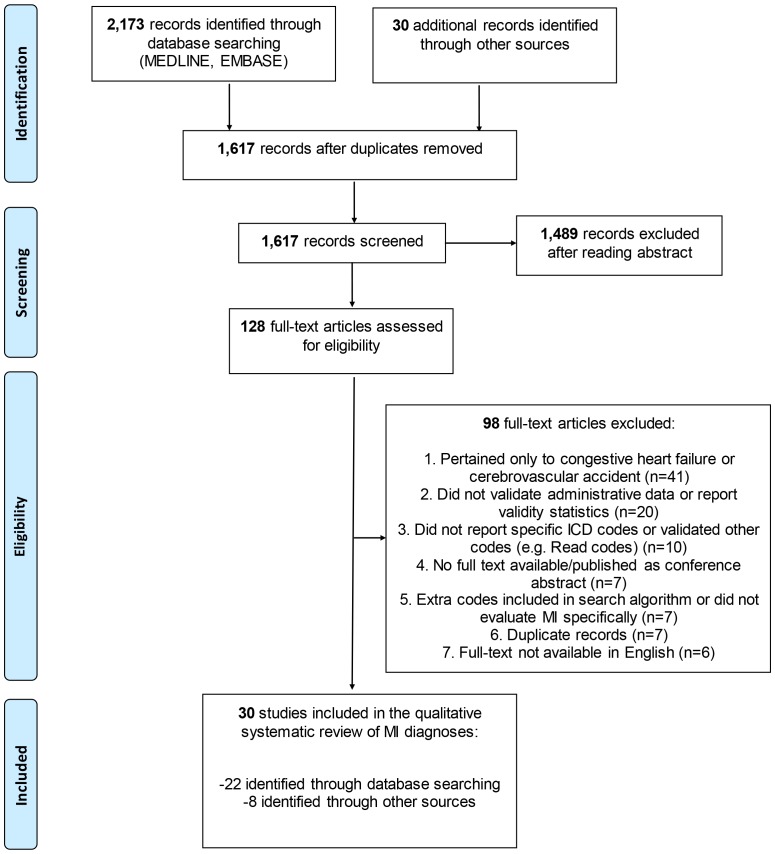
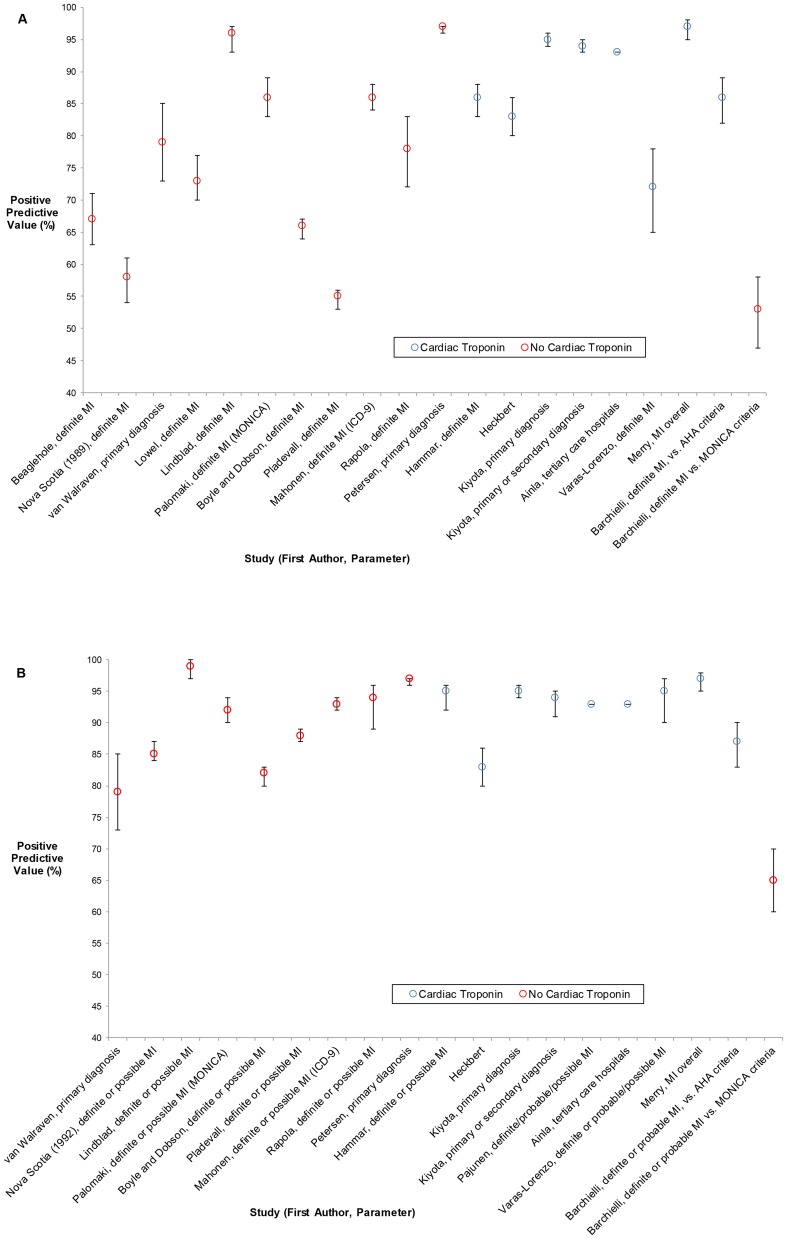
BACKGROUND: Though administrative databases are increasingly being used for research related to myocardial infarction (MI), the validity of MI diagnoses in these databases has never been synthesized on a large scale. OBJECTIVE: To conduct the first systematic review of studies reporting on the validity of diagnostic codes for identifying MI in administrative data. METHODS: MEDLINE and EMBASE were searched (inception to November 2010) for studies: (a) Using administrative data to identify MI; or (b) Evaluating the validity of MI codes in administrative data; and (c) Reporting validation statistics (sensitivity, specificity, positive predictive value (PPV), negative predictive value, or Kappa scores) for MI, or data sufficient for their calculation. Additonal articles were located by handsearch (up to February 2011) of original papers. Data were extracted by two independent reviewers; article quality was assessed using the Quality Assessment of Diagnostic Accuracy Studies tool. RESULTS: Thirty studies published from 1984-2010 were included; most assessed codes from the International Classification of Diseases (ICD)-9th revision. Sensitivity and specificity of hospitalization data for identifying MI in most [≥50%] studies was ≥86%, and PPV in most studies was ≥93%. The PPV was higher in the more-recent studies, and lower when criteria that do not incorporate cardiac troponin levels (such as the MONICA) were employed as the gold standard. MI as a cause-of-death on death certificates also demonstrated lower accuracy, with maximum PPV of 60% (for definite MI). CONCLUSIONS: Hospitalization data has higher validity and hence can be used to identify MI, but the accuracy of MI as a cause-of-death on death certificates is suboptimal, and more studies are needed on the validity of ICD-10 codes. When using administrative data for research purposes, authors should recognize these factors and avoid using vital statistics data if hospitalization data is not available to confirm deaths from MI.
Overview
The claims and statistics of this paper haven’t been checked yet.
Run the check — free, no account needed. It reads the open-access text and checks the sources it cites.
Integrity signals
Registry
Cites
Statistics
Figures
Verification
Claims the paper makes
The claims and statistics of this paper haven’t been checked yet.
Run the check — free, no account needed. It reads the open-access text and checks the sources it cites.
Claims other papers make about this one
Each is checked against this paper’s own text: does it say what the citing paper says it does?
The source backs part of the claim, not all of it — or backs it for a different population, condition or comparison.
In the citing paper
“Second, conditions were defined using ICD-10 diagnosis codes. Differences in coding practices might exist; however, coding for common conditions, especially the life-threatening conditions described in this report, is likely consistent (9,10).”
From Potential Indirect Effects of the COVID-19 Pandemic on Use of Emergency Departments for Acute Life-Threatening Conditions — United States, January–May 2020 (2020) · cites this paper as [9]
Experimental — accuracy not yet measured
Self-check
Percentages, sums and reported differences re-computed from the paper’s own numbers.
The self-check needs the paper’s full text.
Citations
Cites
The Measurement of Observer Agreement for Categorical Data
Landis, J. R., & Koch, G. G. (1977) · Biometrics · doi:10.2307/2529310 · Cited by 81,148
Third universal definition of myocardial infarction
the Writing Group on behalf of the Joint ESC/ACCF/AHA/WHF Task Force for the Universal Definition of Myocardial Infarction, Thygesen, K., Alpert, J. S., Jaffe, A. S., Simoons, M. L., CHAITMAN, B. R., & White, H. D. (2012) · Nature Reviews Cardiology · doi:10.1038/nrcardio.2012.122 · Cited by 6,585
Antman, E. M., Bassand, J., Klein, W. W., Ohman, M. E., Sendón, J. L. L., Rydén, L., Simoons, M. L., & Tendera, M. (2000) · Journal of the American College of Cardiology · doi:10.1016/s0735-1097(00)00804-4 · Cited by 4,824
Whiting, P., Rutjes, A. W., Reitsma, J. B., Bossuyt, P. M., & Kleijnen, J. (2003) · BMC Medical Research Methodology · doi:10.1186/1471-2288-3-25 · Cited by 3,592
Third Universal Definition of Myocardial Infarction
Thygesen, K. A., Alpert, J. S., Jaffe, A. S., Simoons, M. L., CHAITMAN, B. R., White, H. D., Thygesen, K. A., Alpert, J. S., White, H. D., Jaffe, A. S., et al. (2012) · Journal of the American College of Cardiology · doi:10.1016/j.jacc.2012.08.001 · Cited by 2,619
WHO MONICA Project Principal Invest (1988) · Journal of Clinical Epidemiology · doi:10.1016/0895-4356(88)90084-4 · Cited by 1,846
Alpert, J. S., Thygesen, K. A., Antman, E. M., & Bassand, J. (2001) · Journal of the American College of Cardiology · Cited by 1,282
Kornitzer, M., Berghmans, L., Wilmet, M. D., Darquennes, H., Lagasse, R., & Payen, R. (1988) · Dépôt institutionnel de l'Université libre de Bruxelles (Université Libre de Bruxelles) · Cited by 1,270
Case Definitions for Acute Coronary Heart Disease in Epidemiology and Clinical Research Studies
Luepker, R. V., Apple, F. S., Christenson, R. H., Crow, R. S., Fortmann, S. P., Goff, D. C., Goldberg, R. J., Hand, M. M., Jaffe, A. S., Julian, D. G., et al. (2003) · Circulation · doi:10.1161/01.cir.0000100560.46946.ea · Cited by 810
Economic burden of cardiovascular diseases in the enlarged European Union
Leal, J., Luengo-Fernández, R., Gray, A. M., Petersen, S., & Rayner, M. (2006) · European Heart Journal · doi:10.1093/eurheartj/ehi733 · Cited by 698
Kiyota, Y., Schneeweiß, S., Glynn, R. J., Cannuscio, C. C., Avorn, J., & Solomon, D. H. (2004) · American Heart Journal · doi:10.1016/j.ahj.2004.02.013 · Cited by 533
Austin, P. C., Daly, P. A., & Tu, J. V. (2002) · American Heart Journal · doi:10.1067/mhj.2002.123839 · Cited by 524
An Overview Of Cardiovascular Disease Burden In The United States
Mensah, G. A., & Brown, D. W. (2007) · Health Affairs · doi:10.1377/hlthaff.26.1.38 · Cited by 428
The Validity of a Diagnosis of Heart Failure in a Hospital Discharge Register
Ingelsson, E., Ärnlöv, J., Sundström, J., & Lind, L. (2005) · European Journal of Heart Failure · doi:10.1016/j.ejheart.2004.12.007 · Cited by 417
Quality of Diagnosis and Procedure Coding in ICD-10 Administrative Data
Henderson, T., Shepheard, J., & Sundararajan, V. (2006) · Medical Care · doi:10.1097/01.mlr.0000228018.48783.34 · Cited by 408
High Risk of Cardiovascular Disease in Patients With Type 1 Diabetes in the U.K.
Soedamah‐Muthu, S. S., Fuller, J., Mulnier, H. E., Raleigh, V. S., Lawrenson, R. A., & Colhoun, H. M. (2006) · Diabetes Care · doi:10.2337/diacare.29.04.06.dc05-1433 · Cited by 395
Trends in Incidence, Severity, and Outcome of Hospitalized Myocardial Infarction
Roger, V. L., Weston, S. A., Gerber, Y., Killian, J. M., Dunlay, S. M., Jaffe, A. S., Bell, M. R., Kors, J. A., Yawn, B. P., & Jacobsen, S. J. (2010) · Circulation · doi:10.1161/circulationaha.109.897249 · Cited by 336
Pajunen, P., Koukkunen, H., Ketonen, M., Jerkkola, T., Immonen‐Räihä, P., K??rj??-Koskenkari, P., nen, M. M. H., Niemel, M., Kuulasmaa, K., ki, P. P. A., et al. (2005) · European Journal of Cardiovascular Prevention & Rehabilitation · doi:10.1097/00149831-200504000-00007 · Cited by 334
Sánchez-González, Á., Kremers, H. M., Crowson, C. S., Ballman, K. V., Roger, V. L., Jacobsen, S. J., O’Fallon, W. M., & Gabriel, S. E. (2007) · Annals of the Rheumatic Diseases · doi:10.1136/ard.2006.059980 · Cited by 317
Watson, D. J., Rhodes, T., & Guess, H. A. (2003) · PubMed · Cited by 284
Heckbert, S. R., Kooperberg, C. L., Safford, M. M., Psaty, B. M., Hsia, J. A., McTiernan, A., Gaziano, J. M., Frishman, W. H., & Curb, J. D. (2004) · American Journal of Epidemiology · doi:10.1093/aje/kwh314 · Cited by 268
Humphries, K. H., Rankin, J. M., Carere, R. G., Buller, C. E. H., Kiely, F. M., & Spinelli, J. J. (2000) · Journal of Clinical Epidemiology · doi:10.1016/s0895-4356(99)00188-2 · Cited by 258
A national record linkage to study acute myocardial infarction incidence and case fatality in Sweden
Hammar, N., Alfredsson, L. S., Rosén, M., Spetz, C.-L., Kahan, T., & Ysberg, A. ‐. (2001) · International Journal of Epidemiology · doi:10.1093/ije/30.suppl_1.s30 · Cited by 251
Does Clinical Evidence Support ICD-9-CM Diagnosis Coding of Complications?
McCarthy, E. P., Iezzoni, L. I., Davis, R. B., Palmer, R. H., Cahalane, M. J., Hamel, M. B., Mukamal, K. J., Phillips, R. S., & Davies, D. T. (2000) · Medical Care · doi:10.1097/00005650-200008000-00010 · Cited by 242
Fischer, L. M., Schlienger, R. G., Matter, C. M., Jick, H., & Meier, C. R. (2004) · The American Journal of Cardiology · doi:10.1016/j.amjcard.2003.09.037 · Cited by 240
Petersen, L. A., Wright, S. M., Normand, S. T., & Daley, J. (1999) · Journal of General Internal Medicine · doi:10.1046/j.1525-1497.1999.10198.x · Cited by 233
Coding accuracy of hospital discharge data for elderly survivors of myocardial infarction.
Levy, A., Tamblyn, R. M., FITCHETT, D. H., McLeod, P. J., & Hanley, J. A. (1999) · PubMed · Cited by 191
Chen, G., Faris, P., Hemmelgarn, B., Walker, R. L., & Quan, H. (2009) · BMC Medical Research Methodology · doi:10.1186/1471-2288-9-5 · Cited by 183
Solomon, D. H., Avorn, J., Katz, J. N., Weinblatt, M. E., Setoguchi, S., Levin, R., & Schneeweiß, S. (2006) · Arthritis & Rheumatism · doi:10.1002/art.22255 · Cited by 181
Wahl, P. M., Rodgers, K., Schneeweiß, S., Gage, B. F., Butler, J., Wilmer, C. I., Nash, M., Esper, G. J., Gitlin, N., Osborn, N. K., et al. (2010) · Pharmacoepidemiology and Drug Safety · doi:10.1002/pds.1924 · Cited by 174
Vera, M. A. D., Rahman, M., Bhole, V., Kopec, J. A., & Choi, H. K. (2010) · Annals of the Rheumatic Diseases · doi:10.1136/ard.2009.122770 · Cited by 154
Parikh, N. I., Gona, P., Larson, M. G., Fox, C. S., Benjamin, E. J., Murabito, J. M., O'Donnell, C. J., Vasan, R. S., & Levy, D. (2009) · Circulation · doi:10.1161/circulationaha.108.825364 · Cited by 149
Validity of register data on acute myocardial infarction and acute stroke
Lindblad, U., Råstam, L., Ranstam, J., & Peterson, M. (1993) · Scandinavian Journal of Social Medicine · doi:10.1177/140349489302100102 · Cited by 146
Tunstall-Pedoe, H., Puska, P., & Tuomilehto, J. (1988) · STM:n Hallinnonalan avoin julkaisuarkisto (Julkari) · Cited by 144
Scherrer, J. F., Chrusciel, T., Zeringue, A., Garfield, L. D., Hauptman, P. J., Lustman, P. J., Freedland, K. E., Carney, R. M., Bucholz, K. K., Owen, R. R., et al. (2010) · American Heart Journal · doi:10.1016/j.ahj.2010.02.033 · Cited by 141
Bernatsky, S., Joseph, L., Pineau, C. A., Tamblyn, R. M., Feldman, D. E., & Clarke, A. E. (2007) · Lara D. Veeken · doi:10.1093/rheumatology/kem233 · Cited by 135
Merry, A. H. H., Boer, J. M. A., Schouten, L. J., Feskens, E. J. M., Verschuren, W. M. M., Gorgels, A. P. M., & van den Brandt, P. A. (2009) · European Journal of Epidemiology · doi:10.1007/s10654-009-9335-x · Cited by 131
Rawson, N. S. B., & Malcolm, E. (1995) · Statistics in Medicine · doi:10.1002/sim.4780142404 · Cited by 130
Rapola, J., Virtamo, J. R. K., Korhonen, P. A., Haapakoski, J., Hartman, A. M., Edwards, B. K., & Heinonen, O. P. (1997) · European Journal of Epidemiology · doi:10.1023/a:1007380408729 · Cited by 127
Use of oral corticosteroids and the risk of acute myocardial infarction
Varas‐Lorenzo, C., Rodríguez, L. A. G., Maguire, A., Castellsagué, J., & Perez‐Gutthann, S. (2006) · Atherosclerosis · doi:10.1016/j.atherosclerosis.2006.05.019 · Cited by 127
Risk of Cardiovascular Disease in Patients With Osteoarthritis: A Prospective Longitudinal Study
Rahman, M. M., Kopec, J. A., Anis, A. H., Cibere, J., & Goldsmith, C. H. (2013) · Arthritis Care & Research · doi:10.1002/acr.22092 · Cited by 124
Risk of myocardial infarction among patients with gout: a nationwide population-based study
Kuo, C. ‐., Yu, K., See, L., Chou, I., Ko, Y.-S., Chang, H.-C., Chiou, M.-J., & Luo, S.-F. (2012) · Rheumatology · doi:10.1093/rheumatology/kes169 · Cited by 117
Impact of the troponin standard on the prevalence of acute myocardial infarction
Kontos, M. C., Fritz, L. M., Anderson, F. P., Tatum, J. L., Ornato, J. P., & Jesse, R. L. (2003) · American Heart Journal · doi:10.1016/s0002-8703(03)00245-x · Cited by 110
Varas‐Lorenzo, C., Castellsagué, J., Stang, M. R., Tomas, L., Aguado, J., & Perez‐Gutthann, S. (2008) · Pharmacoepidemiology and Drug Safety · doi:10.1002/pds.1619 · Cited by 107
Löwel, H., Lewis, M., Hörmann, A., & Keil, U. (1991) · Journal of Clinical Epidemiology · doi:10.1016/0895-4356(91)90036-9 · Cited by 106
The validity of hospital discharge register data on coronary heart disease in Finland
Mähönen, M., Salomaa, V. V., Brommels, M., Molarius, A., Miettinen, H., Pyörälä, K., Tuomilehto, J., Arstila, M., Kaarsalo, E., Ketonen, M., et al. (1997) · European Journal of Epidemiology · doi:10.1023/a:1007306110822 · Cited by 100
Rosamond, W. D., Chambless, L. E., Sorlie, P. D., Bell, E. M., Weitzman, S., Smith, J. C., & Folsom, A. R. (2004) · American Journal of Epidemiology · doi:10.1093/aje/kwh341 · Cited by 92
The validity of administrative data to identify hip fractures is high—a systematic review
Hudson, M., Aviña-Zubieta, A., Lacaille, D. V., Bernatsky, S., Lix, L. M., & Jean, S. (2013) · Journal of Clinical Epidemiology · doi:10.1016/j.jclinepi.2012.10.004 · Cited by 89
A new definition for myocardial infarction: what difference does it make?
Salomaa, V. V., Koukkunen, H., Ketonen, M., Immonen‐Räihä, P., Kärjä-Koskenkari, P., Mustonen, J. N., Lehto, S., Torppa, J., Lehtonen, A., Tuomilehto, J., et al. (2005) · European Heart Journal · doi:10.1093/eurheartj/ehi185 · Cited by 87
Pajunen, P., Koukkunen, H., Ketonen, M., et al. (2005) · European Journal of Cardiovascular Prevention & Rehabilitation · doi:10.1097/01.hjr.0000140718.09768.ab · Cited by 87
Kavsak, P. A., MacRae, A. R., Lustig, V., Bhargava, R. K., Vandersluis, R., Palomaki, G. E., Yerna, M.-J., & Jaffe, A. S. (2006) · American Heart Journal · doi:10.1016/j.ahj.2005.09.022 · Cited by 83
Pladevall, M., Goff, D. C., Nichaman, M. Z., Chan, F. A., Ramsey, D. J., ORTIZ, C., & Labarthe, D. R. (1996) · International Journal of Epidemiology · doi:10.1093/ije/25.5.948 · Cited by 76
Barnabe, C. C. M., Joseph, L., Bélisle, P., Labrecque, J. A., Edworthy, S. M., Barr, S. G., Fritzler, M. J., Svenson, L. W., Hemmelgarn, B. R., & Bernatsky, S. (2011) · Arthritis Care & Research · doi:10.1002/acr.20656 · Cited by 73
Barber, C. E. H., Lacaille, D. V., & Fortin, P. R. (2013) · Arthritis Care & Research · doi:10.1002/acr.21959 · Cited by 72
Widdifield, J., Labrecque, J. A., Lix, L. M., Paterson, J. M., Bernatsky, S., Tu, K., Ivers, N. M., & Bombardier, C. (2013) · Arthritis Care & Research · doi:10.1002/acr.21993 · Cited by 66
Palomäki, P., Miettinen, H., Mustaniemi, H., Lehto, S., Pyör←ä, K., Mähönen, M., & Tuomilehto, J. O. (1994) · Journal of Clinical Epidemiology · doi:10.1016/0895-4356(94)90213-5 · Cited by 61
The Validity of the Routine Mortality Statistics on Coronary Heart Disease in Finland
Mähönen, M., Salomaa, V. V., Torppa, J., Miettinen, H., Pyörälà, K., Immonen‐Räihä, P., Niemelä, M. J., Ketonen, M., Arstila, M., Kaarsalo, E., et al. (1999) · Journal of Clinical Epidemiology · doi:10.1016/s0895-4356(98)00145-0 · Cited by 52
Kennedy, G. T., Stern, M. P., & Crawford, M. H. (1984) · The American Journal of Cardiology · doi:10.1016/0002-9149(84)90625-8 · Cited by 47
The accuracy of hospital records and death certificates for acute myocardial infarction
Boyle, C. A., & Dobson, A. J. (1995) · Australian and New Zealand Journal of Medicine · doi:10.1111/j.1445-5994.1995.tb01896.x · Cited by 43
Kopec, J. A., Rahman, M. M., Sayre, E. C., Cibere, J., Flanagan, W. M., Aghajanian, J., Anis, A. H., Jordan, J. M., & Badley, E. M. (2008) · Arthritis Care & Research · doi:10.1002/art.23827 · Cited by 41
Alpert, J., Antman, E., Apple, F., Armstrong, P. W., Bassand, J., de Luna, A. D., Beller, G., Breithardt, G., Chaitman, B., Clemmensen, P., et al. (2000) · European Heart Journal · doi:10.1053/euhj.2000.2305 · Cited by 37
Surveillance of systemic autoimmune rheumatic diseases using administrative data
Bernatsky, S., Lix, L. M., Hanly, J. G., Hudson, M., Badley, E. M., PESCHKEN, C. A., Pineau, C. A., Clarke, A. E., Fortin, P. R., Smith, M. J., et al. (2010) · Rheumatology International · doi:10.1007/s00296-010-1591-2 · Cited by 36
Bernatsky, S., Lix, L. M., O’Donnell, S. C., Lacaille, D. V., & CANRAD Network (2012) · The Journal of Rheumatology · doi:10.3899/jrheum.120835 · Cited by 34
van Walraven, C., Wang, B., Ugnat, A., & Naylor, C. D. (1990) · PubMed · Cited by 34
Heisler, C. A., Melton, L. J., Weaver, A. L., & Gebhart, J. B. (2009) · Journal of the American College of Surgeons · doi:10.1016/j.jamcollsurg.2009.03.017 · Cited by 30
Henauw, S. D., Smet, P. D., Aelvoet, W., Kornitzer, M., & Backer, G. D. (1998) · Journal of Epidemiology & Community Health · doi:10.1136/jech.52.8.513 · Cited by 29
VALIDATION OF CORONARY HEART DISEASE HOSPITAL DISCHARGE DATA
Beaglehole, R., Stewart, A. W., & WALKER, P. M. A. C. A. P. P. (1987) · Australian and New Zealand Journal of Medicine · doi:10.1111/j.1445-5994.1987.tb05048.x · Cited by 29
Prevalence of autoimmune inflammatory myopathy in the first nations population of Alberta, Canada
Barnabe, C. C. M., Joseph, L., Bélisle, P., Labrecque, J. A., Barr, S. G., Fritzler, M. J., Svenson, L. W., PESCHKEN, C. A., Hemmelgarn, B. R., & Bernatsky, S. (2012) · Arthritis Care & Research · doi:10.1002/acr.21743 · Cited by 25
Validation of coronary heart disease death certificate diagnoses.
Jackson, R., Graham, P., Beaglehole, R., & de Boer, G. (1988) · PubMed · Cited by 23
Barchielli, A., Balzi, D., Naldoni, P., Roberts, A. T., Profili, F., Dima, F., & Palmieri, L. (2010) · Journal of Epidemiology & Community Health · doi:10.1136/jech.2010.110908 · Cited by 21
Life-Table (Survival) Analysis
Kramer, M. S. (1988) · Springer eBooks · doi:10.1007/978-3-642-61372-2_18 · Cited by 7
Ainla, T., Marandi, T., Teesalu, R., Baburin, A., Elmet, M., Lver, A., Peeba, M., & Voitk, J. (2006) · Scandinavian Journal of Social Medicine · doi:10.1080/14034940500242019 · Cited by 7
Cited by
Sorted by citations
Short term exposure to air pollution and stroke: systematic review and meta-analysis
Shah, A. S. V., Lee, K. K., McAllister, D. A., Hunter, A., Nair, H., Whiteley, W., Langrish, J. P., Newby, D. E., & Mills, N. L. (2015) · BMJ · doi:10.1136/bmj.h1295 · Cited by 870
Bosco, E., Hsueh, L., McConeghy, K. W., Gravenstein, S., & Saade, E. A. (2021) · BMC Medical Research Methodology · doi:10.1186/s12874-021-01440-5 · Cited by 581
Validity of diagnostic codes for acute stroke in administrative databases: a systematic review.
McCormick, N., Bhole, V., Lacaille, D., & Avina-Zubieta, J. A. (2015) · PLoS ONE · doi:10.1371/journal.pone.0135834 · Cited by 414
Amin, A. P., Spertus, J. A., Curtis, J. P., Desai, N. R., Masoudi, F. A., Bach, R. G., McNeely, C., Badarin, F. J. A., House, J. A., Kulkarni, H. R., et al. (2019) · Circulation · doi:10.1161/circulationaha.119.044007 · Cited by 423
Lange, S. J., Ritchey, M. D., Goodman, A. B., Dias, T., Twentyman, E., Fuld, J., Schieve, L. A., Imperatore, G., Benoit, S. R., Kite-Powell, A., et al. (2020) · MMWR Morbidity and Mortality Weekly Report · doi:10.15585/mmwr.mm6925e2 · Cited by 367
Metadata
- Authors
- McCormick, N., Lacaille, D., Bhole, V., & Avina-Zubieta, J. A.
- Affiliations
- University of British Columbia (CA)
- Venue
- PLoS ONE
- Publisher
- Public Library of Science (PLoS)
- Published
- 2014-03-28
- Volume
- 9
- Issue
- 3
- Pages
- e92286
- ISSN
- 1932-6203 (ISSN-L)
- PMC
- PMC3969323
- OpenAlex
- W2016940795
- Cited by
- 262
- References
- 73
- Citations by year
- 2026: 18 · 2025: 16 · 2024: 14 · 2023: 12 · 2022: 25 · 2021: 29 · 2020: 36 · 2019: 34 · 2018: 16 · 2017: 30 · 2016: 14 · 2015: 14 · 2014: 3
- FWCI
- 3.06
- Type
- journal article
- Language
- en
- Open access
- gold
- doi.org
- Locations
- PLoS ONE (publishedVersion, cc-by)
- Europe PMC (PubMed Central) (publishedVersion, other-oa)
- PubMed Central (publishedVersion, cc-by)
- PubMed (publishedVersion)
- RePEc: Research Papers in Economics (submittedVersion)
- DOAJ (DOAJ: Directory of Open Access Journals) (submittedVersion)
- Figshare (submittedVersion, cc-by)
- Funders
- Arthritis Society
- Canadian Arthritis Network
- Topics
- Health Sciences › Health Professions › Health Information Management › Medical Coding and Health Information
- Health Sciences › Medicine › Cardiology and Cardiovascular Medicine › Acute Myocardial Infarction Research
- Health Sciences › Health Professions › Health Information Management › Artificial Intelligence in Healthcare
- Keywords
- myocardial infarction, administrative databases, diagnostic validity, ICD-9 codes, ICD-10 codes, hospitalization data, death certificates, causes of death, cardiac troponin, positive predictive value, sensitivity and specificity
- MeSH terms
- Adult, Aged, Death Certificates, Hospitalization, Humans, Middle Aged, Myocardial Infarction, Sensitivity and Specificity, Databases, Factual, International Classification of Diseases, Young Adult, Clinical Coding
About these checks
Registry, retraction, Cites and statistics results are computed, not judged, with one exception: a printed reference that no index lists is read once by a model before it counts as a citation error. Claims are extracted by a model and kept only when their quote appears verbatim in the text; each cited source is then checked, with a model’s help, for whether it says what the claim relies on. Those verdicts can be wrong — read the claim’s quote and the cited source before relying on one.
Statistics and arithmetic are recomputed, not judged.
Confidence bands are shown only for fields calibrated on our annotated test set. None is calibrated yet, so no band is shown.
What counts as a claim ›How we measure confidence ›How we check this ›
Are you an author, or do you see a problem with this page? Request a review
