

The DOI matches its Crossref record; 363 of the 363 references it cites were found in a registry or an index.
Almost All Antipsychotics Result in Weight Gain: A Meta-Analysis
Open accessAbstract
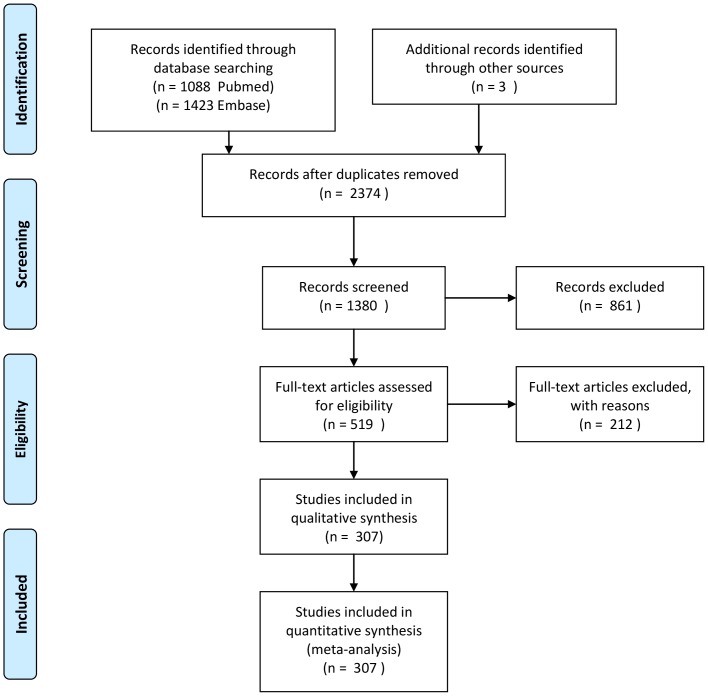
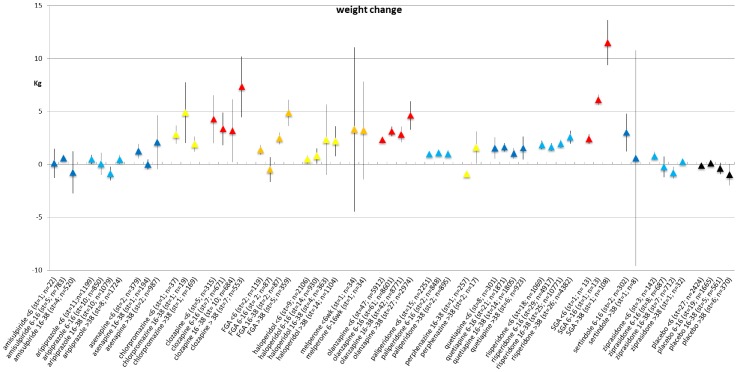
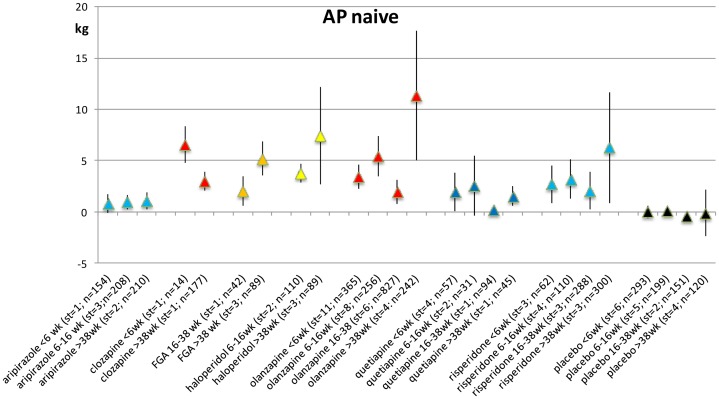
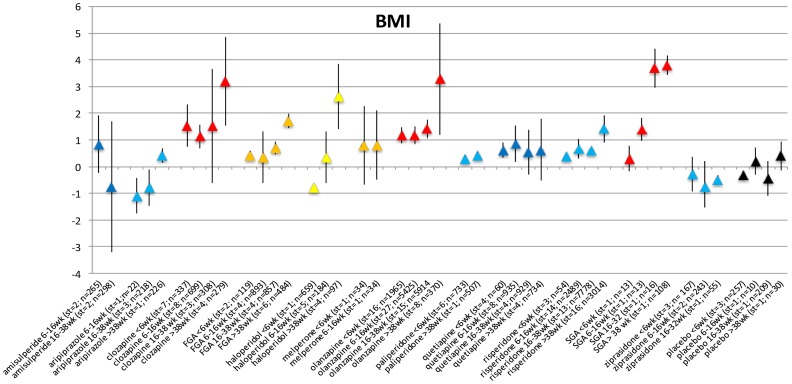
INTRODUCTION: Antipsychotics (AP) induce weight gain. However, reviews and meta-analyses generally are restricted to second generation antipsychotics (SGA) and do not stratify for duration of AP use. It is hypothesised that patients gain more weight if duration of AP use is longer. METHOD: A meta-analysis was conducted of clinical trials of AP that reported weight change. Outcome measures were body weight change, change in BMI and clinically relevant weight change (7% weight gain or loss). Duration of AP-use was stratified as follows: ≤6 weeks, 6-16 weeks, 16-38 weeks and >38 weeks. Forest plots stratified by AP as well as by duration of use were generated and results were summarised in figures. RESULTS: 307 articles met inclusion criteria. The majority were AP switch studies. Almost all AP showed a degree of weight gain after prolonged use, except for amisulpride, aripiprazole and ziprasidone, for which prolonged exposure resulted in negligible weight change. The level of weight gain per AP varied from discrete to severe. Contrary to expectations, switch of AP did not result in weight loss for amisulpride, aripiprazole or ziprasidone. In AP-naive patients, weight gain was much more pronounced for all AP. CONCLUSION: Given prolonged exposure, virtually all AP are associated with weight gain. The rational of switching AP to achieve weight reduction may be overrated. In AP-naive patients, weight gain is more pronounced.
Overview
The claims and statistics of this paper haven’t been checked yet.
Run the check — free, no account needed. It reads the open-access text and checks the sources it cites.
Integrity signals
Registry
Cites
Statistics
Figures
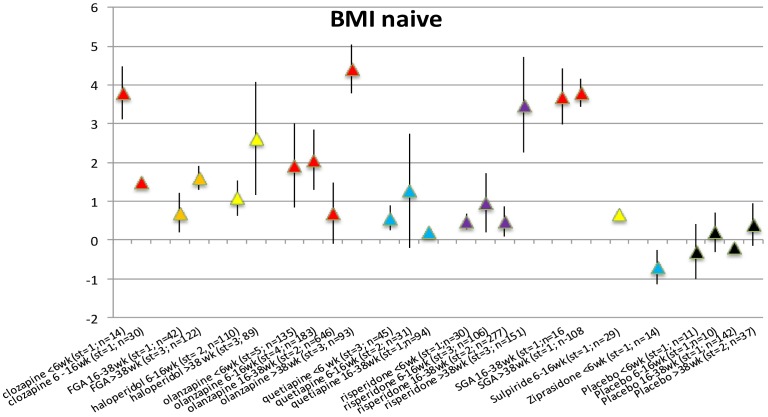
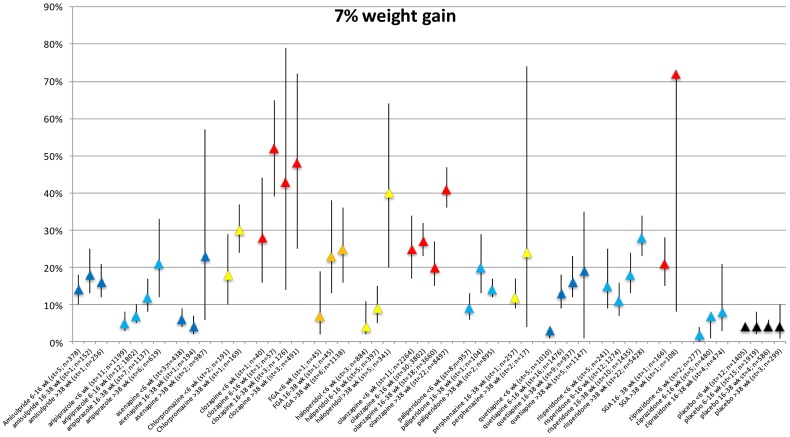
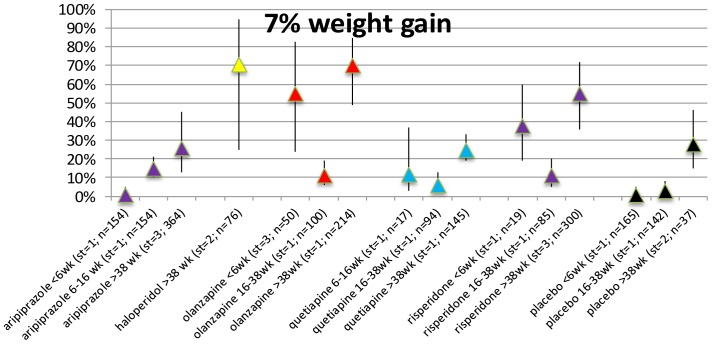
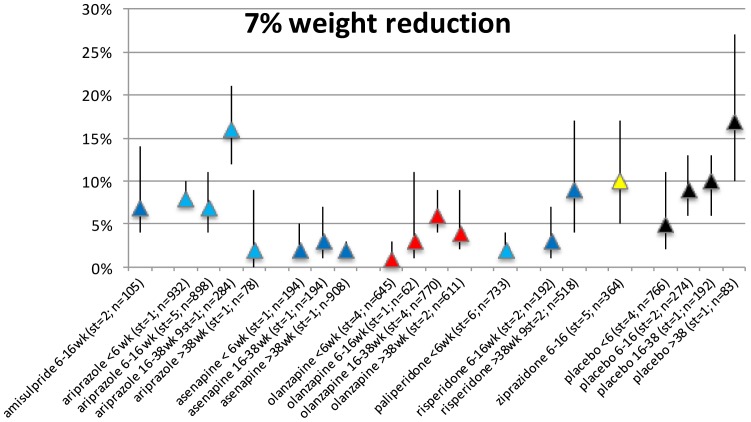
Verification
Claims the paper makes
The claims and statistics of this paper haven’t been checked yet.
Run the check — free, no account needed. It reads the open-access text and checks the sources it cites.
Claims other papers make about this one
Each is checked against this paper’s own text: does it say what the citing paper says it does?
The cited source says what the claim attributes to it.
In the citing paper
“lower BMI has been associated with higher risk of weight gain due to antipsychotics in meta-analyses20 and pooled analyses of brexpiprazole clinical studies.21”
From Brexpiprazole for the maintenance treatment of adults with schizophrenia: an evidence-based review and place in therapy (2019) · cites this paper as [20]
In the citing paper
“Of these risk factors, medication with antipsychotic drugs can be considered partly modifiable, as reducing doses or switching prescriptions only leads to moderate improvement of metabolic risk factors 10,11 .”
Self-check
Percentages, sums and reported differences re-computed from the paper’s own numbers.
The self-check needs the paper’s full text.
Citations
Cites
R: A Language and Environment for Statistical Computing
R Core Team (2000) · doi:10.32614/r.manuals · Cited by 355,893
Meta-analysis of Observational Studies in Epidemiology<SUBTITLE>A Proposal for Reporting</SUBTITLE>
Stroup, D. F. (2000) · JAMA · doi:10.1001/jama.283.15.2008 · Cited by 20,623
Effectiveness of Antipsychotic Drugs in Patients with Chronic Schizophrenia
Lieberman, J. A., Stroup, T. S., McEvoy, J. P., Swartz, M. S., Rosenheck, R. A., Perkins, D. O., Keefe, R. S. E., Davis, S. M., Davis, C. E., Lebowitz, B. D., et al. (2005) · New England Journal of Medicine · doi:10.1056/nejmoa051688 · Cited by 5,892 · cited 1×
“1999 [62–68]; 2000 [69–73]; 2001 [74–90]; 2002 [37,91–106]; 2003 [107–132]; 2004 [133–157]; 2005 [158–191]; 2006 [46,192– 218]; 2007 [219–254]; 2008 [45,49,255–286]; 2009 [287–317]; 2010 [43,318–338]; 2011 [50,339–359]”
Leucht, S., Cipriani, A., Spineli, L., Mavridis, D., Örey, D., Richter, F., Samara, M., Barbui, C., Engel, R. R., Geddes, J. R., et al. (2013) · The Lancet · doi:10.1016/s0140-6736(13)60733-3 · Cited by 2,561
Antipsychotic-induced weight gain: a comprehensive research synthesis
Allison, D. B., Mentore, J. L., Heo, M., Chandler, L. P., Cappelleri, J. C., Infante, M. C., & Weiden, P. J. (1999) · American Journal of Psychiatry · doi:10.1176/ajp.156.11.1686 · Cited by 2,382 · cited 6×
“In addition, Allison [19] suggested to study clinically significant weight gain and weight loss and provided a definition.”
BackgroundMethodResultInfluentialSaha, S., Chant, D., & McGrath, J. (2007) · Archives of General Psychiatry · doi:10.1001/archpsyc.64.10.1123 · Cited by 2,065 · cited 1×
“Compared to the general population, the risk of developing cardiovascular illness is doubled and more than five times higher for endocrine disease [12,14].”
BackgroundTiihonen, J., Lönnqvist, J., Wahlbeck, K., Klaukka, T., Niskanen, L., Tanskanen, A., & Haukka, J. (2009) · The Lancet · doi:10.1016/s0140-6736(09)60742-x · Cited by 1,354
Effectiveness of Atypical Antipsychotic Drugs in Patients with Alzheimer's Disease
Schneider, L. S., Tariot, P. N., Dagerman, K. S., Davis, S. M., Hsiao, J. K., Ismail, M. S., Lebowitz, B. D., Lyketsos, C. G., Ryan, J. M., Stroup, T. S., et al. (2006) · New England Journal of Medicine · doi:10.1056/nejmoa061240 · Cited by 1,206
Metabolic and cardiovascular adverse effects associated with antipsychotic drugs.
De Hert, M., Detraux, J., van Winkel, R., Yu, W., & Correll, C. U. (2012) · Nature Reviews Endocrinology · doi:10.1038/nrendo.2011.156 · Cited by 1,145 · cited 1×
“Indeed some reviews address this issue although restricted to only schizophrenia and bipolar disorder [27,61].”
BackgroundExcess Mortality in Bipolar and Unipolar Disorder in Sweden
Ösby, U., Brandt, L., Correia, N., Ekbom, A., & Sparén, P. (2001) · Archives of General Psychiatry · doi:10.1001/archpsyc.58.9.844 · Cited by 1,120 · cited 1×
“6 in women [15].”
Research works printed but not linked: 1
- P Chue, 2005, Study of long-term quetiapine treatment, The journal of applied research, 5, 246
Cited by
Sorted by citations
Hampl, S. E., Hassink, S. G., Skinner, A. C., Armstrong, S. C., Barlow, S. E., Bolling, C. F., Avila Edwards, K. C., Eneli, I., Hamre, R., Joseph, M. M., et al. (2023) · Pediatrics · doi:10.1542/peds.2022-060640 · Cited by 1,389
Styne, D. M., Arslanian, S. A., Connor, E. L., Farooqi, I. S., Murad, M. H., Silverstein, J. H., & Yanovski, J. A. (2017) · The Journal of Clinical Endocrinology & Metabolism · doi:10.1210/jc.2016-2573 · Cited by 1,375
“Furthermore, clinicians should obtain a history of second-generation antipsychotics use, such as clozapine, risperidone, olan-zapine, and quetiapine, because of their association with weight gain (52, 53).”
Galletly, C., Castle, D., Dark, F., Humberstone, V., Jablensky, A., Killackey, E., Kulkarni, J., McGorry, P., Nielssen, O., & Tran, N. (2016) · Australian & New Zealand Journal of Psychiatry · doi:10.1177/0004867416641195 · Cited by 877
“Where possible, medicines with the least risk of weight gain should be selected (Bak et al., 2014).”
BackgroundCorrell, C. U., Detraux, J., De Lepeleire, J., & De Hert, M. (2015) · World Psychiatry · doi:10.1002/wps.20204 · Cited by 820
Antipsychotic medication in schizophrenia: a review
Lally, J., & MacCabe, J. H. (2015) · British Medical Bulletin · doi:10.1093/bmb/ldv017 · Cited by 560
“The most dramatic weight gain is seen in antipsychotic naïve patients over the first 6 weeks of treatment and for the majority, those with initial weight gain did not lose that weight thereafter, even after switching to more weight-neutral antipsychotics.(14) SGAs such as aripiprazole, lurasidone and asenapine have a…”
Background
Metadata
- Authors
- Bak, M., Fransen, A., Janssen, J., van Os, J., & Drukker, M.
- Affiliations
- Maastricht University Medical Centre (NL)
- Máxima Medisch Centrum (NL)
- Corresponding author
- Bak, Maarten
- Venue
- PLoS ONE
- Publisher
- Public Library of Science (PLoS)
- Published
- 2014-04-24
- Volume
- 9
- Issue
- 4
- Pages
- e94112
- ISSN
- 1932-6203 (ISSN-L)
- PMC
- PMC3998960
- OpenAlex
- W2089001223
- Cited by
- 490
- References
- 362
- Citations by year
- 2026: 17 · 2025: 31 · 2024: 39 · 2023: 42 · 2022: 47 · 2021: 48 · 2020: 45 · 2019: 55 · 2018: 50 · 2017: 43 · 2016: 39 · 2015: 28 · 2014: 5
- FWCI
- 5.28
- Type
- journal article
- Language
- en
- Open access
- gold
- doi.org
- Locations
- PLoS ONE (publishedVersion, cc-by)
- Europe PMC (PubMed Central) (publishedVersion, other-oa)
- PubMed Central (publishedVersion, cc-by)
- PubMed (publishedVersion)
- Research Publications (Maastricht University) (publishedVersion, cc-by)
- RePEc: Research Papers in Economics (submittedVersion)
- DOAJ (DOAJ: Directory of Open Access Journals) (submittedVersion, cc-by-sa)
- Figshare (submittedVersion, cc-by)
- NORA - Norwegian Open Research Archives (submittedVersion, cc-by)
- Research Publications (Maastricht University) (submittedVersion, other-oa)
- Topics
- Health Sciences › Medicine › Psychiatry and Mental health › Schizophrenia research and treatment
- Health Sciences › Medicine › Pharmacology (medical) › Pharmacology and Obesity Treatment
- Social Sciences › Psychology › Clinical Psychology › Eating Disorders and Behaviors
- Keywords
- antipsychotic drugs, weight gain, body mass index, antipsychotic switching, amisulpride, aripiprazole, ziprasidone, antipsychotic-naive patients, weight loss
- MeSH terms
- Bipolar Disorder, Humans, Schizophrenia, Antipsychotic Agents, Weight Gain, Body Mass Index, Overweight
About these checks
Registry, retraction, Cites and statistics results are computed, not judged, with one exception: a printed reference that no index lists is read once by a model before it counts as a citation error. Claims are extracted by a model and kept only when their quote appears verbatim in the text; each cited source is then checked, with a model’s help, for whether it says what the claim relies on. Those verdicts can be wrong — read the claim’s quote and the cited source before relying on one.
Statistics and arithmetic are recomputed, not judged.
Confidence bands are shown only for fields calibrated on our annotated test set. None is calibrated yet, so no band is shown.
What counts as a claim ›How we measure confidence ›How we check this ›
Are you an author, or do you see a problem with this page? Request a review
