

No Sustained Attention Differences in a Longitudinal Randomized Trial Comparing Mindfulness Based Stress Reduction versus Active Control
Open accessPublished version of a preprint
The DOI matches its Crossref record; 30 of the 30 references it cites were found in a registry or an index.
Abstract
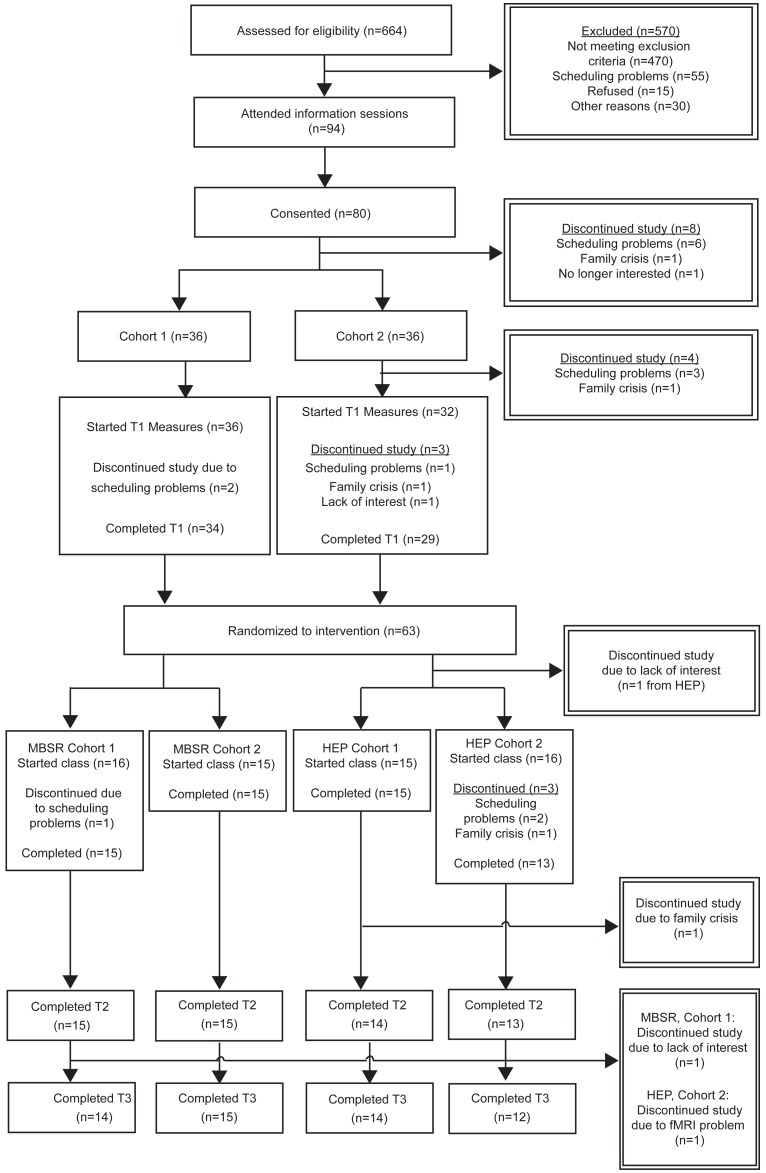
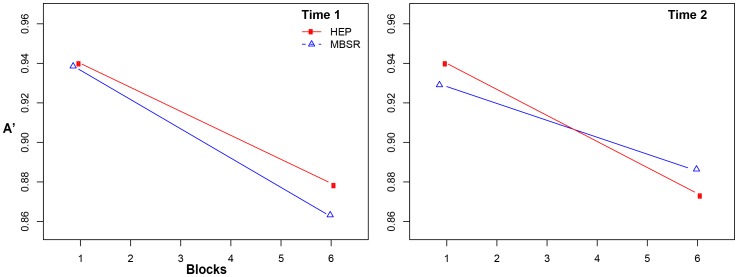
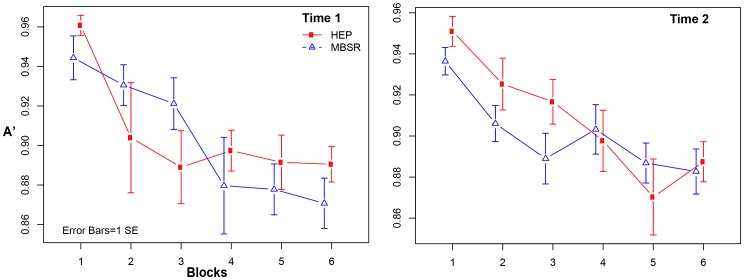
BACKGROUND: Mindfulness Based Stress Reduction (MBSR) is a secular form of meditation training. The vast majority of the extant literature investigating the health effects of mindfulness interventions relies on wait-list control comparisons. Previous studies have found that meditation training over several months is associated with improvements in cognitive control and attention. METHODOLOGY/PRINCIPAL FINDINGS: We used a visual continuous performance task (CPT) to test the effects of eight weeks of mindfulness training on sustained attention by comparing MBSR to the Health Enhancement Program (HEP), a structurally equivalent, active control condition in a randomized, longitudinal design (ClinicalTrials.gov, NCT01301105) focusing on a non-clinical population typical of MBSR participants. Researchers were blind to group assignment. 63 community participants were randomized to either MBSR (n = 31) or HEP (n = 32). CPT analyses were conducted on 29 MBSR participants and 25 HEP participants. We predicted that MBSR would improve visual discrimination ability and sustained attention over time on the CPT compared to HEP, with more home practice associated with greater improvements. Our hypotheses were not confirmed but we did find some evidence for improved visual discrimination similar to effects in partial replication of other research. Our study had sufficient power to demonstrate that intervention groups do not differ in their improvement over time in sustained attention performance. One of our primary predictions concerning the effects of intervention on attentional fatigue was significant but not interpretable. CONCLUSIONS: Attentional sensitivity is not affected by mindfulness practice as taught in MBSR, but it is unclear whether mindfulness might positively affect another aspect of attention, vigilance. These results also highlight the relevant procedural modifications required by future research to correctly investigate the role of sustained attention in similar samples. TRIAL REGISTRATION: ClinicalTrials.gov, NCT01301105.
Overview
The claims and statistics of this paper haven’t been checked yet.
Free: it reads the open-access text and checks the first 5 claims that cite a source we can check. Create a free account to check every claim.
Integrity signals
Registry
Cites
Statistics
Figures
Verification
Claims the paper makes
The claims and statistics of this paper haven’t been checked yet.
Free: it reads the open-access text and checks the first 5 claims that cite a source we can check. Create a free account to check every claim.
Claims other papers make about this one
Each is checked against this paper’s own text: does it say what the citing paper says it does?
The source backs part of the claim, not all of it — or backs it for a different population, condition or comparison.
In the citing paper
“Although the HEP and mindfulness conditions were effective at improving mood, stress, and cognition, they did not significantly differ.”
From The neural mechanisms of mindfulness-based pain relief: a functional magnetic resonance imaging-based review and primer (2019) · cites this paper as [75]
Experimental — accuracy not yet measuredIn the citing paper
“Although the HEP and MBSR program were effective at reducing self-reports of anxiety, distress, hostility,139 and attentional stability,140 there were no significant differences between groups.”
From Mindfulness meditation-based pain relief: a mechanistic account (2016) · cites this paper as [140]
Self-check
Percentages, sums and reported differences re-computed from the paper’s own numbers.
The self-check needs the paper’s full text.
Citations
Cites
(2008) · Medical Entomology and Zoology · Cited by 7,477
HASKELL, W. L., LEE, I.-M., PATE, R. R., POWELL, K. E., BLAIR, S. N., FRANKLIN, B. A., MACERA, C. A., HEATH, G. W., THOMPSON, P. D., & BAUMAN, A. (2007) · Medicine & Science in Sports & Exercise · doi:10.1249/mss.0b013e3180616b27 · Cited by 4,616
Kabat-Zinn, J. (1982) · General Hospital Psychiatry · doi:10.1016/0163-8343(82)90026-3 · Cited by 4,255
Shapiro, S. L., Carlson, L. E., Astin, J. A., & Freedman, B. (2006) · Journal of Clinical Psychology · doi:10.1002/jclp.20237 · Cited by 4,002 · cited 1×
“Reflecting a trend toward more detailed and mechanistic accounts of MBSR – and meditation training more generally – some authors have more rigorously explicated each of these latter three components [6].”
Background(2005) · Medical Entomology and Zoology · Cited by 3,197
Wherever you go, there you are: Mindfulness meditation in everyday life
Kwee, M. (1995) · Behaviour Research and Therapy · doi:10.1016/0005-7967(95)90133-7 · Cited by 2,896
Calculation of signal detection theory measures
Stanislaw, H., & Todorov, N. (1999) · Behavior Research Methods, Instruments, & Computers · doi:10.3758/bf03207704 · Cited by 2,673 · cited 2×
“A9 is a nonparametric version of D9, an index of perceptual sensitivity [18] in which a score of 1 represents perfect discrimination between targets and distractors, .”
BackgroundMethodAttention regulation and monitoring in meditation
Lutz, A., Slagter, H. A., Dunne, J. D., & Davidson, R. J. (2008) · Trends in Cognitive Sciences · doi:10.1016/j.tics.2008.01.005 · Cited by 2,659
Self-citationLr, D., & Derogatis, L. R. (1983) · Medical Entomology and Zoology · Cited by 2,027
Mindfulness training modifies subsystems of attention
JHA, A. P., KROMPINGER, J., & BAIME, M. J. (2007) · Cognitive, Affective, & Behavioral Neuroscience · doi:10.3758/cabn.7.2.109 · Cited by 1,580 · cited 2×
“Whereas [27] reported an effect of MBSR on vigilance, the two studies quoted above, found rather an effect of MBSR on selective attention [23,25].”
BackgroundResult
Research works printed but not linked: 1
- J Kabat-Zinn, 1984, An outpatient program in behavioral medicine for chronic pain patients based on the practice of mindfulness meditation: Theoretical considerations and preliminary results, ReVISION, 7, 71
Cited by
The Neuroscience of Mindfulness Meditation
Tang, Y.-Y., Hölzel, B. K., & Posner, M. I. (2015) · Nature reviews. Neuroscience · doi:10.1038/nrn3916 · Cited by 2,889
Diamond, A., & Ling, D. S. (2019) · Cognitive and Working Memory Training · doi:10.1093/oso/9780199974467.003.0008 · Cited by 247
Galante, J., Friedrich, C., Dawson, A. F., Modrego-Alarcón, M., Gebbing, P., Delgado-Suárez, I., Gupta, R., Dean, L., Dalgleish, T., White, I. R., et al. (2021) · PLOS Medicine · doi:10.1371/journal.pmed.1003481 · Cited by 319
Recent theoretical, neural, and clinical advances in sustained attention research
Fortenbaugh, F. C., DeGutis, J., & Esterman, M. (2017) · Annals of the New York Academy of Sciences · doi:10.1111/nyas.13318 · Cited by 271
Mindfulness meditation-based pain relief: a mechanistic account
Zeidan, F., & Vago, D. R. (2016) · Annals of the New York Academy of Sciences · doi:10.1111/nyas.13153 · Cited by 300
Metadata
- Authors
- MacCoon, D. G., MacLean, K. A., Davidson, R. J., Saron, C. D., & Lutz, A.
- Affiliations
- University of Wisconsin–Madison (US)
- Johns Hopkins University (US)
- University of California, Davis (US)
- Corresponding author
- MacCoon, Donal G.
- Venue
- PLoS ONE
- Publisher
- Public Library of Science (PLoS)
- Published
- 2014-06-23
- Volume
- 9
- Issue
- 6
- Pages
- e97551
- ISSN
- 1932-6203 (ISSN-L)
- PMC
- PMC4067292
- OpenAlex
- W2089855130
- Cited by
- 100
- References
- 30
- Citations by year
- 2026: 1 · 2025: 8 · 2024: 5 · 2023: 3 · 2022: 4 · 2021: 9 · 2020: 17 · 2019: 13 · 2018: 11 · 2017: 10 · 2016: 11 · 2015: 8
- FWCI
- 11.35
- Type
- journal article
- Language
- en
- Open access
- gold
- doi.org
- Locations
- PLoS ONE (publishedVersion, cc-by)
- PubMed Central (publishedVersion, cc-by)
- PubMed (publishedVersion)
- DOAJ (DOAJ: Directory of Open Access Journals) (submittedVersion, cc-by-sa)
- MindRxiv (OSF Preprints) (submittedVersion)
- MindRxiv (OSF Preprints) (submittedVersion, cc-by)
- Funders
- Fetzer Institute
- Curtin University of Technology
- National Institutes of Health (5u01at002114-03)
- National Institute of Mental Health (P50-MH069315-03, P50MH069315, MH069315)
- National Center for Complementary and Alternative Medicine (U01AT002114-01A1)
- National Center for Complementary and Integrative Health (U01-AT002114, P01AT004952, U01AT002114-01A1)
- Eunice Kennedy Shriver National Institute of Child Health and Human Development (P30HD003352)
- FP7 People: Marie-Curie Actions
- Topics
- Social Sciences › Psychology › Clinical Psychology › Mindfulness and Compassion Interventions
- Life Sciences › Neuroscience › Cognitive Neuroscience › Mind wandering and attention
- Social Sciences › Psychology › Experimental and Cognitive Psychology › Cognitive Functions and Memory
- Keywords
- mindfulness-based stress reduction, sustained attention, mindfulness meditation, continuous performance test, visual discrimination, attentional fatigue, active control, home practice, cognitive control, non-clinical population
- MeSH terms
- Adult, Arousal, Attention, Discrimination, Psychological, Female, Health Promotion, Humans, Longitudinal Studies, Male, Middle Aged, Models, Biological, Stress, Psychological, Time Factors, Young Adult, Mindfulness
About these checks
Registry, retraction, Cites and statistics results are computed, not judged, with one exception: a printed reference that no index lists is read once by a model before it counts as a citation error. Claims are extracted by a model and kept only when their quote appears verbatim in the text; each cited source is then checked, with a model’s help, for whether it says what the claim relies on. Those verdicts can be wrong — read the claim’s quote and the cited source before relying on one.
Statistics and arithmetic are recomputed, not judged.
Confidence bands are shown only for fields calibrated on our annotated test set. None is calibrated yet, so no band is shown.
What counts as a claim ›How we measure confidence ›How we check this ›
Are you an author, or do you see a problem with this page? Request a review
How to cite
Cite CoChat for the checks on this page, and the paper for its own findings.
- This page
- CoChat. (2026). Citation check: No Sustained Attention Differences in a Longitudinal Randomized Trial Comparing Mindfulness Based Stress Reduction versus Active Control. https://app.cochat.ai/papers/10.1371/journal.pone.0097551
- The paper
- MacCoon, D. G., MacLean, K. A., Davidson, R. J., Saron, C. D., & Lutz, A. (2014). No Sustained Attention Differences in a Longitudinal Randomized Trial Comparing Mindfulness Based Stress Reduction versus Active Control. PLoS ONE. https://doi.org/10.1371/journal.pone.0097551
Data sources
Bibliographic data: Semantic Scholar, OpenAlex, Crossref.
Contains information from the Semantic Scholar Academic Graph Datasets, made available under the ODC Attribution License (ODC-BY 1.0).
Semantic Scholar’s data is described in: Kinney, R., et al. (2023). The Semantic Scholar Open Data Platform. arXiv:2301.10140.
