

The DOI matches its Crossref record; 68 of the 69 references it cites were found in a registry or an index.
The Need for Randomization in Animal Trials: An Overview of Systematic Reviews
Open accessAbstract
BACKGROUND AND OBJECTIVES: Randomization, allocation concealment, and blind outcome assessment have been shown to reduce bias in human studies. Authors from the Collaborative Approach to Meta Analysis and Review of Animal Data from Experimental Studies (CAMARADES) collaboration recently found that these features protect against bias in animal stroke studies. We extended the scope the work from CAMARADES to include investigations of treatments for any condition. METHODS: We conducted an overview of systematic reviews. We searched Medline and Embase for systematic reviews of animal studies testing any intervention (against any control) and we included any disease area and outcome. We included reviews comparing randomized versus not randomized (but otherwise controlled), concealed versus unconcealed treatment allocation, or blinded versus unblinded outcome assessment. RESULTS: Thirty-one systematic reviews met our inclusion criteria: 20 investigated treatments for experimental stroke, 4 reviews investigated treatments for spinal cord diseases, while 1 review each investigated treatments for bone cancer, intracerebral hemorrhage, glioma, multiple sclerosis, Parkinson's disease, and treatments used in emergency medicine. In our sample 29% of studies reported randomization, 15% of studies reported allocation concealment, and 35% of studies reported blinded outcome assessment. We pooled the results in a meta-analysis, and in our primary analysis found that failure to randomize significantly increased effect sizes, whereas allocation concealment and blinding did not. In our secondary analyses we found that randomization, allocation concealment, and blinding reduced effect sizes, especially where outcomes were subjective. CONCLUSIONS: Our study demonstrates the need for randomization, allocation concealment, and blind outcome assessment in animal research across a wide range of outcomes and disease areas. Since human studies are often justified based on results from animal studies, our results suggest that unduly biased animal studies should not be allowed to constitute part of the rationale for human trials.
Overview
The claims and statistics of this paper haven’t been checked yet.
Run the check — free, no account needed. It reads the open-access text and checks the sources it cites.
Integrity signals
Registry
Cites
Statistics
Figures
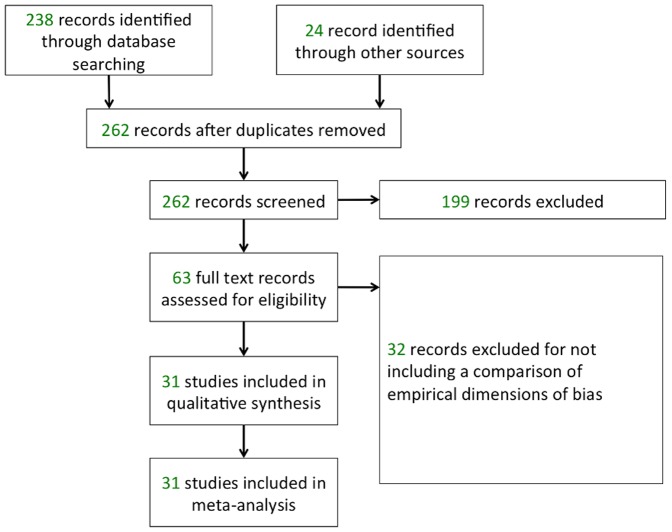
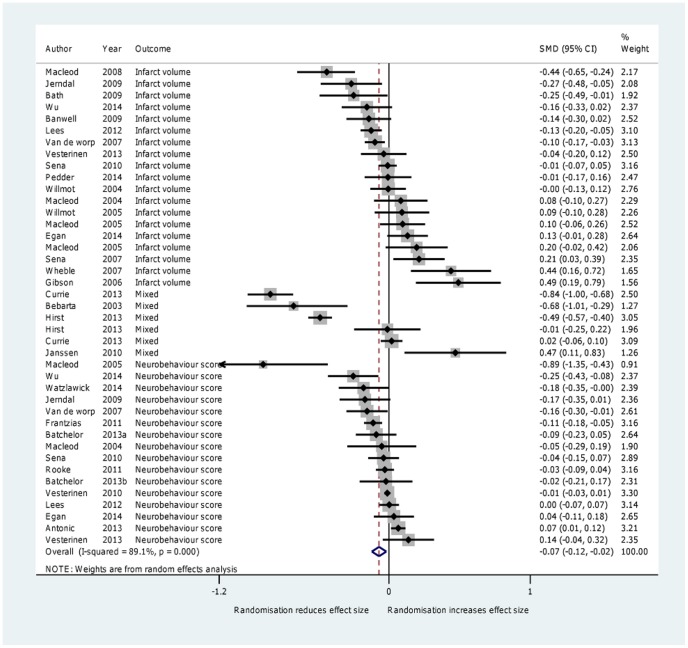
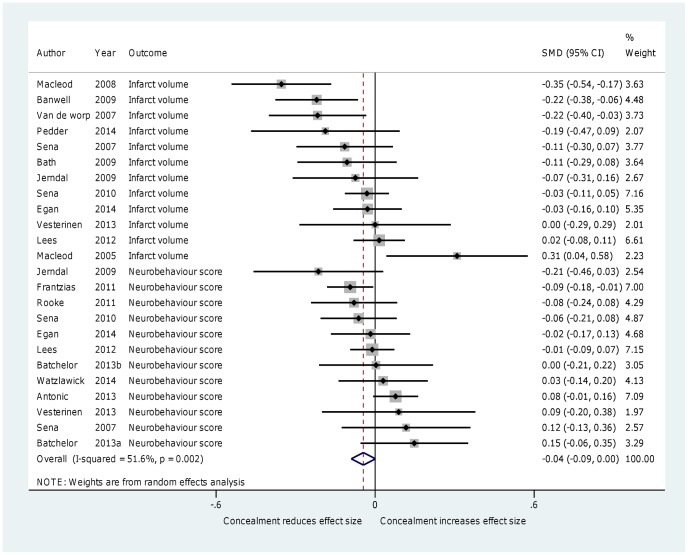
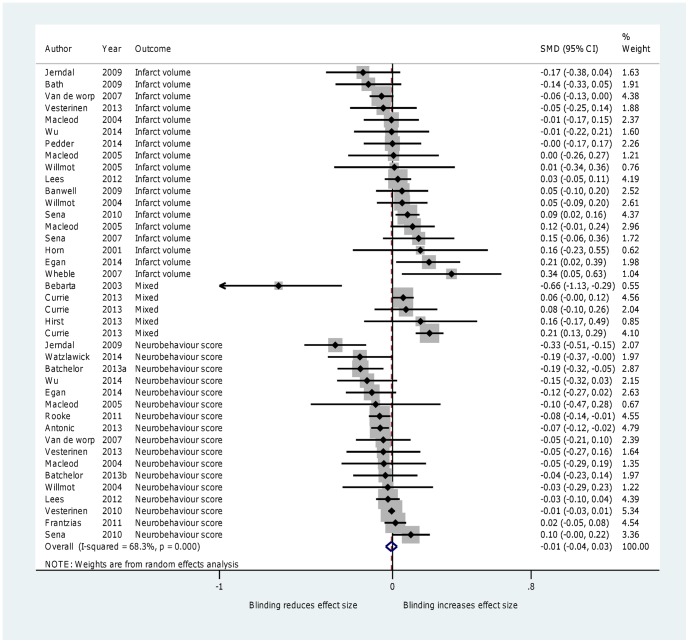
Verification
Claims the paper makes
The claims and statistics of this paper haven’t been checked yet.
Run the check — free, no account needed. It reads the open-access text and checks the sources it cites.
Claims other papers make about this one
Each is checked against this paper’s own text: does it say what the citing paper says it does?
The source backs part of the claim, not all of it — or backs it for a different population, condition or comparison.
In the citing paper
“There are, however, compelling data from systematic reviews showing that nonblinded outcome assessment leads to the treatment effects being overestimated, and the lack of bias-reducing measures such as randomisation and blinding can contribute to as much as 30%–45% inflation of effect sizes [67,68,85].”
From Reporting animal research: Explanation and elaboration for the ARRIVE guidelines 2.0 (2020) · cites this paper as [67]
Experimental — accuracy not yet measuredThe source backs part of the claim, not all of it — or backs it for a different population, condition or comparison.
In the citing paper
“Systematic reviews have shown that animal experiments that do not report randomisation or other bias-reducing measures such as blinding are more likely to report exaggerated effects that meet conventional measures of statistical significance [67–69].”
From Reporting animal research: Explanation and elaboration for the ARRIVE guidelines 2.0 (2020) · cites this paper as [67]
Experimental — accuracy not yet measured
Self-check
Percentages, sums and reported differences re-computed from the paper’s own numbers.
The self-check needs the paper’s full text.
Citations
Cites
Meta-analysis in clinical trials
DerSimonian, R., & Laird, N. (1986) · Controlled Clinical Trials · doi:10.1016/0197-2456(86)90046-2 · Cited by 39,552
Cochrane Handbook for Systematic Reviews of Interventions: Cochrane Book Series
(2008) · doi:10.1002/9780470712184 · Cited by 25,048
Improving bioscience research reporting: The ARRIVE guidelines for reporting animal research
Kilkenny, C., Browne, W. J., Cuthill, I. C., Emerson, M., & Altman, D. G. (2010) · Journal of Pharmacology and Pharmacotherapeutics · doi:10.4103/0976-500x.72351 · Cited by 6,277
Schulz (1995) · doi:10.1001/jama.1995.03520290060030 · Cited by 5,634
Assessing the quality of controlled clinical trials
Jüni, P., Altman, D. G., & Egger, M. (2001) · BMJ · doi:10.1136/bmj.323.7303.42 · Cited by 3,309 · cited 1×
“[6] This is because concealed random allocation reduces selection bias and blinding outcome assessors reduces detection bias.”
BackgroundVitamin E Supplementation and Cardiovascular Events in High-Risk Patients
(2000) · New England Journal of Medicine · doi:10.1056/nejm200001203420302 · Cited by 1,957
Sex bias in neuroscience and biomedical research
Beery, A. K., & Zucker, I. (2011) · Neuroscience & Biobehavioral Reviews · doi:10.1016/j.neubiorev.2010.07.002 · Cited by 1,763
Decousus, H., Leizorovicz, A., Parent, F., Page, Y., Tardy, B., Girard, P., Laporte, S., Faivre, R., Charbonnier, B., Barral, F.-G., et al. (1998) · New England Journal of Medicine · doi:10.1056/nejm199802123380701 · Cited by 1,702
Rules of Evidence and Clinical Recommendations on the Use of Antithrombotic Agents
Sackett, D. L. (1989) · CHEST Journal · doi:10.1378/chest.95.2_supplement.2s · Cited by 1,369
A call for transparent reporting to optimize the predictive value of preclinical research
Landis, S. C., Amara, S. G., Asadullah, K., Austin, C. P., Blumenstein, R., Bradley, E. W., Crystal, R. G., Darnell, R. B., Ferrante, R. J., Fillit, H., et al. (2012) · Nature · doi:10.1038/nature11556 · Cited by 1,196
Cited by
Sorted by citations
Reporting animal research: Explanation and elaboration for the ARRIVE guidelines 2.0
Percie du Sert, N., Ahluwalia, A., Alam, S., Avey, M. T., Baker, M., Browne, W. J., Clark, A., Cuthill, I. C., Dirnagl, U., Emerson, M., et al. (2020) · PLOS Biology · doi:10.1371/journal.pbio.3000411 · Cited by 2,677
“There are, however, compelling data from systematic reviews showing that nonblinded outcome assessment leads to the treatment effects being overestimated, and the lack of bias-reducing measures such as randomisation and blinding can contribute to as much as 30%–45% inflation of effect sizes [67,68,85].”
BackgroundThe Mass Production of Redundant, Misleading, and Conflicted Systematic Reviews and Meta‐analyses
IOANNIDIS, J. P. A. (2016) · The Milbank Quarterly · doi:10.1111/1468-0009.12210 · Cited by 1,483
Methods Used to Evaluate Pain Behaviors in Rodents
Deuis, J. R., Dvorakova, L. S., & Vetter, I. (2017) · Frontiers in Molecular Neuroscience · doi:10.3389/fnmol.2017.00284 · Cited by 1,269
Reporting animal research: Explanation and Elaboration for the ARRIVE guidelines 2019Preprint
du Sert, N. P., Ahluwalia, A., Alam, S., Avey, M. T., Baker, M., Browne, W. J., Clark, A., Cuthill, I. C., Dirnagl, U., Emerson, M., et al. (2019) · bioRxiv (Cold Spring Harbor Laboratory) · doi:10.1101/703355 · Cited by 557
Increasing value and reducing waste in biomedical research: who's listening?
Moher, D., Glasziou, P., Chalmers, I., Nasser, M., Bossuyt, P. M. M., Korevaar, D. A., Graham, I. D., Ravaud, P., & Boutron, I. (2016) · The Lancet · doi:10.1016/s0140-6736(15)00307-4 · Cited by 462
Metadata
- Authors
- Hirst, J. A., Howick, J., Aronson, J. K., Roberts, N., Perera, R., Koshiaris, C., & Heneghan, C.
- Affiliations
- University of Oxford (GB)
- Corresponding author
- Hirst, Jennifer A.
- Howick, Jeremy
- ORCID
- Venue
- PLoS ONE
- Publisher
- Public Library of Science (PLoS)
- Published
- 2014-06-06
- Volume
- 9
- Issue
- 6
- Pages
- e98856
- ISSN
- 1932-6203 (ISSN-L)
- PMC
- PMC4048216
- OpenAlex
- W2037669635
- Cited by
- 294
- References
- 69
- Citations by year
- 2026: 18 · 2025: 25 · 2024: 20 · 2023: 25 · 2022: 28 · 2021: 38 · 2020: 30 · 2019: 21 · 2018: 20 · 2017: 19 · 2016: 32 · 2015: 16 · 2014: 1
- FWCI
- 6.20
- Type
- journal article
- Language
- en
- Open access
- gold
- doi.org
- Locations
- PLoS ONE (publishedVersion, cc-by)
- PubMed Central (publishedVersion, cc-by)
- PubMed (publishedVersion)
- RePEc: Research Papers in Economics (submittedVersion)
- DOAJ (DOAJ: Directory of Open Access Journals) (submittedVersion, cc-by-sa)
- Figshare (submittedVersion, cc-by)
- Funders
- National Institute for Health and Care Research
- Topics
- Social Sciences › Decision Sciences › Statistics, Probability and Uncertainty › Meta-analysis and systematic reviews
- Health Sciences › Veterinary › Small Animals › Animal testing and alternatives
- Physical Sciences › Mathematics › Statistics and Probability › Statistical Methods in Clinical Trials
- Keywords
- randomization, allocation concealment, blinding, animal models, effect size
- MeSH terms
- Animals, Research Design, Review Literature as Topic, Bias, Animal Experimentation
About these checks
Registry, retraction, Cites and statistics results are computed, not judged, with one exception: a printed reference that no index lists is read once by a model before it counts as a citation error. Claims are extracted by a model and kept only when their quote appears verbatim in the text; each cited source is then checked, with a model’s help, for whether it says what the claim relies on. Those verdicts can be wrong — read the claim’s quote and the cited source before relying on one.
Statistics and arithmetic are recomputed, not judged.
Confidence bands are shown only for fields calibrated on our annotated test set. None is calibrated yet, so no band is shown.
What counts as a claim ›How we measure confidence ›How we check this ›
Are you an author, or do you see a problem with this page? Request a review
