

The DOI matches its Crossref record; 30 of the 30 references it cites were found in a registry or an index.
Quantitative Computed Tomographic Descriptors Associate Tumor Shape Complexity and Intratumor Heterogeneity with Prognosis in Lung Adenocarcinoma
Open accessAbstract
Two CT features were developed to quantitatively describe lung adenocarcinomas by scoring tumor shape complexity (feature 1: convexity) and intratumor density variation (feature 2: entropy ratio) in routinely obtained diagnostic CT scans. The developed quantitative features were analyzed in two independent cohorts (cohort 1: n = 61; cohort 2: n = 47) of patients diagnosed with primary lung adenocarcinoma, retrospectively curated to include imaging and clinical data. Preoperative chest CTs were segmented semi-automatically. Segmented tumor regions were further subdivided into core and boundary sub-regions, to quantify intensity variations across the tumor. Reproducibility of the features was evaluated in an independent test-retest dataset of 32 patients. The proposed metrics showed high degree of reproducibility in a repeated experiment (concordance, CCC≥0.897; dynamic range, DR≥0.92). Association with overall survival was evaluated by Cox proportional hazard regression, Kaplan-Meier survival curves, and the log-rank test. Both features were associated with overall survival (convexity: p = 0.008; entropy ratio: p = 0.04) in Cohort 1 but not in Cohort 2 (convexity: p = 0.7; entropy ratio: p = 0.8). In both cohorts, these features were found to be descriptive and demonstrated the link between imaging characteristics and patient survival in lung adenocarcinoma.
Overview
The claims and statistics of this paper haven’t been checked yet.
Run the check — free, no account needed. It reads the open-access text and checks the sources it cites.
Integrity signals
Registry
Cites
Statistics
Figures
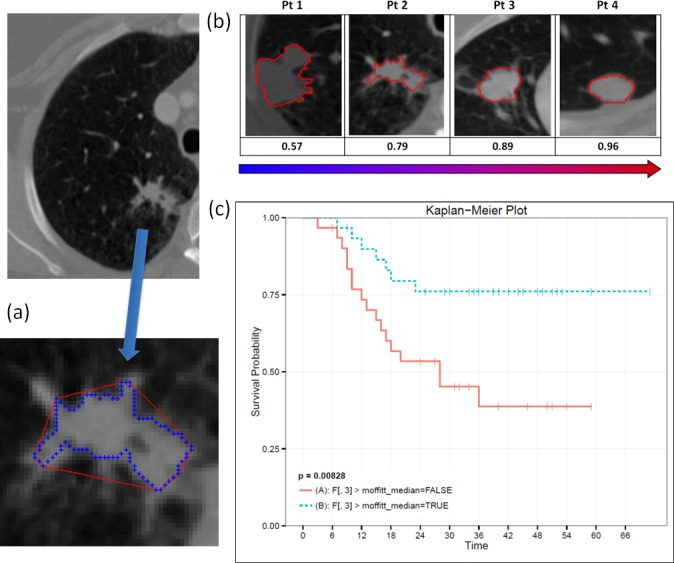
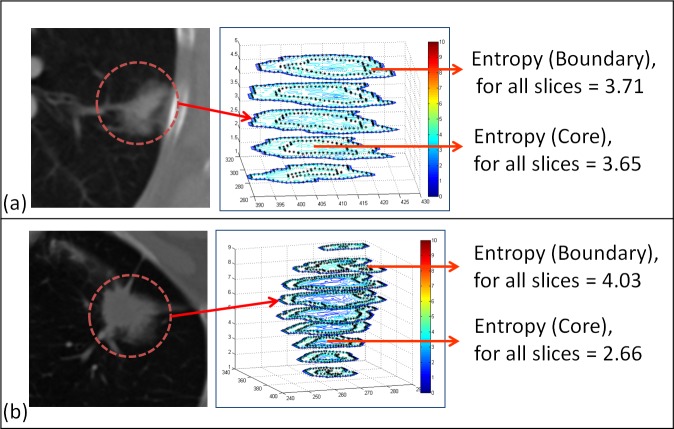
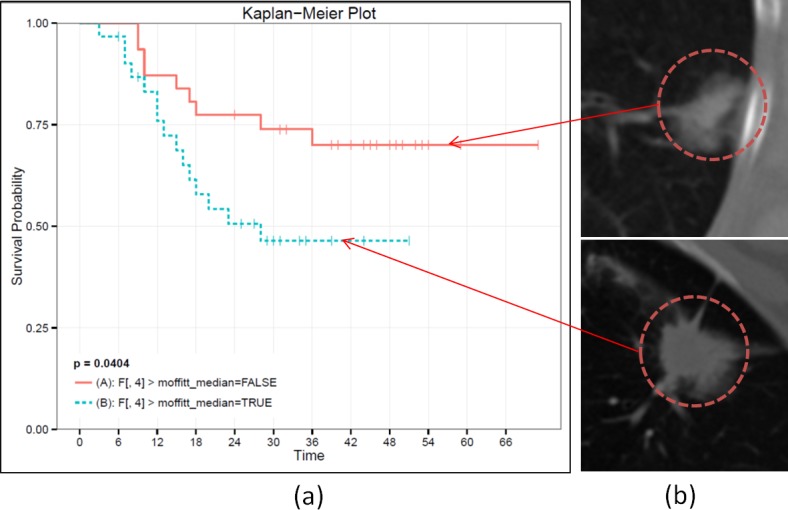
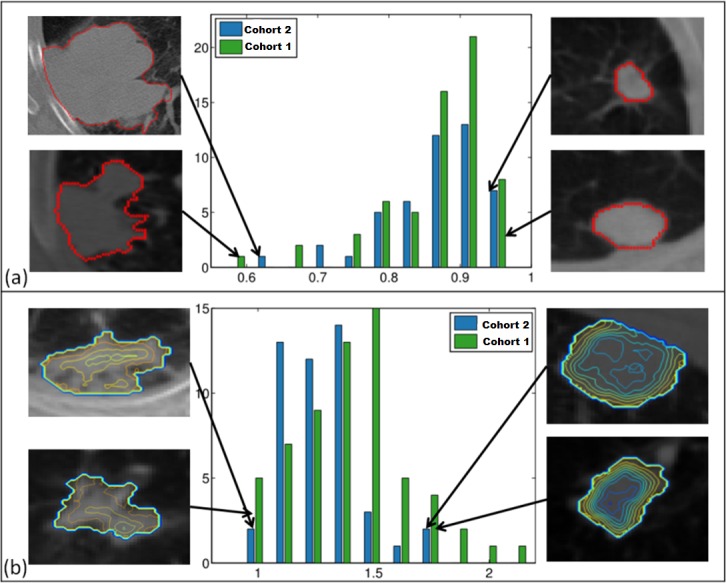
Verification
Claims the paper makes
The claims and statistics of this paper haven’t been checked yet.
Run the check — free, no account needed. It reads the open-access text and checks the sources it cites.
Claims other papers make about this one
Each is checked against this paper’s own text: does it say what the citing paper says it does?
In the citing paper
“Grove et al found these measures to be strong prognostic indicators in patients with early-stage lung cancer (P < .01) (56).”
From Radiomics: Images Are More than Pictures, They Are Data (2016) · cites this paper as [56]
Self-check
Percentages, sums and reported differences re-computed from the paper’s own numbers.
The self-check needs the paper’s full text.
Citations
Cites
Siegel, R., Naishadham, D., & Jemal, A. (2013) · CA A Cancer Journal for Clinicians · doi:10.3322/caac.21166 · Cited by 11,825
A concordance correlation coefficient to evaluate reproducibility.
Lin, L. I.-K. (1989) · Biometrics · doi:10.2307/2532051 · Cited by 8,785
Radiomics: extracting more information from medical images using advanced feature analysis
Lambin, P., Rios-Velazquez, E., Leijenaar, R., Carvalho, S., van Stiphout, R. G. P. M., Granton, P., Zegers, C. M. L., Gillies, R., Boellard, R., Dekker, A., et al. (2012) · European Journal of Cancer · doi:10.1016/j.ejca.2011.11.036 · Cited by 6,084
Self-citationThe quickhull algorithm for convex hulls
Barber, C. B., Dobkin, D., & Huhdanpaa, H. T. (1996) · ACM Transactions on Mathematical Software · doi:10.1145/235815.235821 · Cited by 5,562
Somatic mutations affect key pathways in lung adenocarcinoma
Ding, L., Getz, G., Wheeler, D. A., Mardis, E. R., McLellan, M. D., Cibulskis, K., Sougnez, C., Greulich, H., Muzny, D. M., Morgan, M. B., et al. (2008) · Nature · doi:10.1038/nature07423 · Cited by 2,681
Integrative genome analyses identify key somatic driver mutations of small-cell lung cancer
Peifer, M., Fernandez‐Cuesta, L., Sos, M. L., George, J., Seidel, D., Kasper, L. H., Plenker, D., Leenders, F., Sun, R., Zander, T., et al. (2012) · Nature Genetics · doi:10.1038/ng.2396 · Cited by 1,404
Wojnar, L. (1998) · Cited by 912
Decoding global gene expression programs in liver cancer by noninvasive imaging
Segal, E., Sirlin, C. B., Ooi, C., Adler, A. S., Gollub, J., Chen, X., Chan, B. K., Matcuk, G. R., Barry, C. T., Chang, H. Y., et al. (2007) · Nature Biotechnology · doi:10.1038/nbt1306 · Cited by 629
Quantitative Imaging in Cancer Evolution and Ecology
Gatenby, R. A., Grove, O., & Gillies, R. J. (2013) · Radiology · doi:10.1148/radiol.13122697 · Cited by 515
Self-citationGaneshan, B., Panayiotou, E., Burnand, K., Dizdarevic, S., & Miles, K. A. (2011) · European Radiology · doi:10.1007/s00330-011-2319-8 · Cited by 504
Cited by
Sorted by citations
Radiomics: Images Are More than Pictures, They Are Data
Gillies, R. J., Kinahan, P. E., & Hricak, H. (2016) · Radiology · doi:10.1148/radiol.2015151169 · Cited by 8,421
Self-citationPredicting cancer outcomes with radiomics and artificial intelligence in radiology
Bera, K., Braman, N., Gupta, A., Velcheti, V., & Madabhushi, A. (2022) · Nature Reviews Clinical Oncology · doi:10.1038/s41571-021-00560-7 · Cited by 819
Innovative approaches for cancer treatment: current perspectives and new challenges
Pucci, C., Martinelli, C., & Ciofani, G. (2019) · ecancermedicalscience · doi:10.3332/ecancer.2019.961 · Cited by 864
Limkin, E. J., Sun, R., Dercle, L., Zacharaki, E. I., Robert, C., Reuzé, S., Schernberg, A., Nikos Paragios, A., Deutsch, É., & Ferté, C. (2017) · Annals of Oncology · doi:10.1093/annonc/mdx034 · Cited by 756
Radiomics and radiogenomics in lung cancer: A review for the clinician
Thawani, R., McLane, M. J., Beig, N. G., Ghose, S., Prasanna, P., Velcheti, V., & Madabhushi, A. (2017) · Lung Cancer · doi:10.1016/j.lungcan.2017.10.015 · Cited by 459
Metadata
- Authors
- Grove, O., Berglund, A. E., Schabath, M. B., Aerts, H. J. W. L., Dekker, A., Wang, H., Velazquez, E. R., Lambin, P., Gu, Y., Balagurunathan, Y., Eikman, E., Gatenby, R. A., Eschrich, S., & Gillies, R. J.
- Affiliations
- Moffitt Cancer Center (US)
- Brigham and Women's Hospital (US)
- Maastricht University (NL)
- Tianjin Medical University Cancer Institute and Hospital (CN)
- Corresponding author
- Gillies, Robert J.
- ORCID
- Venue
- PLOS ONE
- Publisher
- Public Library of Science (PLoS)
- Published
- 2015-03-04
- Volume
- 10
- Issue
- 3
- Pages
- e0118261
- ISSN
- 1932-6203 (ISSN-L)
- PMC
- PMC4349806
- OpenAlex
- W2067959276
- Cited by
- 263
- References
- 30
- Citations by year
- 2026: 9 · 2025: 12 · 2024: 16 · 2023: 19 · 2022: 18 · 2021: 32 · 2020: 38 · 2019: 32 · 2018: 34 · 2017: 27 · 2016: 22 · 2015: 4
- FWCI
- 23.50
- Type
- journal article
- Language
- en
- Update notices
- correction (2021-03-08)
- Open access
- gold
- doi.org
- Licence
- Locations
- PLoS ONE (publishedVersion, cc-by)
- Europe PMC (PubMed Central) (publishedVersion, cc-by)
- PubMed Central (publishedVersion, cc-by)
- PubMed (publishedVersion)
- Research Publications (Maastricht University) (publishedVersion, cc-by)
- Digital Access to Scholarship at Harvard (DASH) (Harvard University) (submittedVersion, cc-by)
- DOAJ (DOAJ: Directory of Open Access Journals) (submittedVersion, cc-by-sa)
- Figshare (submittedVersion, cc-by)
- Research Publications (Maastricht University) (submittedVersion, other-oa)
- Funders
- National Institutes of Health (NIH/NCI P50CA119997)
- National Cancer Institute (U01CA143062, P50CA119997, U01CA196405, P30CA076292, R25CA174664)
- Topics
- Health Sciences › Medicine › Radiology, Nuclear Medicine and Imaging › Radiomics and Machine Learning in Medical Imaging
- Physical Sciences › Computer Science › Artificial Intelligence › AI in cancer detection
- Health Sciences › Medicine › Pulmonary and Respiratory Medicine › Lung Cancer Diagnosis and Treatment
- Keywords
- lung adenocarcinoma, intratumoral heterogeneity, CT imaging features, prognostic factors, overall survival, tumor segmentation, reproducibility
- MeSH terms
- Adenocarcinoma of Lung, Adenocarcinoma, Aged, Female, Humans, Image Processing, Computer-Assisted, Lung Neoplasms, Male, Middle Aged, Prognosis, Retrospective Studies, Tomography, X-Ray Computed, Proportional Hazards Models, Entropy
About these checks
Registry, retraction, Cites and statistics results are computed, not judged, with one exception: a printed reference that no index lists is read once by a model before it counts as a citation error. Claims are extracted by a model and kept only when their quote appears verbatim in the text; each cited source is then checked, with a model’s help, for whether it says what the claim relies on. Those verdicts can be wrong — read the claim’s quote and the cited source before relying on one.
Statistics and arithmetic are recomputed, not judged.
Confidence bands are shown only for fields calibrated on our annotated test set. None is calibrated yet, so no band is shown.
What counts as a claim ›How we measure confidence ›How we check this ›
Are you an author, or do you see a problem with this page? Request a review
