

Risk Factors for Invasive Cryptococcus neoformans Diseases: A Case-Control Study
Open accessThe DOI matches its Crossref record; 41 of the 42 references it cites were found in a registry or an index.
Abstract
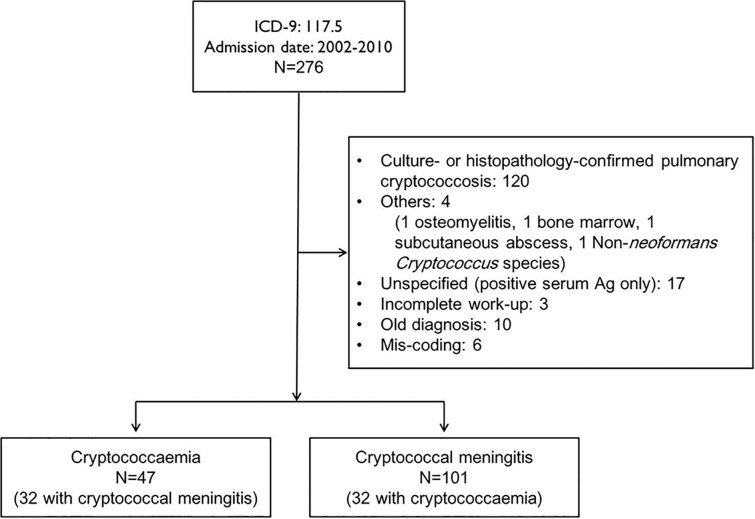
BACKGROUND: Cryptococcus neoformans is a ubiquitous environmental fungus that can cause life-threatening meningitis and fungemia, often in the presence of acquired immunodeficiency syndrome (AIDS), liver cirrhosis, diabetes mellitus, or other medical conditions. To distinguish risk factors from comorbidities, we performed a hospital-based, density-sampled, matched case-control study. METHODS: All new-onset cryptococcal meningitis cases and cryptococcemia cases at a university hospital in Taiwan from 2002-2010 were retrospectively identified from the computerized inpatient registry and were included in this study. Controls were selected from those hospitalized patients not experiencing cryptococcal meningitis or cryptococcemia. Controls and cases were matched by admission date, age, and gender. Conditional logistic regression was used to analyze the risk factors. RESULTS: A total of 101 patients with cryptococcal meningitis (266 controls) and 47 patients with cryptococcemia (188 controls), of whom 32 patients had both cryptococcal meningitis and cryptococcemia, were included in this study. Multivariate regression analysis showed that AIDS (adjusted odds ratio [aOR] = 181.4; p < 0.001), decompensated liver cirrhosis (aOR = 8.5; p = 0.008), and cell-mediated immunity (CMI)-suppressive regimens without calcineurin inhibitors (CAs) (aOR = 15.9; p < 0.001) were independent risk factors for cryptococcal meningitis. Moreover, AIDS (aOR = 216.3, p < 0.001), decompensated liver cirrhosis (aOR = 23.8; p < 0.001), CMI-suppressive regimens without CAs (aOR = 7.3; p = 0.034), and autoimmune diseases (aOR = 9.3; p = 0.038) were independent risk factors for developing cryptococcemia. On the other hand, diabetes mellitus and other medical conditions were not found to be risk factors for cryptococcal meningitis or cryptococcemia. CONCLUSIONS: The findings confirm AIDS, decompensated liver cirrhosis, CMI-suppressive regimens without CAs, and autoimmune diseases are risk factors for invasive C. neoformans diseases.
Overview
The claims and statistics of this paper haven’t been checked yet.
Free: it reads the open-access text and checks the first 5 claims that cite a source we can check. Create a free account to check every claim.
Integrity signals
Registry
Cites
Statistics
Figures
Verification
Claims the paper makes
The claims and statistics of this paper haven’t been checked yet.
Free: it reads the open-access text and checks the first 5 claims that cite a source we can check. Create a free account to check every claim.
Claims other papers make about this one
Each is checked against this paper’s own text: does it say what the citing paper says it does?
The source backs part of the claim, not all of it — or backs it for a different population, condition or comparison.
In the citing paper
“Although the liver is not the target organ of C. neoformans, evidence suggests liver disease is a risk factor for cryptococcosis [111–114].”
From Mechanisms of fungal dissemination (2021) · cites this paper as [112]
Experimental — accuracy not yet measuredIn the citing paper
“This demonstrates an important role for KCs in reducing fungal dissemination to other organs by directly removing organisms from circulation [116], and likely explains the association between liver disease and increased susceptibility to fungal infections [112–114].”
From Mechanisms of fungal dissemination (2021) · cites this paper as [112]
Self-check
Percentages, sums and reported differences re-computed from the paper’s own numbers.
The self-check needs the paper’s full text.
Citations
Cites
Diagnosis and Classification of Diabetes Mellitus
American Diabetes Association (2011) · Diabetes Care · doi:10.2337/dc11-s062 · Cited by 13,988
Castro, K. G., Ward, J. W., Slutsker, L., Buehler, J. W., Jaffe, H. W., Berkelman, R. L., & Curran, J. W. (1993) · Clinical Infectious Diseases · doi:10.1093/clinids/17.4.802 · Cited by 4,349
Park, B. J., Wannemuehler, K. A., Marston, B. J., Govender, N., Pappas, P. G., & Chiller, T. M. (2009) · AIDS · doi:10.1097/qad.0b013e328322ffac · Cited by 2,014
Surgery and portal hypertension.
Child, C. G., & Turcotte, J. (1964) · PubMed · Cited by 1,933
Cryptococcosis in the era of AIDS--100 years after the discovery of Cryptococcus neoformans
Mitchell, T. G., & Perfect, J. R. (1995) · Clinical Microbiology Reviews · doi:10.1128/cmr.8.4.515 · Cited by 1,213
(1993) · JAMA: The Journal of the American Medical Association · doi:10.1001/jama.1993.03500040022009 · Cited by 958
Diagnosis and Classification of Diabetes Mellitus
American Diabetes Association (2006) · Diabetes Care · doi:10.2337/diacare.29.s1.06.s43 · Cited by 924
Epidemiology of Invasive Mycoses in North America
Pfaller, M. A., & Diekema, D. J. (2010) · Critical Reviews in Microbiology · doi:10.3109/10408410903241444 · Cited by 901
Infections with Cryptococcus neoformans in the Acquired Immunodeficiency Syndrome
Chuck, S. L., & Sande, M. A. (1989) · New England Journal of Medicine · doi:10.1056/nejm198909213211205 · Cited by 797
Cryptococcosis in the Acquired Immunodeficiency Syndrome
KOVACS, J. A., KOVACS, A. A., POLIS, M., WRIGHT, W. C., GILL, V. J., TUAZON, C. U., GELMANN, E. P., LANE, H. C., LONGFIELD, R., OVERTURF, G., et al. (1985) · Annals of Internal Medicine · doi:10.7326/0003-4819-103-4-533 · Cited by 621
Research works printed but not linked: 3
- Hansemann DV (1905) Uber eine bisher nicht beobachtete Gehirner Krankung durch Hefen. Verh Dtsch Ges Pathol 9: 21– 24.
- World Health Organization (2011) Rapid advice: diagnosis, prevention and management of cryptococcal disease in HIV-infected adults, adolescents and children. Geneva. 26110194
- Lee TK, Chiu WS, Hsu CJ, Yang SP (1959) Cryptococcosis: a review with two case reports. J Formosan Med Assoc 58: 567– 578.
Cited by
Maziarz, E. K., & Perfect, J. R. (2016) · Infectious Disease Clinics of North America · doi:10.1016/j.idc.2015.10.006 · Cited by 698
Mechanisms of fungal dissemination
Strickland, A. B., & Shi, M. (2021) · Cellular and Molecular Life Sciences · doi:10.1007/s00018-020-03736-z · Cited by 127
Tugume, L., Ssebambulidde, K., Kasibante, J., Ellis, J. P., Wake, R. M., Gakuru, J., Lawrence, D. S., Abassi, M., Rajasingham, R., Meya, D. B., et al. (2023) · Nature Reviews Disease Primers · doi:10.1038/s41572-023-00472-z · Cited by 155
“Less commonly, chronic diseases such as diabetes mellitus, chronic lung disease, renal failure and liver disease impair T cell function, thereby conferring susceptibility to reactivation of latent crypto-coccal infection 86–88 .”
BackgroundMarr, K. A., Sun, Y., Spec, A., Lu, N., Panackal, A. A., Bennett, J. E., Pappas, P. G., Ostrander, D. B., Datta, K., Zhang, S. X., et al. (2019) · Clinical Infectious Diseases · doi:10.1093/cid/ciz193 · Cited by 107
Fungal dissemination is limited by liver macrophage filtration of the blood
Sun, D., Sun, P., Li, H., Zhang, M., Liu, G., Strickland, A. B., Chen, Y., Fu, Y., Xu, J., Yosri, M., et al. (2019) · Nature Communications · doi:10.1038/s41467-019-12381-5 · Cited by 83
Howard‐Jones, A. R., Sparks, R., Pham, D., Halliday, C. L., Beardsley, J., & Chen, S. C.-A. (2022) · Journal of Fungi · doi:10.3390/jof8111156 · Cited by 111
“Other risk factors for cryptococcal disease include solid organ transplant [27], calcineurin inhibitors and other immunomodulatory agents [28], auto-antibodies against granulocyte-macrophage-colony stimulating factor (anti-GM-CSF) [29], decompensated cirrhosis [28], type 2 diabetes mellitus, malignant solid tumours, a…”
BackgroundFlucytosine and its clinical usage
Sigera, L. S. M., & Denning, D. W. (2023) · Therapeutic Advances in Infectious Disease · doi:10.1177/20499361231161387 · Cited by 131
“47 However, in treating fluconazole-resistant urine or ocular infections, 5FC may be tried as monotherapy, as responses do occur, and resistance emergence is not inevitable.”
BackgroundA dissemination-prone morphotype enhances extrapulmonary organ entry by Cryptococcus neoformans
Denham, S. T., Brammer, B., Chung, K. Y., Wambaugh, M. A., Bednarek, J. M., Guo, L., Moreau, C. T., & Brown, J. C. S. (2022) · Cell Host & Microbe · doi:10.1016/j.chom.2022.08.017 · Cited by 80
End-Stage Liver Disease Is a Strong Predictor of Early Mortality in Cryptococcosis
Spec, A., Raval, K., & Powderly, W. G. (2016) · Open Forum Infectious Diseases · doi:10.1093/ofid/ofv197 · Cited by 65
Treatment of cryptococcosis in non-HIV immunocompromised patients
Henao‐Martínez, A. F., Chastain, D. B., & Franco‐Paredes, C. (2018) · Current Opinion in Infectious Diseases · doi:10.1097/qco.0000000000000458 · Cited by 70
Invasive fungal infections in acute and chronic liver impairment: A systematic review
Lahmer, T., Pietrobom, P. M. P., Schmid, R. M., & Colombo, A. L. (2021) · Mycoses · doi:10.1111/myc.13403 · Cited by 61
Dao, A., Kim, H. Y., Garnham, K., Kidd, S. E., Sati, H. F., Perfect, J. R., Sorrell, T. C., Harrison, T. S., Rickerts, V., Gigante, V., et al. (2024) · Medical Mycology · doi:10.1093/mmy/myae043 · Cited by 79
Sangalli-Leite, F., Scorzoni, L., Silva, A. C. A. D. P. E., da Silva, J. D. F., de Oliveira, H. C., Singulani, J. D. L., Gullo, F. P., da Silva, R. M., Regasini, L. O., Silva, D. H. S., et al. (2016) · International Journal of Antimicrobial Agents · doi:10.1016/j.ijantimicag.2016.07.025 · Cited by 55
Hamadani, B. H. K., Franco‐Paredes, C., McCollister, B. D., Shapiro, L., Beckham, J. D., & Henao‐Martínez, A. F. (2017) · Mycoses · doi:10.1111/myc.12742 · Cited by 39
Cryptococcosis in patients with diabetes mellitus II in mainland China: 1993‐2015
Li, Y., Fang, W., Jiang, W., Hagen, F., Liu, J., Zhang, L., Hong, N., Zhu, Y. M., Xu, X., Lei, X., et al. (2017) · Mycoses · doi:10.1111/myc.12645 · Cited by 39
Influenza A Virus as a Predisposing Factor for Cryptococcosis
Oliveira, L. V. N., da Costa, M. C., Magalhães, T. F. F., Bastos, R. W., Santos, P. C., Carneiro, H. C. S., Ribeiro, N. Q., Ferreira, G. F., Ribeiro, L. S., Gonçalves, A. P., et al. (2017) · Frontiers in Cellular and Infection Microbiology · doi:10.3389/fcimb.2017.00419 · Cited by 36
“neoformans infections are HIV, organ transplantation, decompensated hepatic cirrhosis, cell-mediated immune suppression, autoimmune diseases, pneumonia, other pulmonary disorders, and invasive cancer (Lin et al., 2015).”
BackgroundRisk Factors for Cryptococcal Meningitis: A Single United States Center Experience
Henao‐Martínez, A. F., Gross, L., McNair, B. K., McCollister, B. D., DeSanto, K., Montoya, J. G., Shapiro, L., & Beckham, J. D. (2016) · Mycopathologia · doi:10.1007/s11046-016-0048-x · Cited by 36
“Using previous research [2, 6, 9, 17, 20], we ranked the primary predictor variables by order of clinical importance: HIV infection, use of steroids, transplant, cirrhosis, sarcoidosis, and type 2 diabetes (in order of ranking).”
MethodStack, M., Hiles, J. J., Valinetz, E. D., Gupta, S. K., Butt, S., & Schneider, J. G. (2023) · Open Forum Infectious Diseases · doi:10.1093/ofid/ofad420 · Cited by 38
Tsai, W., Lien, C.-Y., Lee, J., Hsiao, W.-C., Huang, C.-R., Tsai, N., Chang, C., Lu, C., & Chang, W. (2019) · BMC Geriatrics · doi:10.1186/s12877-019-1108-0 · Cited by 35
Cryptococcal Meningitis Reported With Fingolimod Treatment: Case Series
Poeta, M. D., Ward, B. J., Greenberg, B. M., Hemmer, B., Cree, B., Komatireddy, S. R., Mishra, J., Sullivan, R., Kilaru, A., Moore, A., et al. (2022) · Neurology Neuroimmunology & Neuroinflammation · doi:10.1212/nxi.0000000000001156 · Cited by 32
“Cryptococcal infections arising from pets and birds have also been reported.(4,5) CM is among the rare opportunistic infections reported in patients with multiple sclerosis (MS) receiving a variety of diseasemodifying treatments (DMTs), including natalizumab,(6,7) dimethyl fumarate (DMF),(8) and fingolimod.”
BackgroundKupffer cells in liver homeostasis and disease: from immune sentinels to metabolic gatekeepers
David, B. A., Andreata, F., Blériot, C., Ginhoux, F., Kubes, P., & Iannacone, M. (2026) · Nature reviews. Immunology · doi:10.1038/s41577-026-01288-0 · Cited by 31
Lahiri, S., Maji, S., Netravathi, M., Bahubali, V. H., & Chandrashekar, N. (2023) · Journal de Mycologie Médicale · doi:10.1016/j.mycmed.2023.101358 · Cited by 24
Swan, C. D., & Gottlieb, T. (2018) · BMJ Case Reports · doi:10.1136/bcr-2018-224786 · Cited by 23
Clinical Predictors Impacting Cryptococcal Dissemination and Poor Outcome in Patients With Cirrhosis
Cheng, J.-H., Yip, C., Jiang, Y., Zhou, L., Que, C., Luo, Y., Wang, X., Zhao, H., & Zhu, L. (2021) · Open Forum Infectious Diseases · doi:10.1093/ofid/ofab296 · Cited by 21
“8-fold increased risks for CM and cryptococcemia, respectively [28].”
BackgroundRamli, M. I., Sulong, A. B., Muhamad, N., Muchtar, A., Arifin, A., Foudzi, F. M., & Al-Furjan, M. S. H. (2018) · PLoS ONE · doi:10.1371/journal.pone.0206247 · Cited by 20
Guess, T. E., Rosen, J. A., Castro-Lopez, N., Wormley, F. L., & McClelland, E. E. (2019) · Biology of Sex Differences · doi:10.1186/s13293-019-0258-2 · Cited by 20
de Castro, R. J. A., Marina, C. L., Sturny-Leclère, A., Hoffmann, C., Bürgel, P. H., Wong, S. S. W., Aimanianda, V., Varet, H., Agrawal, R., Bocca, A. L., et al. (2023) · PLoS Pathogens · doi:10.1371/journal.ppat.1011841 · Cited by 22
Elements of dissemination in cryptococcosis
Bednarek, J. M., & Brown, J. C. S. (2024) · mBio · doi:10.1128/mbio.02155-23 · Cited by 22
“Pulmonary escape is typically preceded by some form of immune insult, with T lymphocyte depletion or suppression being the primary risk factor for cryptococcosis (45).”
Immunosuppressive drugs and associated complications in abdominal organ transplantation
Olson, J. C. (2022) · Current Opinion in Critical Care · doi:10.1097/mcc.0000000000000927 · Cited by 22
“regimens which modify thatcell-mediated immunity and do not contain CNIs have been identified as an independent risk factor for Invasive Cryptococcus neoformans related disease [24].”
BackgroundQian, W., Wang, W., Zhang, J., Fu, Y., Liu, Q., Li, X., Wang, T., & Zhang, Q. (2022) · Biofouling · doi:10.1080/08927014.2022.2094260 · Cited by 23
“It can cause life-threatening meningitis and fungemia (Lin et al. 2015).”
BackgroundLahiri, S., Netravathi, M., Bhat, M. D., Hagen, F., Bahubali, V. H., Palaniappan, M., Maji, S., & Chandrashekar, N. (2019) · Medical Mycology · doi:10.1093/mmy/myz097 · Cited by 19
Khwantongyim, P., Wansee, S., Lu, X., Zhang, W., & Sun, G. (2021) · Journal of Fungi · doi:10.3390/jof7090764 · Cited by 19
“J. Fungi 2021, 7, x FOR PEER REVIEW 11 of 23 Xylariales; six families such s ordycipitaceae, Didymosphaeriacea , Lophiostomatace e, Teichosporaceae, Tremellacea , and Chaetothy iales fam In ertae sedis; three genera such as Aureobasidium, Cryptococc s, and an unidentified genus; three speci s such as Aureobasidium pul…”
InfluentialArchuleta, S., Gharamti, A. A., Sillau, S., Castellanos, P., Chadalawada, S., Mundo, W., Bandali, M., Oñate, J., Martínez, E., Chastain, D. B., et al. (2021) · Therapeutic Advances in Infectious Disease · doi:10.1177/20499361211004367 · Cited by 19
Cryptococcosis in Renal Transplant Recipients: A Single-Center Experience
Marques, S., Carmo, R., Ferreira, I. C., Bustorff, M., Sampaio, S., & Pestana, M. (2016) · Transplantation Proceedings · doi:10.1016/j.transproceed.2016.06.006 · Cited by 18
Clinical features and Outcomes of Cryptococcemia patients with and without HIV infection
Zhao, H., Zhou, M., Zheng, Q., Zhu, M., Yang, Z., Hu, C., & Xu, L. (2021) · Mycoses · doi:10.1111/myc.13261 · Cited by 18
Mahajan, K. R., Roberts, A. L., Curtis, M. T., Fortuna, D., Dharia, R. N., & Sheehan, L. B. (2016) · Case Reports in Neurological Medicine · doi:10.1155/2016/7381943 · Cited by 18
“Diagnostics utilize CrAg for antibody based assays (sensitivity and specificity for serum): latex agglutination (LA, 97% sensitivity; 86–100% specificity [12]), enzyme immunoassay (EIA, sensitivity 94%; specificity 96% [13]), and lateral flow assay (LFA, 98.”
BackgroundMethodEpelbaum, O., de Moraes, A. G., Olson, J. C., & Lionakis, M. S. (2025) · Intensive Care Medicine · doi:10.1007/s00134-025-07797-1 · Cited by 19
“In these cohorts, cirrhosis repeatedly emerged as an independent risk factor for disseminated cryptococcosis (aOR 5.3–8.5), especially cryptococcemia (aOR 23.8), on par with receipt of corticosteroids and other medications that suppress cell-mediated immune responses [108, 109].”
InfluentialMushtaq, K., Khan, Z. H., Aziz, M., Alyousif, Z. A., Siddiqui, N. S., Khan, M. A., & Nawras, A. T. (2020) · Translational Gastroenterology and Hepatology · doi:10.21037/tgh.2019.10.14 · Cited by 14
“They found that AIDS, Malignancy and autoimmune diseases were independent risk factors for development of cryptococcosis (23).”
BackgroundCryptococcal infection in haematologic malignancies and haematopoietic stem cell transplantation
Nematollahi, S., & Dioverti, M. V. (2020) · Mycoses · doi:10.1111/myc.13153 · Cited by 16
Li, Z., Liu, Y., Chong, Y., Li, X., Jie, Y., Zheng, X., & Yan, Y. (2019) · Mycoses · doi:10.1111/myc.12944 · Cited by 14
Suleman, A., Padmore, R., Faught, C., & Cowan, J. (2019) · IDCases · doi:10.1016/j.idcr.2019.e00566 · Cited by 14
“Non-HIV conditions that may be associated with predisposition to cryptococcosis include corticosteroid therapy [5], cytotoxic chemotherapy, immunotherapy agents [5,6], idiopathic CD4 lymphocytopenia [7], organ transplantation [8], and decompensated liver cirrhosis [9].”
BackgroundJiang, Z.-J., Hong, J.-C., Lin, B.-W., Zhang, W.-Q., Fan, Q.-C., Yang, B., & Yao, X.-P. (2025) · Scientific Reports · doi:10.1038/s41598-025-86481-2 · Cited by 17
Thoracolumbar Scoliosis Due to Cryptococcal Osteomyelitis
Li, Z., Liang, J., Shen, J., Qiu, G., & Weng, X. (2016) · Medicine · doi:10.1097/md.0000000000002613 · Cited by 12
Infections in Cirrhosis: A Guide for the Clinician
Campbell, K. A., Trivedi, H. D., & Chopra, S. (2021) · The American Journal of Medicine · doi:10.1016/j.amjmed.2021.01.015 · Cited by 17
Schub, T., Förster, J., Suerbaum, S., Wagener, J., & Dichtl, K. (2021) · Current Microbiology · doi:10.1007/s00284-021-02664-w · Cited by 13
“Immunosuppressed and immunocompromised patients are at particular risk of cryptococcal infections [2, 7].”
BackgroundAre macrophages the heroes or villains during cryptococcosis?
Rudman, J., Evans, R. J., & Johnston, S. A. (2019) · Fungal Genetics and Biology · doi:10.1016/j.fgb.2019.103261 · Cited by 13
Transmission of cryptococcosis by liver transplantation: A case report and review of literature
Ferreira, G. D. S. A., Watanabe, A. L. C., Trevizoli, N. D. C., Jorge, F. M. F., Couto, C. D. F., de Campos, P. B., & Caja, G. O. N. (2020) · World Journal of Hepatology · doi:10.4254/wjh.v12.i5.253 · Cited by 12
Focused library of phenyl-fused macrocyclic amidinoureas as antifungal agents
Balestri, L. J. I., D’Agostino, I., Rango, E., Vagaggini, C., Marchitiello, R., Mariotti, M., Casian, A., Deodato, D., Truglio, G. I., Orofino, F., et al. (2022) · Molecular Diversity · doi:10.1007/s11030-022-10388-7 · Cited by 12
“Besides Candida species, Cryptococcus neoformans is highly invasive in humans, causing life-threatening meningitis [16], especially in resource-limited regions where treatments of choice based on amphotericin B and 5-flucytosine are not available since too expensive [17].”
BackgroundWang, J., Hong, J.-J., Zhang, P.-P., Yang, M., Yang, Q. H., & Qu, T. (2019) · Medicine · doi:10.1097/md.0000000000016354 · Cited by 13
“neoformans diseases.([22]) Among patients with hepatic cirrhosis, cryptococcal meningitis was frequently reported, while several cases of cryptococcal peritonitis were reported, and cases of cryptococcal pleuritis were rarely reported especially as the only manifestation.”
Choi, H. S. (2022) · Medicine · doi:10.1097/md.0000000000030143 · Cited by 11
The Evolving Challenge of Infections in Cirrhosis
Haidar, G., & Singh, N. (2021) · New England Journal of Medicine · doi:10.1056/nejmc2111760 · Cited by 9
Recent advances in the clinical development of antifungal vaccines: a narrative review
Alapan, D., Bisweswar, O., Prasenjit, S., Prasanjit, D., & Bandyopadhyay, A. (2024) · Frontiers in Tropical Diseases · doi:10.3389/fitd.2024.1446477 · Cited by 11
Singh, N., Sifri, C. D., Silveira, F. P., Miller, R. A., Gregg, K., Huprikar, S. S., Lease, E. D., Zimmer, A. J., Dummer, J. S., Spak, C. W., et al. (2016) · Medical Mycology · doi:10.1093/mmy/myw079 · Cited by 11
Vélez, N., Alvarado, M., Parra‐Giraldo, C. M., Sánchez-Quitian, Z. A., Escandón, P., & Castañeda, E. (2018) · Journal of Fungi · doi:10.3390/jof4030082 · Cited by 10
“Cryptococcosis is a potentially fatal opportunistic mycosis affecting the lungs and central nervous system [1].”
BackgroundSim, B., Conway, L., Smith, L. K., Fairhead, L., Der, Y. S., Payne, L., Binotto, E., Smith, S., & Hanson, J. (2022) · PLoS ONE · doi:10.1371/journal.pone.0265739 · Cited by 12
Su, Y., Miao, Q., Li, N., Hu, B., & Pan, J. (2022) · Frontiers in Cellular and Infection Microbiology · doi:10.3389/fcimb.2022.997256 · Cited by 10
“Immunocompromised hosts were considered to have at least one predisposing condition, including AIDS, liver cirrhosis, hematologic malignancy, malignant solid tumor, chronic steroid use and rheumatologic disease (rheumatoid arthritis, lupus, psoriatic arthritis, ankylosing spondylitis (AS), Sjogren’s syndrome, and infl…”
BackgroundPrevalence of cryptococcal antigenemia in hospitalized patients with liver cirrhosis
Suh, H. J., Choe, P. G., Song, K., Park, W. B., Bang, J. H., Kim, E. S., Kim, H. B., Park, S., Oh, M., & Kim, N. J. (2019) · Medical Mycology · doi:10.1093/mmy/myz045 · Cited by 10
Chen, Y.-T., Lee, W., Tsai, C.-A., Fan, W.-C., Wu, P.-F., & Wang, F. (2019) · International Journal of Infectious Diseases · doi:10.1016/j.ijid.2019.08.021 · Cited by 9
A Mimic of Hepatic Encephalopathy: Two Cases of Cryptococcal Meningitis in North America
Ting, P.-S., Agarwalla, A., & Woreta, T. A. (2019) · Journal of Clinical and Translational Hepatology · doi:10.14218/jcth.2019.00005 · Cited by 8
du Plooy, L. M., Telzrow, C. L., Nichols, C. B., Probst, C., Castro-Lopez, N., Wormley, F. L., & Alspaugh, J. A. (2024) · mBio · doi:10.1128/mbio.00981-24 · Cited by 9
Zhang, F., Zhou, Y., Tang, X., & Li, M. (2023) · European journal of medical research · doi:10.1186/s40001-023-01592-8 · Cited by 10
“…could be attributed to Cryptococcus species bypassing the liver’s clearance system in patients with decompensated liver cirrhosis and directly entering the systemic circulation through collateral circulation, resulting in crypto-coccal sepsis and subsequent dissemination to the CNS [17].”
BackgroundFungal infections in liver cirrhosis
Iqbal, H., Mehmood, B. F., Jones, K., Sohal, A., & Roytman, M. M. (2024) · Translational Gastroenterology and Hepatology · doi:10.21037/tgh-24-6 · Cited by 8
“A case-control study by Lin et al. found that decompensated liver cirrhosis is a risk factor for invasive cryptococcal infection (43).”
BackgroundPleural involvement in cryptococcal infection
Georgakopoulou, V., Damaskos, C., Sklapani, P., Τράκας, Ν., & Gkoufa, A. (2022) · World Journal of Clinical Cases · doi:10.12998/wjcc.v10.i16.5510 · Cited by 8
Carvajal, S. K., Vargas‐Casanova, Y., Pineda‐Castañeda, H. M., García‐Castañeda, J. E., Monroy, Z. J. R., & Parra‐Giraldo, C. M. (2022) · Antibiotics · doi:10.3390/antibiotics11121819 · Cited by 7
Yeast Infections in Solid Organ Transplantation
Taimur, S. (2018) · Infectious Disease Clinics of North America · doi:10.1016/j.idc.2018.04.005 · Cited by 9
Silva, L. M., Ferreira, W. A., Filho, R. A. A. B., Lacerda, M., Ferreira, G. M. A., Barbosa, M. D. N. S., Macêdo, M. M., Cristo, D. D. A., Alves, M. J., Matsuura, A. B. J., et al. (2020) · Annals of Clinical Microbiology and Antimicrobials · doi:10.1186/s12941-020-00361-3 · Cited by 7
Kung, V. M., Ferraz, C., Kennis, M., Franco‐Paredes, C., Tuells, J., Barahona, L. V., Shapiro, L., Thompson, G. R., Chastain, D. B., & Henao‐Martínez, A. F. (2023) · Current Microbiology · doi:10.1007/s00284-023-03512-9 · Cited by 9
Genet, A., & Girma, A. (2024) · Universa Medicina · doi:10.18051/univmed.2024.v43.102-113 · Cited by 6
“(24)”
Tsai, W., Lien, C.-Y., Lee, J., Huang, C.-R., Tsai, N., Chang, C., Lu, C., & Chang, W. (2019) · Journal of Clinical Neuroscience · doi:10.1016/j.jocn.2019.06.015 · Cited by 6
Koba, S., Ueda, K., Mori, M., Miki, K., & Imashuku, S. (2018) · Case Reports in Hepatology · doi:10.1155/2018/5174518 · Cited by 6
Cryptococcal meningitis in a non-HIV patient with solid organ transplantation
Uğur, M., Çetin, S., Karagöz, E. U., Sağlam, M., Sarıgüzel, F. M., & Koç, A. N. (2023) · Journal de Mycologie Médicale · doi:10.1016/j.mycmed.2023.101388 · Cited by 6
Ito, H., Okamoto, K., Yamamoto, S., Yamashita, M., Kanno, Y., Jubishi, D., Ikeda, M., Harada, S., Okugawa, S., & Moriya, K. (2021) · Open Forum Infectious Diseases · doi:10.1093/ofid/ofab601 · Cited by 5
Henao‐Martínez, A. F., & Vela‐Duarte, D. (2018) · Elsevier eBooks · doi:10.1016/b978-0-12-813806-9.00013-5 · Cited by 9
Chastain, D. B., Golpayegany, S., Henao‐Martínez, A. F., Jackson, B., Stoudenmire, L. L., Bell, K., Stover, K. R., & Franco‐Paredes, C. (2022) · Therapeutic Advances in Infectious Disease · doi:10.1177/20499361221112639 · Cited by 5
COVID-19 associated with cryptococcosis: a scoping review
Quincho-Lopez, A., Poma, N., & Montenegro-Idrogo, J. J. (2024) · Therapeutic Advances in Infectious Disease · doi:10.1177/20499361241232851 · Cited by 9
Elucidation of furanone as ergosterol pathway inhibitor in Cryptococcus neoformans
Sathiyamoorthy, J., Rathore, S. S., Suma Mohan, S., Maheswari, C. U., & Ramakrishnan, J. (2023) · Journal of Biomolecular Structure and Dynamics · doi:10.1080/07391102.2023.2230301 · Cited by 4
“…suppression by other means such as lymphomas (e.g. Hodgkin’s lymphoma), sarcoidosis, liver cirrhosis, long-term corticosteroid therapy, SOT, medications to treat rheumatoid arthritis, cancer chemotherapy and Idiopathic CD4 lymphopenia (Azam et al., 2022; Lin et al., 2015; Pasquier et al., 2018).”
BackgroundMundo, W., Berning, A. A., Koullias, Y., Chastain, D. B., Stone, N. R. H., Franco‐Paredes, C., Henao‐Martínez, A. F., & Barahona, L. V. (2021) · Open Forum Infectious Diseases · doi:10.1093/ofid/ofab258 · Cited by 5
Unmasking the Unusual: Cryptococcal Pericarditis in a Patient with Liver Failure – a Rare Occurrence
Phang, C. R., Farooqi, A., & Sangwan, Y. S. (2024) · American Journal of Case Reports · doi:10.12659/ajcr.943530 · Cited by 4
“Immunosuppression is the major underlying mechanism, with AIDS being the most common immunocompromised conditions seen in patients with cryptococcosis [12,13].”
BackgroundMurali, S., Schweid, K., Chebaya, P., Rao, S. S., & Rufa, E. (2021) · Medical Mycology Case Reports · doi:10.1016/j.mmcr.2021.08.007 · Cited by 4
“In patients with ESLD, this response is compromised and results in an increased risk of Cryptococcal meningitis and disseminated disease [3].”
BackgroundPaul, C., & Nweze, E. I. (2018) · Comparative Clinical Pathology · doi:10.1007/s00580-018-2876-1 · Cited by 3
Tsai, W.-T., Cheng, A., Chuang, Y., Ho, C., Wu, Y., Ho, M., Sun, H., Hu, R.-H., & Chen, Y. (2024) · Journal of Microbiology Immunology and Infection · doi:10.1016/j.jmii.2024.08.001 · Cited by 3
Chidebelu, P. E., Nweze, E. I., Meis, J. F. G. M., Cogliati, M., & Hagen, F. (2021) · Journal of Medical Microbiology · doi:10.1099/jmm.0.001440 · Cited by 4
Chastain, D. B., Zhang, Q., Chen, X., Young, H. N., Franco‐Paredes, C., Tuells, J., Thompson, G. R., & Henao‐Martínez, A. F. (2024) · Therapeutic Advances in Infectious Disease · doi:10.1177/20499361241244967 · Cited by 7
Cryptococcus Infection in Captive Callitrichids in the United Kingdom
Mota, S. M., Stidworthy, M. F., Guthrie, A. L., Spiro, S., & Denk, D. (2021) · Journal of Comparative Pathology · doi:10.1016/j.jcpa.2020.12.001 · Cited by 3
Cryptococcal Meningitis in a Mexican Neurological Center
Cárdenas, G., Vargas-García, L. F., Espinal, H. A., Soto‐Hernández, J. L., & Castañón-Olivares, L. R. (2023) · The Neurologist · doi:10.1097/nrl.0000000000000482 · Cited by 2
Speckled-egg staining appearance of cryptococcal osteomyelitis in an immunocompetent patient
Stack, M. A., Lavik, J.-P., Schneider, J. G., & Cross, B. (2025) · IDCases · doi:10.1016/j.idcr.2025.e02171 · Cited by 2
“Notably, studies on cryptococcal infections in individuals without HIV or organ transplants have suggested that advanced age may be a risk factor for cryptococcal disease [8 – 11].”
Hepatic encephalopathy: Part 1, a diagnostic approach
Ntuli, Y., Mangini, C., Tranah, T. H., Kronsten, V. T., Montagnese, S., & Shawcross, D. L. (2025) · Frontline Gastroenterology · doi:10.1136/flgastro-2025-103135 · Cited by 2
“102 CT brain, MRI and lumbar puncture may be indicated in suspected cases.”
Cryptococcemia in primary HIV infection
Yeung, V. A., Azzam, R., Dendle, C., Graham, M., Woolley, I. J., & Korman, T. M. (2016) · International Journal of STD & AIDS · doi:10.1177/0956462416632139 · Cited by 2
Botta, A., Piccica, M., Lagi, F., Borchi, B., Zammarchi, L., D, G. S. M., & Bartoloni, A. (2021) · SN Comprehensive Clinical Medicine · doi:10.1007/s42399-021-00981-6 · Cited by 2
“With the improvement of antiretroviral therapy (ART) and reduction of AIDS diagnoses, more cases are related to other cause of immunosuppression, like solid organ transplantation (SOT), systemic lupus erythematosus (LES), malignancy, and sarcoidosis [4, 5, 6, 7, 8].”
BackgroundCryptococcal Peritonitis in a Patient with Decompensated Liver Cirrhosis
Libera, R., Dimala, C. A., Oakes, K., & Moss, C. (2023) · Journal of Community Hospital Internal Medicine Perspectives · doi:10.55729/2000-9666.1139 · Cited by 2
Chippa, V. M., Chenna, S., Gujarathi, R. H., & Candula, N. (2023) · Cureus · doi:10.7759/cureus.37243 · Cited by 2
Cryptococcus: A Rare Cause of Parotid Abscess in Liver Cirrhosis
Okamoto, T., & Fukuda, K. (2020) · Case Reports in Hepatology · doi:10.1155/2020/8849448 · Cited by 3
“Retrospective studies suggest that 5–17% of non-HIV cryptococcal infections are associated with cirrhosis [7, 10].”
BackgroundAssociation of Diabetes with Meningitis Infection Risks: A Systematic Review and Meta-Analysis
Asori, M., Musah, A., & Gyasi, R. M. (2022) · Global Health · doi:10.1155/2022/3996711 · Cited by 1
Patel, D. D., Khillan, V., Patel, N., & Kale, P. R. (2023) · Indian Journal of Medical Microbiology · doi:10.1016/j.ijmmb.2023.100465 · Cited by 2
Prevalence of cryptococcal meningitis in Asian countries: a systematic review and meta-analysis
Falcon, R. M. G., Aboy, K. L. B., Fajutagana, H. K. F., Leh, J. F. A., Reyes, O. M. T., Suguitan, M. L. L., Uy, G. T. V., Zapata, A. N. T., & Pascual, J. L. R. (2025) · Discover Neuroscience · doi:10.1186/s13064-025-00209-6 · Cited by 1
Scott, T. L., Quezado, M., & Williamson, P. R. (2026) · Expert Review of Anti-infective Therapy · doi:10.1080/14787210.2026.2628049 · Cited by 2
64-Year-Old Man With Subacute Altered Mental Status and Headache
Mehra, N. S., Ward, R. C., & Issa, M. (2019) · Mayo Clinic Proceedings · doi:10.1016/j.mayocp.2018.05.040 · Cited by 1
An Unusual Cause of Recurrent Pleural Effusion
He, K., Priyank, K., & Weber, D. M. (2019) · Infectious Diseases in Clinical Practice · doi:10.1097/ipc.0000000000000795 · Cited by 1
“650]), and no relationship between MGUS and cryptococcosis has yet been cited despite the former placing patients at a higher risk of infection at long-term followup.(13,18,19) Despite more than a year of sustained virologic response after treatment with ledipasvir/sofosbuvir, HCV cirrhosis seems to still predispose p…”
BackgroundCaicedo-Bejarano, L. D., & Álvarez, M. I. (2019) · ENTRAMADO · doi:10.18041/1900-3803/entramado.1.6087 · Cited by 2
Alex, V., Nana, T., & Chibabhai, V. (2021) · Antimicrobial Stewardship & Healthcare Epidemiology · doi:10.1017/ash.2021.236 · Cited by 3
Metadata
- Authors
- Lin, Y.-Y., Shiau, S., & Fang, C.-T.
- Affiliations
- Columbia University (US)
- National Taiwan University (TW)
- Corresponding author
- Fang, Chi-Tai
- Venue
- PLOS ONE
- Publisher
- Public Library of Science (PLoS)
- Published
- 2015-03-06
- Volume
- 10
- Issue
- 3
- Pages
- e0119090
- ISSN
- 1932-6203 (ISSN-L)
- PMC
- PMC4352003
- OpenAlex
- W2031767376
- Cited by
- 128
- References
- 42
- Citations by year
- 2026: 9 · 2025: 7 · 2024: 15 · 2023: 13 · 2022: 15 · 2021: 22 · 2020: 8 · 2019: 16 · 2018: 9 · 2017: 4 · 2016: 9 · 2015: 1
- FWCI
- 6.02
- Type
- journal article
- Language
- en
- Open access
- gold
- doi.org
- Licence
- Locations
- PLoS ONE (publishedVersion, cc-by)
- Europe PMC (PubMed Central) (publishedVersion, cc-by)
- PubMed Central (publishedVersion, cc-by)
- PubMed (publishedVersion)
- DOAJ (DOAJ: Directory of Open Access Journals) (submittedVersion, cc-by-sa)
- Columbia Academic Commons (Columbia University)
- Topics
- Health Sciences › Medicine › Infectious Diseases › Fungal Infections and Studies
- Life Sciences › Immunology and Microbiology › Microbiology › Bacterial Infections and Vaccines
- Health Sciences › Medicine › Infectious Diseases › Antifungal resistance and susceptibility
- Keywords
- Cryptococcus neoformans, cryptococcal meningitis, invasive fungal infections, risk factors, AIDS, decompensated cirrhosis, cell-mediated immunity suppression, calcineurin inhibitors, autoimmune disease, immunosuppression
- MeSH terms
- Acquired Immunodeficiency Syndrome, Adult, Aged, Aged, 80 and over, Cryptococcus neoformans, Female, Humans, Liver Cirrhosis, Male, Middle Aged, Registries, Retrospective Studies, Risk Factors, Fungemia, Meningitis, Cryptococcal
About these checks
Registry, retraction, Cites and statistics results are computed, not judged, with one exception: a printed reference that no index lists is read once by a model before it counts as a citation error. Claims are extracted by a model and kept only when their quote appears verbatim in the text; each cited source is then checked, with a model’s help, for whether it says what the claim relies on. Those verdicts can be wrong — read the claim’s quote and the cited source before relying on one.
Statistics and arithmetic are recomputed, not judged.
Confidence bands are shown only for fields calibrated on our annotated test set. None is calibrated yet, so no band is shown.
What counts as a claim ›How we measure confidence ›How we check this ›
Are you an author, or do you see a problem with this page? Request a review
Data sources
Bibliographic data: Semantic Scholar, OpenAlex, Crossref.
Contains information from the Semantic Scholar Academic Graph Datasets, made available under the ODC Attribution License (ODC-BY 1.0).
Semantic Scholar’s data is described in: Kinney, R., et al. (2023). The Semantic Scholar Open Data Platform. arXiv:2301.10140.
