

Risk Factors for Invasive Cryptococcus neoformans Diseases: A Case-Control Study
Open accessThe DOI matches its Crossref record; 41 of the 42 references it cites were found in a registry or an index.
Abstract
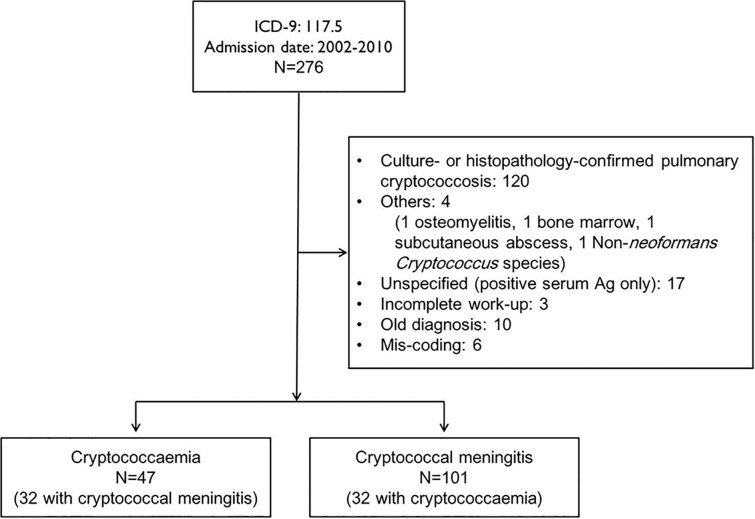
BACKGROUND: Cryptococcus neoformans is a ubiquitous environmental fungus that can cause life-threatening meningitis and fungemia, often in the presence of acquired immunodeficiency syndrome (AIDS), liver cirrhosis, diabetes mellitus, or other medical conditions. To distinguish risk factors from comorbidities, we performed a hospital-based, density-sampled, matched case-control study. METHODS: All new-onset cryptococcal meningitis cases and cryptococcemia cases at a university hospital in Taiwan from 2002-2010 were retrospectively identified from the computerized inpatient registry and were included in this study. Controls were selected from those hospitalized patients not experiencing cryptococcal meningitis or cryptococcemia. Controls and cases were matched by admission date, age, and gender. Conditional logistic regression was used to analyze the risk factors. RESULTS: A total of 101 patients with cryptococcal meningitis (266 controls) and 47 patients with cryptococcemia (188 controls), of whom 32 patients had both cryptococcal meningitis and cryptococcemia, were included in this study. Multivariate regression analysis showed that AIDS (adjusted odds ratio [aOR] = 181.4; p < 0.001), decompensated liver cirrhosis (aOR = 8.5; p = 0.008), and cell-mediated immunity (CMI)-suppressive regimens without calcineurin inhibitors (CAs) (aOR = 15.9; p < 0.001) were independent risk factors for cryptococcal meningitis. Moreover, AIDS (aOR = 216.3, p < 0.001), decompensated liver cirrhosis (aOR = 23.8; p < 0.001), CMI-suppressive regimens without CAs (aOR = 7.3; p = 0.034), and autoimmune diseases (aOR = 9.3; p = 0.038) were independent risk factors for developing cryptococcemia. On the other hand, diabetes mellitus and other medical conditions were not found to be risk factors for cryptococcal meningitis or cryptococcemia. CONCLUSIONS: The findings confirm AIDS, decompensated liver cirrhosis, CMI-suppressive regimens without CAs, and autoimmune diseases are risk factors for invasive C. neoformans diseases.
Overview
The claims and statistics of this paper haven’t been checked yet.
Free: it reads the open-access text and checks the first 5 claims that cite a source we can check. Create a free account to check every claim.
Integrity signals
Registry
Cites
Statistics
Figures
Verification
Claims the paper makes
The claims and statistics of this paper haven’t been checked yet.
Free: it reads the open-access text and checks the first 5 claims that cite a source we can check. Create a free account to check every claim.
Claims other papers make about this one
Each is checked against this paper’s own text: does it say what the citing paper says it does?
The source backs part of the claim, not all of it — or backs it for a different population, condition or comparison.
In the citing paper
“Although the liver is not the target organ of C. neoformans, evidence suggests liver disease is a risk factor for cryptococcosis [111–114].”
From Mechanisms of fungal dissemination (2021) · cites this paper as [112]
Experimental — accuracy not yet measuredIn the citing paper
“This demonstrates an important role for KCs in reducing fungal dissemination to other organs by directly removing organisms from circulation [116], and likely explains the association between liver disease and increased susceptibility to fungal infections [112–114].”
From Mechanisms of fungal dissemination (2021) · cites this paper as [112]
Self-check
Percentages, sums and reported differences re-computed from the paper’s own numbers.
The self-check needs the paper’s full text.
Citations
Cites
Diagnosis and Classification of Diabetes Mellitus
American Diabetes Association (2011) · Diabetes Care · doi:10.2337/dc11-s062 · Cited by 13,988
Castro, K. G., Ward, J. W., Slutsker, L., Buehler, J. W., Jaffe, H. W., Berkelman, R. L., & Curran, J. W. (1993) · Clinical Infectious Diseases · doi:10.1093/clinids/17.4.802 · Cited by 4,349
Park, B. J., Wannemuehler, K. A., Marston, B. J., Govender, N., Pappas, P. G., & Chiller, T. M. (2009) · AIDS · doi:10.1097/qad.0b013e328322ffac · Cited by 2,014
Surgery and portal hypertension.
Child, C. G., & Turcotte, J. (1964) · PubMed · Cited by 1,933
Cryptococcosis in the era of AIDS--100 years after the discovery of Cryptococcus neoformans
Mitchell, T. G., & Perfect, J. R. (1995) · Clinical Microbiology Reviews · doi:10.1128/cmr.8.4.515 · Cited by 1,213
(1993) · JAMA: The Journal of the American Medical Association · doi:10.1001/jama.1993.03500040022009 · Cited by 958
Diagnosis and Classification of Diabetes Mellitus
American Diabetes Association (2006) · Diabetes Care · doi:10.2337/diacare.29.s1.06.s43 · Cited by 924
Epidemiology of Invasive Mycoses in North America
Pfaller, M. A., & Diekema, D. J. (2010) · Critical Reviews in Microbiology · doi:10.3109/10408410903241444 · Cited by 901
Infections with Cryptococcus neoformans in the Acquired Immunodeficiency Syndrome
Chuck, S. L., & Sande, M. A. (1989) · New England Journal of Medicine · doi:10.1056/nejm198909213211205 · Cited by 797
Cryptococcosis in the Acquired Immunodeficiency Syndrome
KOVACS, J. A., KOVACS, A. A., POLIS, M., WRIGHT, W. C., GILL, V. J., TUAZON, C. U., GELMANN, E. P., LANE, H. C., LONGFIELD, R., OVERTURF, G., et al. (1985) · Annals of Internal Medicine · doi:10.7326/0003-4819-103-4-533 · Cited by 621
ZUGER, A., LOUIE, E., HOLZMAN, R. S., SIMBERKOFF, M. S., & RAHAL, J. J. (1986) · Annals of Internal Medicine · doi:10.7326/0003-4819-104-2-234 · Cited by 522
Calcineurin is required for virulence of Cryptococcus neoformans
Odom, A., Muir, S., Lim, E., Toffaletti, D. L., Perfect, J., & Heitman, J. (1997) · The EMBO Journal · doi:10.1093/emboj/16.10.2576 · Cited by 516 · cited 1×
“neoformans depends on fungal calcineurin [32].”
Mirza, S. A., Phelan, M., Rimland, D., Graviss, E., Hamill, R., Brandt, M. E., Gardner, T., Sattah, M., Ponce de Leon, G., Baughman, W., et al. (2003) · Clinical Infectious Diseases · doi:10.1086/368091 · Cited by 459 · cited 2×
“The wide use of highly active antiretroviral therapy (HAART), which can help prevent the development of AIDS if initiated early in the course of HIV infection, led to a decline in the number of C. neoformans cases in North America and Western Europe [20,31].”
BackgroundDiagnosis and classification of diabetes mellitus.
(2006) · PubMed · Cited by 373
Cryptococcal infections in patients with acquired immune deficiency syndrome
Eng, R. H. K., Bishburg, E., Smith, S. M., & Kapila, R. (1986) · The American Journal of Medicine · doi:10.1016/0002-9343(86)90176-2 · Cited by 317
Singh, N., Alexander, B. D., Lortholary, O., Dromer, F., Gupta, K. L., John, G. T., del Busto, R., Klintmalm, G. B., Somani, J., Lyon, G. M., et al. (2007) · The Journal of Infectious Diseases · doi:10.1086/511438 · Cited by 264 · cited 1×
“neoformans [29,33] and may mitigate the increased risk of C.”
BackgroundCryptococcosis in the era of AIDS 100 years after the discovery of Cryptococcus neoformans
Tomecki, K. J. (1997) · Journal of the American Academy of Dermatology · doi:10.1016/s0190-9622(97)80336-2 · Cited by 239
Defective Chemotaxis Associated with a Serum Inhibitor in Cirrhotic Patients
DeMeo, A. N., Andersen, B. R., English, D. K., & Peterson, J. (1972) · New England Journal of Medicine · doi:10.1056/nejm197204062861401 · Cited by 224
Jiang, Y.-D., Chang, C.-H., Tai, T.-Y., Chen, J.-F., & Chuang, L.-M. (2012) · Journal of the Formosan Medical Association · doi:10.1016/j.jfma.2012.09.014 · Cited by 224 · cited 1×
“97% among Taiwanese men aged 60–79, in Year 2009) [40].”
BackgroundDromer, F., Mathoulin-Pélissier, S., Fontanet, A., Ronin, O., Dupont, B., & Lortholary, O. (2004) · AIDS · doi:10.1097/00002030-200402200-00024 · Cited by 197 · cited 2×
“The wide use of highly active antiretroviral therapy (HAART), which can help prevent the development of AIDS if initiated early in the course of HIV infection, led to a decline in the number of C. neoformans cases in North America and Western Europe [20,31].”
BackgroundCryptococcosis in human immunodeficiency virus-negative patients
Kiertiburanakul, S., Wirojtananugoon, S., Pracharktam, R., & Sungkanuparph, S. (2006) · International Journal of Infectious Diseases · doi:10.1016/j.ijid.2004.12.004 · Cited by 176 · cited 1×
“5% to 33% of cryptococcosis cases in reported series [21,23,26,39] and in 15.”
BackgroundCryptococcal meningitis in non-HIV-infected patients
Shih, C.-C. (2000) · QJM · doi:10.1093/qjmed/93.4.245 · Cited by 137
Cauley, L. K., & Murphy, J. W. (1979) · Infection and Immunity · doi:10.1128/iai.23.3.644-651.1979 · Cited by 133
Cruz, M. C., Del Poeta, M., Wang, P., Wenger, R., Zenke, G., Quesniaux, V. F. J., Movva, N. R., Perfect, J. R., Cardenas, M. E., & Heitman, J. (2000) · Antimicrobial Agents and Chemotherapy · doi:10.1128/aac.44.1.143-149.2000 · Cited by 129 · cited 1×
“neoformans [29,33] and may mitigate the increased risk of C.”
BackgroundCryptococcus neoformans Infection in Patients With Cirrhosis, Including Liver Transplant Candidates
Singh, N., Husain, S., de Vera, M., Gayowski, T., & Cacciarelli, T. V. (2004) · Medicine · doi:10.1097/01.md.0000126760.45299.69 · Cited by 113
Cryptococcaemia: clinical features and prognostic factors
Jean, S.-S. (2002) · QJM · doi:10.1093/qjmed/95.8.511 · Cited by 109 · cited 3×
“We had previously reported that cryptococcemia is a fulminant form of cryptococcal disease with a high acute mortality rate, especially for those with liver cirrhosis [25].”
BackgroundThe pathology of pulmonary cryptococcal infections in the acquired immunodeficiency syndrome.
Gal, A. A., Koss, M. N., Hawkins, J., Evans, S., & Einstein, H. E. (1986) · PubMed · Cited by 92
Disseminated cryptococcosis in HIV-uninfected patients
Chuang, Y.-H., Ho, Y., Chang, H.-Y., Yu, C., Yang, P., & Hsueh, P. (2007) · European Journal of Clinical Microbiology & Infectious Diseases · doi:10.1007/s10096-007-0430-1 · Cited by 88 · cited 1×
“5% to 33% of cryptococcosis cases in reported series [21,23,26,39] and in 15.”
BackgroundT helper cell dysfunction in systemic lupus erythematosus (SLE): Relation to disease activity
Bermas, B. L., Petri, M., GOLDMAN, D. W., Mittleman, B. B., Miller, M. W., Stocks, N. I., Via, C. S., & Shearer, G. M. (1994) · Journal of Clinical Immunology · doi:10.1007/bf01533366 · Cited by 86 · cited 2×
“In a study involving 150 SLE patients, the functional impairment of T helper cells was found to be correlated with disease activity rather than the medication doses [34], which indicates that autoimmune disease per se is an independent factor that contributes to decreased CMI.”
BackgroundHost defense in cryptococcosis
Graybill, J. R., & Drutz, D. J. (1978) · Cellular Immunology · doi:10.1016/0008-8749(78)90334-9 · Cited by 75
Tseng, H.-K., Liu, C.-P., Ho, M.-W., Lu, P.-L., Lo, H.-J., Lin, Y.-H., Cho, W.-L., Chen, Y.-C., & the Taiwan Infectious Diseases Study Network (TIDSnet) for cryptococcosis (2013) · PLoS ONE · doi:10.1371/journal.pone.0061921 · Cited by 75 · cited 2×
“5% to 33% of cryptococcosis cases in reported series [21,23,26,39] and in 15.”
BackgroundSelf-citationThe Variety of Cryptococcus neoformans in Patients with AIDS
Shimizu, R. Y., Howard, D. H., & Clancy, M. N. (1986) · The Journal of Infectious Diseases · doi:10.1093/infdis/154.6.1042 · Cited by 66
Sun, H., Hung, C., & Chang, S. (2004) · Clinical Infectious Diseases · doi:10.1086/421272 · Cited by 39 · cited 1×
“Large clinical case series on cryptococcal meningitis [23,24], cryptococcemia [25] and cryptococcal diseases [26] reported high rates of HIV/AIDS, immunosuppressive therapy, decompensated liver cirrhosis, malignancy, diabetes mellitus, and kidney diseases among the case patients.”
BackgroundHistopathological studies on experimental Cryptococcosis in nude mice
Nishimura, K., & Miyaji, M. (1979) · Mycopathologia · doi:10.1007/bf00578522 · Cited by 37
Serum Bactericidal and Opsonic Activities in Patients with Non-Alcoholic Cirrhosis
Akalın, H., Laleli, Y. R., & TELATAR, H. (1985) · QJM · doi:10.1093/oxfordjournals.qjmed.a067889 · Cited by 34 · cited 1×
“In addition, deficiencies in complement [36] and chemotaxis [37] as well as lymphocyte hyporesponsiveness [38] have been reported.”
BackgroundHoldstock, G., Chastenay, B. F., & Krawitt, E. L. (1982) · Gastroenterology · doi:10.1016/0016-5085(82)90005-1 · Cited by 30
Pathogenesis of Cryptococcus neoformans in congenitally immunodeficient beige athymic mice
Salkowski, C. A., & Balish, E. (1990) · Infection and Immunity · doi:10.1128/iai.58.10.3300-3306.1990 · Cited by 25
Cutaneous cryptococcosis in athymic and beige-athymic mice
Salkowski, C. A., & Balish, E. (1991) · Infection and Immunity · doi:10.1128/iai.59.5.1785-1789.1991 · Cited by 16
Inflammatory Responses to Cryptococcosis in Congenitally Athymic Mice
Salkowski, C. A., & Balish, E. (1991) · Journal of Leukocyte Biology · doi:10.1002/jlb.49.6.533 · Cited by 16
Cryptococcus neoformans peritonitis in two patients with liver cirrhosis.
Jean, S., Wang, J., Wang, J., Fang, C., Chen, Y., & Chang, S. (2005) · PubMed · Cited by 9
Self-citationCryptococcus neoformans-Meningoencephalitis und Mehrfachinfektionen bei AIDS
Zoller, W., Kellner, H., Goebel, F. D., Schmiedtke, K., Holecek, B. U., Staib, F., Seibold, M., & Zöllner, N. (1989) · Journal of Molecular Medicine · doi:10.1007/bf01721688 · Cited by 7
Research works printed but not linked: 3
- Hansemann DV (1905) Uber eine bisher nicht beobachtete Gehirner Krankung durch Hefen. Verh Dtsch Ges Pathol 9: 21– 24.
- World Health Organization (2011) Rapid advice: diagnosis, prevention and management of cryptococcal disease in HIV-infected adults, adolescents and children. Geneva. 26110194
- Lee TK, Chiu WS, Hsu CJ, Yang SP (1959) Cryptococcosis: a review with two case reports. J Formosan Med Assoc 58: 567– 578.
Cited by
Maziarz, E. K., & Perfect, J. R. (2016) · Infectious Disease Clinics of North America · doi:10.1016/j.idc.2015.10.006 · Cited by 698
Mechanisms of fungal dissemination
Strickland, A. B., & Shi, M. (2021) · Cellular and Molecular Life Sciences · doi:10.1007/s00018-020-03736-z · Cited by 127
Tugume, L., Ssebambulidde, K., Kasibante, J., Ellis, J. P., Wake, R. M., Gakuru, J., Lawrence, D. S., Abassi, M., Rajasingham, R., Meya, D. B., et al. (2023) · Nature Reviews Disease Primers · doi:10.1038/s41572-023-00472-z · Cited by 155
“Less commonly, chronic diseases such as diabetes mellitus, chronic lung disease, renal failure and liver disease impair T cell function, thereby conferring susceptibility to reactivation of latent crypto-coccal infection 86–88 .”
BackgroundMarr, K. A., Sun, Y., Spec, A., Lu, N., Panackal, A. A., Bennett, J. E., Pappas, P. G., Ostrander, D. B., Datta, K., Zhang, S. X., et al. (2019) · Clinical Infectious Diseases · doi:10.1093/cid/ciz193 · Cited by 107
Fungal dissemination is limited by liver macrophage filtration of the blood
Sun, D., Sun, P., Li, H., Zhang, M., Liu, G., Strickland, A. B., Chen, Y., Fu, Y., Xu, J., Yosri, M., et al. (2019) · Nature Communications · doi:10.1038/s41467-019-12381-5 · Cited by 83
Metadata
- Authors
- Lin, Y.-Y., Shiau, S., & Fang, C.-T.
- Affiliations
- Columbia University (US)
- National Taiwan University (TW)
- Corresponding author
- Fang, Chi-Tai
- Venue
- PLOS ONE
- Publisher
- Public Library of Science (PLoS)
- Published
- 2015-03-06
- Volume
- 10
- Issue
- 3
- Pages
- e0119090
- ISSN
- 1932-6203 (ISSN-L)
- PMC
- PMC4352003
- OpenAlex
- W2031767376
- Cited by
- 128
- References
- 42
- Citations by year
- 2026: 9 · 2025: 7 · 2024: 15 · 2023: 13 · 2022: 15 · 2021: 22 · 2020: 8 · 2019: 16 · 2018: 9 · 2017: 4 · 2016: 9 · 2015: 1
- FWCI
- 6.02
- Type
- journal article
- Language
- en
- Open access
- gold
- doi.org
- Licence
- Locations
- PLoS ONE (publishedVersion, cc-by)
- Europe PMC (PubMed Central) (publishedVersion, cc-by)
- PubMed Central (publishedVersion, cc-by)
- PubMed (publishedVersion)
- DOAJ (DOAJ: Directory of Open Access Journals) (submittedVersion, cc-by-sa)
- Columbia Academic Commons (Columbia University)
- Topics
- Health Sciences › Medicine › Infectious Diseases › Fungal Infections and Studies
- Life Sciences › Immunology and Microbiology › Microbiology › Bacterial Infections and Vaccines
- Health Sciences › Medicine › Infectious Diseases › Antifungal resistance and susceptibility
- Keywords
- Cryptococcus neoformans, cryptococcal meningitis, invasive fungal infections, risk factors, AIDS, decompensated cirrhosis, cell-mediated immunity suppression, calcineurin inhibitors, autoimmune disease, immunosuppression
- MeSH terms
- Acquired Immunodeficiency Syndrome, Adult, Aged, Aged, 80 and over, Cryptococcus neoformans, Female, Humans, Liver Cirrhosis, Male, Middle Aged, Registries, Retrospective Studies, Risk Factors, Fungemia, Meningitis, Cryptococcal
About these checks
Registry, retraction, Cites and statistics results are computed, not judged, with one exception: a printed reference that no index lists is read once by a model before it counts as a citation error. Claims are extracted by a model and kept only when their quote appears verbatim in the text; each cited source is then checked, with a model’s help, for whether it says what the claim relies on. Those verdicts can be wrong — read the claim’s quote and the cited source before relying on one.
Statistics and arithmetic are recomputed, not judged.
Confidence bands are shown only for fields calibrated on our annotated test set. None is calibrated yet, so no band is shown.
What counts as a claim ›How we measure confidence ›How we check this ›
Are you an author, or do you see a problem with this page? Request a review
Data sources
Bibliographic data: Semantic Scholar, OpenAlex, Crossref.
Contains information from the Semantic Scholar Academic Graph Datasets, made available under the ODC Attribution License (ODC-BY 1.0).
Semantic Scholar’s data is described in: Kinney, R., et al. (2023). The Semantic Scholar Open Data Platform. arXiv:2301.10140.
