

The DOI matches its Crossref record; 43 of the 43 references it cites were found in a registry or an index.
Reducing Frequent Visits to the Emergency Department: A Systematic Review of Interventions
Open accessAbstract
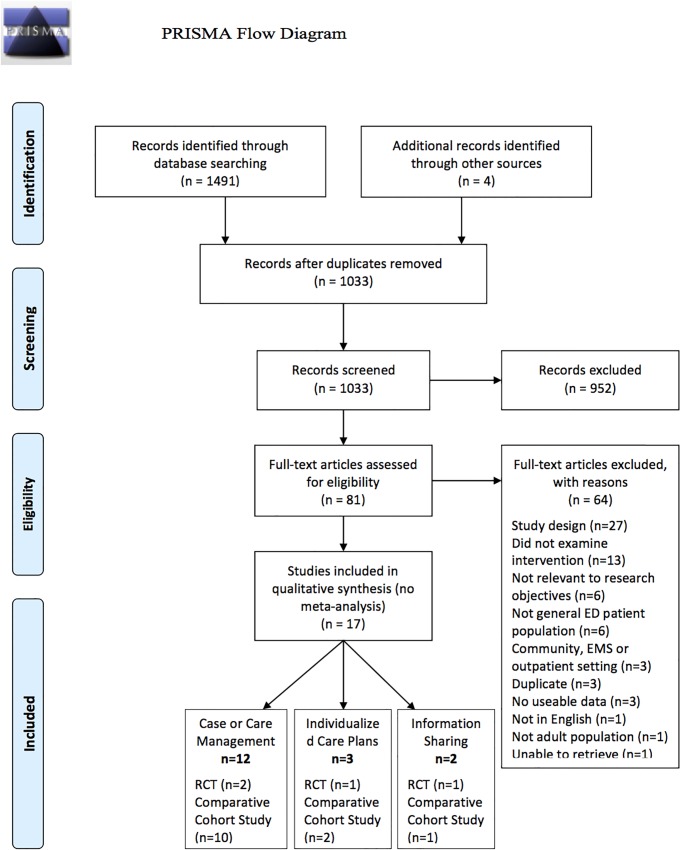
OBJECTIVE: The objective of this study was to establish the effectiveness of interventions to reduce frequent emergency department (ED) use among a general adult high ED-use population. METHODS: Systematic review of the literature from 1950-January 2015. Studies were included if they: had a control group (controlled trials or comparative cohort studies), were set in an ED or acute care facility, and examined the impact of an intervention to reduce frequent ED use in a general adult population. Studies reporting non-original data or focused on a specific patient population were excluded. Study design, patient population, intervention, the frequency of ED visits, and costs of frequent ED use and/or interventions were extracted and narratively synthesized. RESULTS: Among 17 included articles, three intervention categories were identified: case management (n = 12), individualized care plans (n = 3), and information sharing (n = 2). Ten studies examining case management reported reductions in mean (-0.66 to -37) or median (-0.1 to -20) number of ED visits after 12-months; one study reported an increase in mean ED visits (+2.79); and one reported no change. Of these, 6 studies also reported reduced hospital costs. Only 1 study evaluating individualized care plans examined ED utilization and found no change in median ED visits post-intervention. Costs following individualized care plans were also only evaluated in 1 study, which reported savings in hospital costs of $742/patient. Evidence was mixed regarding information sharing: 1 study reported no change in mean ED visits and did not examine costs; whereas the other reported a decrease in mean ED visits (-16.9) and ED cost savings of $15,513/patient. CONCLUSIONS: The impact of all three frequent-user interventions was modest. Case management had the most rigorous evidence base, yielded moderate cost savings, but with variable reductions in ED use. Future studies evaluating non-traditional interventions, tailoring to patient subgroups or socio-cultural contexts, are warranted.
Overview
The claims and statistics of this paper haven’t been checked yet.
Run the check — free, no account needed. It reads the open-access text and checks the sources it cites.
Integrity signals
Registry
Cites
Statistics
Figures
Verification
Claims the paper makes
The claims and statistics of this paper haven’t been checked yet.
Run the check — free, no account needed. It reads the open-access text and checks the sources it cites.
Claims other papers make about this one
Each is checked against this paper’s own text: does it say what the citing paper says it does?
In the citing paper
“The relative strength of the association we observed with past ED visits is informative, suggesting that past ED use would be useful measure to identify patients who would benefit from closer follow-up, geriatric referral, ED-to-community transition support, and closer engagement with primary care and home care.36”
From Factors associated with recurrent emergency department visits among people living with dementia: A retrospective cohort study (2023) · cites this paper as [36]
Self-check
Percentages, sums and reported differences re-computed from the paper’s own numbers.
The self-check needs the paper’s full text.
Citations
Cites
Preferred Reporting Items for Systematic Reviews and Meta-Analyses: the PRISMA statement
Moher, D., Liberati, A., Tetzlaff, J., Altman, D. G., & for the PRISMA Group (2009) · BMJ · doi:10.1136/bmj.b2535 · Cited by 83,823
Preferred reporting items for systematic reviews and meta-analyses: the PRISMA Statement.
(2009) · PubMed Central · Cited by 44,859
Preferred reporting items for systematic reviews and meta-analyses: The PRISMA statement
Moher, D., Liberati, A., Tetzlaff, J., Altman, D. G., & the PRISMA Group* (2009) · Annals of Internal Medicine · doi:10.7326/0003-4819-151-4-200908180-00135 · Cited by 37,554
The Cochrane Collaboration's tool for assessing risk of bias in randomised trials
Higgins, J. P. T., Altman, D. G., Gotzsche, P. C., Juni, P., Moher, D., Oxman, A. D., Savovic, J., Schulz, K. F., Weeks, L., Sterne, J. A. C., et al. (2011) · BMJ · doi:10.1136/bmj.d5928 · Cited by 33,817
Dermyshi, E., Wang, Y., Yan, C., Hong, W., Qiu, G., Gong, X., & Zhang, T. (2017) · Neonatology · doi:10.1159/000454668 · Cited by 24,586
Downs, S. H., & Black, N. (1998) · Journal of Epidemiology and Community Health · doi:10.1136/jech.52.6.377 · Cited by 8,252
Frequent Users of Emergency Departments: The Myths, the Data, and the Policy Implications
LaCalle, E., & Rabin, E. (2010) · Annals of Emergency Medicine · doi:10.1016/j.annemergmed.2010.01.032 · Cited by 648
Althaus, F., Paroz, S., Hügli, O., Ghali, W. A., Daeppen, J., Peytremann‐Bridevaux, I., & Bodenmann, P. (2011) · Annals of Emergency Medicine · doi:10.1016/j.annemergmed.2011.03.007 · Cited by 319
Hansagi, H., Olsson, M., Sjöberg, S., Tomson, Y., & Göransson, S. (2001) · Annals of Emergency Medicine · doi:10.1067/mem.2001.111762 · Cited by 318
Weintraub, N. L., Collins, S. P., Pang, P. S., Levy, P. D., Anderson, A. S., Arslanian‐Engoren, C., Gibler, W. B., McCord, J., Parshall, M. B., Francis, G. S., et al. (2010) · Circulation · doi:10.1161/cir.0b013e3181f9a223 · Cited by 274
Cited by
Sorted by citations
Items 201–251 of 251
Abazi, L. F., Lindqvist, E., Edman, G., Norberg, M., Bergman, J., Zachrisson, I., & Forsberg, S. (2021) · F1000Research · doi:10.12688/f1000research.53193.1 · Cited by 1
Rejon, C. S., Kirbyshire, M., Thorpe, R. J., Myring, G., Evans, C., Lloyd-Rees, J., Bezer, A., & McLeod, H. (2023) · medRxiv · doi:10.1101/2023.04.17.23287910 · Cited by 1
Non-Emergency Department (ED) Interventions to Reduce ED Utilization: a Scoping ReviewPreprint
Nummedal, M. A., Bjørnsen, L. P., King, S. E., Pedersen, S. A., & Uleberg, O. (2023) · Research Square · doi:10.21203/rs.3.rs-3296308/v1 · Cited by 1
Persons who frequently visit the psychiatric emergency room. Who are they and what are their needs
Schmidt, M. (2018) · Lund University Publications (Lund University)
Shaheen, S. P. (2019) · Springer eBooks · doi:10.1007/978-3-319-98343-1_142
Preventing Emergency Department Overutilization for Florida’s Seasonal Resident Population
Garcia, A. (2018) · University of New Hampshire Scholars Repository (University of New Hampshire at Manchester)
The Association Between Behavior Disorders and Return Visit to the Emergency Department
Fraguada, D. (2019) · ScholarWorks (Walden University)
An approach to interprofessional management of complex patients: a case report.
Bauman, C. A., Fillingham, J., Candidate, E., Keely-Dyck, E., Elrafih, Y., Stevenson, J., Boehm, M., Haesler, L., Kaufman, S., Duck, T., et al. (2019) · PubMed Central
The Effect of Individual Care of Case Manager on Breast Cancer Patients
Wang, L., Ma, Y., & Lin, J. (2020) · American Journal of Nursing Science · doi:10.11648/j.ajns.20200903.18
Hudelson, C. E. (2018) · Digital Access to Scholarship at Harvard (DASH) (Harvard University)
Frequent Emergency Department Use: A Social Emergency Medicine Perspective
Raven, M. C., & Kanzaria, H. K. (2021) · Springer eBooks · doi:10.1007/978-3-030-65672-0_9
Gonçalves, S., von Hafe, F., Martins, F., Menino, C., Guimarães, M. J., Mesquita, A., Sampaio, S., & Londral, A. R. M. (2021) · Research Square · doi:10.21203/rs.3.rs-991452/v1
Valenzi, N. (2023) · Western Journal of Emergency Medicine · doi:10.5811/westjem.61977
Special Issue on Social Emergency Medicine
Saucedo, C. (2023) · Western Journal of Emergency Medicine · doi:10.5811/westjem.62279 · Cited by 1
Case management for acquired brain injury: A systematic review of the evidence base.Preprint
Leonard, R. A., Linden, M., & Holloway, M. (2023) · Research Square · doi:10.21203/rs.3.rs-3660598/v1
Emergency Department Psychiatry
Thomson, A. B., & Albert, R. (2023) · Cambridge University Press eBooks · doi:10.1017/9781911623533.023
The Evidence Base for Consultation-Liaison Psychiatry
Guthrie, E. (2023) · Cambridge University Press eBooks · doi:10.1017/9781911623533.021
Hudon, C., Chouinard, M., Doucet, S. A., Piccinini‐Vallis, H., Fairman, K., Sampalli, T., Zed, J., Brodeur, M., Chênevert, D., Dépelteau, A., et al. (2024) · BMJ Open · doi:10.1136/bmjopen-2023-083783
Mauch, L., Sarti, T. D., de Abreu, K. C. M., & Almeida, A. P. S. C. (2024) · BMC Health Services Research · doi:10.1186/s12913-024-11427-9
Rupprecht, M., Campione, A., Wu, Y. N., Fischer‐Rosinsky, A., Slagman, A. C., Riedlinger, D., Möckel, M. M., Keil, T. O. P., Reitzle, L., & Henschke, C. (2025) · Frontiers in Medicine · doi:10.3389/fmed.2025.1509220
Lavelle-Cafferkey, S., Sheerin, F. K., & Comiskey, C. M. (2025) · Emergency Nurse · doi:10.7748/en.2025.e2253
Chastonay, O. J., Lemoine, M., Grazioli, V. S., Canepa Allen, M., Kasztura, M., Moullin, J. C., Daeppen, J.-B., Hügli, O., & Bodenmann, P. (2021) · Figshare · doi:10.6084/m9.figshare.13544152
Additional file 1 of CONECT-6: a case-finding tool to identify patients with complex health needs
Hudon, C., Bisson, M., Dubois, M., Chiu, Y. M., Chouinard, M., Dubuc, N., Elazhary, N., Sabourin, V., & Vanasse, A. (2021) · Figshare · doi:10.6084/m9.figshare.14053722
Chastonay, O. J., Lemoine, M., Grazioli, V. S., Canepa Allen, M., Kasztura, M., Moullin, J. C., Daeppen, J.-B., Hügli, O., & Bodenmann, P. (2021) · Figshare · doi:10.6084/m9.figshare.13544149
Hudon, C., Bisson, M., Chouinard, M., Delahunty‐Pike, A., Lambert, M., Howse, D., Schwarz, C., Dumont‐Samson, O., Aubrey-Bassler, K., Burge, F., et al. (2023) · Figshare · doi:10.6084/m9.figshare.22662482
Magwenzi, P., Rusakaniko, S., Sibanda, E. N., & Fz, G. (2022) · Figshare · doi:10.6084/m9.figshare.21162922
Additional file 1 of Caring for high-need patients
Hempel, S., Bolshakova, M., Hochman, M. E., Jimenez, E. E., Thompson, G., Motala, A., Ganz, D. A., Gabrielian, S. E., Edwards, S. T., Zenner, J., et al. (2023) · Figshare · doi:10.6084/m9.figshare.24630333
Moe, J., Wang, Y. E., Schull, M. J., Dong, K., McGregor, M. J., Hohl, C. M., Holroyd, B. R., & McGrail, K. M. (2022) · Figshare · doi:10.6084/m9.figshare.20317860
Magwenzi, P., Rusakaniko, S., Sibanda, E. N., & Gumbo, F. Z. (2022) · Figshare · doi:10.6084/m9.figshare.21162919
Purkey, E., Davison, C., MacKenzie, M., Beckett, T., Korpal, D., Soucie, K., & Bartels, S. A. (2020) · Figshare · doi:10.6084/m9.figshare.12365117
Gonçalves, S., von Hafe, F., Martins, F., Menino, C., Guimarães, M. J., Mesquita, A., Sampaio, S., & Londral, A. R. M. (2022) · Figshare · doi:10.6084/m9.figshare.21102344
Magwenzi, P., Rusakaniko, S., Sibanda, E. N., & Fz, G. (2022) · Figshare · doi:10.6084/m9.figshare.21162925
Chastonay, O. J., Lemoine, M., Grazioli, V. S., Canepa Allen, M., Kasztura, M., Moullin, J. C., Daeppen, J.-B., Hügli, O., & Bodenmann, P. (2021) · Figshare · doi:10.6084/m9.figshare.13544146
Suicide Prevention in Clinical Practice
Gask, L. L., & Thomson, A. (2025) · Cambridge University Press eBooks · doi:10.1017/9781108963763.014
Cartographie et analyse des parcours des patients de plus de 75 ans aux urgences
Colleter, L. L., Dehaut, H., Telle, K., Bas, H., & Puisieux, F. (2026) · Soins · doi:10.1016/j.soin.2025.11.008
Ibrahim, M. M., AlHammadi, A., AlHamadi, A., Pilankuveedu, S., Naqvi, S. A., Vinodson, B., Preman, N., & Khan, Y. (2026) · Telemedicine Journal and e-Health · doi:10.1177/15305627251411362
Fleury, M., Cao, Z., & Grenier, G. (2026) · Substance Abuse Treatment Prevention and Policy · doi:10.1186/s13011-026-00708-7
Greengross, P., Ismail, I., Parr, C., Wright, R., & Hunter, S. (2026) · JRSM Open · doi:10.1177/20542704251413949
Adeyemo, A. (2026) · SSRN Electronic Journal · doi:10.2139/ssrn.6207018
Improving Emergency Department Staff Satisfaction Through Lean Thinking: Evidence From a Mixed Study
Pastor-Puigdomènech, A., Sánchez, M., Font‐Cabrera, C., Fabrellas, N., Benito‐Aracil, L., & Guix‐Comellas, E. M. (2026) · Journal of Nursing Management · doi:10.1155/jonm/2158539
Contribution des études observationnelles dans la méta-analyse
Cheurfa, C. (2023) · theses.fr (ABES) · doi:10.70675/ecaa782bz76f7z4c43za043ze1d3e0cfbfaa
Mou, L., Lau, Y., & William, W. (2026) · Health Policy · doi:10.1016/j.healthpol.2026.105654
Hsiang, E., Teymourtash, M., & Khan, A. (2026) · Academic Emergency Medicine · doi:10.1111/acem.70368
Health system responses to homelessness in the United States: prevalence and predictors
Dewald, A., Unwala, N., Creedon, T. B., Singer, P. M., & Willison, C. E. (2026) · Health Affairs Scholar · doi:10.1093/haschl/qxag188
Ackers, S. M., & Grace, J. (2026) · Journal of Child & Adolescent Trauma · doi:10.1007/s40653-026-00955-7
Samosh, J., Agha, A., Pettey, D., & Aubry, T. (2026) · Administration and Policy in Mental Health and Mental Health Services Research · doi:10.1007/s10488-026-01518-6
Advancing Financing Arrangements for Whole-Child Health
Wertman, E., Cholera, R., Ryan, S., & Wong, C. A. (2026) · Pediatric Clinics of North America · doi:10.1016/j.pcl.2026.06.003
Măruşter, L., van der Zee, D.-J., & Dercksen, B. (2026) · medRxiv · doi:10.64898/2026.09.07.26362041
Impact of frequent emergency department visits on resource utilization
Bas, R. K., & Çakmak, S. (2026) · BMC Emergency Medicine · doi:10.1186/s12873-026-01784-5
Kumar, A., Marshall, C. S., Saraiva, S., Lee, W., Mason, S., Burton, C., van der Feltz-Cornelis, C., de la Haye, S., West, R., Bojke, C., et al. (2026) · BJPsych Open · doi:10.1192/bjo.2026.12111
Metadata
- Authors
- Soril, L. J. J., Leggett, L. E., Lorenzetti, D. L., Noseworthy, T. W., & Clement, F. M.
- Affiliations
- O'Brien Institute for Public Health (CA)
- Institute of Health Economics (CA)
- Corresponding author
- Clement, Fiona M.
- Venue
- PLOS ONE
- Publisher
- Public Library of Science (PLoS)
- Published
- 2015-04-13
- Volume
- 10
- Issue
- 4
- Pages
- e0123660
- ISSN
- 1932-6203 (ISSN-L)
- PMC
- PMC4395429
- OpenAlex
- W1965434882
- Cited by
- 251
- References
- 43
- Citations by year
- 2026: 18 · 2025: 17 · 2024: 13 · 2023: 34 · 2022: 28 · 2021: 32 · 2020: 31 · 2019: 22 · 2018: 24 · 2017: 17 · 2016: 14 · 2015: 1
- FWCI
- 4.35
- Type
- journal article
- Language
- en
- Open access
- gold
- doi.org
- Licence
- Locations
- PLoS ONE (publishedVersion, cc-by)
- PubMed Central (publishedVersion, cc-by)
- PubMed (publishedVersion)
- RePEc: Research Papers in Economics (submittedVersion)
- DOAJ (DOAJ: Directory of Open Access Journals) (submittedVersion)
- Figshare (submittedVersion, cc-by)
- Topics
- Health Sciences › Medicine › Emergency Medicine › Emergency and Acute Care Studies
- Health Sciences › Medicine › Epidemiology › Chronic Disease Management Strategies
- Health Sciences › Nursing › Leadership and Management › Hospital Admissions and Outcomes
- Keywords
- frequent emergency department users, emergency department utilization, case management, individualized care plans, information sharing, hospital costs, cost reduction, intervention effectiveness
- MeSH terms
- Adult, Emergency Service, Hospital, Humans, Patient Care Planning, Quality Assurance, Health Care, Randomized Controlled Trials as Topic, Cost Savings, Hospital Costs, Case Management
About these checks
Registry, retraction, Cites and statistics results are computed, not judged, with one exception: a printed reference that no index lists is read once by a model before it counts as a citation error. Claims are extracted by a model and kept only when their quote appears verbatim in the text; each cited source is then checked, with a model’s help, for whether it says what the claim relies on. Those verdicts can be wrong — read the claim’s quote and the cited source before relying on one.
Statistics and arithmetic are recomputed, not judged.
Confidence bands are shown only for fields calibrated on our annotated test set. None is calibrated yet, so no band is shown.
What counts as a claim ›How we measure confidence ›How we check this ›
Are you an author, or do you see a problem with this page? Request a review
