

Diorcinol D Exerts Fungicidal Action against Candida albicans through Cytoplasm Membrane Destruction and ROS Accumulation
Open accessThe DOI matches its Crossref record; 39 of the 40 references it cites were found in a registry or an index.
Abstract
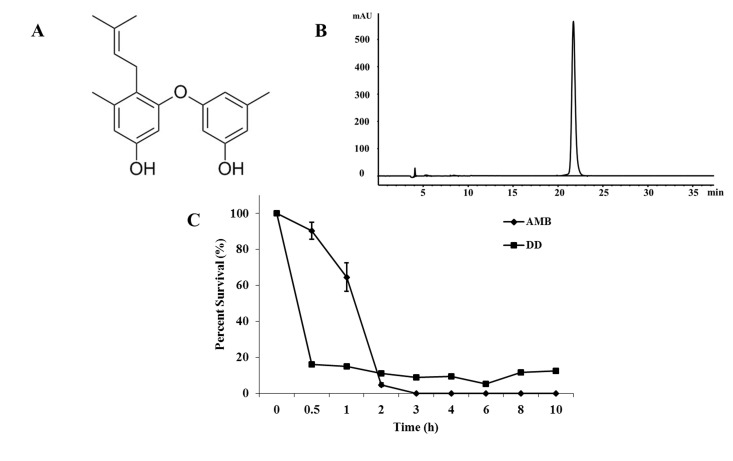
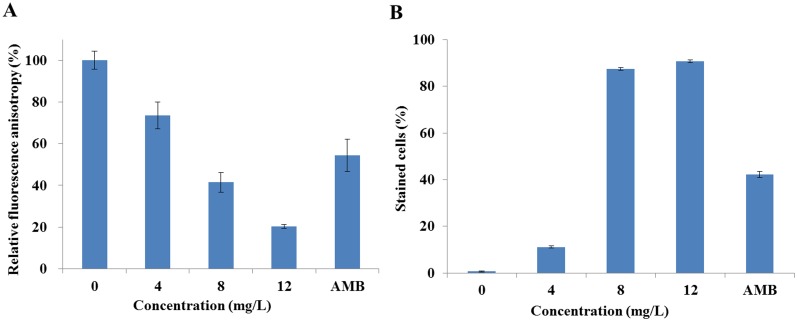
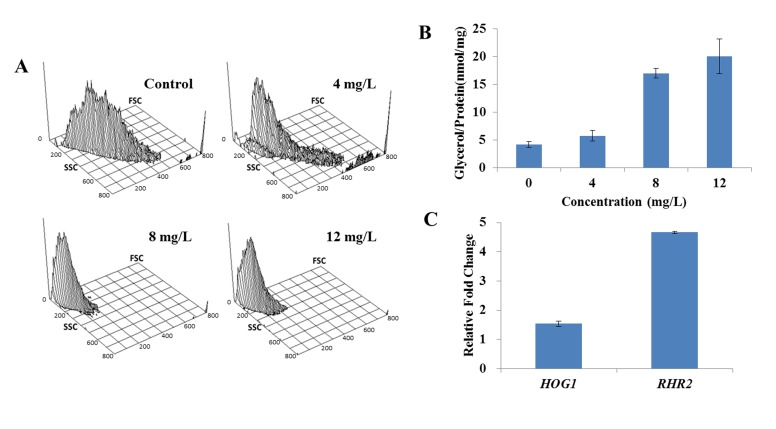
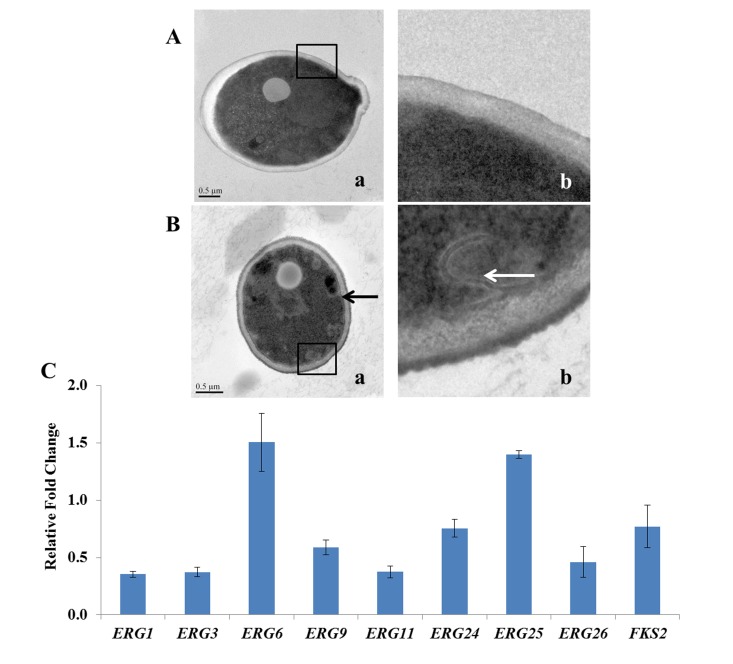
Candida albicans, which is the most common human fungal pathogen, causes high mortality among immunocompromised patients. Antifungal drug resistance becomes a major challenge for the management of Candida infection. Diorcinol D (DD), a diphenyl ether derivative isolated from an endolichenic fungus, exerted fungicidal action against Candida species. In this study, we investigated the possible mechanism of its antifungal activity. The change of membrane dynamics and permeability suggested that the cell membrane was disrupted by the treatment of DD. This was further supported by the evidences of intracellular glycerol accumulation, alteration of cell ultrastructure, and down-regulation of genes involved in cell membrane synthesis. In addition, the treatment of C. albicans with DD resulted in the elevation of reactive oxygen species (ROS), which caused the dysfunction of mitochondria. These altogether suggested that DD exerted its antifungal activity through cytoplasmic membrane destruction and ROS accumulation. This finding is helpful to uncover the underlying mechanisms for the diphenyl ether derivatives and provides a potential application in fighting clinical fungal infections.
Overview
The claims and statistics of this paper haven’t been checked yet.
Free: it reads the open-access text and checks the first 5 claims that cite a source we can check. Create a free account to check every claim.
Integrity signals
Registry
Cites
Statistics
Figures
Verification
Claims the paper makes
The claims and statistics of this paper haven’t been checked yet.
Free: it reads the open-access text and checks the first 5 claims that cite a source we can check. Create a free account to check every claim.
Claims other papers make about this one
Each is checked against this paper’s own text: does it say what the citing paper says it does?
In the citing paper
“The two GFP-tagged C. albicans strains were previously constructed in our laboratory28,40.”
From Chiloscyphenol A derived from Chinese liverworts exerts fungicidal action by eliciting both mitochondrial dysfunction and plasma membrane destruction (2018) · cites this paper as [28]
Self-check
Percentages, sums and reported differences re-computed from the paper’s own numbers.
The self-check needs the paper’s full text.
Citations
Cites
Mosmann, T. (1983) · Journal of Immunological Methods · doi:10.1016/0022-1759(83)90303-4 · Cited by 56,104 · cited 1×
“umbilical vein endothelial cell line) proliferation was determined by a MTT assay, as previously described [14].”
MethodWisplinghoff, H., Bischoff, T., Tallent, S. M., Seifert, H., Wenzel, R. P., & Edmond, M. B. (2004) · Clinical Infectious Diseases · doi:10.1086/421946 · Cited by 4,496 · cited 1×
“Candida species are the fourth most common pathogenic fungus causing nosocomial bloodstream infections in the United States [1].”
BackgroundMechanisms of biofilm resistance to antimicrobial agents
Mah, T.-F. C., & O'Toole, G. A. (2001) · Trends in Microbiology · doi:10.1016/s0966-842x(00)01913-2 · Cited by 3,921 · cited 1×
“In addition, the formation of biofilms dramatically increases the resistance to antimicrobial drugs up to 10–1000 times [6].”
BackgroundLeBel, C. P., Ischiropoulos, H., & Bondy, S. C. (1992) · Chemical Research in Toxicology · doi:10.1021/tx00026a012 · Cited by 2,689 · cited 1×
“Since, fluorescence probe DCFH-DA could cross cell membranes and be hydrolyzed to nonfluorescent DCFH, which could be rapidly oxidized to highly fluorescent 2’,7’-dichlorofluorescein (DCF) by the intracellular ROS, we used DCFH-DA as an indicator to detect the production of ROS [18].”
MethodThe mitochondrial permeability transition
Zoratti, M., & Szabò, I. (1995) · Biochimica et Biophysica Acta (BBA) - Reviews on Biomembranes · doi:10.1016/0304-4157(95)00003-a · Cited by 2,401
Endophytes: a rich source of functional metabolites (1987 to 2000)
Tan, R. X., & Zou, W. X. (2001) · Natural Product Reports · doi:10.1039/b100918o · Cited by 1,764 · cited 1×
“Fungal endophytes, which reside in internal tissues of living plants without causing any immediate overt negative effects, are an alternative prolific source of bioactive natural products with antimicrobial, antiparasitic, cytotoxic, and neuroprotective activities [11,12].”
BackgroundAn Osmosensing Signal Transduction Pathway in Yeast
Brewster, J. L., de Valoir, T., Dwyer, N. D., Winter, E., & Gustin, M. C. (1993) · Science · doi:10.1126/science.7681220 · Cited by 1,248
Antifungal agents: mechanisms of action
Odds, F. C., Brown, A. J. P., & Gow, N. A. R. (2003) · Trends in Microbiology · doi:10.1016/s0966-842x(03)00117-3 · Cited by 1,202 · cited 1×
“Clinical used antifungal drugs often cause side effects, such as nephrotoxicity, hepatotoxicity, haemolytic anaemia, and life threatening arrhythmias due to lack of target specificity [4,5].”
BackgroundMitochondrial reactive oxygen species in cell death signaling
Fleury, C., Mignotte, B., & Vayssière, J.-L. (2002) · Biochimie · doi:10.1016/s0300-9084(02)01369-x · Cited by 1,068 · cited 1×
“albicans cell death is probably applicable to the death of human cells [37,38].”
BackgroundNatural Products as Leads to Potential Drugs: An Old Process or the New Hope for Drug Discovery?
Newman, D. J. (2008) · Journal of Medicinal Chemistry · doi:10.1021/jm0704090 · Cited by 716
Research works printed but not linked: 1
- Nash TH (1996) Lichen biology: Cambridge University Press.
Cited by
Antifungal peptides: To be or not to be membrane active
Rautenbach, M., Troskie, A. M., & Vosloo, J. A. (2016) · Biochimie · doi:10.1016/j.biochi.2016.05.013 · Cited by 202
Synthesis and investigation of novel benzimidazole derivatives as antifungal agents
Chandrika, N. T., Shrestha, S. K., Ngo, H., & Garneau‐Tsodikova, S. (2016) · Bioorganic & Medicinal Chemistry · doi:10.1016/j.bmc.2016.06.010 · Cited by 154
Discovery of β-Carboline Oxadiazole Derivatives as Fungicidal Agents against Rice Sheath Blight
Zhang, Z., Jiang, Z., Zhu, Q., & Zhong, G. (2018) · Journal of Agricultural and Food Chemistry · doi:10.1021/acs.jafc.8b02124 · Cited by 108
Sun, L., Liao, K., Hang, C., & Wang, D. (2017) · PLOS ONE · doi:10.1371/journal.pone.0172228 · Cited by 105
Shang, X., Zhao, Z.-M., Li, J., Yang, G., Liu, Y., Dai, L., Zhang, Z., Yang, Z., Miao, X., Yang, C., et al. (2019) · Industrial Crops and Products · doi:10.1016/j.indcrop.2019.05.055 · Cited by 97
Metadata
- Authors
- Li, Y., Chang, W., Zhang, M., Li, X., Jiao, Y., & Lou, H.
- Affiliations
- Shandong University (CN)
- Venue
- PLOS ONE
- Publisher
- Public Library of Science (PLoS)
- Published
- 2015-06-05
- Volume
- 10
- Issue
- 6
- Pages
- e0128693
- ISSN
- 1932-6203 (ISSN-L)
- PMC
- PMC4457822
- OpenAlex
- W978901490
- Cited by
- 79
- References
- 40
- Citations by year
- 2026: 4 · 2025: 3 · 2024: 10 · 2023: 5 · 2022: 11 · 2021: 8 · 2020: 10 · 2019: 6 · 2018: 7 · 2017: 5 · 2016: 10
- FWCI
- 5.71
- Type
- journal article
- Language
- en
- Open access
- gold
- doi.org
- Licence
- Locations
- PLoS ONE (publishedVersion, cc-by)
- PubMed Central (publishedVersion, cc-by)
- PubMed (publishedVersion)
- DOAJ (DOAJ: Directory of Open Access Journals) (submittedVersion, cc-by-sa)
- Funders
- National Natural Science Foundation of China (81172956, 81273383, 81402804)
- Topics
- Health Sciences › Medicine › Infectious Diseases › Antifungal resistance and susceptibility
- Life Sciences › Agricultural and Biological Sciences › Plant Science › Fungal Plant Pathogen Control
- Life Sciences › Immunology and Microbiology › Applied Microbiology and Biotechnology › Antimicrobial agents and applications
- Keywords
- Candida albicans, antifungal activity, diphenyl ether derivatives, fungal cell membrane disruption, membrane permeability, reactive oxygen species, mitochondrial dysfunction, glycerol accumulation, endolichenic fungi, antifungal resistance, fungal infection
- MeSH terms
- Antifungal Agents, Candida albicans, Candidiasis, Humans, Phenols, Phenyl Ethers, Down-Regulation, Reactive Oxygen Species, Drug Resistance, Fungal
About these checks
Registry, retraction, Cites and statistics results are computed, not judged, with one exception: a printed reference that no index lists is read once by a model before it counts as a citation error. Claims are extracted by a model and kept only when their quote appears verbatim in the text; each cited source is then checked, with a model’s help, for whether it says what the claim relies on. Those verdicts can be wrong — read the claim’s quote and the cited source before relying on one.
Statistics and arithmetic are recomputed, not judged.
Confidence bands are shown only for fields calibrated on our annotated test set. None is calibrated yet, so no band is shown.
What counts as a claim ›How we measure confidence ›How we check this ›
Are you an author, or do you see a problem with this page? Request a review
How to cite
Cite CoChat for the checks on this page, and the paper for its own findings.
- This page
- CoChat. (2026). Citation check: Diorcinol D Exerts Fungicidal Action against Candida albicans through Cytoplasm Membrane Destruction and ROS Accumulation. https://app.cochat.ai/papers/10.1371/journal.pone.0128693
- The paper
- Li, Y., Chang, W., Zhang, M., Li, X., Jiao, Y., & Lou, H. (2015). Diorcinol D Exerts Fungicidal Action against Candida albicans through Cytoplasm Membrane Destruction and ROS Accumulation. PLOS ONE. https://doi.org/10.1371/journal.pone.0128693
Data sources
Bibliographic data: Semantic Scholar, OpenAlex, Crossref.
Contains information from the Semantic Scholar Academic Graph Datasets, made available under the ODC Attribution License (ODC-BY 1.0).
Semantic Scholar’s data is described in: Kinney, R., et al. (2023). The Semantic Scholar Open Data Platform. arXiv:2301.10140.
