

The DOI matches its Crossref record; 30 of the 31 references it cites were found in a registry or an index, and 1 are not checked yet.
Organized Sport Participation Is Associated with Higher Levels of Overall Health-Related Physical Activity in Children (CHAMPS Study-DK)
Open accessAbstract
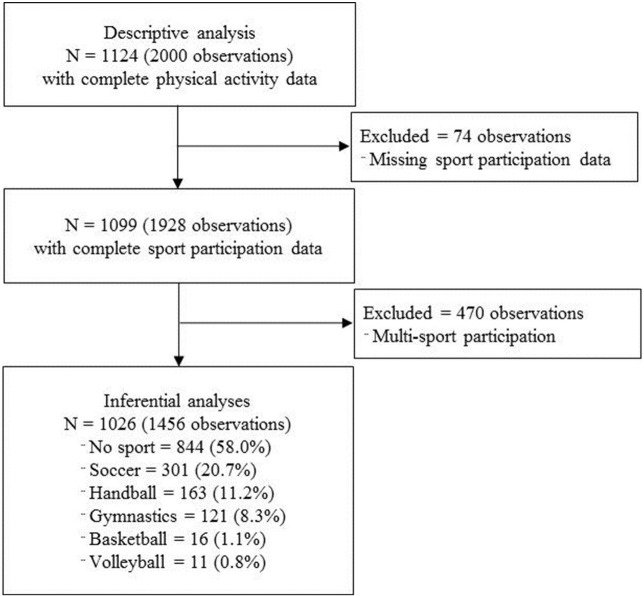
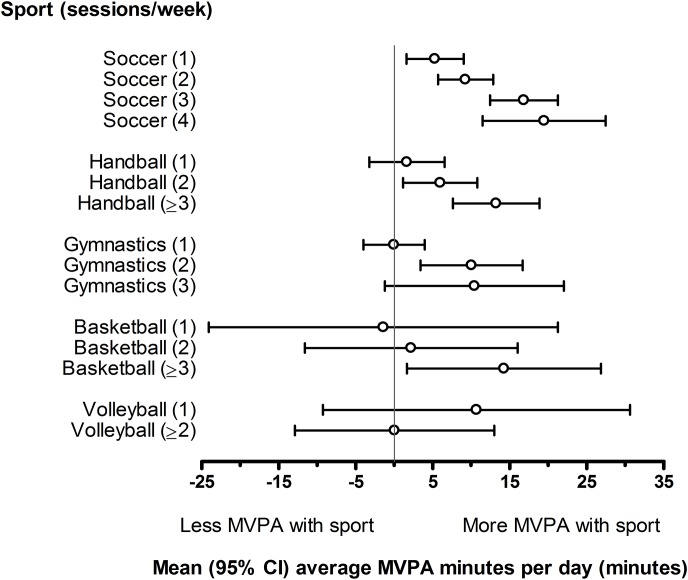
INTRODUCTION: Many children fail to meet international guideline recommendations for health-related activity (≥60 minutes/day of moderate-to-vigorous physical activity [MVPA]), and intervention studies to date have reported negligible effects. OBJECTIVE: Explore the associations of organized leisure-time sport participation with overall physical activity levels and health-related physical activity guideline concordance. METHODS: This prospective cohort study was nested in the Childhood Health, Activity, and Motor Performance School Study Denmark. Study participants were a representative sample of 1124 primary school students. Organized leisure-time sport participation was reported via text messaging and physical activity was objectively measured over seven days with accelerometry. Associations between sport participation and physical activity level were explored with multilevel mixed-effects regression models and reported with beta coefficients (b) and adjusted odds ratios (aOR). RESULTS: Participants were 53% female, with mean(SD) age = 8.4(1.4) years. Boys were more active than girls (p<0.001), and physical activity levels and guideline concordance decreased with age (p<0.001). Soccer participation at any frequency was associated with greater overall MVPA (b[95% CI] = 0.66[0.20,1.13] to 2.44[1.44,3.44]). Depending on participation frequency, this equates to 5-20 minutes more MVPA on the average day and 3 to 15 fold increased odds of achieving recommended levels of health-related physical activity (aOR[95%CI] = 3.04[1.49,6.19] to 14.49[1.97,106.56]). Similar associations were identified among children playing handball at least twice per week. Relationships with other sports (gymnastics, basketball, volleyball) were inconsistent. CONCLUSIONS: Many children, particularly girls and those in higher grade levels do not adhere to health-related physical activity recommendations. Organized leisure-time sport participation may be a viable strategy to increase overall health-related physical activity levels and international guideline concordance in children.
Overview
The claims and statistics of this paper haven’t been checked yet.
Run the check — free, no account needed. It reads the open-access text and checks the sources it cites.
Integrity signals
Registry
Cites
Statistics
Figures
Verification
Claims the paper makes
The claims and statistics of this paper haven’t been checked yet.
Run the check — free, no account needed. It reads the open-access text and checks the sources it cites.
Claims other papers make about this one
Each is checked against this paper’s own text: does it say what the citing paper says it does?
The source backs part of the claim, not all of it — or backs it for a different population, condition or comparison.
In the citing paper
“In a recent study of Danish primary school students [22], differences in objectively assessed physical activity between sports participants and their non-sporting peers were large for soccer and handball.”
From Framework for the design and delivery of organized physical activity sessions for children and adolescents: rationale and description of the ‘SAAFE’ teaching principles (2017) · cites this paper as [22]
Experimental — accuracy not yet measuredThe source backs part of the claim, not all of it — or backs it for a different population, condition or comparison.
In the citing paper
“However, participation in basketball, volleyball and gymnastics contributed little to overall physical activity levels, and students participating in these sports were no more likely to meet physical activity guidelines than non-sporting youth [22].”
From Framework for the design and delivery of organized physical activity sessions for children and adolescents: rationale and description of the ‘SAAFE’ teaching principles (2017) · cites this paper as [22]
Experimental — accuracy not yet measuredThe cited source says what the claim attributes to it.
In the citing paper
“The contribution of youth sports to habitual physical activity may also not be as large as commonly thought [22–24].”
Self-check
Percentages, sums and reported differences re-computed from the paper’s own numbers.
The self-check needs the paper’s full text.
Citations
Cites
Hao (2015) · doi:10.1002/14651858 · Cited by 11,321
‘Small Changes' to Diet and Physical Activity Behaviors for Weight Management
Hills, A. P., Byrne, N. M., Lindstrom, R. C., & Hill, J. O. (2013) · Obesity Facts · doi:10.1159/000345030 · Cited by 9,526
Physical Activity in the United States Measured by Accelerometer
TROIANO, R. P., BERRIGAN, D., DODD, K. W., MÂSSE, L. C., TILERT, T., & MCDOWELL, M. (2008) · Medicine & Science in Sports & Exercise · doi:10.1249/mss.0b013e31815a51b3 · Cited by 7,638
Janssen, I., & LeBlanc, A. G. (2010) · International Journal of Behavioral Nutrition and Physical Activity · doi:10.1186/1479-5868-7-40 · Cited by 4,829
Evidence Based Physical Activity for School-age Youth
Strong, W. B., Malina, R. M., Blimkie, C. J. R., Daniels, S. R., Dishman, R. K., Gutin, B., Hergenroeder, A. C., Must, A., Nixon, P. A., Pivarnik, J. M., et al. (2005) · The Journal of Pediatrics · doi:10.1016/j.jpeds.2005.01.055 · Cited by 4,222
Calibration of two objective measures of physical activity for children
Evenson, K. R., Catellier, D. J., Gill, K., Ondrak, K. S., & McMurray, R. G. (2008) · Journal of Sports Sciences · doi:10.1080/02640410802334196 · Cited by 2,677
Eime, R. M., Young, J. A., Harvey, J. T., Charity, M. J., & Payne, W. R. (2013) · International Journal of Behavioral Nutrition and Physical Activity · doi:10.1186/1479-5868-10-98 · Cited by 2,366
Dobbins, M., Husson, H., DeCorby, K., & LaRocca, R. L. (2013) · Cochrane Database of Systematic Reviews · doi:10.1002/14651858.cd007651.pub2 · Cited by 1,358
Moderate-to-Vigorous Physical Activity From Ages 9 to 15 Years
Nader, P. R. (2008) · JAMA · doi:10.1001/jama.300.3.295 · Cited by 1,213
Hilpert, M., Brockmeier, K., Dordel, S., Koch, B., Weiß, V., Ferrari, N., Tokarski, W., & Gräf, C. (2017) · Obesity Facts · doi:10.1159/000464105 · Cited by 1,185
Metcalf, B., Henley, W., & Wilkin, T. (2012) · BMJ · doi:10.1136/bmj.e5888 · Cited by 658
Hills, A. P., King, N. A., & Armstrong, T. P. (2007) · Sports Medicine · doi:10.2165/00007256-200737060-00006 · Cited by 560
Sport and exercise as contributors to the health of nations
Khan, K. M., Thompson, A. M., Blair, S. N., Sallis, J. F., Powell, K. E., Bull, F., & Bauman, A. E. (2012) · The Lancet · doi:10.1016/s0140-6736(12)60865-4 · Cited by 513
Physical Activity Levels of Children Who Walk, Cycle, or Are Driven to School
Cooper, A. R., Andersen, L. B., Wedderkopp, N., Page, A. S., & Froberg, K. (2005) · American Journal of Preventive Medicine · doi:10.1016/j.amepre.2005.05.009 · Cited by 400
Self-citationThe biological basis of physical activity
Rowland, T. (1998) · Medicine & Science in Sports & Exercise · doi:10.1097/00005768-199803000-00009 · Cited by 351
The Exercise is Medicine Global Health Initiative: a 2014 update
Lobelo, F., Stoutenberg, M., & Hutber, A. (2014) · British Journal of Sports Medicine · doi:10.1136/bjsports-2013-093080 · Cited by 281
Marques, A., Ekelund, U., & Sardinha, L. B. (2015) · Journal of science and medicine in sport · doi:10.1016/j.jsams.2015.02.007 · Cited by 257
Gomersall, S. R., Rowlands, A. V., English, C., Maher, C. A., & Olds, T. (2012) · Sports Medicine · doi:10.1007/s40279-012-0008-7 · Cited by 225
Physical Activity During Youth Sports Practices
Leek, D., Carlson, J. A., Cain, K. L., Henrichon, S., Rosenberg, D., Patrick, K., & Sallis, J. F. (2011) · Archives of Pediatrics & Adolescent Medicine · doi:10.1001/archpediatrics.2010.252 · Cited by 192
Developing healthcare systems to support exercise: exercise as the fifth vital sign
Sallis, R. E. (2011) · British Journal of Sports Medicine · doi:10.1136/bjsm.2010.083469 · Cited by 182
Johansen, B., & Wedderkopp, N. (2010) · Chiropractic & Manual Therapies · doi:10.1186/1746-1340-18-10 · Cited by 139
Self-citationWedderkopp, N., Jespersen, E., Franz, C., Klakk, H., Heidemann, M., Rexen, C. T., Møller, N. C., & Leboeuf‐Yde, C. (2012) · BMC Pediatrics · doi:10.1186/1471-2431-12-128 · Cited by 120
Self-citationGirls’ Physical Activity Levels during Organized Sports in Australia
GUAGLIANO, J. M., ROSENKRANZ, R. R., & KOLT, G. S. (2013) · Medicine & Science in Sports & Exercise · doi:10.1249/mss.0b013e31826a0a73 · Cited by 103
Møller, N. C., Tarp, J., Kamelarczyk, E. F., Brønd, J. C., Klakk, H., & Wedderkopp, N. (2014) · International Journal of Behavioral Nutrition and Physical Activity · doi:10.1186/s12966-014-0121-0 · Cited by 93
Self-citationBaranowski, T., Smith, M., Baranowski, J. C., Wang, D. T., Doyle, C., Lin, L. S., Hearn, M. D., & Resnicow, K. (1997) · Journal of the American Dietetic Association · doi:10.1016/s0002-8223(97)00022-9 · Cited by 89
Basterfield, L., Reilly, J. K., Pearce, M. S., Parkinson, K. N., Adamson, A., Reilly, J. J., & Vella, S. A. (2014) · Journal of science and medicine in sport · doi:10.1016/j.jsams.2014.03.005 · Cited by 84
Predictors of growth and decline in leisure time physical activity from adolescence to adulthood.
Wichstrøm, L., von Soest, T., & Kvalem, I. L. (2012) · Health Psychology · doi:10.1037/a0029465 · Cited by 79
Sacheck, J. M., Nelson, T., Ficker, L., Kafka, T., Kuder, J., & Economos, C. D. (2011) · Pediatric Exercise Science · doi:10.1123/pes.23.2.281 · Cited by 73
Determinants of sufficient daily activity in Australian primary school children
Spinks, A. B., Macpherson, A., Bain, C., & McClure, R. (2006) · Journal of Paediatrics and Child Health · doi:10.1111/j.1440-1754.2006.00950.x · Cited by 59
Practical Approaches to Office-Based Physical Activity Promotion for Children and Adolescents
Joy, E. A. (2008) · Current Sports Medicine Reports · doi:10.1249/jsr.0b013e31818ec87b · Cited by 18
Testing the activitystat hypothesis: a randomised controlled trial protocol
Gomersall, S. R., Maher, C. A., Norton, K. I., Dollman, J., Tomkinson, G. R., Esterman, A., English, C., Lewis, N., & Olds, T. (2012) · BMC Public Health · doi:10.1186/1471-2458-12-851 · Cited by 7
Cited by
Sorted by citations
Organized Sports for Children, Preadolescents, and Adolescents
Logan, K., Cuff, S., COUNCIL ON SPORTS MEDICINE AND FITNESS, LaBella, C. R., Brooks, M. A., Canty, G., Diamond, A. B., Hennrikus, W., Moffatt, K., Nemeth, B. A., et al. (2019) · Pediatrics · doi:10.1542/peds.2019-0997 · Cited by 261
Lubans, D. R., Lonsdale, C., Cohen, K., Eather, N., Beauchamp, M. R., Morgan, P. J., Sylvester, B. D., & Smith, J. J. (2017) · International Journal of Behavioral Nutrition and Physical Activity · doi:10.1186/s12966-017-0479-x · Cited by 180
“However, participation in basketball, volleyball and gymnastics contributed little to overall physical activity levels, and students participating in these sports were no more likely to meet physical activity guidelines than nonsporting youth [22].”
BackgroundAutonomy support in sport and exercise settings: a systematic review and meta-analysis
Mossman, L. H., Slemp, G. R., Lewis, K. J., Colla, R. H., & O’Halloran, P. (2022) · International Review of Sport and Exercise Psychology · doi:10.1080/1750984x.2022.2031252 · Cited by 229
Meester, A. D., Maes, J., Stodden, D. F., Cardon, G., Goodway, J. D., Lenoir, M., & Haerens, L. L. (2016) · Journal of Sports Sciences · doi:10.1080/02640414.2016.1149608 · Cited by 151
Psychosocial Impacts of Sports-related Injuries in Adolescent Athletes
Haraldsdóttir, K., & Watson, A. M. (2021) · Current Sports Medicine Reports · doi:10.1249/jsr.0000000000000809 · Cited by 102
Metadata
- Authors
- Hebert, J. J., Møller, N. C., Andersen, L. B., & Wedderkopp, N.
- Affiliations
- University of Southern Denmark (DK)
- Venue
- PLOS ONE
- Publisher
- Public Library of Science (PLoS)
- Published
- 2015-08-11
- Volume
- 10
- Issue
- 8
- Pages
- e0134621
- ISSN
- 1932-6203 (ISSN-L)
- PMC
- PMC4532417
- OpenAlex
- W1765938683
- Cited by
- 151
- References
- 30
- Citations by year
- 2026: 4 · 2025: 18 · 2024: 15 · 2023: 18 · 2022: 18 · 2021: 18 · 2020: 12 · 2019: 16 · 2018: 20 · 2017: 6 · 2016: 6
- FWCI
- 7.86
- Type
- journal article
- Language
- en
- Open access
- gold
- doi.org
- Licence
- Locations
- PLoS ONE (publishedVersion, cc-by)
- Europe PMC (PubMed Central) (publishedVersion, cc-by)
- PubMed Central (publishedVersion, cc-by)
- PubMed (publishedVersion)
- University of Southern Denmark Research Portal (University of Southern Denmark) (publishedVersion)
- BIBSYS Brage (BIBSYS (Norway)) (acceptedVersion)
- Murdoch University Research Portal (submittedVersion)
- DOAJ (DOAJ: Directory of Open Access Journals) (submittedVersion, cc-by-sa)
- NORA - Norwegian Open Research Archives (submittedVersion, cc-by-nc)
- Funders
- Gigtforeningen
- Nordisk Institut for Kiropraktik og Klinisk Biomekanik
- Nordea-fonden
- Syddansk Universitet
- TrygFonden
- Egmont Fonden
- IMK Almene Fond
- Topics
- Health Sciences › Medicine › Public Health, Environmental and Occupational Health › Physical Activity and Health
- Social Sciences › Life-span and Life-course Studies › Recreational Sport and Physical Activity
- Health Sciences › Medicine › Public Health, Environmental and Occupational Health › Obesity, Physical Activity, Diet
- Keywords
- organized sports participation, recreational sports, children, health-related physical activity, moderate-to-vigorous physical activity, physical activity guidelines, soccer, handball, sex differences, age differences, elementary school students, accelerometer-measured activity
- MeSH terms
- Child, Female, Health, Humans, Leisure Activities, Male, Motor Activity, Prospective Studies, Sex Factors, Sports, Time Factors, Cohort Studies, Health Behavior
About these checks
Registry, retraction, Cites and statistics results are computed, not judged, with one exception: a printed reference that no index lists is read once by a model before it counts as a citation error. Claims are extracted by a model and kept only when their quote appears verbatim in the text; each cited source is then checked, with a model’s help, for whether it says what the claim relies on. Those verdicts can be wrong — read the claim’s quote and the cited source before relying on one.
Statistics and arithmetic are recomputed, not judged.
Confidence bands are shown only for fields calibrated on our annotated test set. None is calibrated yet, so no band is shown.
What counts as a claim ›How we measure confidence ›How we check this ›
Are you an author, or do you see a problem with this page? Request a review
