

Playing 20 Questions with the Mind: Collaborative Problem Solving by Humans Using a Brain-to-Brain Interface
Open accessThe DOI matches its Crossref record; 25 of the 27 references it cites were found in a registry or an index.
Abstract
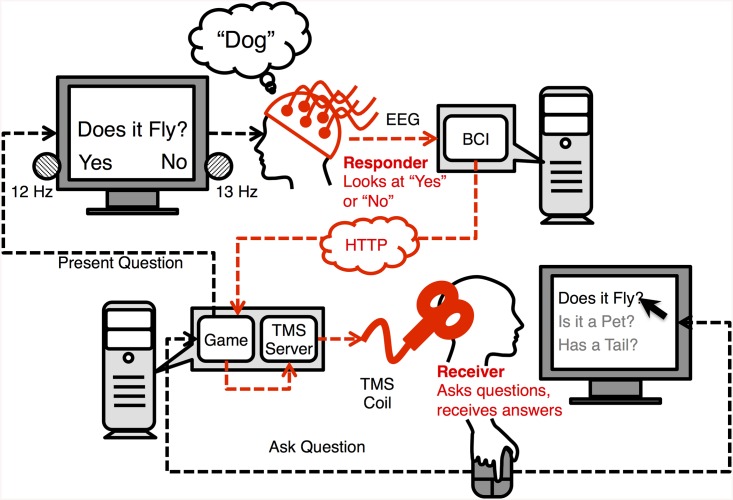
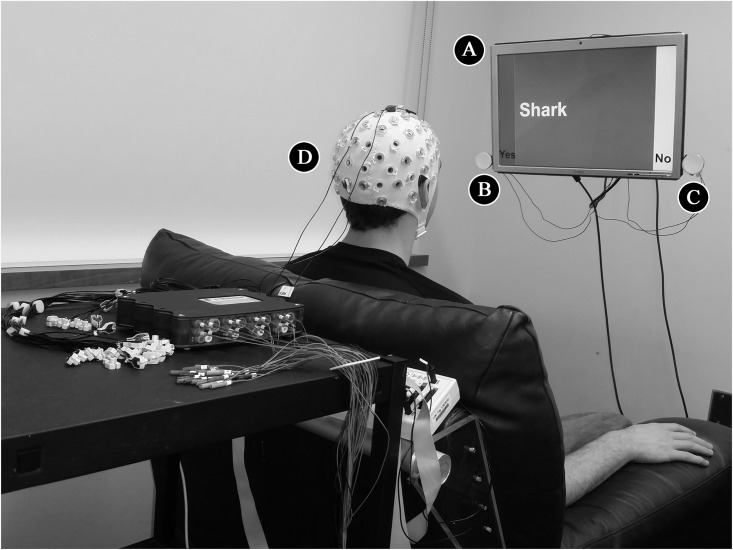
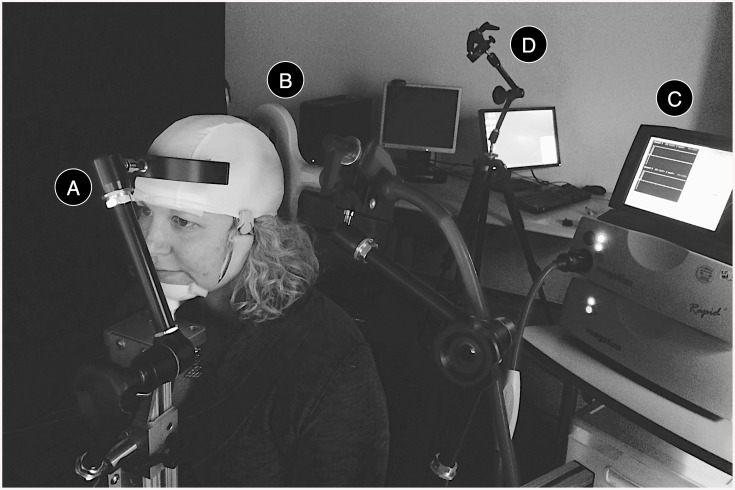
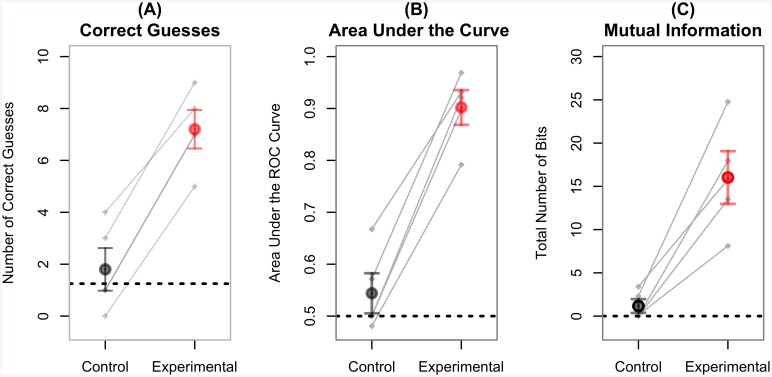
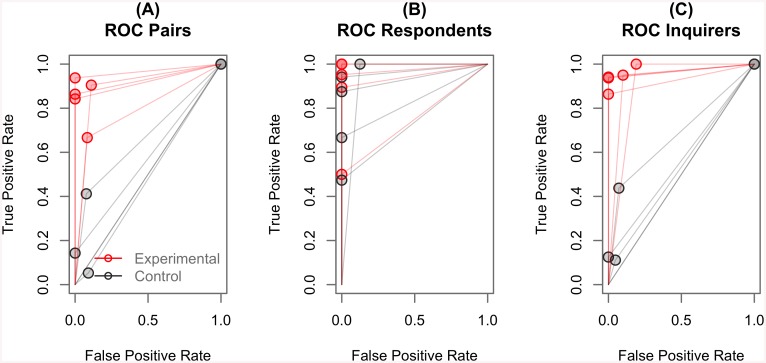
We present, to our knowledge, the first demonstration that a non-invasive brain-to-brain interface (BBI) can be used to allow one human to guess what is on the mind of another human through an interactive question-and-answering paradigm similar to the "20 Questions" game. As in previous non-invasive BBI studies in humans, our interface uses electroencephalography (EEG) to detect specific patterns of brain activity from one participant (the "respondent"), and transcranial magnetic stimulation (TMS) to deliver functionally-relevant information to the brain of a second participant (the "inquirer"). Our results extend previous BBI research by (1) using stimulation of the visual cortex to convey visual stimuli that are privately experienced and consciously perceived by the inquirer; (2) exploiting real-time rather than off-line communication of information from one brain to another; and (3) employing an interactive task, in which the inquirer and respondent must exchange information bi-directionally to collaboratively solve the task. The results demonstrate that using the BBI, ten participants (five inquirer-respondent pairs) can successfully identify a "mystery item" using a true/false question-answering protocol similar to the "20 Questions" game, with high levels of accuracy that are significantly greater than a control condition in which participants were connected through a sham BBI.
Overview
The claims and statistics of this paper haven’t been checked yet.
Free: it reads the open-access text and checks the first 5 claims that cite a source we can check. Create a free account to check every claim.
Integrity signals
Registry
Cites
Statistics
Figures
Verification
Claims the paper makes
The claims and statistics of this paper haven’t been checked yet.
Free: it reads the open-access text and checks the first 5 claims that cite a source we can check. Create a free account to check every claim.
Claims other papers make about this one
Each is checked against this paper’s own text: does it say what the citing paper says it does?
The cited source says what the claim attributes to it.
In the citing paper
“Stocco and colleagues5 extended these results by showing that a Sender and a Receiver can iteratively exchange information using a BBI to identify an unknown object from a list, using a question-and-answer paradigm akin to “20 Questions.””
From BrainNet: A Multi-Person Brain-to-Brain Interface for Direct Collaboration Between Brains (2019) · cites this paper as [5]
The cited source says what the claim attributes to it.
In the citing paper
“First, the degree of interactivity has been minimal; for example, in the case of the “20 Questions” BBI5, the Sender only responds to the question the Receiver chooses, and the Receiver’s performance does not affect the Sender’s decision.”
From BrainNet: A Multi-Person Brain-to-Brain Interface for Direct Collaboration Between Brains (2019) · cites this paper as [5]
The cited source says what the claim attributes to it.
In the citing paper
“Because of ethical and safety considerations, existing human BBIs rely on non-invasive technologies, typically electroencephalography (EEG), to record neural activity and transcranial magnetic stimulation (TMS) to deliver information to the brain.”
From BrainNet: A Multi-Person Brain-to-Brain Interface for Direct Collaboration Between Brains (2019) · cites this paper as [5]
The cited source says what the claim attributes to it.
In the citing paper
“As noted in previous studies from our group1,5,14, raw accuracy can be an inadequate measure of performance because it does not differentiate the kind of mistakes being made, i.e., whether they are misses or false positives.”
From BrainNet: A Multi-Person Brain-to-Brain Interface for Direct Collaboration Between Brains (2019) · cites this paper as [5]
Self-check
Percentages, sums and reported differences re-computed from the paper’s own numbers.
The self-check needs the paper’s full text.
Citations
Cites
Elements of Information Theory
Cover, T. M., & Thomas, J. A. (2001) · Wiley eBooks · doi:10.1002/0471200611 · Cited by 36,808
An introduction to ROC analysis
Fawcett, T. (2006) · Pattern Recognition Letters · doi:10.1016/j.patrec.2005.10.010 · Cited by 21,879 · cited 4×
“increase in the false positive rate [18]).”
BackgroundMethodInfluentialROCR: visualizing classifier performance in R
Sing, T., Sander, O., Beerenwinkel, N., & Lengauer, T. (2005) · Bioinformatics · doi:10.1093/bioinformatics/bti623 · Cited by 3,200
BCI2000: A General-Purpose Brain-Computer Interface (BCI) System
Schalk, G., McFarland, D. J., Hinterberger, T., Birbaumer, N., & Wolpaw, J. R. (2004) · IEEE Transactions on Biomedical Engineering · doi:10.1109/tbme.2004.827072 · Cited by 3,024 · cited 1×
“Signal processing and data storage were managed through the BCI2000 software package [17].”
MethodNunez, P. L., & Srinivasan, R. (2006) · doi:10.1093/acprof:oso/9780195050387.001.0001 · Cited by 2,531
Elements of Information Theory
Nalewajski, R. F. (2011) · Perspectives in Electronic Structure Theory · doi:10.1007/978-3-642-20180-6_8 · Cited by 2,309
Electric Fields of the Brain: The Neurophysics of EEG
Nunez, P. L., & Harth, E. (1982) · Physics Today · doi:10.1063/1.2915137 · Cited by 2,232
Steady-state visually evoked potentials: Focus on essential paradigms and future perspectives
Vialatte, F.-B., Maurice, M., Dauwels, J., & Cichocki, A. (2010) · Progress in Neurobiology · doi:10.1016/j.pneurobio.2009.11.005 · Cited by 1,066 · cited 1×
“The respondent’s answer was identified from real-time EEG recordings using steady-state visually-evoked potentials (SSVEPs), which are stable oscillations of neural activity in the visual cortex that match the frequency of flashing visual stimuli [10], and which yield among the highest information transfer rates in no…”
MethodSelective attention to stimulus location modulates the steady-state visual evoked potential.
Morgan, S. T., Hansen, J. C., & Hillyard, S. A. (1996) · Proceedings of the National Academy of Sciences · doi:10.1073/pnas.93.10.4770 · Cited by 593 · cited 1×
“There is, in fact, experimental evidence suggesting that reduced attention has detrimental effects on both SSVEP detection [22] and phosphene perception [23].”
BackgroundA Dynamically Optimized SSVEP Brain–Computer Interface (BCI) Speller
Yin, E., Zhou, Z., Jiang, J., Yu, Y., & Hu, D. (2015) · IEEE Transactions on Biomedical Engineering · doi:10.1109/tbme.2014.2320948 · Cited by 254 · cited 1×
“A larger difference between the frequencies would not have necessarily improved accuracy as many previous experiments have demonstrated effective SSVEP-based BCIs with frequency differences less than or equal to 1 Hz [14,15], with some using frequency differences as small as 0.”
Cited by
Progress in Brain Computer Interface: Challenges and Opportunities
Saha, S., Mamun, K. A., Ahmed, K., Mostafa, R., Naik, G. R., Darvishi, S., Khandoker, A. H., & Baumert, M. (2021) · Frontiers in Systems Neuroscience · doi:10.3389/fnsys.2021.578875 · Cited by 365
“For human brain-to-brain interface applications [23], [150], one may define an upper bound for research depths keeping in mind the necessity of ethical utilization of this technology.”
BackgroundNeurotechnologies for Human Cognitive Augmentation: Current State of the Art and Future Prospects
Cinel, C., Valeriani, D., & Poli, R. (2019) · Frontiers in Human Neuroscience · doi:10.3389/fnhum.2019.00013 · Cited by 178
“Of course, all of the above mentioned studies present a number of limitations, including the fact that the communication is restricted to very limited type of information, and that the ITR is very low (for a discussion of some of the limits see for example Stocco et al., 2015).”
BackgroundBrainNet: A Multi-Person Brain-to-Brain Interface for Direct Collaboration Between Brains
Jiang, L., Stocco, A., Losey, D. M., Abernethy, J. A., Prat, C. S., & Rao, R. P. N. (2019) · Scientific Reports · doi:10.1038/s41598-019-41895-7 · Cited by 190
Self-citationSecurity in Brain-Computer Interfaces: State-of-the-Art, Opportunities, and Future Challenges
Bernal, S. L., Celdrán, A. H., Pérez, G. M., Barros, M. T., & Balasubramaniam, S. (2021) · ACM Computing Surveys · doi:10.1145/3427376 · Cited by 132
“er et a l. [150] B rainet Grau et al. [149] BtB P oliet al. [151] Brainet Rao et al. [107] BtB ais-V er t l.[15] B t, raine Kyr izset l. [156] tI , raine R am krishn n et l. [108] rainet Stoccoet al. [159] BtB Zhang et al. [105] BtI Li et al. [164] BtB Hosseini et al. [172] BtI He et al. [71] BtI Saboor et al.[177] Bt…”
BackgroundOn the Necessity of Ethical Guidelines for Novel Neurotechnologies
Goering, S., & Yuste, R. (2016) · Cell · doi:10.1016/j.cell.2016.10.029 · Cited by 94
“Brain-to-brain interface experiments (Stocco et al., 2015), while still primitive in many respects, demonstrate the possibility of sending neural activity from one person’s brain directly into another person’s brain.”
BackgroundLee, W., Kim, S., Kim, B., Lee, C., Chung, Y. A., Kim, L., & Yoo, S. (2017) · PLoS ONE · doi:10.1371/journal.pone.0178476 · Cited by 69
“The same group further applied a similar technique, combined with a traditional motor task (manipulation of a computer mouse), to allow mutual interactions between two individuals in solving a Twenty Questions game [24].”
BackgroundMethodInfluentialRao, R. P. N. (2019) · Current Opinion in Neurobiology · doi:10.1016/j.conb.2019.03.008 · Cited by 77
“Rao, Stocco and colleagues utilized noninvasive technologies to demonstrate the first human brain-to-brain interface [50,51,52].”
Self-citationInterfacing to the brain’s motor decisions
Mirabella, G., & Lebedev, M. (2016) · Journal of Neurophysiology · doi:10.1152/jn.00051.2016 · Cited by 57
“One example of such a scheme recently emerged in EEG-based BMIs (Stocco et al. 2015).”
BackgroundHilken, T., Chylinski, M., de Ruyter, K., Heller, J., & Keeling, D. I. (2022) · Journal of service management · doi:10.1108/josm-11-2021-0439 · Cited by 53
Shabat, Y., Lichtenstein, Y., & Ilan, Y. (2020) · Inflammation · doi:10.1007/s10753-020-01348-0 · Cited by 34
Direct Communication Between Brains: A Systematic PRISMA Review of Brain-To-Brain Interface
Nam, C. S., Traylor, Z., Chen, M., Jiang, X., Feng, W., & Chhatbar, P. Y. (2021) · Frontiers in Neurorobotics · doi:10.3389/fnbot.2021.656943 · Cited by 32
“Phosphenes, or tMS stimulation of the visual cortex to produce artifacts in a person’s field of view, were used as a visual indicator of a binary choice (1 or 0, yes or no, left or right) in Grau et al. (2014), Stocco et al. (2015), and Jiang et al. (2019).”
BackgroundMethodInfluentialSchimek, N., Burke-Conte, Z., Abernethy, J. A., Schimek, M., Burke-Conte, C., Bobola, M. S., Stocco, A., & Mourad, P. D. (2020) · Frontiers in Human Neuroscience · doi:10.3389/fnhum.2020.00066 · Cited by 26
“In fact, the very existence of thresholding procedures such as the one employed in this study and previously used in other studies (Stocco et al., 2015; Losey et al., 2016; Jiang et al., 2019) depends on the documented lack of carry-over effects.”
MethodSelf-citationNavigating a 2D Virtual World Using Direct Brain Stimulation
Losey, D. M., Stocco, A., Abernethy, J. A., & Rao, R. P. N. (2016) · Frontiers in Robotics and AI · doi:10.3389/frobt.2016.00072 · Cited by 19
Self-citationBrain–Computer Interface—A Brain-in-the-Loop Communication System
Gao, X., Wang, Y., Chen, X., Liu, B., & Gao, S. (2025) · Proceedings of the IEEE · doi:10.1109/jproc.2025.3600389 · Cited by 32
“Besides, for individuals with Broca’s aphasia or those who speak different native languages, BBI can establish an innovative communication platform [270].”
Internet of Everything: A Unifying Framework Beyond Internet of Things
Dinc, E., Kuşcu, M., Bilgin, B. A., & Akan, Ö. B. (2019) · Advances in computer and electrical engineering book series · doi:10.4018/978-1-5225-7332-6.ch001 · Cited by 22
Lu, L., Wang, R., & Luo, M. (2020) · Science China Life Sciences · doi:10.1007/s11427-020-1675-x · Cited by 18
Brain‐to‐brain interface technology: A brief history, current state, and future goals
Vakilipour, P., & Fekrvand, S. (2024) · International Journal of Developmental Neuroscience · doi:10.1002/jdn.10334 · Cited by 15
“Subsequently, the response was converted into a single TMS pulse and delivered to the investigator ’ s occipital cortex (Stocco et al., 2015) to make visual percepts, phos-phenes, elicited by neurostimulation of the primary and secondary visual cortices (Marg & Rudiak, 1994; Meyer et al., 1991).”
Multi-Brain BCI: Characteristics and Social Interactions
Nijholt, A., & Poel, M. (2016) · Lecture notes in computer science · doi:10.1007/978-3-319-39955-3_8 · Cited by 13
Brain Co-processors: Using AI to Restore and Augment Brain Function
Rao, R. P. N. (2021) · Handbook of Neuroengineering · doi:10.1007/978-981-15-2848-4_32-1 · Cited by 12
Self-citationReactivating the Neural Dimension Role in Interactive Arts
Ahmedien, D. A. M. (2016) · Leonardo · doi:10.1162/leon_a_01376 · Cited by 10
Wang, K.-J., Zheng, C. Y., Shidujaman, M., Wairagkar, M., & Mohr, M. V. (2020) · Conference proceedings/Conference proceedings - IEEE International Conference on Systems, Man, and Cybernetics · doi:10.1109/smc42975.2020.9283049 · Cited by 12
“Stocco et al. [21] showed that two persons can exchange information iteratively using B2B, thereby identifying unknown objects from the list using the question and answer paradigm.”
BackgroundMethodEthical and social aspects of neural prosthetics
Glannon, W. (2021) · Progress in Biomedical Engineering · doi:10.1088/2516-1091/ac23e6 · Cited by 10
“They combine EEG recording of brain signals and transcranial magnetic stimulation (TMS) to deliver and receive this information between them (Grau et al 2014, Rao et al 2014, Stocco et al 2015).”
Augmentation of Sensorimotor Functions with Neural Prostheses
Lebedev, M. (2016) · Russian Agency for Digital Standardization · doi:10.20388/omp2016.003.0035 · Cited by 9
Brain Co-processors: Using AI to Restore and Augment Brain Function
Rao, R. P. N. (2023) · Handbook of Neuroengineering · doi:10.1007/978-981-16-5540-1_32 · Cited by 8
Self-citationSilva‐dos‐Santos, A. (2017) · Frontiers in Psychology · doi:10.3389/fpsyg.2017.00105 · Cited by 6
Lyreskog, D. M., Zohny, H., Mann, S. P., Singh, I., & Savulescu, J. (2024) · Science and Engineering Ethics · doi:10.1007/s11948-024-00492-2 · Cited by 7
“This approach has been used in BBI experiments, particularly where there are more than two participants, and/or where participants are geographically distant (Jiang et al., 2019; Stocco et al., 2015; Ramakrishnan et al., 2015).”
MethodNeural Bypasses: Literature Review and Future Directions in Developing Artificial Neural Connections
Zuccaroli, I., Lucke-Wold, B. P., Palla, A., Eremiev, A. N., Sorrentino, Z. A., Zakare-Fagbamila, R. T., McNulty, J., Christie, C., Chandra, V., & Mampre, D. M. (2023) · OBM Neurobiology · doi:10.21926/obm.neurobiol.2301158 · Cited by 4
“These tasks can be performed in real-time, as shown by subjects successfully playing games like ‘20 Questions’ or Tetris-like games with up to three participants through brain-brain interfaces [72, 75].”
BackgroundNeural Prosthetics: Neuroscientific and Philosophical Aspects of Changing the Brain
Glannon, W. (2021) · doi:10.1093/oso/9780198813910.001.0001 · Cited by 7
Emerging Technologies, Trends and Wild Cards in Human Enhancement
Sarıtas, O. (2019) · Science, technology and innovation studies · doi:10.1007/978-3-030-04370-4_11 · Cited by 3
Brain Computer Interface and Transcranial Magnetic Stimulation in Legal Practice and Regulations
Folgieri, R. (2020) · Springer eBooks · doi:10.1007/978-3-030-38840-9_14 · Cited by 6
The impact of social networks and social support on mental disorders and mortality
Santini, Z. I. (2016) · Dipòsit Digital de la Universitat de Barcelona (Universitat de Barcelona) · doi:10.13140/rg.2.2.17298.25282 · Cited by 6
Auditory and Visual Prosthetics
Glannon, W. (2021) · Oxford University Press eBooks · doi:10.1093/oso/9780198813910.003.0001 · Cited by 2
Neuro Sync: Inventing Data-enhanced communication in Russia
Ninenko, I. (2017) · Russian Journal of Communication · doi:10.1080/19409419.2017.1376560 · Cited by 2
“There already have been several successful experiments showing the possibility of direct brain-to-brain communication transmitting neural readings from one person to another (Grau et al., 2014; Stocco et al., 2015).”
BackgroundGebrehiwot, A. N., Kato, T., & Nakazawa, K. (2021) · PLoS ONE · doi:10.1371/journal.pone.0249996 · Cited by 3
“At a thickness of 20mm, the prop was secured onto the coil and positioned over the predetermined phosphene hotspot [25,30].”
MethodAugmentation Through Interconnection: Brain-Nets and Telemedicine
Lebedev, M., Shaderkin, I. A., Ryabkov, I. V., & Lebedev, G. S. (2021) · Contemporary clinical neuroscience · doi:10.1007/978-3-030-54564-2_16 · Cited by 1
From Perception to Action: Brain-to-Brain Information Transmission of Pigeons
Yang, L., Yang, L., Wang, H., Li, M., & Shang, Z. (2024) · Journal of Bionic Engineering · doi:10.1007/s42235-024-00581-9 · Cited by 1
“Recent among multi-person, realizing the transmission of word information [5], game process [6], movement intention [7, 8] and other information between human brains.”
Rao, R. P. N. (2018) · arXiv (Cornell University) · doi:10.48550/arxiv.1811.11876 · Cited by 1
“Rao, Stocco and colleagues utilized noninvasive technologies to demonstrate the first human brain-to-brain interface [50,51,52].”
BackgroundSelf-citationSpinal Cord and Peripheral Nerve Regeneration Current Research and Future Possibilities
Young, W., & Kaplan, H. M. (2017) · Springer eBooks · doi:10.1007/978-3-319-41406-5_27 · Cited by 1
Embodied observations from an intrinsic perspective can entail quantum dynamicsPreprint
Realpe-Gómez, J. (2020) · arXiv (Cornell University) · doi:10.48550/arxiv.2005.03653
“Such techniques have allowed humans to navigate virtual worlds without any traditional sensory input [18], control avatars and robots by thought [19, 20], and extend their capabilities via direct brain-machine [17, 21] and brain-brain communication [22, 23].”
BackgroundShevchenko, A., Shevchenko, A. A., Tyatyushkina, O., & Ulyanov, S. V. (2020) · System Analysis in Science and Education · doi:10.37005/2071-9612-2020-4-90-134
Brain–Computer Interfaces for Movement
Glannon, W. (2021) · Oxford University Press eBooks · doi:10.1093/oso/9780198813910.003.0003
Brain–Computer and Brain-to-Brain Interfaces for Communication
Glannon, W. (2021) · Oxford University Press eBooks · doi:10.1093/oso/9780198813910.003.0004
Glannon, W. (2021) · Oxford University Press eBooks · doi:10.1093/oso/9780198813910.003.0007
علی, ع. ع. ا., فارس, أ. ف., علی, آ. م., & السلام, ح. ع. ع. (2022) · مجلة البحث في التربية وعلم النفس · doi:10.21608/mathj.2022.115489.1177
Grant, D. G., & Moses, L. B. (2018) · doi:10.4337/9781785369971.00004
Mental and Neural Causation in Brain–Computer and Brain-to-Brain Interfaces
Glannon, W. (2021) · Oxford University Press eBooks · doi:10.1093/oso/9780198813910.003.0005
Glannon, W. (2021) · Oxford University Press eBooks · doi:10.1093/oso/9780198813910.003.0006
Neurostimulation for Neurological and Psychiatric Disorders
Glannon, W. (2021) · Oxford University Press eBooks · doi:10.1093/oso/9780198813910.003.0002
A Path to Science Fiction Style Technology Applications? The Example of Brain-to-Brain Interfaces
Hildt, E. (2023) · Advances in neuroethics · doi:10.1007/978-3-031-26801-4_6
Brain Co-processors: Ethical and Social Implications
Rao, R. P. N., & Schönau, A. (2023) · Advances in neuroethics · doi:10.1007/978-3-031-26801-4_10 · Cited by 1
Self-citation“Buenos jueces” en el proceso civil: dogmática y neurociencia
Delgado, N. C. (2022) · Revista de Derecho de la Pontificia Universidad Católica de Valparaíso · doi:10.4151/s0718-68512022000-1375 · Cited by 2
Glannon, W. (2021) · Oxford University Press eBooks · doi:10.1093/oso/9780198813910.002.0008
Advance Praise for Neural Prosthetics
Glannon, W. (2021) · Oxford University Press eBooks · doi:10.1093/oso/9780198813910.002.0001
Glannon, W. (2021) · Oxford University Press eBooks · doi:10.1093/oso/9780198813910.002.0003
Glannon, W. (2021) · Oxford University Press eBooks · doi:10.1093/oso/9780198813910.002.0007
Glannon, W. (2021) · Oxford University Press eBooks · doi:10.1093/oso/9780198813910.002.0004
Metadata
- Authors
- Stocco, A., Prat, C. S., Losey, D. M., Cronin, J. A., Wu, J., Abernethy, J. A., & Rao, R. P. N.
- Affiliations
- University of Washington (US)
- Corresponding author
- Stocco, Andrea
- Rao, Rajesh P. N.
- Venue
- PLOS ONE
- Publisher
- Public Library of Science (PLoS)
- Published
- 2015-09-23
- Volume
- 10
- Issue
- 9
- Pages
- e0137303
- ISSN
- 1932-6203 (ISSN-L)
- PMC
- PMC4580467
- OpenAlex
- W2264340605
- Cited by
- 57
- References
- 27
- Citations by year
- 2025: 1 · 2024: 3 · 2023: 4 · 2022: 3 · 2021: 20 · 2020: 7 · 2019: 5 · 2018: 2 · 2017: 4 · 2016: 8
- FWCI
- 2.80
- Type
- journal article
- Language
- en
- Open access
- gold
- doi.org
- Licence
- Locations
- PLoS ONE (publishedVersion, cc-by)
- Europe PMC (PubMed Central) (publishedVersion, cc-by)
- PubMed Central (publishedVersion, cc-by)
- PubMed (publishedVersion)
- DOAJ (DOAJ: Directory of Open Access Journals) (submittedVersion)
- Funders
- W. M. Keck Foundation
- Topics
- Life Sciences › Neuroscience › Cognitive Neuroscience › EEG and Brain-Computer Interfaces
- Life Sciences › Neuroscience › Neurology › Transcranial Magnetic Stimulation Studies
- Life Sciences › Neuroscience › Cognitive Neuroscience › Tactile and Sensory Interactions
- Keywords
- brain-to-brain interfaces, collaborative problem solving, 20 questions game, EEG, transcranial magnetic stimulation, visual cortex stimulation, question answering, sham stimulation
- MeSH terms
- Adult, Brain, Electroencephalography, Evoked Potentials, Visual, Female, Humans, Male, Problem Solving, Transcranial Magnetic Stimulation, Young Adult
About these checks
Registry, retraction, Cites and statistics results are computed, not judged, with one exception: a printed reference that no index lists is read once by a model before it counts as a citation error. Claims are extracted by a model and kept only when their quote appears verbatim in the text; each cited source is then checked, with a model’s help, for whether it says what the claim relies on. Those verdicts can be wrong — read the claim’s quote and the cited source before relying on one.
Statistics and arithmetic are recomputed, not judged.
Confidence bands are shown only for fields calibrated on our annotated test set. None is calibrated yet, so no band is shown.
What counts as a claim ›How we measure confidence ›How we check this ›
Are you an author, or do you see a problem with this page? Request a review
Data sources
Bibliographic data: Semantic Scholar, OpenAlex, Crossref.
Contains information from the Semantic Scholar Academic Graph Datasets, made available under the ODC Attribution License (ODC-BY 1.0).
Semantic Scholar’s data is described in: Kinney, R., et al. (2023). The Semantic Scholar Open Data Platform. arXiv:2301.10140.
