

Imaging Striatal Microglial Activation in Patients with Parkinson’s Disease
Open accessThe DOI matches its Crossref record; 30 of the 30 references it cites were found in a registry or an index.
Abstract
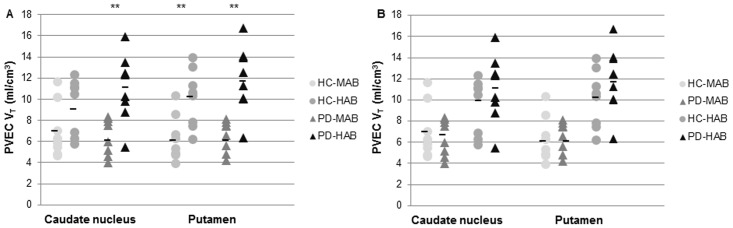
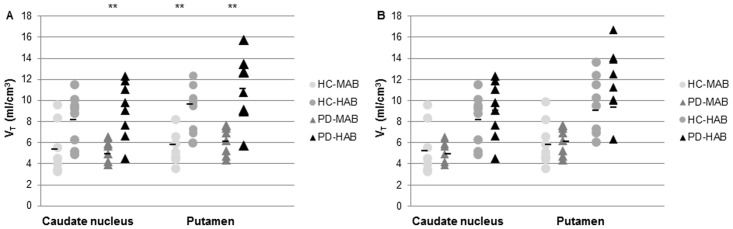
This study investigated whether the second-generation translocator protein 18kDa (TSPO) radioligand, [18F]-FEPPA, could be used in neurodegenerative parkinsonian disorders as a biomarker for detecting neuroinflammation in the striatum. Neuroinflammation has been implicated as a potential mechanism for the progression of Parkinson's disease (PD). Positron Emission Tomography (PET) radioligand targeting for TSPO allows for the quantification of neuroinflammation in vivo. Based on genotype of the rs6791 polymorphism in the TSPO gene, 16 mixed-affinity binders (MABs) (8 PD and age-matched 8 healthy controls (HCs)), 16 high-affinity binders (HABs) (8 PD and age-matched 8 HCs) and 4 low-affinity binders (LABs) (3 PD and 1 HCs) were identified. Total distribution volume (VT) values in the striatum were derived from a two-tissue compartment model with arterial plasma as an input function. There was a significant main effect of genotype on [18F]-FEPPA VT values in the caudate nucleus (p = 0.001) and putamen (p < 0.001), but no main effect of disease or disease x genotype interaction in either ROI. In the HAB group, the percentage difference between PD and HC was 16% in both caudate nucleus and putamen; in the MAB group, it was -8% and 3%, respectively. While this PET study showed no evidence of increased striatal TSPO expression in PD patients, the current findings provide some insights on the possible interactions between rs6791 polymorphism and neuroinflammation in PD.
Overview
The claims and statistics of this paper haven’t been checked yet.
Free: it reads the open-access text and checks the first 5 claims that cite a source we can check. Create a free account to check every claim.
Integrity signals
Registry
Cites
Statistics
Figures
Verification
Claims the paper makes
The claims and statistics of this paper haven’t been checked yet.
Free: it reads the open-access text and checks the first 5 claims that cite a source we can check. Create a free account to check every claim.
Claims other papers make about this one
Each is checked against this paper’s own text: does it say what the citing paper says it does?
The source backs part of the claim, not all of it — or backs it for a different population, condition or comparison.
In the citing paper
“Microglial activation in human PD has been demonstrated by positron emission tomography161”
From Microglial signatures and their role in health and disease (2018) · cites this paper as [161]
Experimental — accuracy not yet measured
Self-check
Percentages, sums and reported differences re-computed from the paper’s own numbers.
The self-check needs the paper’s full text.
Citations
Cites
McGeer, P. L., Itagaki, S., Boyes, B. E., & McGeer, E. G. (1988) · Neurology · doi:10.1212/wnl.38.8.1285 · Cited by 2,990
A rapid non-enzymatic method for the preparation of HMW DNA from blood for RFLP studies
Lahiri, D. K., & Numberger, J. I. (1991) · Nucleic Acids Research · doi:10.1093/nar/19.19.5444 · Cited by 2,300
Setiawan, E., Wilson, A. A., Mizrahi, R., Rusjan, P. M., Miler, L., Rajkowska, G., Suridjan, I., Kennedy, J. L., Rekkas, P. V., Houle, S., et al. (2015) · JAMA Psychiatry · doi:10.1001/jamapsychiatry.2014.2427 · Cited by 939
Self-citationMogi, M., Harada, M., Kondo, T., Riederer, P., Inagaki, H., Minami, M., & Nagatsu, T. (1994) · Neuroscience Letters · doi:10.1016/0304-3940(94)90508-8 · Cited by 855
Microglial activation and dopamine terminal loss in early Parkinson's disease
Ouchi, Y., Yoshikawa, E., Sekine, Y., Futatsubashi, M., Kanno, T., Ogusu, T., & Torizuka, T. (2005) · Annals of Neurology · doi:10.1002/ana.20338 · Cited by 843
Blum-Degena, D., Müller, T., Kuhn, W., Gerlach, M., Przuntek, H., & Riederer, P. (1995) · Neuroscience Letters · doi:10.1016/0304-3940(95)12192-7 · Cited by 801
Imamura, K., Hishikawa, N., Sawada, M., Nagatsu, T., Yoshida, M., & Hashizume, Y. (2003) · Acta Neuropathologica · doi:10.1007/s00401-003-0766-2 · Cited by 791 · cited 1×
“further identified activated microglia in the extended brain areas such as putamen, hippocampus, as well as trans-entorhinal, cingulate, and temporal cortices [2].”
BackgroundOwen, D. R., Yeo, A. J., Gunn, R. N., Song, K., Wadsworth, G., Lewis, A., Rhodes, C., Pulford, D. J., Bennacef, I., Parker, C. A., et al. (2012) · Journal of Cerebral Blood Flow & Metabolism · doi:10.1038/jcbfm.2011.147 · Cited by 779
Translocator protein 18 kDa (TSPO): Molecular sensor of brain injury and repair
Chen, M.-K., & Guilarte, T. R. (2008) · Pharmacology & Therapeutics · doi:10.1016/j.pharmthera.2007.12.004 · Cited by 506 · cited 2×
“Similarly, despite the welldocumented increase in the TSPO expression as a result of brain insult in ex-vivo brain tissue, the functional significance of the upregulated TSPO is still unclear [6].”
BackgroundRone, M. B., Fan, J., & Papadopoulos, V. (2009) · Biochimica et Biophysica Acta (BBA) - Molecular and Cell Biology of Lipids · doi:10.1016/j.bbalip.2009.03.001 · Cited by 399 · cited 1×
“The rs6791 polymorphism can be associated with the susceptibility, progression or disease protection [25].”
Background
Cited by
Items 101–108 of 108
Mansouri-Guilani, N. (2017) · theses.fr (ABES) · doi:10.70675/99ced3b5zeac6z4eb2z8e6cz01bcad7cf2d9
Liu, S.-Y., Qiao, H.-W., Song, T.-B., Liu, X.-L., Yao, Y., Zhao, C.-S., Barret, O., Xu, S.-L., Cai, Y.-N., Tamagnan, G. D., et al. (2022) · Figshare · doi:10.6084/m9.figshare.20727575
Deriving Physiological Information from PET Images Using Machine Learning
Gassara, O., Chikhaoui, B., Mabrouk, R., & Wang, S. (2023) · Lecture notes in computer science · doi:10.1007/978-3-031-43950-6_3
Self-citation岩田, 真. (2024) · Institutional Repositories DataBase (IRDB)
Moleculaire beeldvorming van mGluR5 en P2X7 in preklinische modellen van de ziekte van Parkinson
Crabbé, M. (2019) · Lirias (KU Leuven)
ミクログリアのxc-系は敗血症後の神経疾患および精神疾患に対する新規の治療標的である
Kitagawa, Y. (2019) · Institutional Repositories DataBase (IRDB)
Preparation of Mouse Primary Microglia Cultures for α-Synuclein Propagation
Ma, Z., Zhang, T., Xiong, K., Jiang, M., Zhang, S., & Meng, H. (2026) · Methods in molecular biology · doi:10.1007/978-1-0716-5699-0_13
Metadata
- Authors
- Koshimori, Y., Ko, J.-H., Mizrahi, R., Rusjan, P., Mabrouk, R., Jacobs, M. F., Christopher, L., Hamani, C., Lang, A. E., Wilson, A. A., Houle, S., & Strafella, A. P.
- Affiliations
- University Health Network (CA)
- University of Manitoba (CA)
- Centre for Addiction and Mental Health (CA)
- University of Toronto (CA)
- Corresponding author
- Strafella, Antonio P.
- ORCID
- Venue
- PLOS ONE
- Publisher
- Public Library of Science (PLoS)
- Published
- 2015-09-18
- Volume
- 10
- Issue
- 9
- Pages
- e0138721
- ISSN
- 1932-6203 (ISSN-L)
- PMC
- PMC4575151
- OpenAlex
- W2338646937
- Cited by
- 100
- References
- 30
- Citations by year
- 2026: 2 · 2025: 2 · 2024: 3 · 2023: 7 · 2022: 12 · 2021: 11 · 2020: 11 · 2019: 15 · 2018: 14 · 2017: 15 · 2016: 7 · 2015: 1
- FWCI
- 6.58
- Type
- journal article
- Language
- en
- Open access
- gold
- doi.org
- Licence
- Locations
- PLoS ONE (publishedVersion, cc-by)
- Europe PMC (PubMed Central) (publishedVersion, cc-by)
- PubMed Central (publishedVersion, cc-by)
- PubMed (publishedVersion)
- DOAJ (DOAJ: Directory of Open Access Journals) (submittedVersion, cc-by-sa)
- Funders
- Weston Brain Institute
- Canadian Institutes of Health Research (INE - 117891, GDS-D 128684, 117891_1)
- Topics
- Life Sciences › Neuroscience › Neurology › Neuroinflammation and Neurodegeneration Mechanisms
- Health Sciences › Medicine › Clinical Neurology › Parkinson's Disease Mechanisms and Treatments
- Health Sciences › Medicine › Radiology, Nuclear Medicine and Imaging › Medical Imaging Techniques and Applications
- Keywords
- Parkinson's disease, neuroinflammation, translocator protein (TSPO), [18F]FEPPA, positron emission tomography, caudate nucleus, putamen, volume of distribution, biomarkers
- MeSH terms
- Aged, Corpus Striatum, Female, Genotype, Humans, Inflammation, Male, Middle Aged, Parkinson Disease, Polymorphism, Genetic, Radionuclide Imaging, Microglia, Neuroimaging
About these checks
Registry, retraction, Cites and statistics results are computed, not judged, with one exception: a printed reference that no index lists is read once by a model before it counts as a citation error. Claims are extracted by a model and kept only when their quote appears verbatim in the text; each cited source is then checked, with a model’s help, for whether it says what the claim relies on. Those verdicts can be wrong — read the claim’s quote and the cited source before relying on one.
Statistics and arithmetic are recomputed, not judged.
Confidence bands are shown only for fields calibrated on our annotated test set. None is calibrated yet, so no band is shown.
What counts as a claim ›How we measure confidence ›How we check this ›
Are you an author, or do you see a problem with this page? Request a review
Data sources
Bibliographic data: Semantic Scholar, OpenAlex, Crossref.
Contains information from the Semantic Scholar Academic Graph Datasets, made available under the ODC Attribution License (ODC-BY 1.0).
Semantic Scholar’s data is described in: Kinney, R., et al. (2023). The Semantic Scholar Open Data Platform. arXiv:2301.10140.
