

The DOI matches its Crossref record; 53 of the 54 references it cites were found in a registry or an index, and 1 are not checked yet.
Stand-Alone Personalized Normative Feedback for College Student Drinkers: A Meta-Analytic Review, 2004 to 2014
Open accessAbstract
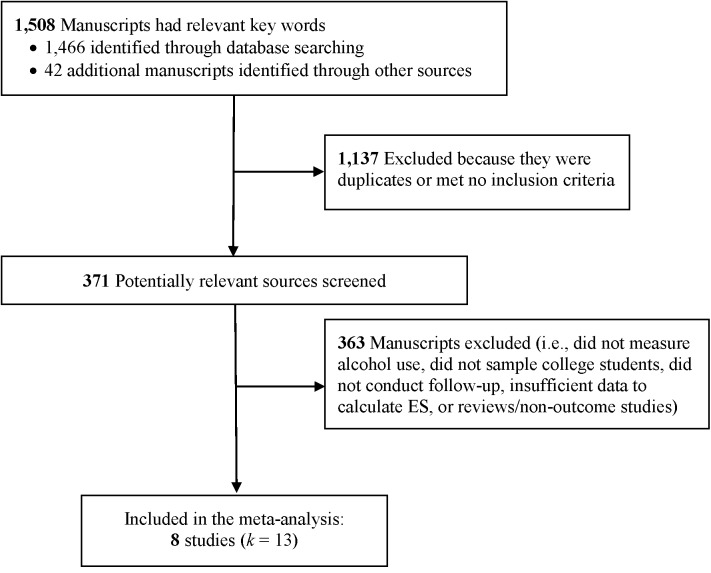
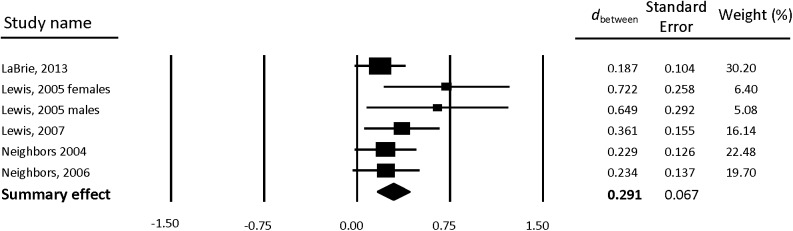
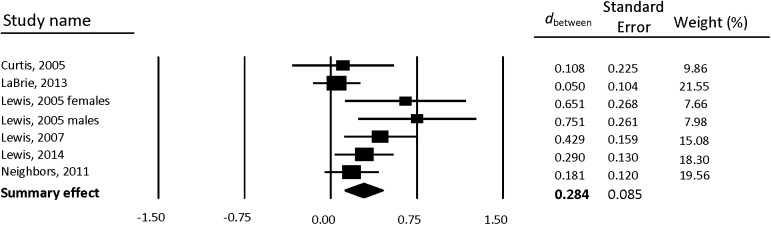
BACKGROUND: Norms clarification has been identified as an effective component of college student drinking interventions, prompting research on norms clarification as a single-component intervention known as Personalized Normative Feedback (PNF). Previous reviews have examined PNF in combination with other components but not as a stand-alone intervention. OBJECTIVES: To investigate the degree to which computer-delivered stand-alone personalized normative feedback interventions reduce alcohol consumption and alcohol-related harms among college students and to compare gender-neutral and gender-specific PNF. DATA SOURCES: Electronic databases were searched systematically through November 2014. Reference lists were reviewed manually and forward and backward searches were conducted. SELECTION CRITERIA: Outcome studies that compared computer-delivered, stand-alone PNF intervention with an assessment only, attention-matched, or active treatment control and reported alcohol use and harms among college students. METHODS: Between-group effect sizes were calculated as the standardized mean difference in change scores between treatment and control groups divided by pooled standard deviation. Within-group effect sizes were calculated as the raw mean difference between baseline and follow-up divided by pooled within-groups standard deviation. RESULTS: Eight studies (13 interventions) with a total of 2,050 participants were included. Compared to control participants, students who received gender-neutral (dbetween = 0.291, 95% CI [0.159, 0.423]) and gender-specific PNF (dbetween = 0.284, 95% CI [0.117, 0.451]) reported greater reductions in drinking from baseline to follow-up. Students who received gender-neutral PNF reported 3.027 (95% CI [2.171, 3.882]) fewer drinks per week at first follow-up and gender-specific PNF reported 3.089 (95% CI [0.992, 5.186]) fewer drinks. Intervention effects were small for harms (dbetween = 0.157, 95% CI [0.037, 0.278]). CONCLUSIONS: Computer-delivered PNF is an effective stand-alone approach for reducing college student drinking and has a small impact on alcohol-related harms. Effects are small but clinically relevant when considered from a public health perspective. Additional research is needed to examine computer-delivered, stand-alone PNF as a population-level prevention program.
Overview
The claims and statistics of this paper haven’t been checked yet.
Run the check — free, no account needed. It reads the open-access text and checks the sources it cites.
Integrity signals
Registry
Cites
Statistics
Figures
Verification
Claims the paper makes
The claims and statistics of this paper haven’t been checked yet.
Run the check — free, no account needed. It reads the open-access text and checks the sources it cites.
Claims other papers make about this one
Each is checked against this paper’s own text: does it say what the citing paper says it does?
The source backs part of the claim, not all of it — or backs it for a different population, condition or comparison.
In the citing paper
“For instance, daily-level findings can inform personalized interventions which are often effective as they can directly address specific challenges and behaviors of each participant (Dotson et al., 2015;Riper et al., 2009).”
From Daily Communication Between First-Year College Students and Their Parents: Associations With Perceived Relationship Positivity (2024) · cites this paper as Dotson et al., 2015
Experimental — accuracy not yet measured
Self-check
Percentages, sums and reported differences re-computed from the paper’s own numbers.
The self-check needs the paper’s full text.
Citations
Cites
Statistical power analysis for the behavioral sciences
Cohen, J. (1990) · Computers Environment and Urban Systems · doi:10.1016/0198-9715(90)90050-4 · Cited by 65,417
Measuring inconsistency in meta-analyses
Higgins, J. P. T., Thompson, S. G., Deeks, J. J., & Altman, D. G. (2003) · BMJ · doi:10.1136/bmj.327.7414.557 · Cited by 63,139
Duval, S., & Tweedie, R. (2000) · Biometrics · doi:10.1111/j.0006-341x.2000.00455.x · Cited by 14,099
The file drawer problem and tolerance for null results.
Rosenthal, R. (1979) · Psychological Bulletin · doi:10.1037/0033-2909.86.3.638 · Cited by 9,068 · cited 2×
“12 Publication Bias I conducted fail-safe analyses to estimate the number of missing studies with null findings that would nullify the observed summary effect (Rosenthal, 1979).”
BackgroundMethodMonitoring the Future: National Results on Adolescent Drug Use: Overview of Key Findings
Johnston, L. D., O’Malley, P. M., Bachman, J. G., & Schulenberg, J. E. (2003) · FOCUS The Journal of Lifelong Learning in Psychiatry · doi:10.1037/e560352009-001 · Cited by 6,930
A basic introduction to fixed-effect and random-effects models for meta-analysis
Borenstein, M., Hedges, L. V., Higgins, J. P. T., & Rothstein, H. R. (2010) · Research Synthesis Methods · doi:10.1002/jrsm.12 · Cited by 6,793
Social Influence: Compliance and Conformity
Cialdini, R. B., & Goldstein, N. J. (2004) · Annual Review of Psychology · doi:10.1146/annurev.psych.55.090902.142015 · Cited by 6,077
Methods of Meta-Analysis: Correcting Error and Bias in Research Findings
Schmidt, F. L., & Hunter, J. E. (2015) · doi:10.4135/9781483398105 · Cited by 5,542
Hunter, J., & Schmidt, F. (2004) · doi:10.4135/9781412985031 · Cited by 3,023
Morris, S. B., & DeShon, R. P. (2002) · Psychological Methods · doi:10.1037/1082-989x.7.1.105 · Cited by 2,502
Research works printed but not linked: 2
- From Local and National Action to Global Change. World Health Organization. Global Alcohol Policy Conference; 2013; Seoul, Korea.
- C Neighbors, 2006, Being controlled by normative influences: Self-determination as a moderator of a normative feedback alcohol intervention, Health Psychol, 25, 571, 10.1037/0278-6133.25.5.571 · DOI
Cited by
Sorted by citations
Binge drinking: Health impact, prevalence, correlates and interventions
Kuntsche, E. N., Kuntsche, S., Thrul, J., & Gmel, G. E. (2017) · Psychology and Health · doi:10.1080/08870446.2017.1325889 · Cited by 407
Kaner, E. F., Beyer, F. R., Garnett, C., Crane, D., Brown, J., Muirhead, C., Redmore, J., O'Donnell, A., Newham, J. J., de Vocht, F., et al. (2017) · Cochrane Database of Systematic Reviews · doi:10.1002/14651858.cd011479.pub2 · Cited by 308
Determinants of behaviour and their efficacy as targets of behavioural change interventions
Albarracín, D., Farkhad, B. F., & Samayoa, J. A. G. (2024) · Nature Reviews Psychology · doi:10.1038/s44159-024-00305-0 · Cited by 313
Health behaviour: Current issues and challenges
Conner, M. T., & Norman, P. E. (2017) · Psychology and Health · doi:10.1080/08870446.2017.1336240 · Cited by 230
Graupensperger, S. A., Abdallah, D. A., & Lee, C. M. (2021) · Vaccine · doi:10.1016/j.vaccine.2021.03.018 · Cited by 222
Metadata
- Authors
- Dotson, K. B., Dunn, M. E., & Bowers, C. A.
- Affiliations
- University of Central Florida (US)
- Venue
- PLOS ONE
- Publisher
- Public Library of Science (PLoS)
- Published
- 2015-10-08
- Volume
- 10
- Issue
- 10
- Pages
- e0139518
- ISSN
- 1932-6203 (ISSN-L)
- PMC
- PMC4598082
- OpenAlex
- W2124616725
- Cited by
- 181
- References
- 54
- Citations by year
- 2026: 4 · 2025: 21 · 2024: 12 · 2023: 15 · 2022: 21 · 2021: 25 · 2020: 15 · 2019: 20 · 2018: 21 · 2017: 16 · 2016: 11
- FWCI
- 12.55
- Type
- journal article
- Language
- en
- Open access
- gold
- doi.org
- Licence
- Locations
- PLoS ONE (publishedVersion, cc-by)
- Europe PMC (PubMed Central) (publishedVersion, cc-by)
- PubMed Central (publishedVersion, cc-by)
- PubMed (publishedVersion)
- Journal of International Crisis and Risk Communication Research (submittedVersion)
- RePEc: Research Papers in Economics (submittedVersion)
- DOAJ (DOAJ: Directory of Open Access Journals) (submittedVersion, cc-by-sa)
- Figshare (submittedVersion, cc-by)
- Topics
- Health Sciences › Medicine › Epidemiology › Substance Abuse Treatment and Outcomes
- Social Sciences › Psychology › Applied Psychology › Behavioral Health and Interventions
- Social Sciences › Communication › Media Influence and Health
- Keywords
- personalized normative feedback, college drinking, alcohol consumption, alcohol-related harm, computer-based intervention, alcohol prevention
- MeSH terms
- Alcohol Drinking in College, Alcohol Drinking, Humans, Databases, Factual, Internet, Feedback, Psychological
About these checks
Registry, retraction, Cites and statistics results are computed, not judged, with one exception: a printed reference that no index lists is read once by a model before it counts as a citation error. Claims are extracted by a model and kept only when their quote appears verbatim in the text; each cited source is then checked, with a model’s help, for whether it says what the claim relies on. Those verdicts can be wrong — read the claim’s quote and the cited source before relying on one.
Statistics and arithmetic are recomputed, not judged.
Confidence bands are shown only for fields calibrated on our annotated test set. None is calibrated yet, so no band is shown.
What counts as a claim ›How we measure confidence ›How we check this ›
Are you an author, or do you see a problem with this page? Request a review
