

The DOI matches its Crossref record; 61 of the 61 references it cites were found in a registry or an index.
Web-Based Mindfulness Intervention in Heart Disease: A Randomized Controlled Trial
Open accessAbstract
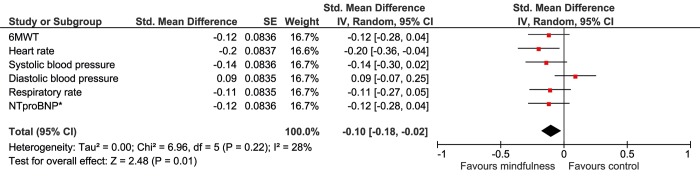
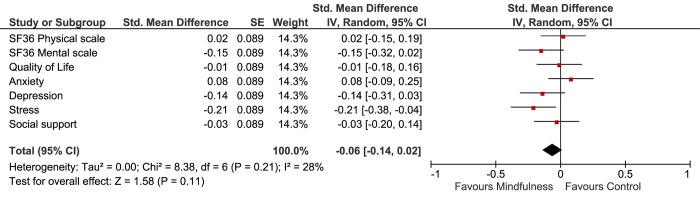
BACKGROUND: Evidence is accumulating that mindfulness training has favorable effects on psychological outcomes, but studies on physiological outcomes are limited. Patients with heart disease have a high incidence of physiological and psychological problems and may benefit from mindfulness training. Our aim was to determine the beneficial physiological and psychological effects of online mindfulness training in patients with heart disease. METHODS: The study was a pragmatic randomized controlled single-blind trial. Between June 2012 and April 2014 we randomized 324 patients (mean age 43.2 years, 53.7% male) with heart disease in a 2:1 ratio (n = 215 versus n = 109) to a 12-week online mindfulness training in addition to usual care (UC) compared to UC alone. The primary outcome was exercise capacity measured with the 6 minute walk test (6MWT). Secondary outcomes were other physiological parameters (heart rate, blood pressure, respiratory rate, and NT-proBNP), subjective health status (SF-36), perceived stress (PSS), psychological well-being (HADS), social support (PSSS12) and a composite endpoint (all-cause mortality, heart failure, symptomatic arrhythmia, cardiac surgery, and percutaneous cardiac intervention). Linear mixed models were used to evaluate differences between groups on the repeated outcome measures. RESULTS: Compared to UC, mindfulness showed a borderline significant improved 6MWT (effect size, meters: 13.2, 95%CI: -0.02; 26.4, p = 0.050). There was also a significant lower heart rate in favor of the mindfulness group (effect size, beats per minute: -2.8, 95%CI: -5.4;-0.2, p = 0.033). No significant differences were seen on other outcomes. CONCLUSIONS: Mindfulness training showed positive effects on the physiological parameters exercise capacity and heart rate and it might therefore be a useful adjunct to current clinical therapy in patients with heart disease. TRIAL REGISTRATION: Dutch Trial Register 3453.
Overview
The claims and statistics of this paper haven’t been checked yet.
Run the check — free, no account needed. It reads the open-access text and checks the sources it cites.
Integrity signals
Registry
Cites
Statistics
Figures




Verification
Claims the paper makes
The claims and statistics of this paper haven’t been checked yet.
Run the check — free, no account needed. It reads the open-access text and checks the sources it cites.
Claims other papers make about this one
Each is checked against this paper’s own text: does it say what the citing paper says it does?
The cited source doesn’t support the claim as written.
In the citing paper
“a significantly moderate effect of mindfulness in CVD was also observed (g = 0.78, 95% CI: 0.20; 1.36, p = 0.008, I2 = 89.4%, τ2 = 0.42)”
From Mindfulness-based interventions for physical and psychological wellbeing in cardiovascular diseases: A systematic review and meta-analysis (2021) · cites this paper as [17]
Checked by a reasoning model — may be wrong.
Experimental — accuracy not yet measuredThe cited source doesn’t support the claim as written.
In the citing paper
“There was a large reduction in systolic blood pressure (g = 1.12, 95% CI: 0.40; 1.84, p = 0.002, I2 = 89.1%, τ2 = 0.56)”
From Mindfulness-based interventions for physical and psychological wellbeing in cardiovascular diseases: A systematic review and meta-analysis (2021) · cites this paper as [17]
Checked by a reasoning model — may be wrong.
Experimental — accuracy not yet measuredThe cited source doesn’t support the claim as written.
In the citing paper
“a significantly large effect of mindfulness in CVD was observed for perceived stress (g = 1.16, 95% CI: 0.31; 2.01, p = 0.007, I2 = 93.9%, τ2 = 0.87)”
From Mindfulness-based interventions for physical and psychological wellbeing in cardiovascular diseases: A systematic review and meta-analysis (2021) · cites this paper as [17]
Checked by a reasoning model — may be wrong.
Experimental — accuracy not yet measuredThe source backs part of the claim, not all of it — or backs it for a different population, condition or comparison.
In the citing paper
“diastolic blood pressure was not significant after correction (g = 0.66, 95% CI: −0.04; 1.36, p = 0.043, I2 = 89.3%, τ2 = 0.54)”
From Mindfulness-based interventions for physical and psychological wellbeing in cardiovascular diseases: A systematic review and meta-analysis (2021) · cites this paper as [17]
Experimental — accuracy not yet measuredThe source backs part of the claim, not all of it — or backs it for a different population, condition or comparison.
In the citing paper
“In addition, another facet of online training must be considered: the lack of external control. Indeed, teachers cannot control whether participants have practiced the tasks accurately. This can lead to less motivation and lower adherence than training with teachers and other group members [17].”
From Mindfulness-based interventions for physical and psychological wellbeing in cardiovascular diseases: A systematic review and meta-analysis (2021) · cites this paper as [17]
Experimental — accuracy not yet measured
7 more claims about this paper
Create a free account to see every claim other papers make about this one.
Self-check
Percentages, sums and reported differences re-computed from the paper’s own numbers.
The self-check needs the paper’s full text.
Citations
Cites
The Hospital Anxiety and Depression Scale
Zigmond, A. S., & Snaith, R. P. (1983) · Acta Psychiatrica Scandinavica · doi:10.1111/j.1600-0447.1983.tb09716.x · Cited by 47,139
(1992) · PubMed · Cited by 33,716
A Global Measure of Perceived Stress
Cohen, S., Kamarck, T., & Mermelstein, R. (1983) · Journal of Health and Social Behavior · doi:10.2307/2136404 · Cited by 32,807 · cited 1×
“A total perceived stress score is made by summing all individual items.[29] Social support.”
BackgroundThe MOS 36-ltem Short-Form Health Survey (SF-36): I. Conceptual Framework and Item Selection
Ware, J. E., & Sherbourne, C. D. (1992) · Medical Care · doi:10.1097/00005650-199206000-00002 · Cited by 30,033
Depression and quality of life in older persons: A review
Sivertsen, H., Bjørkløf, G. H., Engedal, K., Selbæk, G., & Helvik, A.-S. (2015) · Dementia and Geriatric Cognitive Disorders · doi:10.1159/000437299 · Cited by 14,152
The Multidimensional Scale of Perceived Social Support
Zimet, G. D., Dahlem, N. W., Zimet, S. G., & Farley, G. K. (1988) · Journal of Personality Assessment · doi:10.1207/s15327752jpa5201_2 · Cited by 13,339
ATS Statement: Guidelines for the Six-Minute Walk Test
(2002) · American Journal of Respiratory and Critical Care Medicine · doi:10.1164/ajrccm.166.1.at1102 · Cited by 11,195
Murray, C. J. L., Vos, T., Lozano, R., Naghavi, M., Flaxman, A. D., Michaud, C., Ezzati, M., Shibuya, K., Salomon, J. A., Abdalla, S., et al. (2012) · The Lancet · doi:10.1016/s0140-6736(12)61689-4 · Cited by 8,888
European Guidelines on cardiovascular disease prevention in clinical practice (version 2012)
Authors/Task Force Members:, Perk, J., De Backer, G., Gohlke, H., Graham, I., Reiner, Ž., Verschuren, M., Albus, C., Benlian, P., Boysen, G., et al. (2012) · European Heart Journal · doi:10.1093/eurheartj/ehs092 · Cited by 8,490
Mindfulness: A proposed operational definition.
Bishop, S. R., Lau, M., Shapiro, S., Carlson, L., Anderson, N. D., Carmody, J., Segal, Z. V., Abbey, S., Speca, M., Velting, D., et al. (2004) · Clinical Psychology: Science and Practice · doi:10.1093/clipsy.bph077 · Cited by 7,234 · cited 1×
“[9, 10] Several core features, such as meditation, yoga, and cognitive assignments, can increase the ability to accept negative experience or emotions.[11] Mindfulness therapy has been found to positively affect psychological outcomes in patients with chronic pain, obesity, hypertension, depression, anxiety and cardio…”
Background
Research works printed but not linked: 2
- S Richardson, 2012, Meta-analysis of perceived stress and its association with incident coronary heart disease, Am J Cardiol, 110, 1711, 10.1016/j.amjcard.2012.08.004 · DOI · Paper page
- Cohen SW, G. Perceived stress in a probability sample of the United States. In: Oskamp ISSS, editor. The social psychology of health: Claremont Symposium on applied social psychology. Newbury Park, CA: Sage; 1988.
Cited by
Steptoe, A. (2019) · Annual Review of Public Health · doi:10.1146/annurev-publhealth-040218-044150 · Cited by 474
“A 12week Web-based mindfulness intervention stimulated increased physical activity in heart disease patients, even though there were no significant effects on psychological well-being or physiological parameters (148).”
BackgroundLevine, G. N., Lange, R. A., Bairey‐Merz, C. N., Davidson, R. J., Jamerson, K., Mehta, P. K., Michos, E. D., Norris, K., Ray, I. B., Saban, K. L., et al. (2017) · Journal of the American Heart Association · doi:10.1161/jaha.117.002218 · Cited by 330
Scott-Sheldon, L. A. J., Gathright, E. C., Donahue, M. L., Balletto, B., Feulner, M. M., DeCosta, J., Cruess, D. G., Wing, R. R., Carey, M. P., & Salmoirago-Blotcher, E. (2020) · Annals of Behavioral Medicine · doi:10.1093/abm/kaz020 · Cited by 145
Web-Based Mindfulness Interventions for People With Physical Health Conditions: Systematic Review
Toivonen, K. I., Zernicke, K., & Carlson, L. E. (2017) · Journal of Medical Internet Research · doi:10.2196/jmir.7487 · Cited by 106
The role of mindfulness in physical activity: a systematic review
Schneider, J., Malinowski, P., Watson, P. M., & Lattimore, P. J. (2018) · Obesity Reviews · doi:10.1111/obr.12795 · Cited by 131
“Specifically, five targeted psychological factors related to PA (84,88,90,94,100); three included PA education and recommendations (96,97,99) and four included yoga (82,85,89,92).”
BackgroundMethodResultInfluential
Metadata
- Authors
- Younge, J. O., Wery, M. F., Gotink, R. A., Utens, E. M. W. J., Michels, M., Rizopoulos, D., van Rossum, E. F. C., Hunink, M. G. M., & Roos-Hesselink, J. W.
- Affiliations
- Erasmus MC (NL)
- Harvard University (US)
- ORCID
- Venue
- PLOS ONE
- Publisher
- Public Library of Science (PLoS)
- Published
- 2015-12-07
- Volume
- 10
- Issue
- 12
- Pages
- e0143843
- ISSN
- 1932-6203 (ISSN-L)
- PMC
- PMC4671576
- OpenAlex
- W2195066828
- Cited by
- 74
- References
- 61
- Citations by year
- 2026: 6 · 2025: 6 · 2024: 6 · 2023: 3 · 2022: 12 · 2021: 8 · 2020: 7 · 2019: 8 · 2018: 8 · 2017: 8 · 2016: 2
- FWCI
- 7.44
- Type
- journal article
- Language
- en
- Open access
- gold
- doi.org
- Licence
- Locations
- PLoS ONE (publishedVersion, cc-by)
- Europe PMC (PubMed Central) (publishedVersion, cc-by)
- PubMed Central (publishedVersion, cc-by)
- PubMed (publishedVersion)
- EUR Research Repository (Erasmus University Rotterdam) (publishedVersion, other-oa)
- Pure Amsterdam UMC (submittedVersion, other-oa)
- Data Archiving and Networked Services (DANS) (submittedVersion)
- EUR Research Repository (Erasmus University Rotterdam) (submittedVersion, other-oa)
- RePub (Erasmus University Rotterdam) (submittedVersion, other-oa)
- DOAJ (DOAJ: Directory of Open Access Journals) (submittedVersion, cc-by-sa)
- Figshare (submittedVersion, cc-by)
- RePub (Erasmus University Rotterdam) (submittedVersion)
- Topics
- Social Sciences › Psychology › Clinical Psychology › Mindfulness and Compassion Interventions
- Health Sciences › Medicine › Cardiology and Cardiovascular Medicine › Cardiac Health and Mental Health
- Health Sciences › Medicine › Cardiology and Cardiovascular Medicine › Heart Rate Variability and Autonomic Control
- Keywords
- mindfulness training, heart disease, online intervention, exercise capacity, 6-minute walk test, heart rate, NT-proBNP, perceived stress, social support, psychological well-being, all-cause mortality, heart failure, cardiac arrhythmias, cardiac surgery, percutaneous coronary intervention
- MeSH terms
- Adult, Blood Pressure, Exercise Test, Female, Health Status, Heart Diseases, Heart Rate, Humans, Male, Middle Aged, Single-Blind Method, Internet, Respiratory Rate, Mindfulness
About these checks
Registry, retraction, Cites and statistics results are computed, not judged, with one exception: a printed reference that no index lists is read once by a model before it counts as a citation error. Claims are extracted by a model and kept only when their quote appears verbatim in the text; each cited source is then checked, with a model’s help, for whether it says what the claim relies on. Those verdicts can be wrong — read the claim’s quote and the cited source before relying on one.
Statistics and arithmetic are recomputed, not judged.
Confidence bands are shown only for fields calibrated on our annotated test set. None is calibrated yet, so no band is shown.
What counts as a claim ›How we measure confidence ›How we check this ›
Are you an author, or do you see a problem with this page? Request a review
How to cite
Cite CoChat for the checks on this page, and the paper for its own findings.
- This page
- CoChat. (2026). Citation check: Web-Based Mindfulness Intervention in Heart Disease: A Randomized Controlled Trial. https://app.cochat.ai/papers/10.1371/journal.pone.0143843
- The paper
- Younge, J. O., Wery, M. F., Gotink, R. A., Utens, E. M. W. J., Michels, M., Rizopoulos, D., van Rossum, E. F. C., Hunink, M. G. M., & Roos-Hesselink, J. W. (2015). Web-Based Mindfulness Intervention in Heart Disease: A Randomized Controlled Trial. PLOS ONE. https://doi.org/10.1371/journal.pone.0143843
Data sources
Bibliographic data: Semantic Scholar, OpenAlex, Crossref.
Contains information from the Semantic Scholar Academic Graph Datasets, made available under the ODC Attribution License (ODC-BY 1.0).
Semantic Scholar’s data is described in: Kinney, R., et al. (2023). The Semantic Scholar Open Data Platform. arXiv:2301.10140.
