

The DOI matches its Crossref record; 43 of the 43 references it cites were found in a registry or an index.
Bias in Research Grant Evaluation Has Dire Consequences for Small Universities
Open accessAbstract
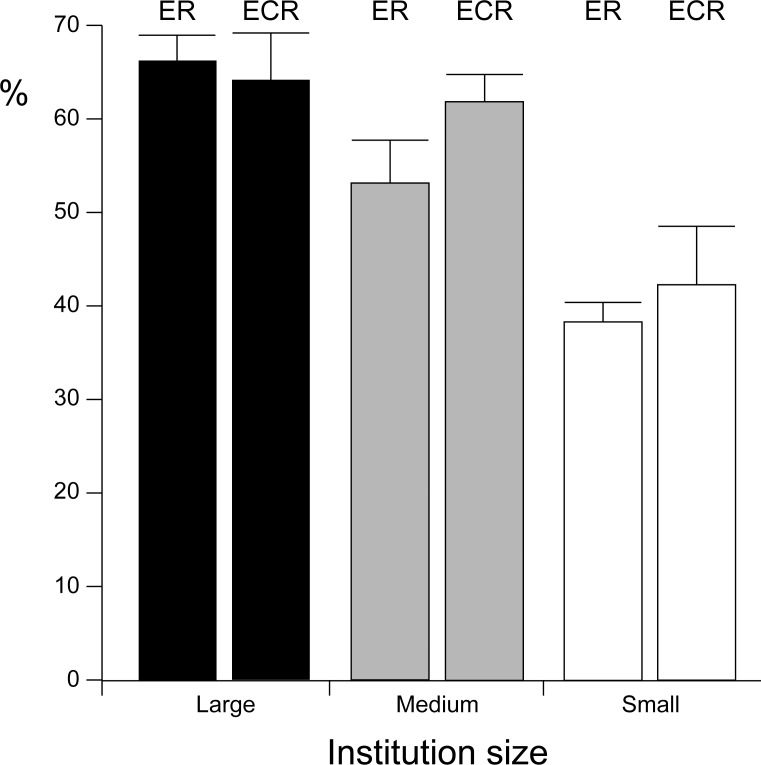
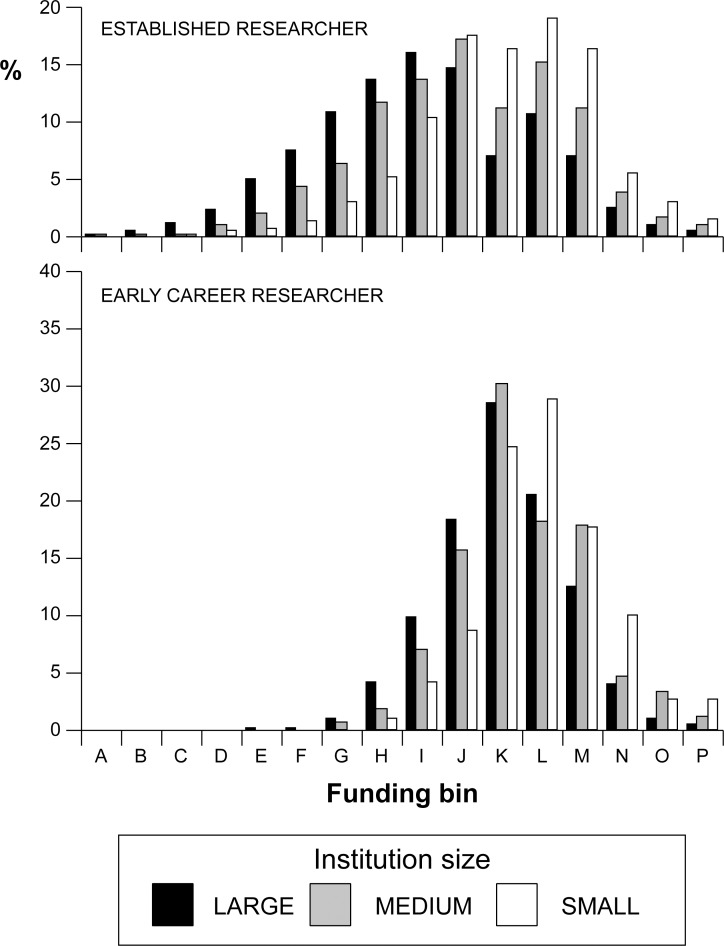
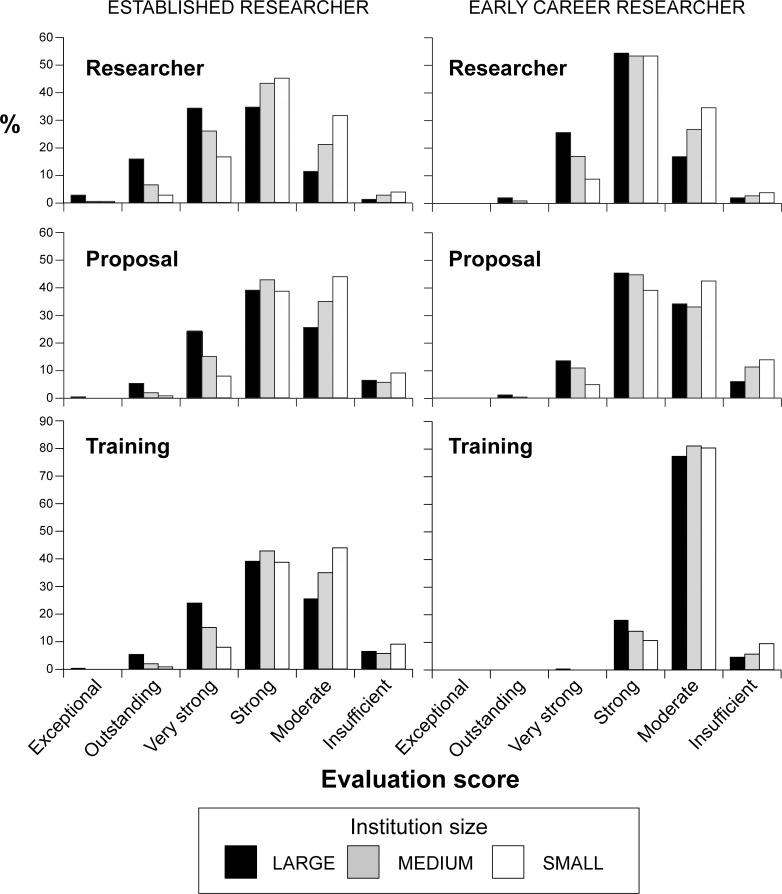
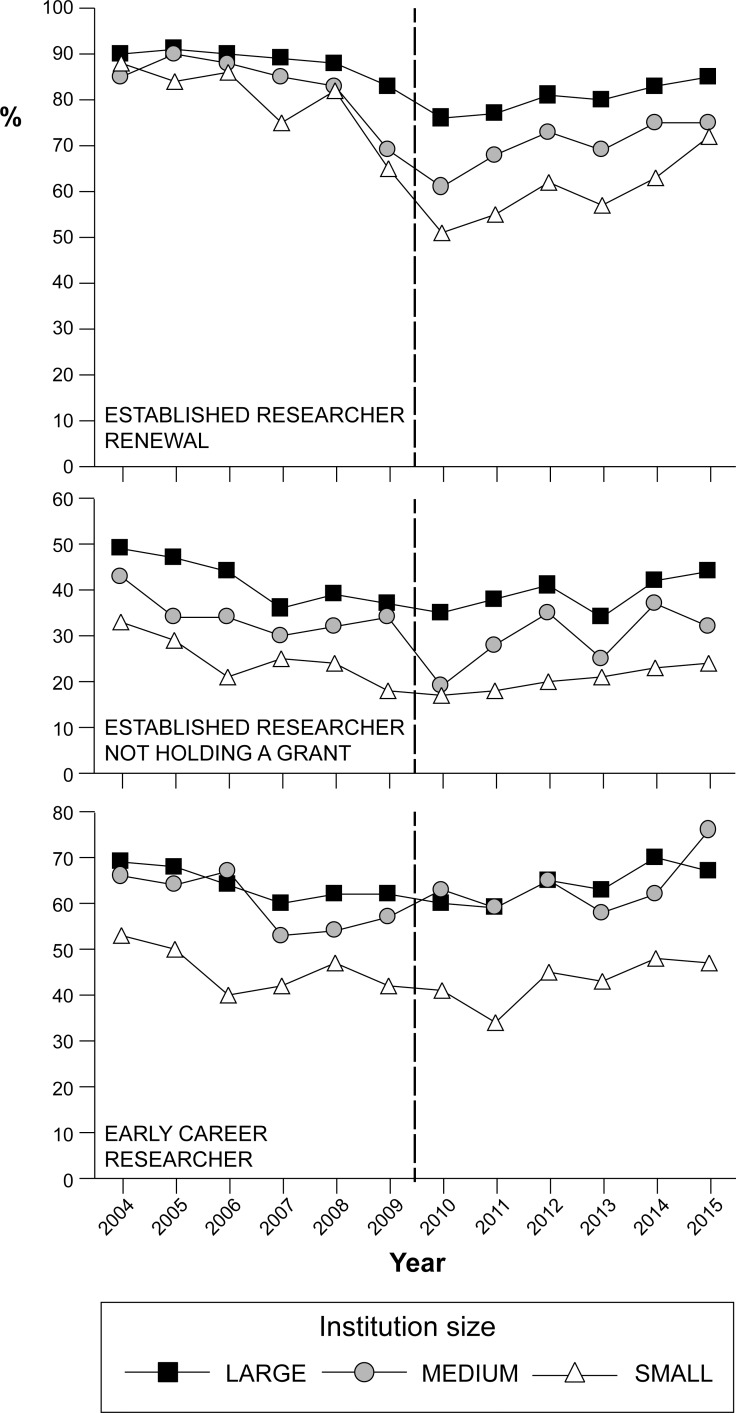
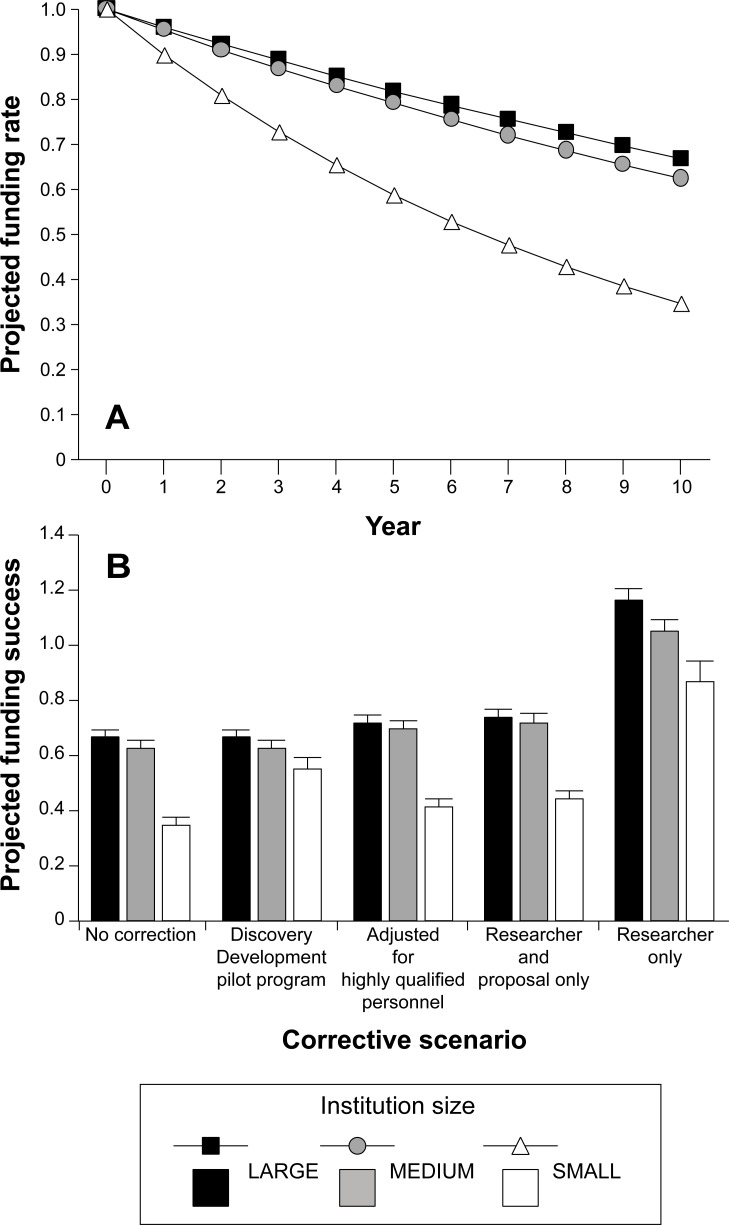
Federal funding for basic scientific research is the cornerstone of societal progress, economy, health and well-being. There is a direct relationship between financial investment in science and a nation's scientific discoveries, making it a priority for governments to distribute public funding appropriately in support of the best science. However, research grant proposal success rate and funding level can be skewed toward certain groups of applicants, and such skew may be driven by systemic bias arising during grant proposal evaluation and scoring. Policies to best redress this problem are not well established. Here, we show that funding success and grant amounts for applications to Canada's Natural Sciences and Engineering Research Council (NSERC) Discovery Grant program (2011-2014) are consistently lower for applicants from small institutions. This pattern persists across applicant experience levels, is consistent among three criteria used to score grant proposals, and therefore is interpreted as representing systemic bias targeting applicants from small institutions. When current funding success rates are projected forward, forecasts reveal that future science funding at small schools in Canada will decline precipitously in the next decade, if skews are left uncorrected. We show that a recently-adopted pilot program to bolster success by lowering standards for select applicants from small institutions will not erase funding skew, nor will several other post-evaluation corrective measures. Rather, to support objective and robust review of grant applications, it is necessary for research councils to address evaluation skew directly, by adopting procedures such as blind review of research proposals and bibliometric assessment of performance. Such measures will be important in restoring confidence in the objectivity and fairness of science funding decisions. Likewise, small institutions can improve their research success by more strongly supporting productive researchers and developing competitive graduate programming opportunities.
Overview
The claims and statistics of this paper haven’t been checked yet.
Run the check — free, no account needed. It reads the open-access text and checks the sources it cites.
Integrity signals
Registry
Cites
Statistics
Figures
Verification
Claims the paper makes
The claims and statistics of this paper haven’t been checked yet.
Run the check — free, no account needed. It reads the open-access text and checks the sources it cites.
Claims other papers make about this one
Each is checked against this paper’s own text: does it say what the citing paper says it does?
The check wasn’t confident either way, so it gives no verdict — never disputed.
In the citing paper
“The globalisation of academic research has underscored the need for open-access publications and international collaborations, allowing researchers to share their findings widely and learn from one another across borders (18).”
From Research Publication Challenges Faced by Dentists in India: A Narrative Review of Multilevel Barriers (2026) · cites this paper as [18]
Experimental — accuracy not yet measuredThe check wasn’t confident either way, so it gives no verdict — never disputed.
In the citing paper
“Customised training modules for faculty can improve confidence and competence in research activities (18).”
From Research Publication Challenges Faced by Dentists in India: A Narrative Review of Multilevel Barriers (2026) · cites this paper as [18]
Experimental — accuracy not yet measured
Self-check
Percentages, sums and reported differences re-computed from the paper’s own numbers.
The self-check needs the paper’s full text.
Citations
Cites
(1990) · Choice Reviews Online · doi:10.5860/choice.27-3338 · Cited by 35,305
Hosmer, D. W., Lemeshow, S., & Sturdivant, R. X. (2013) · Wiley Series in Probability and Statistics · doi:10.1002/9781118548387 · Cited by 13,861
The scientific impact of nations
King, D. A. (2004) · Nature · doi:10.1038/430311a · Cited by 1,245
Lee, C. J., Sugimoto, C. R., Zhang, G., & Cronin, B. (2013) · Journal of the American Society for Information Science and Technology · doi:10.1002/asi.22784 · Cited by 1,000
Rescuing US biomedical research from its systemic flaws
Alberts, B., Kirschner, M. W., Tilghman, S., & Varmus, H. (2014) · Proceedings of the National Academy of Sciences · doi:10.1073/pnas.1404402111 · Cited by 817 · cited 2×
“Further, given the contemporary job market and the glut of PhDs [30, 31], it is unlikely that small schools systematically hire weaker researchers to fill tenure-track positions, or that elite ECRs accept offers only from large institutions.”
BackgroundUniversity Research Evaluation and Funding: An International Comparison
Geuna, A., & Martin, B. R. (2003) · Minerva · doi:10.1023/b:mine.0000005155.70870.bd · Cited by 644
The Scientific Wealth of Nations
May, R. M. (1997) · Science · doi:10.1126/science.275.5301.793 · Cited by 599
Double-blind review favours increased representation of female authors
BUDDEN, A., TREGENZA, T., AARSSEN, L., KORICHEVA, J., LEIMU, R., & LORTIE, C. (2008) · Trends in Ecology & Evolution · doi:10.1016/j.tree.2007.07.008 · Cited by 552 · cited 1×
“Blind review is becoming increasingly common as a means of ensuring objectivity for manuscripts under consideration for publication [44, 45], although a potential drawback of blind review of research grant proposals is the loss of context between applicants’ experience and their ability to successfully conduct the pro…”
BackgroundQuantitative conservation biology
Morris, W. F., & Doak, D. F. (2002) · Cited by 418
A Conceptual Framework for Ordered Logistic Regression Models
Fullerton, A. S. (2009) · Sociological Methods & Research · doi:10.1177/0049124109346162 · Cited by 397 · cited 1×
“We used ordinary logistic regression [21] to determine patterns of funding success for established researchers and ECRs based on a series of a priorimodels; differences in funding bins and funding levels and scores on each of the three evaluation criteria were examined using ordered logistic regression [22], which all…”
Method
Research works printed but not linked: 2
- L Bornmann, 2004, Reliability, fairness, and predictive validity of committee peer review, BIF Futura, 19, 7
- Bornmann, 2011, Improving peer review in scholarly journals, Eur Sci Edit, 37, 41
Cited by
Sorted by citations
The science of science: From the perspective of complex systems
Zeng, A., Shen, Z., Zhou, J., Wu, J., Fan, Y., Wang, Y., & Stanley, E. (2017) · Physics Reports · doi:10.1016/j.physrep.2017.10.001 · Cited by 420
“conducted a case study of the applications to Canada’s Natural Sciences and Engineering Research Council (NSERC) Discovery Grant program and showed that both the success rates and grant amounts are lower for applicants from small institutes [370].”
MethodImplicit bias in healthcare: clinical practice, research and decision making
Gopal, D. P., Chetty, U., O'Donnell, P., Gajria, C., & Blackadder-Weinstein, J. (2021) · Future Healthcare Journal · doi:10.7861/fhj.2020-0233 · Cited by 298
Feminist scholars working around the neoliberal university
Acker, S., & Wagner, A. (2017) · Gender and Education · doi:10.1080/09540253.2017.1296117 · Cited by 106
“…and managerialism are thought to deepen the disadvantages of women and ethnic minority academics in pursuing research, as well as those in small universities or in countries on the periphery (Angervall, Beach, and Gustafsson 2015; Curtis 2016; Leberman, Eames, and Barnett 2015; Murray et al. 2016).”
BackgroundDeSci based on Web3 and DAO: a comprehensive overview and reference model
Ding, W., Hou, J., Li, J., Guo, C., Qin, J., Kozma, R., & Wang, F.-Y. (2022) · IEEE Transactions on Computational Social Systems · doi:10.1109/tcss.2022.3204745 · Cited by 98
“First, research funding is biased and inefficient [10], [11], [12].”
BackgroundEntradas, M., Bauer, M. W., O’Muircheartaigh, C. A., Marcinkowski, F., Okamura, A., Pellegrini, G., Besley, J. C., Massarani, L., Russo, P., Dudo, A. D., et al. (2020) · PLoS ONE · doi:10.1371/journal.pone.0235191 · Cited by 133
“But the fact that the medical sciences may be more susceptible to politicisation and driven by external funding for research [48] [49], may also explain part of this phenomenon.”
BackgroundSato, S., Gygax, P. M., Randall, J., & Mast, M. S. (2020) · Higher Education · doi:10.1007/s10734-020-00626-y · Cited by 99
the Localized HIV Modeling Study Group, Panagiotoglou, D., Olding, M., Enns, B., Feaster, D. J., del Rı́o, C., Metsch, L. R., Granich, R., Strathdee, S. A., Marshall, B. D. L., et al. (2018) · AIDS and Behavior · doi:10.1007/s10461-018-2166-6 · Cited by 38
“However, research into grant competitions has found that reviewer bias can strongly influence the outcomes of applications and penalize applicants who lack the grant writing expertise or human resources needed for success [82, 83].”
An experimental test of the effects of redacting grant applicant identifiers on peer review outcomes
Nakamura, R., Mann, L. S., Lindner, M. D., Braithwaite, J., Chen, M., Vancea, A., Byrnes, N., Durrant, V., & Reed, B. (2021) · eLife · doi:10.7554/elife.71368 · Cited by 38
Hasan, B. S., Rasheed, M. A., Wahid, A., Kumar, R., & Zuhlke, L. J. (2021) · Frontiers in Pediatrics · doi:10.3389/fped.2021.764239 · Cited by 39
“Transparency of the grant evaluation process needs immediate attention (23) and the concept of repeatedly funding the “safe” researcher (48, 49) needs to be abolished.”
BackgroundThe unintended consequences of the pandemic on non-pandemic research activities
Walker, J. T., Brewster, C. J., Fontinha, R., Haak‐Saheem, W., Benigni, S., Lamperti, F., & Ribaudo, D. (2021) · Research Policy · doi:10.1016/j.respol.2021.104369 · Cited by 41
The NIH must reduce disparities in funding to maximize its return on investments from taxpayers
Wahls, W. P. (2018) · eLife · doi:10.7554/elife.34965 · Cited by 37
“There are disparities in grant application success rates or award sizes or both for investigators grouped by race (Ginther et al., 2011), gender (Pohlhaus et al., 2011; Magua et al., 2017), age (Levitt and Levitt, 2017), institution (Murray et al., 2016) and state (Wahls, 2016a).”
BackgroundMeasuring bias, burden and conservatism in research funding processes
Guthrie, S., Rodriguez-Rincon, D., McInroy, G. R., Ioppolo, B., & Gunashekar, S. (2019) · F1000Research · doi:10.12688/f1000research.19156.1 · Cited by 32
“For example, a 2016 study of Canada’s Natural Sciences and Engineering Research Council (NSERC) Discovery Grant program found that funding success and quantity were consistently lower for applicants from small institutions, and that this finding persisted across all levels of applicant experience as well as three diff…”
BackgroundThe Next Generation of Quality Indicators for Group Design Research in Special Education
Toste, J. R., Logan, J. A. R., Shogren, K. A., & Boyd, B. A. (2023) · Exceptional Children · doi:10.1177/00144029221150801 · Cited by 36
“…and high-powered experimental data, supporting more equitable access among trainees or early-career scholars, scholars of color, female-identified scholars, and researchers at underresourced institutions (e.g., Ginther et al., 2011; Magua et al., 2017; Murray et al., 2016; Pohlhaus et al., 2011).”
BackgroundWahls, W. P. (2019) · Proceedings of the National Academy of Sciences · doi:10.1073/pnas.1909217116 · Cited by 26
Bias and Groupthink in Science’s Peer-Review System
Resnik, D. B., & Smith, E. M. R. (2020) · Springer eBooks · doi:10.1007/978-3-030-36822-7_9 · Cited by 29
High cost of bias: Diminishing marginal returns on NIH grant funding to institutionsPreprint
Wahls, W. P. (2018) · bioRxiv (Cold Spring Harbor Laboratory) · doi:10.1101/367847 · Cited by 24
“…rates reported here for a subset of institutions (65% difference between groups) are virtually identical to those reported for all institutions placed in groups by their amounts of grant funding (Eblen et al., 2016) and, in another study, for all institutions grouped by size (Murray et al., 2016).”
BackgroundResultInfluentialJahangiri, A., Flanigan, P. M., Arnush, M., Chandra, A., Rick, J. W., Choi, S. M., Chou, A., Berger, M. S., & Aghi, M. K. (2019) · Journal of neurosurgery · doi:10.3171/2019.1.jns181531 · Cited by 21
Seeber, M., Alon, I., Pina, D. G., Piro, F. N., & Seeber, M. (2022) · Technological Forecasting and Social Change · doi:10.1016/j.techfore.2022.122009 · Cited by 20
An Observation of Research Complexity in Top Universities Based on Research Publications
Lee, I., Xia, F., & Roos, G. (2017) · International World Wide Web Conference (WWW) · doi:10.1145/3041021.3053054 · Cited by 19
“[Murray et al. 2016] Dennis L. Murray, Douglas Morris, Claude Lavoie, Peter R. Leavitt, Hugh MacIsaac, Michael E. J. Masson, and Marc-Andre Villard.”
BackgroundSolans‐Domènech, M., Guillamón, I., Ribera, A., González, I. F., Carrión, C., Permanyer-Miralda, G., & Pons, J. M. V. (2017) · Research Evaluation · doi:10.1093/reseval/rvx021 · Cited by 16
Mapping philanthropic support of science
Shekhtman, L., Gates, A. J., & Barabási, A.-Ĺ. (2024) · Scientific Reports · doi:10.1038/s41598-024-58367-2 · Cited by 13
“These similarities suggest that the inequality identified in NSF funding is mirrored by philanthropic funding 30,31 .”
BackgroundEscobar, M. E., Bell, Z. K., Qazi, M., Kotoye, C. O., & Arcediano, F. (2021) · Frontiers in Psychology · doi:10.3389/fpsyg.2021.734426 · Cited by 13
The AI Review Lottery: Widespread AI-Assisted Peer Reviews Boost Paper Scores and Acceptance Rates
Russo, G., Horta Ribeiro, M., Davidson, T. R., Veselovsky, V., & West, R. (2025) · Proceedings of the ACM on Human-Computer Interaction · doi:10.1145/3757667 · Cited by 12
“…into account reviewers’ bids, expertise, potential conflicts of interests, and “reviewer diversity” per paper; (2) papers typically receive three or more reviews that rate the contribution on a scale from 1 to 10 (where 5 and 6 represent borderline scores around the acceptance threshold) and…”
Piro, F. N., Børing, P., Scordato, L., & Aksnes, D. W. (2020) · Science and Public Policy · doi:10.1093/scipol/scaa037 · Cited by 12
Hultgren, A., Patras, N. M., & Hicks, J. (2024) · eLife · doi:10.7554/elife.92339 · Cited by 13
Williams, M. J., Mullane, K., & Curtis, M. J. (2017) · Elsevier eBooks · doi:10.1016/b978-0-12-804725-5.00005-7 · Cited by 10
Targeted, actionable and fair: Reviewer reports as feedback and its effect on ECR career choices
Derrick, G., Zimmermann, A., Greaves, H., Best, J., & Klavans, R. (2023) · Research Evaluation · doi:10.1093/reseval/rvad034 · Cited by 21
“There is also a high degree of career and financial risk associated with the time taken to apply for funding (von Hippel and von Hippel 2015; Murray et al. 2016), as well as risk associated with possible negative outcomes which are more pronounced for ECRs than for other, more-experienced…”
BackgroundBibliographic coupling networks reveal the advantage of diversification in scientific projects
Li, H., Wu, M., Wang, Y., & Zeng, A. (2022) · Journal of Informetrics · doi:10.1016/j.joi.2022.101321 · Cited by 11
When forgiveness beats permission: Exploring the scholarly ethos of clinical faculty in economics
Mixon, F. G., & Upadhyaya, K. P. (2023) · American Journal of Economics and Sociology · doi:10.1111/ajes.12514 · Cited by 7
Getting funded in a highly fluctuating environment: Shifting from excellence to luck and timing
Kindsiko, E., Rõigas, K., & Niinemets, Ü. (2022) · PLoS ONE · doi:10.1371/journal.pone.0277337 · Cited by 6
Six-decade research bias towards fancy and familiar bird species
Fischer, S. E., Otten, J. G., Lindsay, A. M., Miles, D. B., & Streby, H. M. (2025) · Proceedings of the Royal Society B Biological Sciences · doi:10.1098/rspb.2024.2846 · Cited by 6
The Road to Hell Is Paved with Good Intentions: Modeling Grant Competition between Universities
Daumann, F., Follert, F., & Wassermann, A. (2023) · Economies · doi:10.3390/economies11030081 · Cited by 6
Schneider, B. B., & Holmes, M. A. (2020) · ACS symposium series · doi:10.1021/bk-2020-1354.ch004 · Cited by 6
Invisible Hurdles: Gender and Institutional Bias in the Publication Process in Economics
Ersoy, F. Y., & Pate, J. (2021) · Economic Inquiry · doi:10.1111/ecin.13145 · Cited by 12
“Murray et al. (2016) show that fewer research grants are awarded to authors from smaller, lower-ranked universities.”
BackgroundKucirkova, N. I. (2023) · Educational Psychology Review · doi:10.1007/s10648-023-09727-3 · Cited by 6
“At large and well‐established research institutions, individual academics have access to more resources for writing time and can prioritise research over other obligations, which provides greater opportunities for applying for larger funding grants, which in turn tend to generate larger impact (Murray et al., 2016).”
BackgroundKingsley, I., Slavich, E., Harvey-Smith, L., Johnston, E. L., & Williams, L. A. (2023) · doi:10.31219/osf.io/cpvqk · Cited by 6
What Can Natural Language Processing Do for Peer Review?
Kuznetsov, I., Afzal, O. M., Dercksen, K., Dycke, N., Goldberg, A., Hope, T., Hovy, D., Kummerfeld, J. K., Lauscher, A., Leyton-Brown, K., et al. (2024) · arXiv · doi:10.48550/arxiv.2405.06563 · Cited by 6
Costa, A., Crupi, A., Barabuffi, S., & Minin, A. D. (2025) · Technological Forecasting and Social Change · doi:10.1016/j.techfore.2025.124416 · Cited by 6
Dependency of ERC-funded research on US collaborations
Chowdhary, S., Defenu, N., Musciotto, F., & Battiston, F. (2023) · Nature Physics · doi:10.1038/s41567-023-02239-5 · Cited by 5
NIH's ineffective funding policies
Wahls, W. P. (2017) · Science · doi:10.1126/science.aan6504 · Cited by 5
Invisible Hurdles: Gender and Institutional Bias in the Publication Process in EconomicsPreprint
Ersoy, F. Y., & Pate, J. (2021) · SSRN Electronic Journal · doi:10.2139/ssrn.3870368 · Cited by 5
Plausibility of scientific findings: institutional factors in lay evaluations
Шеремет, Е. П., & Deviatko, I. F. (2022) · Journal of Science Communication · doi:10.22323/2.21050201 · Cited by 4
“…ultimate measure of scientific knowledge and contribution of a nation aiming at supporting “best science”, having “most potential to advance knowledge” [Murray et al., 2016], which necessarily includes expert evaluation and assessment of scientific units and research determining their funding…”
BackgroundEnsuring Sustainable Evaluation: How to Improve Quality of Evaluating Grant Proposals?
Wieczorkowska, G., & Kowalczyk, K. K. (2021) · Sustainability · doi:10.3390/su13052842 · Cited by 4
“The process of grant proposal evaluation has also come under discussion, with particular criticism focused on the selection of reviewers and the fallibility of their assessments [10]; the occurrence of conflicts of interest between the reviewee and the reviewer [11]; randomness of assessments and low level of agreemen…”
BackgroundShafer, A. B. A. (2021) · FACETS · doi:10.1139/facets-2020-0040 · Cited by 4
Kang, Y., Zhang, C., Sun, Z., & Li, Y. (2025) · Journal of Informetrics · doi:10.1016/j.joi.2025.101709 · Cited by 5
Effects of Neoliberalism on Computing Education Research and Practice
Jillepalli, A. A. (2025) · ACM Transactions on Computing Education · doi:10.1145/3766901 · Cited by 3
“Prevalence of audit culture in commodified education systems extends to reviewers of grant proposals [77].”
Wang, S., Li, M., Li, J., & Wu, D. (2025) · Scientometrics · doi:10.1007/s11192-025-05278-2 · Cited by 3
“Applications from high-reputation universities may benefit from reputation effects and the halo effect during the funding review process (Murray et al., 2016).”
Returns of research funding are maximised in media visibility for excellent institutes
Entradas, M., & Santos, J. M. (2021) · Humanities and Social Sciences Communications · doi:10.1057/s41599-021-00884-w · Cited by 3
Kingsley, I., Slavich, E., Harvey-Smith, L., Johnston, E. L., & Williams, L. A. (2025) · Science and Public Policy · doi:10.1093/scipol/scaf012 · Cited by 3
Human Capital, Networks and Segmentation in the Market for Academic Economists
Faria, J. R., Mixon, F. G., & Sawyer, W. (2023) · Economies · doi:10.3390/economies11060165 · Cited by 2
“…that economists affiliated with top-ranked institutions benefit from their institutional affiliation with regard to the receipt of research grants (Murray et al. 2016), membership in the National Bureau of Economic Research (Kleemans and Thornton 2021), invitations to give professional…”
BackgroundImproving the efficiency of research proposals evaluation: A two-stage procedure
Seeber, M., Svege, I. C., & Hesselberg, J. (2024) · Research Evaluation · doi:10.1093/reseval/rvae020 · Cited by 2
Who gets the grant? A persona-based investigation into research funding panelist preferences
Santos, J. M. (2024) · Research Evaluation · doi:10.1093/reseval/rvae030 · Cited by 3
Ali, H., Naz, S., & Bhutto, N. A. (2026) · Journal of Cleaner Production · doi:10.1016/j.jclepro.2026.147979 · Cited by 2
The impact of the pitching research framework on AFAANZ grant applications
Gill, C., Mehrotra, V., Moses, O., & Bui, B. (2022) · Pacific-Basin Finance Journal · doi:10.1016/j.pacfin.2022.101933 · Cited by 2
Jensen, E. A., & Katz, D. S. (2025) · PLoS ONE · doi:10.1371/journal.pone.0329833 · Cited by 2
“Research funders often face competing pressures from top-down government and sponsor priorities [28] and bottom-up criticisms for shortfalls in addressing the research community’s needs [29–31].”
Identification of ‘Early Career Stage’ Researchers from large scale Bibliographic dataset
Gayen, A., Mukherjea, T., Mukherjee, S., & Jana, A. (2023) · International Conference on Computing, Communication and Networking Technologies (ICCCNT) · doi:10.1109/icccnt56998.2023.10307427 · Cited by 2
“…observed that due to lack of attention towards ECR, ECR face strong competition with well-established researchers or group of researchers, to acheive funding for their projects [11], they are dominated by recognized researchers in terms of recognition of their works on identified problems [12].”
BackgroundGuthrie, S., Rodriguez-Rincon, D., McInroy, G. R., Ioppolo, B., & Gunashekar, S. (2019) · RAND Corporation eBooks · doi:10.7249/rr2984 · Cited by 2
Inequality in HierarchiesPreprint
Das, S. (2023) · SSRN Electronic Journal · doi:10.2139/ssrn.4338365 · Cited by 2
Glasford, D. E., & Brown, D. V. (2025) · Journal of Social and Political Psychology · doi:10.5964/jspp.10409 · Cited by 4
The innovation trade-off: how following superstars shapes academic novelty
Kelty, S., Baten, R. A., Proma, A. M., Hoque, M. E., Bollen, J., & Ghoshal, G. (2025) · Humanities and Social Sciences Communications · doi:10.1057/s41599-025-05124-z · Cited by 10
“In recent times, funding has increasingly become more biased towards top institutions (Murray et al., 2016), with 90% of NSF funding in 2018 going to 22% of funded institutions, serving 43% of all institutions and 34% of underrepresented minorities (of Government Affairs, 2021).”
A manifesto for fair and equitable research funding in ecology
Winder, L., & Hodge, S. (2017) · Rethinking Ecology · doi:10.3897/rethinkingecology.2.21798 · Cited by 1
“Known negative biases include those driven by gender (Pohlhaus 2011; Tricco et al. 2017), race (Ginther et al. 2011), institution size (Murray et al. 2016), geographic location (Wahls 2016), and interdisciplinary study (Bromham et al. 2016).”
BackgroundBrain Matters: Exploring Bias in AI for Neuroimaging Research
Martin, S. A., Biondo, F., Cole, J. H., & Taylor, B. (2023) · Lecture notes in computer science · doi:10.1007/978-3-031-45249-9_11 · Cited by 1
How Can I Grow!!: Analysis of Co-authorship Network of Early Career Stage Researchers
Gayen, A., Chakraborty, S., Chakraborty, N., & Jana, A. (2024) · Lecture notes in networks and systems · doi:10.1007/978-981-97-1320-2_28 · Cited by 1
Academic productivity and industry trends of fellowship‐trained U.S. academic rhinologists
Warn, M. J., Chan, D., Nguyen, T. V., Torabi, S. J., Bitner, B. F., & Kuan, E. C. (2024) · World Journal of Otorhinolaryngology - Head and Neck Surgery · doi:10.1002/wjo2.226 · Cited by 1
Ramkumar, R., Betzner, W. R., Cristall, N. D., Drozdowska, B. A., Fladt, J. C., Jaroenngarmsamer, T., McDonough, R. V., Goyal, M., & Ganesh, A. (2025) · International Journal for Equity in Health · doi:10.1186/s12939-025-02458-7 · Cited by 1
“…findings from a previous Canadian study that quantitatively analyzed the evaluations of grant proposals and subsequent funding trends, and found that funding success and grant amounts received were consistently lower for applicants from smaller institutions across all levels of experience [24].”
Research productivity and impact of professors in Canadian undergraduate psychology programmes.
Ng, C. F. (2018) · Canadian Psychology/Psychologie canadienne · doi:10.1037/cap0000137 · Cited by 1
“There may be bias in the evaluation of research grant applications by researchers from small universities (Murray et al., 2016).”
BackgroundKingsley, I., Slavich, E., Harvey-Smith, L., Johnston, E. L., & Williams, L. A. (2024) · doi:10.31219/osf.io/e4jna · Cited by 1
Saran, K., Krishnaprakash, G., Siluvai, S., & Indumathi, K. (2026) · Journal of Clinical and Diagnostic Research · doi:10.7860/jcdr/2026/78238.22217
Building Trust: Defining Subject Matter Expertise through U.S. Federal Peer Review PolicyPreprint
Goins, M. P. (2021) · doi:10.1002/essoar.10505814.1
Zagaglia, B. (2022) · Athens Journal of Social Sciences · doi:10.30958/ajss.9-3-2
"Available Interventions for Implicit Bias in Athletic Training"
Cage, S. A. (2022) · Research & Investigations in Sports Medicine · doi:10.31031/rism.2022.09.000703 · Cited by 1
Women are awarded more team grants than solo grants and lead more gender-balanced teams than menPreprint
Kingsley, I., Slavich, E., Harvey-Smith, L., Johnston, E. L., & Williams, L. A. (2024) · doi:10.31219/osf.io/qawu4
Replaying the Tape of Academia: Fourteen Alternative Practices for the Physical Sciences
Kemeny, P. C., Phillips, A. A., & Johnson, D. L. (2024) · Perspectives of Earth and Space Scientists · doi:10.1029/2024cn000240 · Cited by 1
“Furthermore, bias appears to be deeply embedded in the grant review process, including against women (Morgan et al., 2018), minority populations (Hoppe et al., 2019; Taffe & Gilpin, 2021), small universities (Murray et al., 2016) and the inclusion of novel ideas (Ayoubi et al., 2021).”
Pavliscsak, H. H., & Knisely, B. M. (2024) · Military Medicine · doi:10.1093/milmed/usae063
Improving the Funding of HBCUs
(2024) · Advances in educational marketing, administration, and leadership book series · doi:10.4018/979-8-3693-3427-0.ch003
Conductor and Cobbler: Leadership Lessons From Large-Scale Research Partnership Facilitation
Lam, M. (2024) · Journal of Participatory Research Methods · doi:10.35844/001c.126978
Comeback or dropout: study of discontinued researchers at early career stage
Gayen, A., Chakraborty, S., Mitra, S., & Jana, A. (2025) · Scientometrics · doi:10.1007/s11192-025-05243-z
“It has been noted that, due to insufficient focus on ECRs, they face intense competition with well-established researchers or research groups to secure funding for their projects (Murray et al., 2016).”
Capitalising on ‘the missing middle’ dilemma to strengthen South Africa’s research pipeline
Mathipa-Mdakane, M. G., & Nxumalo, M. (2025) · South African Journal of Science · doi:10.17159/sajs.2025/20144
Ermagan, C., & Teirlinck, P. (2025) · Journal of Regional Science · doi:10.1111/jors.12771
Deviatko, I. F., Шеремет, Е. П., Polyakova, V., & Fursov, K. S. (2025) · Socius Sociological Research for a Dynamic World · doi:10.1177/23780231251332431
“Research funding is also frequently considered as a measure of research quality (Ma, Mondragón, and Latora 2015; Murray et al. 2016; Rosenbloom et al. 2015), which is based on elaborated and careful expert assessment (Geuna and Martin 2003).”
4 ways to help STEM majors stay the course
Irabor, E. G., & White, B. (2022) · doi:10.64628/aai.hkved57mp
Yan, Z. (2025) · Cambridge University Press eBooks · doi:10.1017/9781009381338.015
A brief observation on the relationship between antecedent status and reviewing incentives
Bright, L. K. (2026) · Inquiry · doi:10.1080/0020174x.2026.2617387
Two decades of academic invention in France : scope and driving forces
Carpentier, E. (2022) · theses.fr (ABES) · doi:10.70675/64e32e3ez2e96z43a9zb86bz3e2bfc3e0ec5
Reducing bias in the evaluation of scientific posters and oral presentations
Carter, T. L., Howell, R. M., Gillispie, E. C., Kailer, E. L., Scott, J. G., Wiley, Z., & Chapman, S. (2026) · Natural sciences education · doi:10.1002/nse2.70064
“These data are typically collected at the grant application or individual journal scale, limiting insight into broader, system-level dynamics of bias (Murray et al., 2016; Rennie, 2016; Tennant & Ross-Hellauer, 2020).”
Zhu, Z., Zhu, M. X., & Li, G. (2026) · Research Evaluation · doi:10.1093/reseval/rvag039
The concentration/dispersal debate: Swedish higher education institutions 2008–2020
Bautista‐Puig, N., & Sandström, U. (2026) · Journal of Informetrics · doi:10.1016/j.joi.2026.101879
Metadata
- Authors
- Murray, D. L., Morris, D., Lavoie, C., Leavitt, P. R., MacIsaac, H., Masson, M. E. J., & Villard, M.-A.
- Affiliations
- Trent University (CA)
- Lakehead University (CA)
- Université Laval (CA)
- University of Regina (CA)
- Great Lakes Institute for Environmental Research (CA)
- University of Victoria (CA)
- Corresponding author
- Murray, Dennis L.
- ORCID
- Venue
- PLOS ONE
- Publisher
- Public Library of Science (PLoS)
- Published
- 2016-06-03
- Volume
- 11
- Issue
- 6
- Pages
- e0155876
- ISSN
- 1932-6203 (ISSN-L)
- PMC
- PMC4892638
- OpenAlex
- W2412531419
- Cited by
- 87
- References
- 43
- Citations by year
- 2026: 5 · 2025: 16 · 2024: 12 · 2023: 12 · 2022: 12 · 2021: 10 · 2020: 5 · 2019: 4 · 2018: 4 · 2017: 7
- FWCI
- 9.49
- Type
- journal article
- Language
- en
- Open access
- gold
- doi.org
- Licence
- Locations
- PLoS ONE (publishedVersion, cc-by)
- Europe PMC (PubMed Central) (publishedVersion, cc-by)
- PubMed Central (publishedVersion, cc-by)
- PubMed (publishedVersion)
- RePEc: Research Papers in Economics (submittedVersion)
- DOAJ (DOAJ: Directory of Open Access Journals) (submittedVersion, cc-by-sa)
- UVic’s Research and Learning Repository (University of Victoria) (submittedVersion)
- oURspace (University of Regina) (submittedVersion, cc-by)
- Scholarship at UWindsor (University of Windsor) (submittedVersion, cc-by-nc-nd)
- Funders
- 0 (0)
- Topics
- Social Sciences › Business, Management and Accounting › Management of Technology and Innovation › Research, Science, and Academia
- Social Sciences › Library and Information Sciences › scientometrics and bibliometrics research
- Social Sciences › Political Science and International Relations › Science and Science Education
- Keywords
- research grant evaluation, systemic bias, small universities, research funding disparities, blind peer review, bibliometric assessment, research funding policy, graduate program development
- MeSH terms
- Humans, Research, Research Personnel, Research Support as Topic, Science, Universities, Program Development
About these checks
Registry, retraction, Cites and statistics results are computed, not judged, with one exception: a printed reference that no index lists is read once by a model before it counts as a citation error. Claims are extracted by a model and kept only when their quote appears verbatim in the text; each cited source is then checked, with a model’s help, for whether it says what the claim relies on. Those verdicts can be wrong — read the claim’s quote and the cited source before relying on one.
Statistics and arithmetic are recomputed, not judged.
Confidence bands are shown only for fields calibrated on our annotated test set. None is calibrated yet, so no band is shown.
What counts as a claim ›How we measure confidence ›How we check this ›
Are you an author, or do you see a problem with this page? Request a review
