

The Effect of Perioperative E-Health Interventions on the Postoperative Course: A Systematic Review of Randomised and Non-Randomised Controlled Trials
Open accessThe DOI matches its Crossref record; 58 of the 58 references it cites were found in a registry or an index.
Abstract
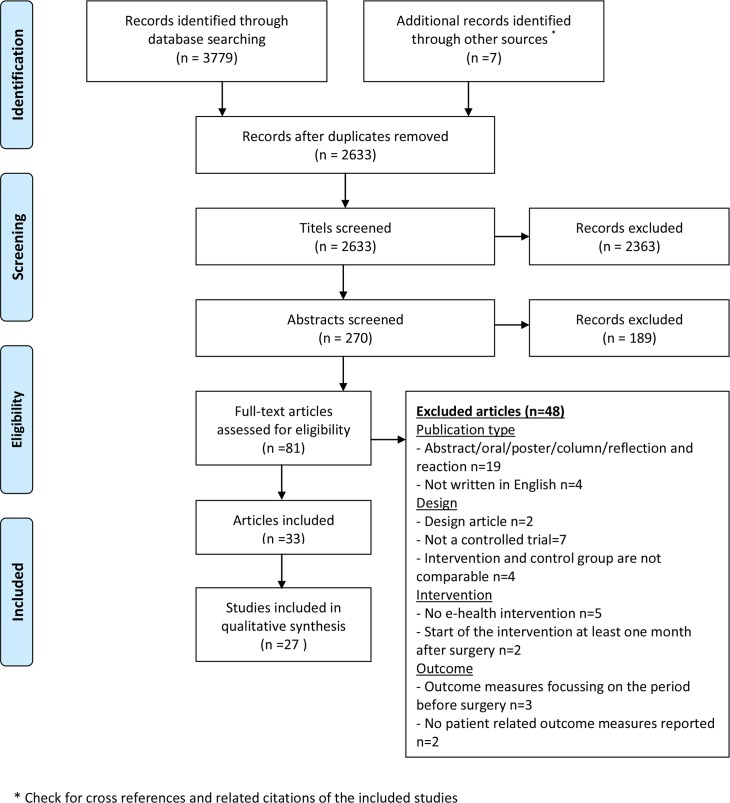
BACKGROUND: E-health interventions have become increasingly popular, including in perioperative care. The objective of this study was to evaluate the effect of perioperative e-health interventions on the postoperative course. METHODS: We conducted a systematic review and searched for relevant articles in the PUBMED, EMBASE, CINAHL and COCHRANE databases. Controlled trials written in English, with participants of 18 years and older who underwent any type of surgery and which evaluated any type of e-health intervention by reporting patient-related outcome measures focusing on the period after surgery, were included. Data of all included studies were extracted and study quality was assessed by using the Downs and Black scoring system. FINDINGS: A total of 33 articles were included, reporting on 27 unique studies. Most studies were judged as having a medium risk of bias (n = 13), 11 as a low risk of bias, and three as high risk of bias studies. Most studies included patients undergoing cardiac (n = 9) or orthopedic surgery (n = 7). All studies focused on replacing (n = 11) or complementing (n = 15) perioperative usual care with some form of care via ICT; one study evaluated both type of interventions. Interventions consisted of an educational or supportive website, telemonitoring, telerehabilitation or teleconsultation. All studies measured patient-related outcomes focusing on the physical, the mental or the general component of recovery. 11 studies (40.7%) reported outcome measures related to the effectiveness of the intervention in terms of health care usage and costs. 25 studies (92.6%) reported at least an equal (n = 8) or positive (n = 17) effect of the e-health intervention compared to usual care. In two studies (7.4%) a positive effect on any outcome was found in favour of the control group. CONCLUSION: Based on this systematic review we conclude that in the majority of the studies e-health leads to similar or improved clinical patient-related outcomes compared to only face to face perioperative care for patients who have undergone various forms of surgery. However, due to the low or moderate quality of many studies, the results should be interpreted with caution.
Overview
The claims and statistics of this paper haven’t been checked yet.
Free: it reads the open-access text and checks the first 5 claims that cite a source we can check. Create a free account to check every claim.
Integrity signals
Registry
Cites
Statistics
Figures
Verification
Claims the paper makes
The claims and statistics of this paper haven’t been checked yet.
Free: it reads the open-access text and checks the first 5 claims that cite a source we can check. Create a free account to check every claim.
Claims other papers make about this one
Each is checked against this paper’s own text: does it say what the citing paper says it does?
The cited source says what the claim attributes to it.
In the citing paper
“For patients undergoing surgery, Van der Meij et al. (2016) found that in the majority of the studies in their review e-health led to similar or improved clinical patient-related outcomes compared to only face-to-face perioperative care.”
From Strength Back – A qualitative study on the co-creation of a positive psychology digital health intervention for spinal surgery patients (2023) · cites this paper as van der Meij et al., 2016
The cited source says what the claim attributes to it.
In the citing paper
“van der Meij et al [50] found in their review that, in most studies, perioperative digital health interventions improved clinical patient-related outcomes compared with face-to-face perioperative care alone for patients who had undergone various forms of surgery.”
Self-check
Percentages, sums and reported differences re-computed from the paper’s own numbers.
The self-check needs the paper’s full text.
Citations
Cites
Liberati, A., Altman, D. G., Tetzlaff, J., Mulrow, C., Gøtzsche, P. C., Ioannidis, J. P. A., Clarke, M., Devereaux, P. J., Kleijnen, J., & Moher, D. (2009) · PLoS Medicine · doi:10.1371/journal.pmed.1000100 · Cited by 28,164 · cited 2×
“Methods We conducted a systematic review in accordance to the Prisma guidelines [18].”
BackgroundMethodDowns, S. H., & Black, N. (1998) · Journal of Epidemiology and Community Health · doi:10.1136/jech.52.6.377 · Cited by 8,252 · cited 1×
“Data Items Data were extracted from each included study on: 1) specific study characteristics (authors, year of publication, geographic location, study design and number of participants) 2) characteristics of the study participants (in- and exclusion criteria, reason for surgery (benign or malign), type of surgery, ag…”
MethodEffectiveness of telemedicine: A systematic review of reviews
Ekeland, A. G., Bowes, A., & Flottorp, S. (2010) · International Journal of Medical Informatics · doi:10.1016/j.ijmedinf.2010.08.006 · Cited by 1,162 · cited 1×
“Ekeland et al, 2010 evaluated the effect of telemedicine interventions in general medical care in a systematic review [57].”
BackgroundInteractive telemedicine: effects on professional practice and health care outcomes
Flodgren, G., Rachas, A., Farmer, A. J., Inzitari, M., & Shepperd, S. (2015) · Cochrane Database of Systematic Reviews · doi:10.1002/14651858.cd002098.pub2 · Cited by 806 · cited 2×
“Flodgren et al, 2015 published a Cochrane systematic review about the effectiveness of e-health on professional practice and health care outcomes [56].”
Backgroundde la Torre-Díez, I., López-Coronado, M., Vaca, C., Aguado, J. S., & de Castro, C. (2015) · Telemedicine and e-Health · doi:10.1089/tmj.2014.0053 · Cited by 495
What Is eHealth (4): A Scoping Exercise to Map the Field
Pagliari, C., Sloan, D., Gregor, P., Sullivan, F., Detmer, D., Kahan, J. P., Oortwijn, W., & MacGillivray, S. (2005) · Journal of Medical Internet Research · doi:10.2196/jmir.7.1.e9 · Cited by 479 · cited 1×
“We used the definition of e-health which was defined by Paglari et al: “eHealth is an emerging field of medical informatics, referring to the organization and delivery of health services and information using the Internet and related technologies” [19].”
MethodeHealth for Patient Engagement: A Systematic Review
Barello, S., Triberti, S., Graffigna, G., Libreri, C., Serino, S., Hibbard, J., & Riva, G. (2016) · Frontiers in Psychology · doi:10.3389/fpsyg.2015.02013 · Cited by 411 · cited 1×
“It has the potential to motivate people and to turn them into more active and effective managers of their own health [4].”
BackgroundRussell, T. G., Buttrum, P., Wootton, R., & Jull, G. A. (2011) · The Journal of Bone and Joint Surgery-American Volume · doi:10.2106/jbjs.i.01375 · Cited by 382 · cited 7×
“Five studies [25; 30; 40; 41; 46] evaluated patient satisfaction, with a particular focus on the intervention, without measuring the control group.”
BackgroundMethodInfluentialCleeland, C. S., Wang, X. S., Shi, Q., Mendoza, T. R., Wright, S. L., Berry, M. D., Malveaux, D., Shah, P. K., Gning, I., Hofstetter, W. L., et al. (2011) · Journal of Clinical Oncology · doi:10.1200/jco.2010.29.8315 · Cited by 341 · cited 4×
“Four out of six studies that compared overall satisfaction with the treatment between groups found a significant difference in effect in favour of the intervention group [24; 30; 40; 49].”
BackgroundResultInfluentialA randomized controlled trial of home telerehabilitation for post-knee arthroplasty
Tousignant, M., Moffet, H., Boissy, P., Corriveau, H., Cabana, F., & Marquis, F. (2011) · Journal of Telemedicine and Telecare · doi:10.1258/jtt.2010.100602 · Cited by 236 · cited 2×
“However, two relatively small studies measured quality of life total scores for patients undergoing total knee arthroplasty, and found no difference in effect [46; 47].”
BackgroundMethodPiqueras, M., Marco, E., Coll, M., Escalada, F., Ballester, A., Cinca, C., Belmonte, R., & Muniesa, J. (2013) · Journal of Rehabilitation Medicine · doi:10.2340/16501977-1119 · Cited by 220 · cited 3×
“Five studies presented no significant differences in pain scores between groups [25; 37; 42; 45; 46].”
BackgroundEffectiveness of Telemedical Applications in Postoperative Follow-Up After Total Joint Arthroplasty
Sharareh, B., & Schwarzkopf, R. (2014) · The Journal of Arthroplasty · doi:10.1016/j.arth.2013.09.019 · Cited by 180 · cited 1×
“Finally in the post-operative course e-health devices or programs are broadly applied to assist patients in their recovery process [12; 13].”
BackgroundCost Analysis of In-Home Telerehabilitation for Post-Knee Arthroplasty
Tousignant, M., Moffet, H., Nadeau, S., Mérette, C., Boissy, P., Corriveau, H., Marquis, F., Cabana, F., Ranger, P., Belzile, É. L., et al. (2015) · Journal of Medical Internet Research · doi:10.2196/jmir.3844 · Cited by 169 · cited 7×
“All were large studies (at least 147 participants) but with a high [44] or medium risk of bias [26; 28; 48; 54; 55].”
BackgroundMethodInfluentialSpinal Cord Injury Rehabilitation Evidence: Method of the SCIRE Systematic Review
Eng, J., Teasell, R., Miller, W., Wolfe, D., Townson, A., Aubut, J.-A., Abramson, C., Hsieh, J., Connolly, S., & Konnyu, K. (2007) · Topics in Spinal Cord Injury Rehabilitation · doi:10.1310/sci1301-1 · Cited by 160
Fairbrother, P., Ure, J., Hanley, J., McCloughan, L., Denvir, M., Sheikh, A., McKinstry, B., & The Telescot programme team (2014) · Journal of Clinical Nursing · doi:10.1111/jocn.12137 · Cited by 140 · cited 1×
“Introduction In recent years e-health interventions have become increasingly popular in medical care [1; 2].”
BackgroundBarnason, S. A., Zimmerman, L. M., Nieveen, J. L., Schmaderer, M. S., Carranza, B., & Reilly, S. (2003) · Heart & Lung · doi:10.1016/s0147-9563(03)00036-0 · Cited by 115 · cited 11×
“Self-efficacy was measured in a small study (n = 35, medium risk of bias) by the Barnason Efficacy Expectation scale 6 weeks and 3 months after CABG surgery [34].”
BackgroundMethodResultInfluentialD’Haese, P.-F., Pallavaram, S., Li, R., Remple, M. S., Kao, C., Neimat, J. S., Konrad, P. E., & Dawant, B. M. (2010) · Medical Image Analysis · doi:10.1016/j.media.2010.07.009 · Cited by 115 · cited 1×
“In addition, many e-health interventions are used intra-operatively, for example tools to assist the surgeon during surgery or simulation interventions for educating trainee surgeons [10; 11].”
A systematic review of the effects of e‐health on chronically ill patients
Eland‐de Kok, P., van Os‐Medendorp, H., Vergouwe‐Meijer, A., Bruijnzeel‐Koomen, C., & Ros, W. (2011) · Journal of Clinical Nursing · doi:10.1111/j.1365-2702.2011.03743.x · Cited by 114 · cited 1×
“2011, systematically reviewed the effects of e-health on care for chronically ill patients [59].”
BackgroundProgress in virtual reality simulators for surgical training and certification
de Visser, H., Watson, M. J. O., Salvado, O., & Passenger, J. D. (2011) · The Medical Journal of Australia · doi:10.5694/j.1326-5377.2011.tb02942.x · Cited by 103 · cited 1×
“In addition, many e-health interventions are used intra-operatively, for example tools to assist the surgeon during surgery or simulation interventions for educating trainee surgeons [10; 11].”
Telerounding and patient satisfaction after surgery
Ellison, L. M., Pinto, P. A., Kim, F., Ong, A. M., Patriciu, A., Stoianovici, D., Rubin, H., Jarrett, T., & Kavoussi, L. R. (2004) · Journal of the American College of Surgeons · doi:10.1016/j.jamcollsurg.2004.06.022 · Cited by 99 · cited 5×
“Four out of six studies that compared overall satisfaction with the treatment between groups found a significant difference in effect in favour of the intervention group [24; 30; 40; 49].”
BackgroundResultInfluentialOptimized post-operative surveillance of permanent pacemakers by home monitoring: the OEDIPE trial
Halimi, F., Clementy, J., Attuel, P., Dessenne, X., Amara, W., & on behalf of the OEDIPE trial Investigators (2008) · Europace · doi:10.1093/europace/eun250 · Cited by 88 · cited 10×
“One of these studies was a non-inferiority study in which complications were the primary outcome measure [28].”
BackgroundMethodResultInfluentialVonk Noordegraaf, A., Anema, Jr., van Mechelen, W., Knol, D., van Baal, W., van Kesteren, P., Brölmann, H., & Huirne, J. (2014) · BJOG: An International Journal of Obstetrics & Gynaecology · doi:10.1111/1471-0528.12661 · Cited by 79 · cited 23×
“ID Type of outcome measure Measuring instrument Measuring moments Effect 1 Details of the effect Mean Intervention group (SD or range) Mean Control group (SD or range) Education or supportive website or device (ESW) Goldsmith et Postoperative 5-point Verbal - Discharge + - NR - NR al, 1999 [36] pain score Rating Scale…”
BackgroundMethodResultInfluentialSelf-citationEriksson, L., Lindström, B., Gard, G., & Lysholm, J. (2009) · Journal of Telemedicine and Telecare · doi:10.1258/jtt.2009.081003 · Cited by 77 · cited 11×
“et al, 2009 [27] improvement in weeks after discharge pain Piquares et al, Mean change in VAS - Between baseline and completing x - 0.”
BackgroundMethodInfluentialPatient Engagement and Reported Outcomes in Surgical Recovery: Effectiveness of an e-Health Platform
Cook, D. J., Manning, D. M., Holland, D. E., Prinsen, S. K., Rudzik, S. D., Roger, V. L., & Deschamps, C. C. (2013) · Journal of the American College of Surgeons · doi:10.1016/j.jamcollsurg.2013.05.003 · Cited by 76 · cited 1×
“For this reason, also in peri-operative care e-health interventions are broadly applied [5; 6].”
BackgroundBarnason, S. A., Zimmerman, L. M., Nieveen, J. L., & Hertzog, M. A. (2006) · Heart & Lung · doi:10.1016/j.hrtlng.2005.10.003 · Cited by 76
Callesen, B. K. (1999) · The European Journal of Surgery · doi:10.1080/110241599750007108 · Cited by 70
Barnason, S., Zimmerman, L., Nieveen, J., Schulz, P., Miller, C., Hertzog, M., & Tu, C. (2009) · Heart & Lung · doi:10.1016/j.hrtlng.2009.01.005 · Cited by 69 · cited 7×
“One large study (n = 232, medium risk of bias) reported a significant change in estimated energy expenditure measured by the RT3 accelerometer; the control group showed higher scores three weeks after surgery when compared to the intervention group [35].”
BackgroundResultInfluentialEllison, L. M. (2007) · Archives of Surgery · doi:10.1001/archsurg.142.12.1177 · Cited by 69
van den Brink, J. L., Moorman, P. W., de Boer, M. F., Hop, W. C. J., Pruyn, J. F. A., Verwoerd, C. D. A., & van Bemmel, J. H. (2007) · Journal of the American Medical Informatics Association · doi:10.1197/jamia.m2199 · Cited by 66 · cited 6×
“As well as this one study used a self-developed quality of life questionnaire with five physical functioning subscales [29].”
BackgroundMethodInfluentialMartorella, G., Côté, J., Racine, M., & Choinière, M. (2012) · Journal of Medical Internet Research · doi:10.2196/jmir.2070 · Cited by 65 · cited 5×
“The second study (n = 60) observed significantly more use of opioid medication in the intervention group than in the control group [37].”
InfluentialYin, B., Goldsmith, L., & Gambardella, R. (2015) · Journal of Bone and Joint Surgery · doi:10.2106/jbjs.n.01174 · Cited by 56 · cited 5×
“Five studies [25; 30; 40; 41; 46] evaluated patient satisfaction, with a particular focus on the intervention, without measuring the control group.”
BackgroundResultInfluentialShort-stay surgery: What really happens after discharge?
Tran, T. T., Kaneva, P. A., Mayo, N. E., Fried, G. M., & Feldman, L. S. (2014) · Surgery · doi:10.1016/j.surg.2014.03.024 · Cited by 55
Vonk Noordegraaf, A., Anema, Jr., Louwerse, M., Heymans, M., van Mechelen, W., Brölmann, H., & Huirne, J. (2014) · BJOG: An International Journal of Obstetrics & Gynaecology · doi:10.1111/1471-0528.12494 · Cited by 53
Self-citationThe Acceptance of e-Health Solutions Among Patients with Chronic Respiratory Conditions
Duplaga, M. (2013) · Telemedicine and e-Health · doi:10.1089/tmj.2012.0306 · Cited by 47 · cited 1×
“Introduction In recent years e-health interventions have become increasingly popular in medical care [1; 2].”
BackgroundPre-employment examinations for preventing occupational injury and disease in workers
Mahmud, N. B., Schönstein, E., Schaafsma, F. G., Lehtola, M. M., Fassier, J., Reneman, M. F., & Verbeek, J. H. A. M. (2010) · Cochrane Database of Systematic Reviews · doi:10.1002/14651858.cd008881 · Cited by 46
Self-citationKeeping‐Burke, L., Purden, M., Frasure‐Smith, N., Cossette, S., McCarthy, F., & Amsel, R. (2013) · Research in Nursing & Health · doi:10.1002/nur.21571 · Cited by 45
Robotic Telepresence: Profit Analysis in Reducing Length of Stay after Laparoscopic Gastric Bypass
Gandsas, A., Parekh, M., Bleech, M. M., & Tong, D. A. (2007) · Journal of the American College of Surgeons · doi:10.1016/j.jamcollsurg.2007.01.070 · Cited by 45 · cited 5×
“All were large studies (at least 147 participants) but with a high [44] or medium risk of bias [26; 28; 48; 54; 55].”
BackgroundResultInfluentialKörtke, H., Stromeyer, H., Zittermann, A., Buhr, N., Zimmermann, E., Wienecke, E., & Körfer, R. (2006) · Telemedicine and e-Health · doi:10.1089/tmj.2006.12.475 · Cited by 45
Interactive systems for patient-centered care to enhance patient engagement
Tang, C., Lorenzi, N., Harle, C. A., Zhou, X., & Chen, Y. (2016) · Journal of the American Medical Informatics Association · doi:10.1093/jamia/ocv198 · Cited by 45 · cited 1×
“On the one hand this is because there is a growing demand for electronic technologies in society; the development of these technologies gives people the opportunity to get information and to self-manage all type of activities in daily living, including their health [3].”
BackgroundUsing the Web to reduce postoperative pain following ambulatory surgery.
Goldsmith, D. M., & Safran, C. (1999) · PubMed · Cited by 42
Barnason, S., Zimmerman, L., Schulz, P., & Tu, C. (2009) · Heart & Lung · doi:10.1016/j.hrtlng.2009.01.010 · Cited by 41
Gender differences in recovery outcomes after an early recovery symptom management intervention
Zimmerman, L. M., Barnason, S. A., Hertzog, M. A., Young, L., Nieveen, J. L., Schulz, P., & Tu, C. (2011) · Heart & Lung · doi:10.1016/j.hrtlng.2010.07.018 · Cited by 41 · cited 1×
“No differences in physical functioning scores were found between men and women [52].”
Background(2005) · PubMed · Cited by 40
Zimmerman, L. M., Barnason, S. A., Schulz, P., Nieveen, J. L., Miller, C., Hertzog, M. A., Rasmussen, D., & Tu, C. (2007) · The Journal of Cardiovascular Nursing · doi:10.1097/01.jcn.0000297379.06379.b6 · Cited by 36
Symptom management intervention in elderly coronary artery bypass graft patients.
Zimmerman, L. M., Barnason, S. A., Nieveen, J. L., & Schmaderer, M. S. (2004) · PubMed · Cited by 33
On-line bariatric surgery information session as effective as in-person information session
Eaton, L., Walsh, C., Magnuson, T., Schweitzer, M., Lidor, A., Nguyen, H., & Steele, K. (2012) · Surgery for Obesity and Related Diseases · doi:10.1016/j.soard.2011.10.015 · Cited by 30
Bouwsma, E. V. A., Noordegraaf, A. V., Szlávik, Z., Brölmann, H. A. M., Emanuel, M. H., Lips, J. P., van Mechelen, W., Mozes, A., Thurkow, A. L., Huirne, J. A. F., et al. (2013) · Journal of Occupational Rehabilitation · doi:10.1007/s10926-013-9475-4 · Cited by 29 · cited 1×
“For this reason, also in peri-operative care e-health interventions are broadly applied [5; 6].”
BackgroundSelf-citationProspective analysis of convalescence and early pain after uncomplicated laparoscopic fundoplication
Bisgaard, T., Støckel, M., Klarskov, B., Kehlet, H., & Rosenberg, J. (2004) · British journal of surgery · doi:10.1002/bjs.4720 · Cited by 27
Palombo, D., Mugnai, D., Mambrini, S., Robaldo, A., Ρούσας, Ν., Mazzei, R., Pane, B., & Spinella, G. (2008) · Annals of Vascular Surgery · doi:10.1016/j.avsg.2008.06.013 · Cited by 25 · cited 1×
“Finally in the post-operative course e-health devices or programs are broadly applied to assist patients in their recovery process [12; 13].”
BackgroundHealth information: what can mobile phone assessments add?
Stomberg, M. W., Platon, B., Widén, A., Wallner, I., & Karlsson, O. (2012) · PubMed · Cited by 21
Pombo, N. G. C. C., Araújo, P., Viana, J., & da Costa, M. D. (2014) · Technology and Health Care · doi:10.3233/thc-130774 · Cited by 20 · cited 3×
“Five studies presented no significant differences in pain scores between groups [25; 37; 42; 45; 46].”
BackgroundAmbulatory Orthopaedic Surgery Patient Education and Cost of Care
Heikkinen, K., Salanterä, S., Suomi, R., Lindblom, A., & Leino‐Kilpi, H. (2011) · Orthopaedic Nursing · doi:10.1097/nor.0b013e318205747f · Cited by 20
Ambulatory Orthopaedic Surgery Patients' Emotions When Using Two Different Patient Education Methods
Heikkinen, K., Salanterä, S., Leppänen, T., Vahlberg, T. J., & Leino‐Kilpi, H. (2012) · Journal of Perioperative Practice · doi:10.1177/175045891202200703 · Cited by 19 · cited 1×
“Postoperative emotion scores were measured in a low risk of bias study with 147 participants undergoing orthopaedic surgery [53].”
MethodNeary, P., Sung, R., Corrigan, M. A., O'Donovan, M., Cahill, R. A., & Redmond, H. P. (2010) · Surgical Innovation · doi:10.1177/1553350610374603 · Cited by 19 · cited 8×
“Five studies [25; 30; 40; 41; 46] evaluated patient satisfaction, with a particular focus on the intervention, without measuring the control group.”
BackgroundInfluentialMiller, C., Zimmerman, L. M., Barnason, S. A., & Nieveen, J. L. (2007) · Heart & Lung · doi:10.1016/j.hrtlng.2007.02.011 · Cited by 19 · cited 4×
“The remaining three studies showed no difference in effect between groups for any of the subscales [28; 35; 38].”
BackgroundInfluentialPerioperative cataract OP management by means of teleconsultation
Zahlmann, G., Mertz, M., Fabian, E., Holle, R., Kaatz, H., Neubauer, L., Strobl, H., & Walther, H.-D. (2001) · Graefe s Archive for Clinical and Experimental Ophthalmology · doi:10.1007/s00417-001-0396-0 · Cited by 15 · cited 5×
“Four out of six studies that compared overall satisfaction with the treatment between groups found a significant difference in effect in favour of the intervention group [24; 30; 40; 49].”
BackgroundResultInfluentialAmbulatory orthopaedic surgery patients’ symptoms with two different patient education methods
Heikkinen, K., Leino‐Kilpi, H., Vahlberg, T. J., & Salanterä, S. (2011) · International Journal of Orthopaedic and Trauma Nursing · doi:10.1016/j.ijotn.2011.04.004 · Cited by 13 · cited 2×
“Five studies reported problems or symptoms in the postoperative course, which were not rated as complications [8; 30; 33; 39; 51].”
BackgroundYoung, L., Zimmerman, L. M., Pozehl, B., Barnason, S. A., & Wang, H. (2012) · PubMed · Cited by 9
Research works printed but not linked: 1
- Cochrane Consumers and Communication Review Groups: Tools and guides for review authors. Data extraction template. 2013. Available: http://cccrg.cochrane.org/author-resources. Accessed 22 April 2014. (2015)
Cited by
Thompson, A., Fleischmann, K. E., Smilowitz, N. R., de las Fuentes, L., Mukherjee, D., Aggarwal, N. R., Ahmad, F. S., Allen, R. B., Altin, S. E., Auerbach, A., et al. (2024) · Circulation · doi:10.1161/cir.0000000000001285 · Cited by 365
The Current State Of Telehealth Evidence: A Rapid Review.
Shigekawa, E., Fix, M., Corbett, G., Roby, D. H., & Coffman, J. (2018) · Health Affairs · doi:10.1377/hlthaff.2018.05132 · Cited by 406
Thompson, A., Fleischmann, K. E., Smilowitz, N. R., de las Fuentes, L., Mukherjee, D., Aggarwal, N. R., Ahmad, F. S., Allen, R. B., Altin, S. E., Auerbach, A., et al. (2024) · Journal of the American College of Cardiology · doi:10.1016/j.jacc.2024.06.013 · Cited by 209
Timmers, T., Janssen, L., van der Weegen, W., Das, D., Marijnissen, W.-J., Hannink, G., van der Zwaard, B. C., Plat, A., Thomassen, B., Swen, J.-W., et al. (2019) · JMIR mHealth and uHealth · doi:10.2196/15323 · Cited by 162
“A 2018 review on perioperative eHealth interventions has demonstrated a positive effect upon the postoperative course in patients who are undergoing orthopedic and cardiac surgery [21].”
Werneke, M. W., Deutscher, D., Grigsby, D., Tucker, C. A., Mioduski, J. E., & Hayes, D. (2021) · Physical Therapy · doi:10.1093/ptj/pzab110 · Cited by 136
Metadata
- Authors
- van der Meij, E., Anema, J. R., Otten, R. H. J., Huirne, J. A. F., & Schaafsma, F. G.
- Affiliations
- Amsterdam Public Health (NL)
- Vrije Universiteit Amsterdam (NL)
- Amsterdam UMC Location Vrije Universiteit Amsterdam (NL)
- Venue
- PLoS ONE
- Publisher
- Public Library of Science (PLoS)
- Published
- 2016-07-06
- Volume
- 11
- Issue
- 7
- Pages
- e0158612
- ISSN
- 1932-6203 (ISSN-L)
- PMC
- PMC4934874
- OpenAlex
- W2471214594
- Cited by
- 103
- References
- 58
- Citations by year
- 2026: 10 · 2025: 8 · 2024: 12 · 2023: 16 · 2022: 15 · 2021: 18 · 2020: 7 · 2019: 4 · 2018: 9 · 2017: 3 · 2016: 1
- FWCI
- 1.08
- Type
- journal article
- Language
- en
- Open access
- gold
- doi.org
- Licence
- Locations
- PLoS ONE (publishedVersion, cc-by)
- Europe PMC (PubMed Central) (publishedVersion, cc-by)
- PubMed Central (publishedVersion, cc-by)
- PubMed (publishedVersion)
- Amsterdam UMC (VU Amsterdam) - Institutional Repository (publishedVersion)
- RePEc: Research Papers in Economics (submittedVersion)
- DOAJ (DOAJ: Directory of Open Access Journals) (submittedVersion, cc-by-sa)
- Figshare (submittedVersion, cc-by)
- Pure Amsterdam UMC (submittedVersion, other-oa)
- Data Archiving and Networked Services (DANS) (submittedVersion)
- Funders
- ZonMw (837002409)
- Topics
- Health Sciences › Health Professions › General Health Professions › Mobile Health and mHealth Applications
- Health Sciences › Medicine › Public Health, Environmental and Occupational Health › Telemedicine and Telehealth Implementation
- Health Sciences › Medicine › Surgery › Enhanced Recovery After Surgery
- Keywords
- digital health interventions, perioperative care, postoperative recovery, remote patient monitoring, telerehabilitation, teleconsultation, educational websites, cardiac surgery, orthopedic surgery, patient-related outcomes, health care costs, risk of bias
- MeSH terms
- Humans, Patient Education as Topic, Postoperative Period, Quality of Health Care, Quality of Life, Randomized Controlled Trials as Topic, Outcome Assessment, Health Care, Perioperative Care, Non-Randomized Controlled Trials as Topic, Health Information Exchange
About these checks
Registry, retraction, Cites and statistics results are computed, not judged, with one exception: a printed reference that no index lists is read once by a model before it counts as a citation error. Claims are extracted by a model and kept only when their quote appears verbatim in the text; each cited source is then checked, with a model’s help, for whether it says what the claim relies on. Those verdicts can be wrong — read the claim’s quote and the cited source before relying on one.
Statistics and arithmetic are recomputed, not judged.
Confidence bands are shown only for fields calibrated on our annotated test set. None is calibrated yet, so no band is shown.
What counts as a claim ›How we measure confidence ›How we check this ›
Are you an author, or do you see a problem with this page? Request a review
Data sources
Bibliographic data: Semantic Scholar, OpenAlex, Crossref.
Contains information from the Semantic Scholar Academic Graph Datasets, made available under the ODC Attribution License (ODC-BY 1.0).
Semantic Scholar’s data is described in: Kinney, R., et al. (2023). The Semantic Scholar Open Data Platform. arXiv:2301.10140.
