

The Effect of Perioperative E-Health Interventions on the Postoperative Course: A Systematic Review of Randomised and Non-Randomised Controlled Trials
Open accessThe DOI matches its Crossref record; 58 of the 58 references it cites were found in a registry or an index.
Abstract
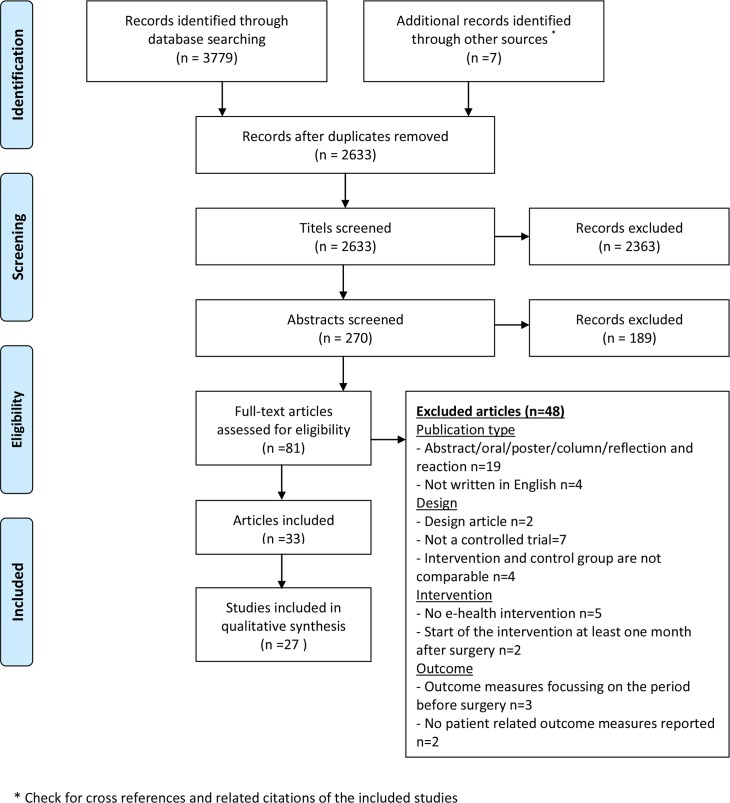
BACKGROUND: E-health interventions have become increasingly popular, including in perioperative care. The objective of this study was to evaluate the effect of perioperative e-health interventions on the postoperative course. METHODS: We conducted a systematic review and searched for relevant articles in the PUBMED, EMBASE, CINAHL and COCHRANE databases. Controlled trials written in English, with participants of 18 years and older who underwent any type of surgery and which evaluated any type of e-health intervention by reporting patient-related outcome measures focusing on the period after surgery, were included. Data of all included studies were extracted and study quality was assessed by using the Downs and Black scoring system. FINDINGS: A total of 33 articles were included, reporting on 27 unique studies. Most studies were judged as having a medium risk of bias (n = 13), 11 as a low risk of bias, and three as high risk of bias studies. Most studies included patients undergoing cardiac (n = 9) or orthopedic surgery (n = 7). All studies focused on replacing (n = 11) or complementing (n = 15) perioperative usual care with some form of care via ICT; one study evaluated both type of interventions. Interventions consisted of an educational or supportive website, telemonitoring, telerehabilitation or teleconsultation. All studies measured patient-related outcomes focusing on the physical, the mental or the general component of recovery. 11 studies (40.7%) reported outcome measures related to the effectiveness of the intervention in terms of health care usage and costs. 25 studies (92.6%) reported at least an equal (n = 8) or positive (n = 17) effect of the e-health intervention compared to usual care. In two studies (7.4%) a positive effect on any outcome was found in favour of the control group. CONCLUSION: Based on this systematic review we conclude that in the majority of the studies e-health leads to similar or improved clinical patient-related outcomes compared to only face to face perioperative care for patients who have undergone various forms of surgery. However, due to the low or moderate quality of many studies, the results should be interpreted with caution.
Overview
The claims and statistics of this paper haven’t been checked yet.
Free: it reads the open-access text and checks the first 5 claims that cite a source we can check. Create a free account to check every claim.
Integrity signals
Registry
Cites
Statistics
Figures
Verification
Claims the paper makes
The claims and statistics of this paper haven’t been checked yet.
Free: it reads the open-access text and checks the first 5 claims that cite a source we can check. Create a free account to check every claim.
Claims other papers make about this one
Each is checked against this paper’s own text: does it say what the citing paper says it does?
The cited source says what the claim attributes to it.
In the citing paper
“For patients undergoing surgery, Van der Meij et al. (2016) found that in the majority of the studies in their review e-health led to similar or improved clinical patient-related outcomes compared to only face-to-face perioperative care.”
From Strength Back – A qualitative study on the co-creation of a positive psychology digital health intervention for spinal surgery patients (2023) · cites this paper as van der Meij et al., 2016
The cited source says what the claim attributes to it.
In the citing paper
“van der Meij et al [50] found in their review that, in most studies, perioperative digital health interventions improved clinical patient-related outcomes compared with face-to-face perioperative care alone for patients who had undergone various forms of surgery.”
Self-check
Percentages, sums and reported differences re-computed from the paper’s own numbers.
The self-check needs the paper’s full text.
Citations
Cites
Liberati, A., Altman, D. G., Tetzlaff, J., Mulrow, C., Gøtzsche, P. C., Ioannidis, J. P. A., Clarke, M., Devereaux, P. J., Kleijnen, J., & Moher, D. (2009) · PLoS Medicine · doi:10.1371/journal.pmed.1000100 · Cited by 28,164 · cited 2×
“Methods We conducted a systematic review in accordance to the Prisma guidelines [18].”
BackgroundMethodDowns, S. H., & Black, N. (1998) · Journal of Epidemiology and Community Health · doi:10.1136/jech.52.6.377 · Cited by 8,252 · cited 1×
“Data Items Data were extracted from each included study on: 1) specific study characteristics (authors, year of publication, geographic location, study design and number of participants) 2) characteristics of the study participants (in- and exclusion criteria, reason for surgery (benign or malign), type of surgery, ag…”
MethodEffectiveness of telemedicine: A systematic review of reviews
Ekeland, A. G., Bowes, A., & Flottorp, S. (2010) · International Journal of Medical Informatics · doi:10.1016/j.ijmedinf.2010.08.006 · Cited by 1,162 · cited 1×
“Ekeland et al, 2010 evaluated the effect of telemedicine interventions in general medical care in a systematic review [57].”
BackgroundInteractive telemedicine: effects on professional practice and health care outcomes
Flodgren, G., Rachas, A., Farmer, A. J., Inzitari, M., & Shepperd, S. (2015) · Cochrane Database of Systematic Reviews · doi:10.1002/14651858.cd002098.pub2 · Cited by 806 · cited 2×
“Flodgren et al, 2015 published a Cochrane systematic review about the effectiveness of e-health on professional practice and health care outcomes [56].”
Backgroundde la Torre-Díez, I., López-Coronado, M., Vaca, C., Aguado, J. S., & de Castro, C. (2015) · Telemedicine and e-Health · doi:10.1089/tmj.2014.0053 · Cited by 495
What Is eHealth (4): A Scoping Exercise to Map the Field
Pagliari, C., Sloan, D., Gregor, P., Sullivan, F., Detmer, D., Kahan, J. P., Oortwijn, W., & MacGillivray, S. (2005) · Journal of Medical Internet Research · doi:10.2196/jmir.7.1.e9 · Cited by 479 · cited 1×
“We used the definition of e-health which was defined by Paglari et al: “eHealth is an emerging field of medical informatics, referring to the organization and delivery of health services and information using the Internet and related technologies” [19].”
MethodeHealth for Patient Engagement: A Systematic Review
Barello, S., Triberti, S., Graffigna, G., Libreri, C., Serino, S., Hibbard, J., & Riva, G. (2016) · Frontiers in Psychology · doi:10.3389/fpsyg.2015.02013 · Cited by 411 · cited 1×
“It has the potential to motivate people and to turn them into more active and effective managers of their own health [4].”
BackgroundRussell, T. G., Buttrum, P., Wootton, R., & Jull, G. A. (2011) · The Journal of Bone and Joint Surgery-American Volume · doi:10.2106/jbjs.i.01375 · Cited by 382 · cited 7×
“Five studies [25; 30; 40; 41; 46] evaluated patient satisfaction, with a particular focus on the intervention, without measuring the control group.”
BackgroundMethodInfluentialCleeland, C. S., Wang, X. S., Shi, Q., Mendoza, T. R., Wright, S. L., Berry, M. D., Malveaux, D., Shah, P. K., Gning, I., Hofstetter, W. L., et al. (2011) · Journal of Clinical Oncology · doi:10.1200/jco.2010.29.8315 · Cited by 341 · cited 4×
“Four out of six studies that compared overall satisfaction with the treatment between groups found a significant difference in effect in favour of the intervention group [24; 30; 40; 49].”
BackgroundResultInfluentialA randomized controlled trial of home telerehabilitation for post-knee arthroplasty
Tousignant, M., Moffet, H., Boissy, P., Corriveau, H., Cabana, F., & Marquis, F. (2011) · Journal of Telemedicine and Telecare · doi:10.1258/jtt.2010.100602 · Cited by 236 · cited 2×
“However, two relatively small studies measured quality of life total scores for patients undergoing total knee arthroplasty, and found no difference in effect [46; 47].”
BackgroundMethod
Research works printed but not linked: 1
- Cochrane Consumers and Communication Review Groups: Tools and guides for review authors. Data extraction template. 2013. Available: http://cccrg.cochrane.org/author-resources. Accessed 22 April 2014. (2015)
Cited by
Thompson, A., Fleischmann, K. E., Smilowitz, N. R., de las Fuentes, L., Mukherjee, D., Aggarwal, N. R., Ahmad, F. S., Allen, R. B., Altin, S. E., Auerbach, A., et al. (2024) · Circulation · doi:10.1161/cir.0000000000001285 · Cited by 365
The Current State Of Telehealth Evidence: A Rapid Review.
Shigekawa, E., Fix, M., Corbett, G., Roby, D. H., & Coffman, J. (2018) · Health Affairs · doi:10.1377/hlthaff.2018.05132 · Cited by 406
Thompson, A., Fleischmann, K. E., Smilowitz, N. R., de las Fuentes, L., Mukherjee, D., Aggarwal, N. R., Ahmad, F. S., Allen, R. B., Altin, S. E., Auerbach, A., et al. (2024) · Journal of the American College of Cardiology · doi:10.1016/j.jacc.2024.06.013 · Cited by 209
Timmers, T., Janssen, L., van der Weegen, W., Das, D., Marijnissen, W.-J., Hannink, G., van der Zwaard, B. C., Plat, A., Thomassen, B., Swen, J.-W., et al. (2019) · JMIR mHealth and uHealth · doi:10.2196/15323 · Cited by 162
“A 2018 review on perioperative eHealth interventions has demonstrated a positive effect upon the postoperative course in patients who are undergoing orthopedic and cardiac surgery [21].”
Werneke, M. W., Deutscher, D., Grigsby, D., Tucker, C. A., Mioduski, J. E., & Hayes, D. (2021) · Physical Therapy · doi:10.1093/ptj/pzab110 · Cited by 136
Metadata
- Authors
- van der Meij, E., Anema, J. R., Otten, R. H. J., Huirne, J. A. F., & Schaafsma, F. G.
- Affiliations
- Amsterdam Public Health (NL)
- Vrije Universiteit Amsterdam (NL)
- Amsterdam UMC Location Vrije Universiteit Amsterdam (NL)
- Venue
- PLoS ONE
- Publisher
- Public Library of Science (PLoS)
- Published
- 2016-07-06
- Volume
- 11
- Issue
- 7
- Pages
- e0158612
- ISSN
- 1932-6203 (ISSN-L)
- PMC
- PMC4934874
- OpenAlex
- W2471214594
- Cited by
- 103
- References
- 58
- Citations by year
- 2026: 10 · 2025: 8 · 2024: 12 · 2023: 16 · 2022: 15 · 2021: 18 · 2020: 7 · 2019: 4 · 2018: 9 · 2017: 3 · 2016: 1
- FWCI
- 1.08
- Type
- journal article
- Language
- en
- Open access
- gold
- doi.org
- Licence
- Locations
- PLoS ONE (publishedVersion, cc-by)
- Europe PMC (PubMed Central) (publishedVersion, cc-by)
- PubMed Central (publishedVersion, cc-by)
- PubMed (publishedVersion)
- Amsterdam UMC (VU Amsterdam) - Institutional Repository (publishedVersion)
- RePEc: Research Papers in Economics (submittedVersion)
- DOAJ (DOAJ: Directory of Open Access Journals) (submittedVersion, cc-by-sa)
- Figshare (submittedVersion, cc-by)
- Pure Amsterdam UMC (submittedVersion, other-oa)
- Data Archiving and Networked Services (DANS) (submittedVersion)
- Funders
- ZonMw (837002409)
- Topics
- Health Sciences › Health Professions › General Health Professions › Mobile Health and mHealth Applications
- Health Sciences › Medicine › Public Health, Environmental and Occupational Health › Telemedicine and Telehealth Implementation
- Health Sciences › Medicine › Surgery › Enhanced Recovery After Surgery
- Keywords
- digital health interventions, perioperative care, postoperative recovery, remote patient monitoring, telerehabilitation, teleconsultation, educational websites, cardiac surgery, orthopedic surgery, patient-related outcomes, health care costs, risk of bias
- MeSH terms
- Humans, Patient Education as Topic, Postoperative Period, Quality of Health Care, Quality of Life, Randomized Controlled Trials as Topic, Outcome Assessment, Health Care, Perioperative Care, Non-Randomized Controlled Trials as Topic, Health Information Exchange
About these checks
Registry, retraction, Cites and statistics results are computed, not judged, with one exception: a printed reference that no index lists is read once by a model before it counts as a citation error. Claims are extracted by a model and kept only when their quote appears verbatim in the text; each cited source is then checked, with a model’s help, for whether it says what the claim relies on. Those verdicts can be wrong — read the claim’s quote and the cited source before relying on one.
Statistics and arithmetic are recomputed, not judged.
Confidence bands are shown only for fields calibrated on our annotated test set. None is calibrated yet, so no band is shown.
What counts as a claim ›How we measure confidence ›How we check this ›
Are you an author, or do you see a problem with this page? Request a review
Data sources
Bibliographic data: Semantic Scholar, OpenAlex, Crossref.
Contains information from the Semantic Scholar Academic Graph Datasets, made available under the ODC Attribution License (ODC-BY 1.0).
Semantic Scholar’s data is described in: Kinney, R., et al. (2023). The Semantic Scholar Open Data Platform. arXiv:2301.10140.
