

The DOI matches its Crossref record.
Unique Clones of Vibrio cholerae O1 El Tor with Haitian Type ctxB Allele Implicated in the Recent Cholera Epidemics from Nigeria, Africa
Open accessAbstract
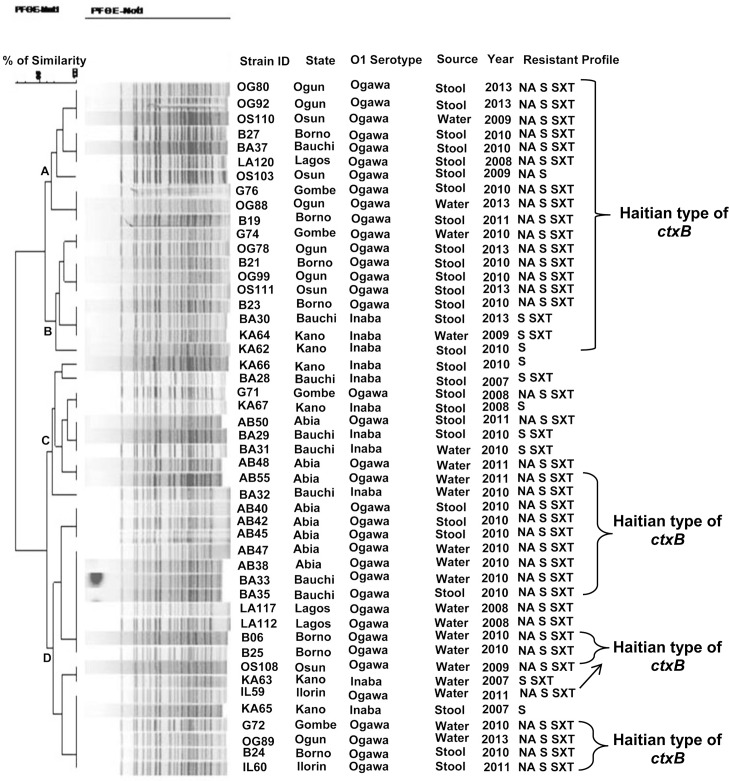
BACKGROUND AND OBJECTIVES: The antimicrobial susceptibility patterns and genetic characteristics of Vibrio cholerae O1, which is responsible for several cholera epidemics in Nigeria, are not reported in detail since 2007. In this study, we screened V. cholerae O1 El Tor biotype isolates from cholera cases and water samples from different states to investigate their phenotypic and genetic attributes with special reference to their clonality. RESULTS: All the V. cholerae O1 biotype El Tor isolates isolated during 2007-2013 were susceptible to fluoroquinolones and tetracycline, the drugs currently used in the treatment of cholera cases in Nigeria. Emergence of CT genotype 7 (Haitian type of ctxB allele) was predominantly seen among Ogawa serotype and the CT genotype 1 (classical ctxB allele) was mostly found in Inaba serotype. Overall, V. cholerae O1 from clinical and water samples were found to be closely related as determined by the pulsed-field gel electrophoresis. V. cholerae isolates from Abia, Kano and Bauchi were found to be genetically distinct from the other states of Nigeria. CONCLUSION: Fecal contamination of the water sources may be the possible source of the cholera infection. Combined prevalence of Haitian and classical ctxB alleles were detected in Ogawa and Inaba serotypes, respectively. This study further demonstrated that V. cholerae O1 with the ctxB has been emerged similar to the isolates reported in Haiti. Our findings suggest that the use of fluoroquinolones or tetracycline/doxycycline may help in the effective management of acute cholera in the affected Nigerian states. In addition, strengthening the existing surveillance in the hospitals of all the states and supply of clean drinking water may control cholera outbreaks in the future.
Overview
The claims and statistics of this paper haven’t been checked yet.
Run the check — free, no account needed. It reads the open-access text and checks the sources it cites.
Integrity signals
Registry
Cites
Statistics
Figures
Verification
Claims the paper makes
The claims and statistics of this paper haven’t been checked yet.
Run the check — free, no account needed. It reads the open-access text and checks the sources it cites.
Claims other papers make about this one
Each is checked against this paper’s own text: does it say what the citing paper says it does?
The source backs part of the claim, not all of it — or backs it for a different population, condition or comparison.
In the citing paper
“In the past decade, V. cholerae isolates have become resistant to penicillins, aminoglycosides and sulfonamides, quinolones, tetracycline, macrolides, and phenicols”
From Antimicrobial Resistance Rates and Surveillance in Sub-Saharan Africa: Where Are We Now? (2022) · cites this paper as [55]
Experimental — accuracy not yet measuredThe source backs part of the claim, not all of it — or backs it for a different population, condition or comparison.
In the citing paper
“The V. cholerae Ogawa biotype has been shown to be the most prevalent in the region, while epidemics are mainly caused by Wave 3 atypical O1 El Tor strain, which has been reported to be resistant to multiple antimicrobials”
From Antimicrobial Resistance Rates and Surveillance in Sub-Saharan Africa: Where Are We Now? (2022) · cites this paper as [55]
Experimental — accuracy not yet measured
Self-check
Percentages, sums and reported differences re-computed from the paper’s own numbers.
The self-check needs the paper’s full text.
Citations
Cites
No references could be resolved yet.
Research works printed but not linked: 25
- 2014, Cholera 2013, Weekly Epi Rep, 89, 345
- AM Wilson, 1971, The spread of cholera to and within Nigeria 1970–71, J Clin Pathol, 24, 768, 10.1136/jcp.24.8.768-c · DOI
- AO Adagbada, 2012, Cholera epidemiology in Nigeria: an overview, Pan Afr Med J, 12, 59
- KS Oyedeji, 2013, Molecular characterization of the circulating strains of Vibrio cholerae during 2010 cholera outbreak in Nigeria, . J Health Popul Nutr, 31, 178, 10.3329/jhpn.v31i2.16381 · DOI
- A Usman, 2005, Recurrent cholera epidemics in Kano-northern Nigeria, Cent Afr J Med, 51, 34
- MM Dalhat, 2014, Descriptive characterization of the 2010 cholera outbreak in Nigeria, BMC Public Health, 14, 1167, 10.1186/1471-2458-14-1167 · DOI
- GC Onyemelukwe, 1991, Serotype variation in Vibrio cholerae El Tor diarrhoea in northern Nigeria, Cent Afr J Med, 37, 186
- ML Quilici, 2010, Vibrio cholerae O1 variant with reduced susceptibility to ciprofloxacin, Western Africa, Emerg Infect Dis, 11, 1804, 10.3201/eid1611.100568 · DOI
- MA Marin, 2013, Cholera outbreaks in Nigeria are associated with multidrug resistant atypical El Tor and non-O1/non-O139 Vibrio cholerae, PLoS Negl Trop Dis, 2, e2049, 10.1371/journal.pntd.0002049 · DOI
- O Oguntoke, 2009, Association of water-borne diseases morbidity pattern and water quality in parts of Ibadan City, Nigeria, Tanzan. J Health Res, 11, 189
- AK Goel, 2008, A new variant of Vibrio cholerae O1 El Tor causing cholera in India, J Infect, 3, 280, 10.1016/j.jinf.2008.06.015 · DOI
- AK Mukhopadhyay, 2014, Cholera outbreaks in the El Tor biotype era and the impact of the new El Tor variants, Curr Top Microbiol Immunol, 379, 17
- KK Hemant, 2008, Quardruplex PCR for simultaneous detection of serotype, Biotype, Toxigenic potential, and central Regulating factor of Vibrio cholerae, J Clin Microbiol, 7, 2399
- N Arindam, 2012, Development and evaluation of a PCR Assay for tracking the emergence and dissemination of Haitian variant ctxB in Vibrio cholerae O1 strains isolated from Kolkata, India, J Clin Microbiol, 50, 1733, 10.1128/JCM.00387-12 · DOI
- KL Cooper, 2006, Development and validation of a PulseNet standardized pulsed-field gel electrophoresis protocol for subtyping of Vibrio cholerae, Foodborne Pathog Dis, 3, 51, 10.1089/fpd.2006.3.51 · DOI
- M Ansaruzzaman, 2004, Cholera in Mozambique, variant of Vibrio cholerae, Emerg Infect Dis, 10, 2057, 10.3201/eid1011.040682 · DOI
- CC Thompson, 2011, Vibrio cholerae O1 lineages driving cholera outbreaks during seventh cholera pandemic in Ghana, Infect Genet Evol, 8, 1951, 10.1016/j.meegid.2011.08.020 · DOI · Paper page
- D Ceccarelli, 2011, New Vibrio cholerae atypical El Tor variant emerged during the 2006 epidemic outbreak in Angola, BMC Microbiol, 11, 130, 10.1186/1471-2180-11-130 · DOI
- NA Bhuiyan, 2012, Genetic characterization of Vibrio cholerae O1 strains isolated in Zambia during 1996–2004 possessing the unique VSP-II region of El Tor variant, Epidemiol Infect, 3, 510, 10.1017/S0950268811000926 · DOI
- MS Islam, 2011, Phenotypic, genotypic, and antibiotic sensitivity patterns of strains isolated from the cholera epidemic in Zimbabwe, J Clin Microbiol, 6, 2325, 10.1128/JCM.00432-11 · DOI
- N Mercy, 2014, Phenotypic and genetic characterization of Vibrio cholerae O1 isolated from various regions of Kenya between 2007 and 2010, Pan Afr Med J, 19, 8, 10.11604/pamj.2014.19.8.2496 · DOI
- SM Dixit, Cholera outbreaks (2012) in three districts of Nepal reveal clonal transmission of multi-drug resistant Vibrio cholerae O1, BMC Infect Dis. 2014, 14, 392, 10.1186/1471-2334-14-392 · DOI
- BB Pal, 2013, Large outbreak of cholera caused by El Tor variant Vibrio cholerae O1 in the eastern coast of Odisha, India during 2009, Epidemiol Infect, 12, 2560, 10.1017/S0950268813000368 · DOI
- SM Saidi, 2014, Prevalence of Vibrio cholerae O1 El Tor variant in a cholera-endemic zone of Kenya, J Med Microbiol, 3, 415, 10.1099/jmm.0.068999-0 · DOI
- JF Akoachere, 2014, Water sources as reservoirs of Vibrio cholerae O1 and non-O1 strains in Bepanda, Douala (Cameroon): relationship between isolation and physico-chemical factors, BMC Infect Dis, 14, 421, 10.1186/1471-2334-14-421 · DOI
Cited by
Sorted by citations
Antimicrobial Resistance Rates and Surveillance in Sub-Saharan Africa: Where Are We Now?
Kariuki, S., Kering, K., Wairimu, C., Onsare, R., & Mbae, C. (2022) · Infection and Drug Resistance · doi:10.2147/idr.s342753 · Cited by 245
Metadata
- Authors
- Adewale, A. K., Pazhani, G. P., Abiodun, I. B., Afolabi, O., Kolawole, O. D., Mukhopadhyay, A. K., & Ramamurthy, T.
- Affiliations
- National Institute of Cholera and Enteric Diseases (IN)
- Nigerian Institute of Medical Research (NG)
- Venue
- PLOS ONE
- Publisher
- Public Library of Science (PLoS)
- Published
- 2016-08-01
- Volume
- 11
- Issue
- 8
- Pages
- e0159794
- ISSN
- 1932-6203 (ISSN-L)
- PMC
- PMC4968787
- OpenAlex
- W2496246630
- Cited by
- 21
- References
- 0
- Citations by year
- 2026: 1 · 2023: 1 · 2022: 1 · 2021: 5 · 2020: 7 · 2019: 1 · 2018: 2 · 2017: 3
- FWCI
- 1.93
- Type
- journal article
- Language
- en
- Open access
- gold
- doi.org
- Licence
- Locations
- PLoS ONE (publishedVersion, cc-by)
- Europe PMC (PubMed Central) (publishedVersion, cc-by)
- PubMed Central (publishedVersion, cc-by)
- PubMed (publishedVersion)
- DOAJ (DOAJ: Directory of Open Access Journals) (submittedVersion)
- Funders
- Academy of Finland
- Topics
- Life Sciences › Immunology and Microbiology › Microbiology › Vibrio bacteria research studies
- Life Sciences › Agricultural and Biological Sciences › Food Science › Salmonella and Campylobacter epidemiology
- Life Sciences › Immunology and Microbiology › Microbiology › Bacterial Infections and Vaccines
- Keywords
- Vibrio cholerae O1 El Tor, cholera epidemic, Ogawa serotype, Inaba serotype, clonality, antimicrobial susceptibility, fluoroquinolone susceptibility, tetracycline susceptibility, waterborne transmission, fecal contamination of water, Nigeria
- MeSH terms
- Alleles, Anti-Bacterial Agents, Cholera, Cholera Toxin, Cross-Sectional Studies, Genotype, Humans, Microbial Sensitivity Tests, Nigeria, Tetracycline, Virulence, Polymerase Chain Reaction, Electrophoresis, Gel, Pulsed-Field, Sequence Analysis, DNA, Fluoroquinolones, Vibrio cholerae O1, Serogroup
About these checks
Registry, retraction, Cites and statistics results are computed, not judged, with one exception: a printed reference that no index lists is read once by a model before it counts as a citation error. Claims are extracted by a model and kept only when their quote appears verbatim in the text; each cited source is then checked, with a model’s help, for whether it says what the claim relies on. Those verdicts can be wrong — read the claim’s quote and the cited source before relying on one.
Statistics and arithmetic are recomputed, not judged.
Confidence bands are shown only for fields calibrated on our annotated test set. None is calibrated yet, so no band is shown.
What counts as a claim ›How we measure confidence ›How we check this ›
Are you an author, or do you see a problem with this page? Request a review
